


This search combines search strings from the content search (i.e. "Full Text", "Author", "Title", "Abstract", or "Keywords") with "Article Type" and "Publication Date Range" using the AND operator.
Beilstein J. Org. Chem. 2024, 20, 1421–1427, doi:10.3762/bjoc.20.124
Graphical Abstract
Scheme 1: Preparation of cyclic oligoglucosamines a) via intramolecular glycosylation and b) via polyglycosyl...
Scheme 2: Proposed reaction mechanism of the formation of 1,6-anhydrosugar 7.
Scheme 3: Electrochemical polyglycosylation of monomer 14 with a 2,3-oxazolidinone protecting group.
Scheme 4: Proposed reaction mechanism of the formation of cyclic trisaccharide 19a.
Scheme 5: Influence of the functional group in position C-2 on the formation of the cyclic product.
Beilstein J. Org. Chem. 2022, 18, 1133–1139, doi:10.3762/bjoc.18.117
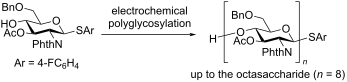
Figure 1: Structures of chitin and chitosan oligosaccharides.
Figure 2: Effect of the anomeric leaving group on the yield of oligosaccharides.
Figure 3: Influence of the glycosylation temperature (T2) on the yield of oligosaccharides.
Figure 4: Influence of temperatures of anodic oxidation (T1) and glycosylation (T2).
Figure 5: MALDI–TOF MS spectra of oligosaccharides.
Figure 6: Proposed structures of byproducts of electrochemical polyglycosylation.
Figure 7: Proposed mechanisms of electrochemical polyglycosylation.
Figure 8: Oxidative potential of monosaccharide 1a, disaccharide 2a, and trisaccharide 3a.
Scheme 1: Electrochemical dimerization of tetrasaccharide 4a.
Figure 9: Influence of cycle number on the yield of longer oligosaccharides 5a (n = 5)–8a (n = 8). Conditions...



