


Search results
Search for "NFSI" in Full Text gives 28 result(s) in Beilstein Journal of Organic Chemistry.
Development of the titanium–TADDOLate-catalyzed asymmetric fluorination of β-ketoesters
Beilstein J. Org. Chem. 2011, 7, 1421–1435, doi:10.3762/bjoc.7.166
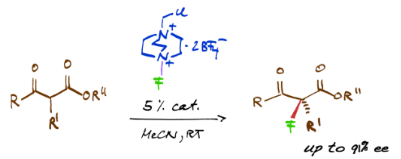
- up to 91% enantiomeric excess, with either F–TEDA (1-chloromethyl-4-fluoro-1,4-diazoniabicyclo[2.2.2]octane bis(tetrafluoroborate)) in acetonitrile solution or NFSI (N-fluorobenzenesulfonimide) in dichloromethane solution as fluorinating reagents. The effects of various reaction parameters and of the
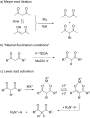
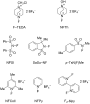
- (Table 3). Results for either fluorination (→6-F) with F–TEDA or the more soluble reagent NFSI (N-fluorobenzenesulfonimide) and NCS (N-chlorosuccinimide) for chlorination [43] (→6-Cl) are displayed in Table 3. Above ambient temperature, increasing temperatures give lower selectivity (Table 3, entries 1–3
- fluorination by choosing NFSI (N-fluorobenzenesulfonimide) as the reagent with better solubility. Reaction with NFSI in dichloroethane gave 1-F with 24% ee (5 mol % K1, 40 °C, 3 d, 66% conversion), which is close to the enantiomeric excess observed with F–TEDA in acetonitrile at the same temperature (Table 2






DBFOX- Ph/metal complexes: Evaluation as catalysts for enantioselective fluorination of 3-(2-arylacetyl)-2-thiazolidinones
Beilstein J. Org. Chem. 2008, 4, No. 16, doi:10.3762/bjoc.4.16
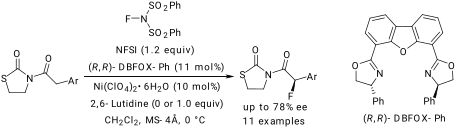
- enantioselective fluorination of 3-(2-arylacetyl)-2-thiazolidinones 1 with N-fluorobenzenesulfonimide (NFSI) by DBFOX-Ph/metal complexes under a variety of conditions. After optimization of the metal salts, solvents and additives, we found that the fluoro-2-thiazolidinones 2 were obtained in good to high yields
- -thiazolidinones with N-fluorobenzenesulfonimide (NFSI) (Figure 1). Results and Discussion Our previous studies of the DBFOX-Ph/Ni(II)-catalyzed enantioselective fluorination of β-keto esters have shown that the optimal reaction conditions require NFSI as the fluorine source and a catalytic amount of Ni(ClO4)2
- a water molecule for DBFOX-Ph/Ni(II)/1 as shown in Scheme 1. In the complex, the Si face is shielded by one of the phenyl groups of DBFOX-Ph so that NFSI approaches from the Re face of the substrates (Scheme 1). Since a major difference in ee values of 2 was not observed for the fluorination


Single and double stereoselective fluorination of (E)-allylsilanes
Beilstein J. Org. Chem. 2007, 3, No. 34, doi:10.1186/1860-5397-3-34

- -fluorobenzenesulfonimide [34] (NFSI). The d.r. for this first fluorination was excellent (>20:1). The subsequent electrophilic fluorodesilylation of the resulting fluorinated silane 6 delivered 3 in excellent yield with no trace of side-products. In comparison with allylsilanes 1a-i, the fluorodesilylation of 6 was more


Other Beilstein-Institut Open Science Activities



