


Search results
Search for "cyclobutene" in Full Text gives 30 result(s) in Beilstein Journal of Organic Chemistry.
Synthesis and in silico screening of a library of β-carboline-containing compounds
Beilstein J. Org. Chem. 2012, 8, 1048–1058, doi:10.3762/bjoc.8.117
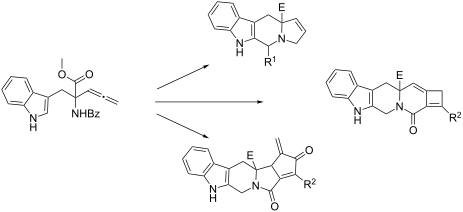
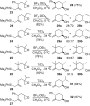
- tosylates was not successful. Next, compounds possessing the cyclobutene-fused β-carboline skeleton were assembled from the versatile allenyl intermediate 6. For this subset of compounds, acylation of the sterically hindered amine of 6{1} with the ynoic acids 8{1–8}, by using bromo-tris-pyrrolidino
- the reaction temperature from 225 °C to 160 °C afforded cyclobutene 2{1,3} in 73% yield (Table 2, entry 3). Similarly, allene-yne 9{1,5} was subjected to the lower reaction temperature (Method A) to produce cyclobutene 2{1,5} in 57% yield (Table 2, entry 5). For the final library scaffold, a small


Fine-tuning alkyne cycloadditions: Insights into photochemistry responsible for the double-strand DNA cleavage via structural perturbations in diaryl alkyne conjugates
Beilstein J. Org. Chem. 2011, 7, 813–823, doi:10.3762/bjoc.7.93
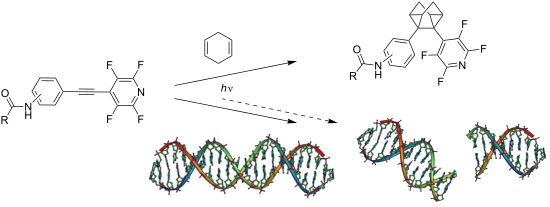
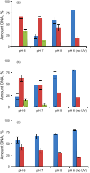
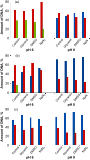
- )-OH/pyridine; f. HCl(g)/MeOH. Photochemical reactions of TFP-substituted aryl alkynes with selected π-systems. In short, the reaction proceeds through the photoinduced electron transfer from thiophene to the singlet excited state of the diaryl acetylene. The initially formed cyclobutene product



Complete transfer of chirality in an intramolecular, thermal [2 + 2] cycloaddition of allene-ynes to form non-racemic spirooxindoles
Beilstein J. Org. Chem. 2011, 7, 601–605, doi:10.3762/bjoc.7.70
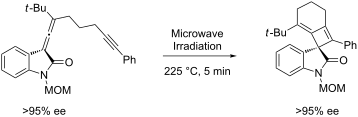
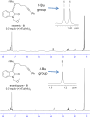
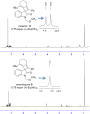
- oxindoles into chiral non-racemic spirooxindoles containing an alkylidene cyclobutene moiety. The enantiomeric excesses were determined by chiral lanthanide shift NMR analysis and the transfer of chiral information from the allene to the spirooxindole was found to be greater than 95%. Keywords: alkylidene
- cyclobutene; allene; allenyloxindole; chiral lanthanide shift reagent; chiral transfer; Introduction The [2 + 2] cycloaddition reaction of allenes and alkynes provides rapid entry into synthetically challenging alkylidene cyclobutene ring systems. We, along with others, have demonstrated the intramolecular
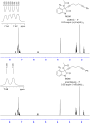
- . Based on this analysis, the product was formed with greater than 95% enantiomeric excess (Figure 3). Our working hypothesis for the mechanism for transfer of chiral information from the allene to the spirooxindole-containing cyclobutene is that the reaction still proceeds through the thermally generated




A thermally-induced, tandem [3,3]-sigmatropic rearrangement/[2 + 2] cycloaddition approach to carbocyclic spirooxindoles
Beilstein J. Org. Chem. 2010, 6, No. 33, doi:10.3762/bjoc.6.33
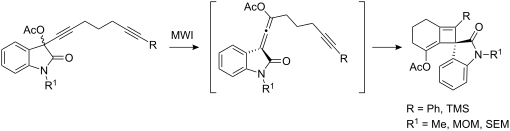
- rearrangement of the propargyl acetate 9a using transition metal catalysis (AuCl3 10 mol %, toluene, 1 h, rt) led to hydrolysis of the allenyl acetate functionality. This densely functionalized alkylidene cyclobutene 10a is postulated to arise via the [2 + 2] cycloaddition reaction between the alkyne and the


Allylsilanes in the synthesis of three to seven membered rings: the silylcuprate strategy
Beilstein J. Org. Chem. 2007, 3, No. 16, doi:10.1186/1860-5397-3-16
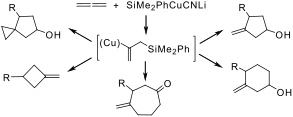
- (Scheme 9). As shown in Scheme 9, the strategy employed allows the selective formation or 1- or 3-substituted derivatives, where the coupling of a C2 acetylenic synthon and a C2 epoxide synthon provides a new and useful [2+2] annulation strategy for the preparation of the strained cyclobutene ring. The
- . Intramolecular cyclization of TMS-epoxyallylsilanes. Spiro-cyclopropanation from oxoallylsilanes. Cyclobutane formation from hydroxy-functionalized allysilanes. Cyclobutene formation from vinyltin cuprates and epoxides. Silylcupration of 1,2-propadiene and reaction with α,β-unsaturated nitriles. Cycloheptane




Other Beilstein-Institut Open Science Activities



