


Search results
Search for "divided cell" in Full Text gives 28 result(s) in Beilstein Journal of Organic Chemistry.
Electrochemical selenium- and iodonium-initiated cyclisation of hydroxy-functionalised 1,4-dienes
Beilstein J. Org. Chem. 2015, 11, 174–183, doi:10.3762/bjoc.11.18

- iodoalkoxylated products of type 5 (Scheme 3). The electrolysis was carried out in an H-type divided cell (4G glass filter) equipped with carbon fiber electrodes (see Supporting Information File 1). Each chamber was charged with 2,6-lutidine and TBABF4 in CH3CN (0.3 M) and additionally the 1,4-dienol and sodium
- ), dried over Na2SO4 and the solvent was removed under reduced pressure. The product was obtained after column chromatography (n-pentane/diethyl ether). General procedure for the electrochemical iodonium-induced alkoxylation of 1,4-dienols An H-type divided cell (4G glass filter) was equipped with a carbon


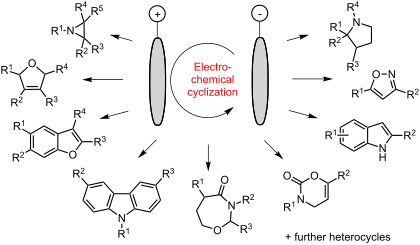
Recent advances in the electrochemical construction of heterocycles
Beilstein J. Org. Chem. 2014, 10, 2858–2873, doi:10.3762/bjoc.10.303
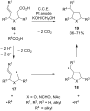
- hydride in combination with a radical initiator such as AIBN. Peters and co-workers described an electrochemical alternative using cathodically generated nickel(I) complexes as mediators [41][42]. Under potentiostatic conditions (C.P.E. = controlled potential electrolysis) in a divided cell
- of the iminium species under formation of oxazolidine or 1,3-oxazinane species 30. According to their protocol, 29 is electrolyzed under galvanostatic conditions in a divided cell, using a NaOMe/MeOH electrolyte and potassium iodide as electron transfer mediator. The method provides access to a
- conventional Wacker-type cyclizations, where stoichiometric amounts of co-oxidant are employed at elevated temperatures, the electrochemical version proceeds smoothly at room temperature. In the case depicted in Scheme 16, the electrolysis was carried out in a divided cell under galvanostatic conditions using




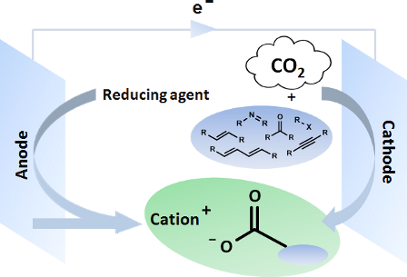
Electrocarboxylation: towards sustainable and efficient synthesis of valuable carboxylic acids
Beilstein J. Org. Chem. 2014, 10, 2484–2500, doi:10.3762/bjoc.10.260
- formed, containing isomers of 3-pentenoic acid (C5), 3-hexenedioic acid (C6) and 3,7-decadienedioic acid (C10) (Table 1, entries 1–7). The product distribution is among other things influenced by the water and proton content in the reaction system. In a divided cell, in which the anolyte consists of 1
- were conducted in a divided cell, giving only moderate yields [114][115]. A drastic increase in efficiency was obtained by employing sacrificial anodes [116], especially magnesium anodes [117][118]. The cathode material is again of great importance, with silver and platinum giving the highest
- oxidation and reduction of respectively halides and halonium species. Therefore, the use of a membrane or glass frit can be interesting to minimize this effect. However, in a divided cell, the electrocarboxylation of chloroacetonitrile to cyanoacetic acid still appeared to give higher current efficiencies


Other Beilstein-Institut Open Science Activities



