


Search results
Search for "lactamization" in Full Text gives 30 result(s) in Beilstein Journal of Organic Chemistry.
Automated three-component synthesis of a library of γ-lactams
Beilstein J. Org. Chem. 2012, 8, 1804–1813, doi:10.3762/bjoc.8.206
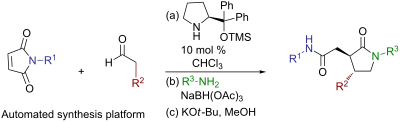
- , aldehydes and amines [12]. The method involved a three-step stepwise sequence involving an organocatalyzed Michael addition, a reductive amination/intramolecular lactamization, and an epimerization step (Scheme 1). It culminated in the preparation of a 43-member library. Although this method permitted
- with the modest enantiomeric enrichment in hand. Combination of three discrete steps into a single-pot process We next turned our attention to combining the initial Michael addition step with the remaining reductive amination/lactamization and epimerization steps. In the original procedure, the
- reductive amination/lactamization reaction was performed in methylene chloride [12]. However, in order to combine this step with the previous Michael addition step, we thought to perform the reaction in chloroform (Scheme 3). In fact, when the Michael addition reaction between propionaldehyde (2{1}) and N


Synthesis of szentiamide, a depsipeptide from entomopathogenic Xenorhabdus szentirmaii with activity against Plasmodium falciparum
Beilstein J. Org. Chem. 2012, 8, 528–533, doi:10.3762/bjoc.8.60
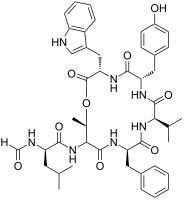
- wanted to synthesize it and make it accessible for additional bioactivity tests. Results and Discussion Synthesis As previous syntheses of depsipeptides showed that lactamization was preferred over lactonization [13][14], the synthesis of 1 was performed as follows: briefly, the linear peptide was



Stereoselective synthesis of four possible isomers of streptopyrrolidine
Beilstein J. Org. Chem. 2011, 7, 34–39, doi:10.3762/bjoc.7.6

- )-streptopyrrolidine (2) (4R,5S)-streptopyrrolidine (3) and (4S,5S)-streptopyrrolidine (4) have been achieved in a concise and highly efficient manner via a highly stereoselective aldol type reaction with the trimethylsilyl enolate of ethyl acetate and Lewis acid mediated lactamization as the key reactions in ≈42
- lactamization; streptopyrrolidine; Introduction Cancer is at present the second most common cause of death, after cardiovascular diseases, and will become the primary cause in the next 10 to 20 years [1]. Traditional cancer therapies make use of chemotherapy at the maximum tolerated dose. This approach has
- (4S,5S)-streptopyrrolidine (4) in a concise and highly efficient manner via a highly stereoselective aldol type reaction and Lewis acid mediated lactamization as the key reactions. A retrosynthetic analysis for streptopyrrolidine is depicted in Scheme 1. The synthesis was initiated from D


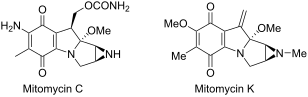
Mitomycins syntheses: a recent update
Beilstein J. Org. Chem. 2009, 5, No. 33, doi:10.3762/bjoc.5.33






The first preparative solution phase synthesis of melanotan II
Beilstein J. Org. Chem. 2008, 4, No. 39, doi:10.3762/bjoc.4.39
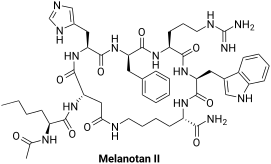
- stimulating the skin tanning process. In this paper we report the first solution phase synthesis of the title compound. The hexapeptide sequence has been assembled by [(2+2)+1+1] scheme. After removing the orthogonal protection, a carbodiimide mediated lactamization, involving the ε-amino group of lysine and
- locking of the linear peptide sequence in its biologically active conformation by lactamization of the lysine ε-amino group and glutamic acid γ-carboxy group, led to a cyclic pseudopeptide analog of α-MSH with good metabolic stability and exceptional activity, known as melanotan II (2) (Figure 1). Results
- groups. The ε-amino group of lysine and the γ-carboxy group of aspartic acid, involved in lactamization, were protected as the base-cleavable Fmoc amide and Fm ester respectively. After synthesizing the peptide chain and cleavage of the base-labile protecting groups, an efficient on-resin cyclization was


Other Beilstein-Institut Open Science Activities



