


Search results
Search for "paracyclophane" in Full Text gives 30 result(s) in Beilstein Journal of Organic Chemistry.
Synthesis of new pyrrole–pyridine-based ligands using an in situ Suzuki coupling method
Beilstein J. Org. Chem. 2012, 8, 1037–1047, doi:10.3762/bjoc.8.116
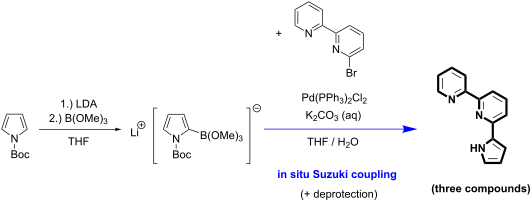
- [2.2]paracyclophane-derivatives [11]. This comprised the in situ reaction of the freshly prepared boronic acid/ester with the heteroaryl bromides 8–10. These starting compounds could be prepared by using literature procedures, as shown in Scheme 4. Substance 8 was synthesized by following the standard


Intraannular photoreactions in pseudo-geminally substituted [2.2]paracyclophanes
Beilstein J. Org. Chem. 2011, 7, 658–667, doi:10.3762/bjoc.7.78

- Braunschweig, Germany, Fax: +49 531 / 391 5387 10.3762/bjoc.7.78 Abstract The photoisomerization of the pseudo-geminal tetraene 11 furnishes the cyclooctadiene derivatives 13 and 15 with a completely new type of molecular bridge for a [2.2]paracyclophane which promise many interesting novel applications; the
- reaction. One such system is the generalized paracyclophane molecule 1 shown in Scheme 1. Here the distance between the benzene “decks” carrying the functional groups F1 and F2 can be adjusted both by the length of the two molecular bridges (variation of m and n), and by the relative orientation between
- same type. In our work we have so far concentrated our efforts on derivatives of [2.2]paracyclophane (1, m = n = 2) with the two functional groups usually in the so-called pseudo-geminal positions, that is, directly above each other as shown in 2. The intraannular distance is approximately 3.1 Å in


Preparation and NMR spectra of four isomeric diformyl[2.2]paracyclophanes (cyclophanes 66)
Beilstein J. Org. Chem. 2010, 6, 932–937, doi:10.3762/bjoc.6.104
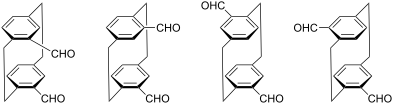
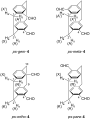
- Previously, we reported that the [2 + 4] cycloaddition of 1,2,4,5-hexatetraene (1) to propiolic aldehyde (2) produced a mixture of four [2.2]paracyclophane dialdehydes 4. This result is in agreement with the generation of the p-xylylene intermediate 3 in the first step of the reaction, which can dimerize by
- and can decompose, even under refrigeration. Although we have separated the four isomers and used them many times for the preparation of numerous [2.2]paracyclophane derivatives (inter alia annelated derivatives [2], metal complexes [3][4][5], diethynyl derivatives [6][7] and preparation of ligands
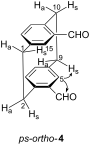
- of all isomers and may hence be easily separated. NMR spectra of the diformyl[2.2]paracyclophanes 4 As the 1H and 13C NMR spectra of [2.2]paracyclophane-4-carbaldehyde have previously been fully assigned and, hence, the influence of the substituent upon the 1H and 13C NMR chemical shifts of all



Reversible intramolecular photocycloaddition of a bis(9-anthrylbutadienyl)paracyclophane – an inverse photochromic system. (Photoactive cyclophanes 5)
Beilstein J. Org. Chem. 2009, 5, No. 20, doi:10.3762/bjoc.5.20
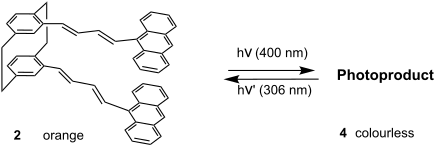
- -anthracenyl)buta-1,3-dienyl][2.2]paracyclophane (2), prepared in 35% overall yield from [2.2]paracyclophane, absorbs light at λmax = 400 nm with a tail down to 480 nm. By irradiation into this band, 2 generates a single photoproduct, 4, whose absorption maximum is situated at 306 nm. The starting material is
- unprecedented. Summary and Conclusion The target molecule (dianthryl-butadienyl[2.2]paracyclophane 2) was synthesized and shown to possess the anticipated photochromic properties. The two interconverting forms exhibit good thermal stability. The cycloreversion can be induced by irradiation or by heating
- of oxygen with an argon or nitrogen stream. Preparations 1. 4,13-bis[(1E,3E)-4-(9-anthracenyl)-buta-1,3-dienyl][2.2]paracyclophane (2): In a 250 mL, dried round-bottom flask, equipped with a reflux condenser, a Claisen adapter, a stirring system, and degassed with nitrogen, 1.3 g dialdehyde (4.1 mmol


Enantiospecific synthesis of [2.2]paracyclophane- 4-thiol and derivatives
Beilstein J. Org. Chem. 2009, 5, No. 9, doi:10.3762/bjoc.5.9
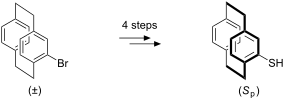
- describes a simple route to enantiomerically enriched [2.2]paracyclophane-4-thiol via the stereospecific introduction of a chiral sulfoxide to the [2.2]paracyclophane skeleton. The first synthesis of an enantiomerically enriched planar chiral benzothiazole is also reported. Keywords: heterocycle; [2.2
- ]paracyclophane; resolution; sulfur; Introduction [2.2]Paracyclophane (1; R = H) is a fascinating compound comprising of two eclipsing benzene rings that are held in place by two ethyl bridges at the para positions (Figure 1). The close proximity of the arene moieties results in strong electronic and structural
- interactions between the two rings and between substituents appended to each layer [1][2]. The resulting unique properties have led to derivatives of [2.2]paracyclophane being employed in a wide range of disciplines including polymer, material and electronic chemistry [3][4][5][6][7][8][9]. Whilst


Other Beilstein-Institut Open Science Activities



