


Search results
Search for "potassium" in Full Text gives 648 result(s) in Beilstein Journal of Organic Chemistry. Showing first 200.
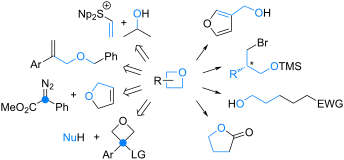
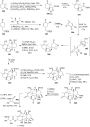
Oxetanes: formation, reactivity and total syntheses of natural products
Beilstein J. Org. Chem. 2025, 21, 1324–1373, doi:10.3762/bjoc.21.101








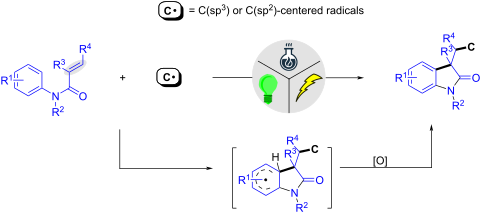
Recent advances in oxidative radical difunctionalization of N-arylacrylamides enabled by carbon radical reagents
Beilstein J. Org. Chem. 2025, 21, 1207–1271, doi:10.3762/bjoc.21.98


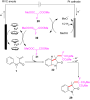


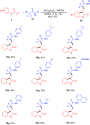








Synthetic approach to borrelidin fragments: focus on key intermediates
Beilstein J. Org. Chem. 2025, 21, 1135–1160, doi:10.3762/bjoc.21.91
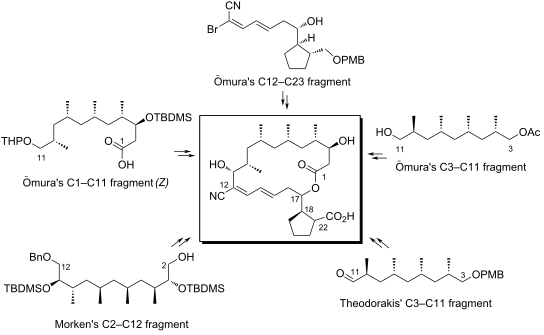
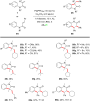
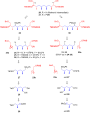
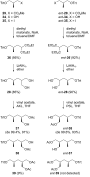
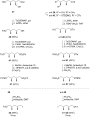
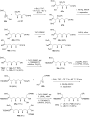
- acetate functionality using potassium carbonate in methanol, followed by reaction with tosyl chloride in pyridine and DMAP. The product, ent-43, was obtained in 79.5% yield over three steps. This compound was reduced using LiAlH4 and treated with TBAF to remove the TBDMS group, yielding alcohol ent-40 in
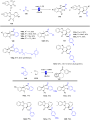
- in 96% yield. Hydrolysis of the acetate group in 69 with potassium carbonate followed by treatment with TBDMSCl and imidazole converted it into silyl ether 70. The ester group in 70 was then hydrolyzed using lithium hydroxide, and the resulting acid was coupled with Evans’ chiral oxazolidinone in the








Gold extraction at the molecular level using α- and β-cyclodextrins
Beilstein J. Org. Chem. 2025, 21, 1116–1125, doi:10.3762/bjoc.21.89
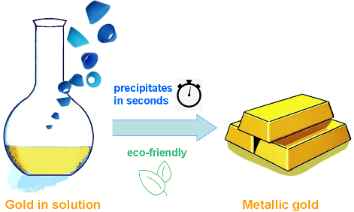
- even non-ore sources (e.g., mining wastes) [18] and abandoned electrical and electronic equipment, called e-waste, which can contain up to ten times more gold than waste ores [19]. To retrieve gold from these materials, the most widespread process is to use potassium or sodium cyanides, which are the
- precious metals [42]. The process of gold precipitation with cyclodextrins, bromic acid and potassium hydroxide to form the potassium bromoaurate salt was patented, with patent coverage expanding to metals like silver, platinum, palladium, and rare earths, as well as the use of other cyclodextrins, β- and
- γ-CDs, other acids (including hydrogen halides, nitric acid, sulfuric acid, and mixtures thereof) and sodium hydroxide (instead of potassium hydroxide) [43]. Scale-up pilot trials on 20 batch samples were conducted in Arizona with partnership from companies already active in the market. Results


Pd-Catalyzed asymmetric allylic amination with isatin using a P,olefin-type chiral ligand with C–N bond axial chirality
Beilstein J. Org. Chem. 2025, 21, 1018–1023, doi:10.3762/bjoc.21.83
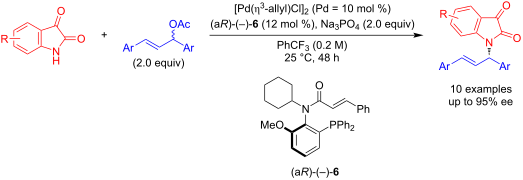
- (Table 1, entry 5). Other potassium salts such as K3PO4 led to a low yield of the product (Table 1, entry 6). Meanwhile, when Na3PO4 was tested, the yield decreased, but the enantioselectivity improved to 88% ee (Table 1, entry 7). With Na3PO4 as the optimum base, which showed the highest




Studies on the syntheses of β-carboline alkaloids brevicarine and brevicolline
Beilstein J. Org. Chem. 2025, 21, 955–963, doi:10.3762/bjoc.21.79

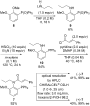
- ammonium derivative 14 with the potassium salt of compound 15 resulted in the ring-opened derivative 16. Removal of the benzylthiocarbonyl moiety, then Beckmann rearrangement of the oxime obtained from ketone 17 and subsequent cyclization gave β-carboline derivative 18, which was dehydrogenated and


Recent advances in the electrochemical synthesis of organophosphorus compounds
Beilstein J. Org. Chem. 2025, 21, 770–797, doi:10.3762/bjoc.21.61
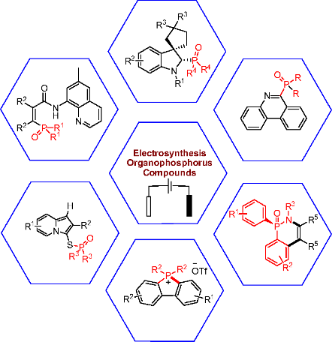
- phosphonates for synthesizing phosphoramidates. The reaction was carried out in an undivided cell at a constant current of 10 mA using platinum electrodes as the anode and cathode and potassium iodide as a key additive. Studies have shown that the choice of solvent significantly impacts the reaction. Studies
- electrosynthesis report, Gao et al. [55] reported similar P–N coupling reactions of indoles with trialkyl phosphites in the presence of potassium iodide as a mediator and electrolyte. The carbon and platinum electrodes were used as the anode and cathode at a constant current of 5 mA for 6 h in acetonitrile as
- solvent. The results showed that potassium iodide is critical in this reaction, and the reaction failed to give a corresponding product without using KI. This reaction was quickly extended to a wide range of substituted indoles. Moreover, despite significant steric hindrance or the presence of a long


Synthesis of HBC fluorophores with an electrophilic handle for covalent attachment to Pepper RNA
Beilstein J. Org. Chem. 2025, 21, 727–735, doi:10.3762/bjoc.21.56
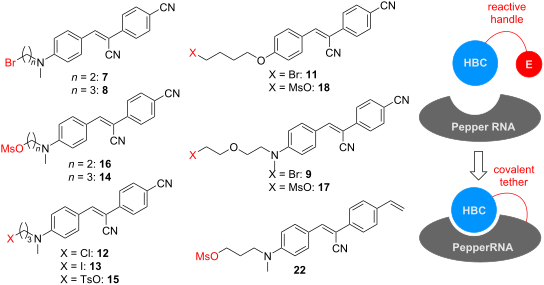
- nucleophilic aromatic substitution of 4-fluorobenzaldehyde with 2-(methylamino)ethanol, 3-methylamino-1-propanol or 2-[2-(methylamino)ethoxy]ethan-1-ol in the presence of potassium carbonate to afford benzaldehyde derivatives 1, 2, and 3 in excellent yields. Next, the piperidine-induced condensation with 4
- containing potassium and magnesium ions at a physiological pH of 7.0 for 5 hours. Analysis of the reaction mixture by anion-exchange HPLC revealed that the bromopropyl handle (C3 homolog 8) gave the highest yield of covalently tethered HBC-RNA complex (50%). Significantly less RNA alkylation yield was
- Exactive Orbitrap. General procedure A. 4-Fluorobenzaldehyde, the corresponding N-methylated amino alcohol and potassium carbonate were suspended in dimethyl sulfoxide and stirred for 30 hours at 120 °C. The resulting suspension was poured on crushed ice and extracted four times with chloroform, dried over

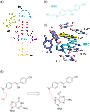


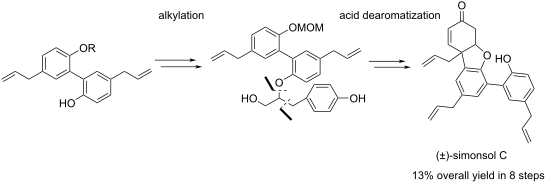
Total synthesis of (±)-simonsol C using dearomatization as key reaction under acidic conditions
Beilstein J. Org. Chem. 2025, 21, 601–606, doi:10.3762/bjoc.21.47
- DIPEA, affording compound 17 with an 89% yield [11]. For the following alkylation step with tert-butyl bromoacetate, three bases were tested: potassium carbonate, cesium carbonate, and sodium hydride. Considering the targeted alkylation of a phenolic hydroxy group and the pKa requirements of this
- reaction, weaker bases like potassium carbonate and cesium carbonate should theoretically suffice. However, the reaction outcomes with these two bases did not meet the desired expectations, as some starting material remained after 5 hours of reaction. Extending the reaction time did not lead to full


Sequential two-step, one-pot microwave-assisted Urech synthesis of 5-monosubstituted hydantoins from L-amino acids in water
Beilstein J. Org. Chem. 2025, 21, 596–600, doi:10.3762/bjoc.21.46
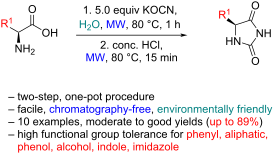
- hydantoins [19][20], we aim towards creating a more efficient procedure to access hydantoins. We are interested in the synthesis of hydantoins from amino acids and potassium cyanate in water due to its simplicity and environmental friendliness, which also precludes the use of water-sensitive and highly toxic
- potassium cyanate (25 mmol) and irradiated in an Anton–Paar Monowave 400 microwave reactor at 80 °C for 1 hour. Upon completion of the N-carbamylation reaction, as confirmed by TLC analysis, the reaction mixture was treated with concentrated hydrochloric acid (7 mL) and microwave irradiated at 80 °C for 15
- -phenylalanine with the corresponding amino acid to obtain H2b,c and H2e,f. General procedure for the synthesis of (S)-5-((2,5-dioxoimidazolidin-4-yl)methyl)-1H-imidazol-3-ium chloride (H2d) A 30 mL microwave reactor vial was charged with ʟ-histidine (5 mmol), distilled water (7 mL), and potassium cyanate (25


Asymmetric synthesis of β-amino cyanoesters with contiguous tetrasubstituted carbon centers by halogen-bonding catalysis with chiral halonium salt
Beilstein J. Org. Chem. 2025, 21, 547–555, doi:10.3762/bjoc.21.43
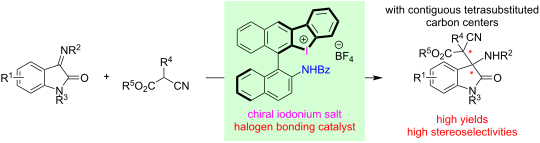
- equivalent of 7a and 5.0 equivalents of 16a in the presence of stoichiometric potassium carbonate and 1.0 mol % of 9. When bromonium salt 9a was applied to the reaction, the desired product was obtained in 83% yield with 77% ee but almost no diastereoselectivity. The iodonium salt 9b also worked well and the
- chiral halonium salt. Next, the reaction temperature was optimized, and −40 °C was found to be optimal (Table 1, entries 7–9). Further optimization of the reaction conditions (amounts of potassium carbonate and pre-nucleophile, catalyst loading, and concentration) were conducted, and the reaction with
- 5.0 equivalents of pre-nucleophile and 1.0 equivalent of potassium carbonate in the presence of 1.0 mol % of 9 at 0.025 M of toluene and −40 °C was found to be optimal (Table 1, entries 10–13). Five equivalents of pre-nucleophile are required to obtain higher yields and enantioselectivities. Next, the


Synthesis of N-acetyl diazocine derivatives via cross-coupling reaction
Beilstein J. Org. Chem. 2025, 21, 490–499, doi:10.3762/bjoc.21.36
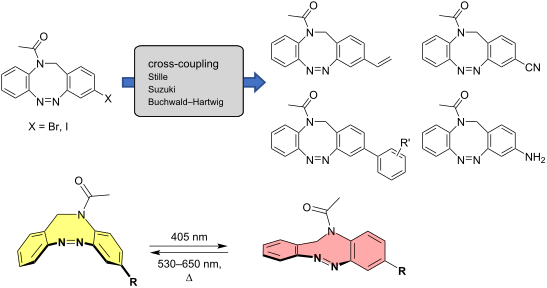
- neurotransmitters [10][11] or as switching units for potential dependent potassium channels [12]. Compared to the Z → E conversion rate of 92% (in n-hexane) of the parent diazocine the conversion in water/DMSO mixtures is decreasing with increasing water concentration (73% in water/DMSO 9:1) [8][9][10][11][12


Synthesis of new condensed naphthoquinone, pyran and pyrimidine furancarboxylates
Beilstein J. Org. Chem. 2025, 21, 340–347, doi:10.3762/bjoc.21.24
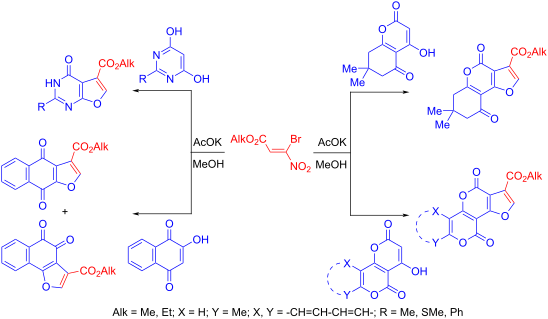
- ]. In addition, we have previously demonstrated the effective use of alkyl 3-bromo-3-nitroacrylates in the preparation of condensed furancarboxylates using potassium acetate as a catalyst [28][29][30]. The present study is aimed at developing methods for the synthesis of a wide range of condensed


Nickel-catalyzed cross-coupling of 2-fluorobenzofurans with arylboronic acids via aromatic C–F bond activation
Beilstein J. Org. Chem. 2025, 21, 146–154, doi:10.3762/bjoc.21.8
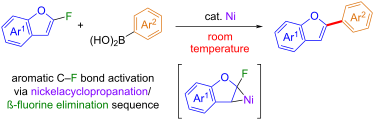
- at the 4-position (2d) also produced high yields (94–98%). For arylboronic acid 2f, which has a methoxy group at the 4-position, the use of potassium phosphate as a base resulted in a 94% yield of 3bf. For arylboronic acid 2g, which features a strongly electron-withdrawing trifluoromethyl group, we
- optimized the coupling reaction using potassium phosphate as a base and increasing the nickel catalyst loading to 20 mol %, achieving a yield of 78% for the desired product 3bg. When 2-naphthylboronic acid (2i) was employed, its solubility was enhanced using a mixed solvent system of toluene, methanol, and



Cu(OTf)2-catalyzed multicomponent reactions
Beilstein J. Org. Chem. 2025, 21, 122–145, doi:10.3762/bjoc.21.7

- alkyltrifluoroborate into its corresponding alkyl radical. o-Halo-substituted aryl selenides and sulfides 13 can be achieved by a three-component coupling reaction performed with an aryne precursor, potassium halides and electrophilic chalcogen species as reactants, in the presence of Cu(OTf)2 (Scheme 10) [23]. Under






Reactivity of hypervalent iodine(III) reagents bearing a benzylamine with sulfenate salts
Beilstein J. Org. Chem. 2024, 20, 3281–3289, doi:10.3762/bjoc.20.272
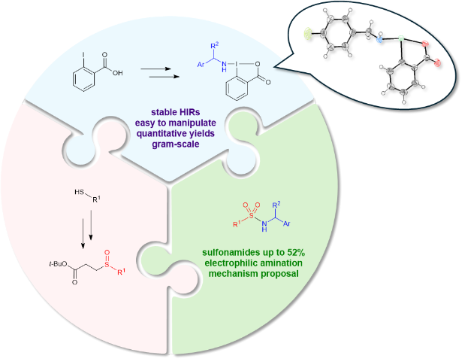
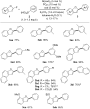
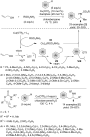
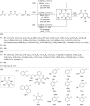
- reaction (Table 1, entry 1) [4]. In the presence of potassium carbonate, only starting material 4a was detected. A stronger base to generate the nucleophilic intermediate was tested, and sulfonamide 5aa was detected in trace amounts (Table 1, entry 2). Considering the low solubility of the hypervalent

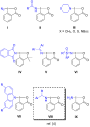


Intramolecular C–H arylation of pyridine derivatives with a palladium catalyst for the synthesis of multiply fused heteroaromatic compounds
Beilstein J. Org. Chem. 2024, 20, 3256–3262, doi:10.3762/bjoc.20.269
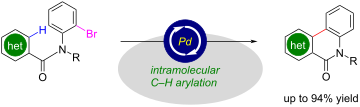
- conditions. We carried out the palladium-catalyzed intramolecular coupling reaction of precursor 1a under similar conditions [23], which afforded smooth reaction with phenanthroline bisamide, with 10 mol % of palladium acetate as a catalyst in the presence of potassium carbonate and tetra-n-butylammonium
- resulted in a decreased yield (27%) (Table 1, entries 4 and 5). It was found that increasing the amount of potassium carbonate to a three-fold excess improved the yield of 2a to 59% in the reaction at 110 °C shown in entry 6 of Table 1. Next, the effect of the ligand of the palladium catalyst was examined
- . Experimental Typical experimental procedure for the C–H arylation of pyridine derivative 5-octyldibenzo[b,f][1,7]naphthyridin-6(5H)-one (2a): To a screw-capped test tube equipped with a magnetic stirring bar were added amide 1a (44.1 mg, 0.100 mmol), potassium carbonate (42.0 mg, 0.304 mmol


Germanyl triazoles as a platform for CuAAC diversification and chemoselective orthogonal cross-coupling
Beilstein J. Org. Chem. 2024, 20, 3198–3204, doi:10.3762/bjoc.20.265
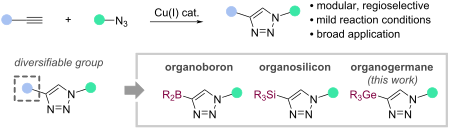
- functional groups for subsequent product diversification (Scheme 1). For example, protected alkynylboron reagents can be employed [35][36][37], such as N-methyliminodiacetic acid (MIDA)boronate esters [38], potassium trifluoroborates [39], and others [40][41][42]. Similarly, organosilicon reagents have



Synthesis of extended fluorinated tripeptides based on the tetrahydropyridazine scaffold
Beilstein J. Org. Chem. 2024, 20, 3174–3181, doi:10.3762/bjoc.20.262
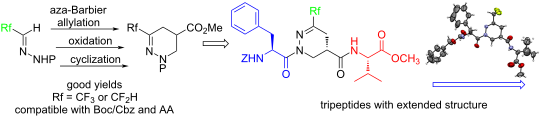
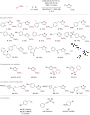
- can be noticed that the presence of an amino acid is compatible with the conditions of the reaction and did not interfere or significantly decrease the yield of the reaction (Scheme 3). Then, the N-carboxylate hydrazides 5a–d were firstly oxidized with iodine in the presence of potassium carbonate to
- on an intramolecular Michael addition carried out in DMF and catalyzed by 10% of potassium carbonate. As previously observed [37], under these conditions, the 5-endo-trig cyclization was selective and the lactam resulting from the 5-exo-trig cyclization was not observed. Furthermore, in the case of


Synthesis of fluorinated acid-functionalized, electron-rich nickel porphyrins
Beilstein J. Org. Chem. 2024, 20, 2954–2958, doi:10.3762/bjoc.20.248
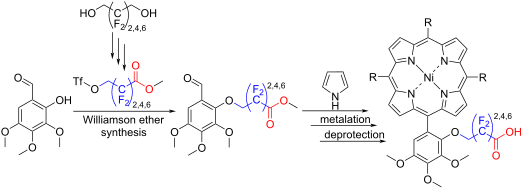
- 4 (65%), 5 (50%), and 6 (40%) by chromatography was straightforward. However, the subsequent oxidation of the alcohol with the usual oxidizing agents (Jones reagent, KMnO4, etc.) was not successful. A radical oxidation with TEMPO, potassium bromide (KBr), sodium hypochlorite (NaOCl), and sodium


The charge transport properties of dicyanomethylene-functionalised violanthrone derivatives
Beilstein J. Org. Chem. 2024, 20, 2921–2930, doi:10.3762/bjoc.20.244
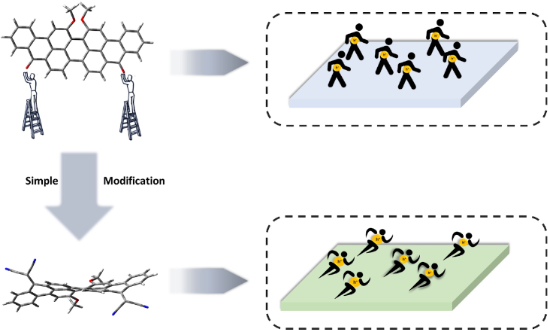
- solution (10 mg mL−1 in CHCl3) of the semiconductor material was deposited by spin-coating at 1000 rpm for 60 seconds. Synthesis Compound 2a 16,17-Dihydroxyviolanthrone (500 mg, 1.02 mmol) and 2-ethylhexyl bromide (550 μL, 3.06 mmol) were dissolved in N,N-dimethylformamide (30 mL). Then, potassium
- mmol) and 1-bromooctane (2.12 mL, 12.28 mmol) were dissolved in N,N-dimethylformamide (60 mL). Then, potassium carbonate was added (1.13 g, 8.19 mmol), and the reaction mixture was stirred at 100 °C overnight. After cooling the reaction mixture to room temperature, it was poured into methanol (400 mL
- ]+ calcd for C50H48NaO4, 753.3409; found, 735.3445. Compound 2c 16,17-Dihydroxyviolanthrone (500 mg, 1.02 mmol) and 1-bromododecane (800 μL, 3.06 mmol) were dissolved in N,N-dimethylformamide (30 mL). Then, potassium carbonate was added (300 mg, 2.04 mmol), and the reaction mixture was stirred at 100 °C


Recent advances in transition-metal-free arylation reactions involving hypervalent iodine salts
Beilstein J. Org. Chem. 2024, 20, 2891–2920, doi:10.3762/bjoc.20.243

- solvent, whereas the arylation of ammonia was achieved by using ethyl acetate as solvent along with potassium carbonate as a base. Likewise, water was arylated using cesium carbonate as a base. The N-arylation reactions were performed under strict anhydrous conditions. The reported mechanistic hypothesis
- of O3-arylated galactosides 64 by reacting benzyl-protected galactoside 63 with diphenyliodonium triflates 16 at room temperature in the presence of potassium tert-butoxide as the base (Scheme 26) [77]. This transition-metal-free approach simplifies the synthesis process. Electron-pushing and
- 101 for the S-arylation of potassium O-alkyl xanthates 100 offers a simpler approach [95]. This method operates under mild conditions, facilitating the creation of substituted S-aryl xanthates 102 (Scheme 41). Utilizing diaryliodonium salts for the arylation of xanthate anions provides a pathway for


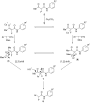


N-Glycosides of indigo, indirubin, and isoindigo: blue, red, and yellow sugars and their cancerostatic activity
Beilstein J. Org. Chem. 2024, 20, 2840–2869, doi:10.3762/bjoc.20.240
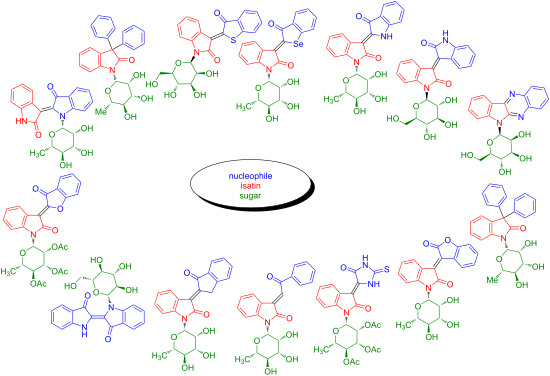
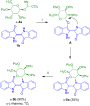
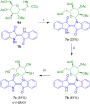
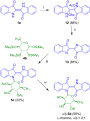
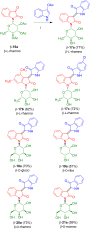
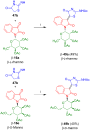
- steps from indigo (1a). The reaction of 1a with potassium permanganate afforded product 12 which was transformed to dehydroindigo (13) by pyridine-mediated elimination of acetic acid. The reaction of 13 with tetra-O-trimethylsilyl-ʟ-rhamnopyranose (4b) in the presence of trimethylsilyl iodide, addition










Synthesis of tricarbonylated propargylamine and conversion to 2,5-disubstituted oxazole-4-carboxylates
Beilstein J. Org. Chem. 2024, 20, 2827–2833, doi:10.3762/bjoc.20.238

- (Table 3, entry 2). Indeed, using THF that had not been dried as purchased resulted in a significant increase of the yield to 82% (Table 3, entry 3). The choice of base was also crucial (Table 3, entries 3–5). While the yield of 5a was low with potassium tert-butoxide, a yield of 66% using lithium tert


The scent gland composition of the Mangshan pit viper, Protobothrops mangshanensis
Beilstein J. Org. Chem. 2024, 20, 2644–2654, doi:10.3762/bjoc.20.222
- shaken for 15 min and then placed in an oven at 100 °C until the silica gel was completely dried. The impregnated silica gel was stored in the dark until use. Syntheses 1-(1-Propen-1-yl)piperidine (2): In a manner analogous to [27], potassium carbonate (2 g, 15 mmol), piperidine (10 mL, 0.1 mol), and





