


Search results
Search for "Hammett" in Full Text gives 53 result(s) in Beilstein Journal of Organic Chemistry.
Backbone tuning in indenylidene–ruthenium complexes bearing an unsaturated N-heterocyclic carbene
Beilstein J. Org. Chem. 2010, 6, 1120–1126, doi:10.3762/bjoc.6.128
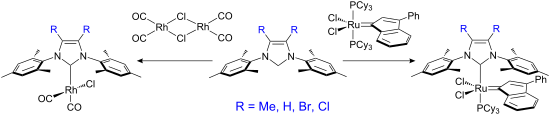
- stretching frequencies (νCOav) were used to provide the TEP (Table 1). As expected, the backbone substitution pattern has a profound effect on the electronic donor capacity of the NHC, and a linear correlation between the electronegativity of the backbone substituent (measured as the Hammett parameter, σp


Kinetics and mechanism of vanadium catalysed asymmetric cyanohydrin synthesis in propylene carbonate
Beilstein J. Org. Chem. 2010, 6, 1043–1055, doi:10.3762/bjoc.6.119
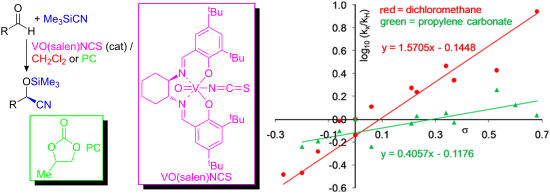
- from 51V NMR spectroscopy suggested that propylene carbonate coordinates to VO(salen)NCS, blocking the free coordination site, thus inhibiting its Lewis acidity and accounting for the reduction in catalytic activity. This explanation was further supported by a Hammett analysis study, which indicated
- that Lewis base catalysis made a much greater contribution to the overall catalytic activity of VO(salen)NCS in propylene carbonate than in dichloromethane. Keywords: cyanohydrin; Hammett; kinetics; propylene carbonate; vanadium; Introduction The last 15 years have witnessed an explosion of activity
- dichloromethane is also consistent with a less tightly organized transition state, again consistent with only one of the reaction components interacting with the catalyst. To investigate this further, a Hammett analysis was undertaken using a range of substituted benzaldehydes. Hammett analysis It is well






Prediction of reduction potentials from calculated electron affinities for metal-salen compounds
Beilstein J. Org. Chem. 2009, 5, No. 82, doi:10.3762/bjoc.5.82
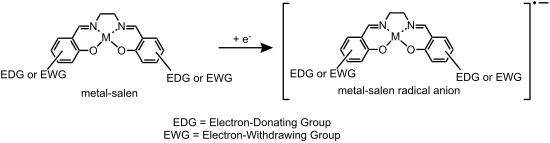
- around the salen ligand), as well as metal-salens with various electron-donating and electron-withdrawing groups around the periphery of the salen ligand. Figure 2 shows that there is a good linear correlation between the computed EA and the Hammett parameter σp for the substituents [11]. Only nickel
- , cobalt, and copper were plotted on the graph due to the other metals (iron, zinc, and palladium) having only one point each in the training set. Negative Hammett parameters result from the presence of electron-donating groups and lead to smaller EAs. Positive Hammett parameters result from the presence
- grade dimethylformamide/0.1 M Bu4N+ BF4− versus Ag/0.1 M AgCl on a Bioanalytical Systems 50-W Voltammetric Analyzer. The potential of the reference electrode was +0.047 V versus SCE. Training set of 19 metal-salens. Correlation between electron affinity (EA) and Hammett σp parameter in the training set


Other Beilstein-Institut Open Science Activities



