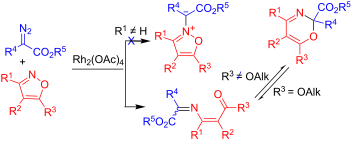
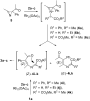
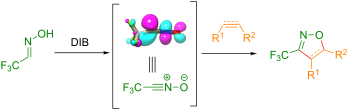
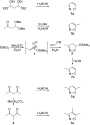
Search for "isoxazole" in Full Text gives 58 result(s) in Beilstein Journal of Organic Chemistry.
Beilstein J. Org. Chem. 2013, 9, 2265–2319, doi:10.3762/bjoc.9.265
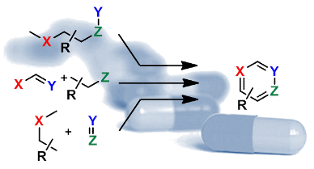
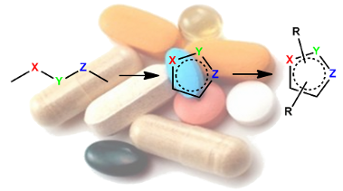
Graphical Abstract
Scheme 1: Scaled industrial processes for the synthesis of simple pyridines.
Scheme 2: Synthesis of nicotinic acid from 2-methyl-5-ethylpyridine (1.11).
Scheme 3: Synthesis of 3-picoline and nicotinic acid.
Scheme 4: Synthesis of 3-picoline from 2-methylglutarodinitrile 1.19.
Scheme 5: Picoline-based synthesis of clarinex (no yields reported).
Scheme 6: Mode of action of proton-pump inhibitors and structures of the API’s.
Scheme 7: Hantzsch-like route towards the pyridine rings in common proton pump inhibitors.
Figure 1: Structures of rosiglitazone (1.40) and pioglitazone (1.41).
Scheme 8: Synthesis of rosiglitazone.
Scheme 9: Syntheses of 2-pyridones.
Scheme 10: Synthesis and mechanism of 2-pyrone from malic acid.
Scheme 11: Polymer-assisted synthesis of rosiglitazone.
Scheme 12: Synthesis of pioglitazone.
Scheme 13: Meerwein arylation reaction towards pioglitazone.
Scheme 14: Route towards pioglitazone utilising tyrosine.
Scheme 15: Route towards pioglitazone via Darzens ester formation.
Scheme 16: Syntheses of the thiazolidinedione moiety.
Scheme 17: Synthesis of etoricoxib utilising Negishi and Stille cross-coupling reactions.
Scheme 18: Synthesis of etoricoxib via vinamidinium condensation.
Figure 2: Structures of nalidixic acid, levofloxacin and moxifloxacin.
Scheme 19: Synthesis of moxifloxacin.
Scheme 20: Synthesis of (S,S)-2,8-diazabicyclo[4.3.0]nonane 1.105.
Scheme 21: Synthesis of levofloxacin.
Scheme 22: Alternative approach to the levofloxacin core 1.125.
Figure 3: Structures of nifedipine, amlodipine and clevidipine.
Scheme 23: Mg3N2-mediated synthesis of nifedipine.
Scheme 24: Synthesis of rac-amlodipine as besylate salt.
Scheme 25: Aza Diels–Alder approach towards amlodipine.
Scheme 26: Routes towards clevidipine.
Figure 4: Examples of piperidine containing drugs.
Figure 5: Discovery of tiagabine based on early leads.
Scheme 27: Synthetic sequences to tiagabine.
Figure 6: Structures of solifenacin (2.57) and muscarine (2.58).
Scheme 28: Enantioselective synthesis of solifenacin.
Figure 7: Structures of DPP-4 inhibitors of the gliptin-type.
Scheme 29: Formation of inactive diketopiperazines from cis-rotameric precursors.
Figure 8: Co-crystal structure of carmegliptin bound in the human DPP-4 active site (PDB 3kwf).
Scheme 30: Improved route to carmegliptin.
Figure 9: Structures of lamivudine and zidovudine.
Scheme 31: Typical routes accessing uracil, thymine and cytosine.
Scheme 32: Coupling between pyrimidones and riboses via the Vorbrüggen nucleosidation.
Scheme 33: Synthesis of lamivudine.
Scheme 34: Synthesis of raltegravir.
Scheme 35: Mechanistic studies on the formation of 3.22.
Figure 10: Structures of selected pyrimidine containing drugs.
Scheme 36: General preparation of pyrimidines and dihydropyrimidones.
Scheme 37: Synthesis of imatinib.
Scheme 38: Flow synthesis of imatinib.
Scheme 39: Syntheses of erlotinib.
Scheme 40: Synthesis of erlotinib proceeding via Dimroth rearrangement.
Scheme 41: Synthesis of lapatinib.
Scheme 42: Synthesis of rosuvastatin.
Scheme 43: Alternative preparation of the key aldehyde towards rosuvastatin.
Figure 11: Structure comparison between nicotinic acetylcholine receptor agonists.
Scheme 44: Syntheses of varenicline and its key building block 4.5.
Scheme 45: Synthetic access to eszopiclone and brimonidine via quinoxaline intermediates.
Figure 12: Bortezomib bound in an active site of the yeast 20S proteasome ([114], pdb 2F16).
Scheme 46: Asymmetric synthesis of bortezomib.
Figure 13: Structures of some prominent piperazine containing drugs.
Figure 14: Structural comparison between the core of aplaviroc (4.35) and a type-1 β-turn (4.36).
Scheme 47: Examplary synthesis of an aplaviroc analogue via the Ugi-MCR.
Scheme 48: Syntheses of azelastine (5.1).
Figure 15: Structures of captopril, enalapril and cilazapril.
Scheme 49: Synthesis of cilazapril.
Figure 16: Structures of lamotrigine, ceftriaxone and azapropazone.
Scheme 50: Synthesis of lamotrigine.
Scheme 51: Alternative synthesis of lamotrigine (no yields reported).
Figure 17: Structural comparison between imiquimod and the related adenosine nucleoside.
Scheme 52: Conventional synthesis of imiquimod (no yields reported).
Scheme 53: Synthesis of imiquimod.
Scheme 54: Synthesis of imiquimod via tetrazole formation (not all yields reported).
Figure 18: Structures of various anti HIV-medications.
Scheme 55: Synthesis of abacavir.
Figure 19: Structures of diazepam compared to modern replacements.
Scheme 56: Synthesis of ocinaplon.
Scheme 57: Access to zaleplon and indiplon.
Scheme 58: Different routes towards the required N-methylpyrazole 6.65 of sildenafil.
Scheme 59: Polymer-supported reagents in the synthesis of key aminopyrazole 6.72.
Scheme 60: Early synthetic route to sildenafil.
Scheme 61: Convergent preparations of sildenafil.
Figure 20: Comparison of the structures of sildenafil, tadalafil and vardenafil.
Scheme 62: Short route to imidazotriazinones.
Scheme 63: Alternative route towards vardenafils core imidazotriazinone (6.95).
Scheme 64: Bayer’s approach to the vardenafil core.
Scheme 65: Large scale synthesis of vardenafil.
Scheme 66: Mode of action of temozolomide (6.105) as methylating agent.
Scheme 67: Different routes to temozolomide.
Scheme 68: Safer route towards temozolomide.
Figure 21: Some unreported heterocyclic scaffolds in top market drugs.
Beilstein J. Org. Chem. 2012, 8, 308–312, doi:10.3762/bjoc.8.33
Graphical Abstract
Figure 1: The 3-acyl-4-hydroxypyridin-2-one motif, example natural products and the isoxazolopyridone scaffol...
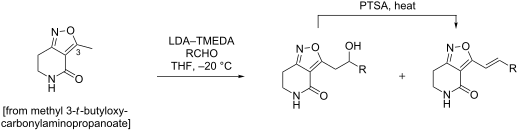
Scheme 1: Aldol reactions of tetrahydroisoxazolopyridone 6. Reagents: (i) LDA–TMEDA, RCHO, THF, −20 °C; (ii) ...
Figure 2: X-ray crystal structure of 3-(2-phenylethenyl)-4,5,6,7-tetrahydroisoxazolo[4,3-c]pyridin-4-one (8a) ...
Figure 3: Ilicicolin H as an example of a 3-decalinoyl-4-hydroxypyridin-2-one metabolite.
Scheme 2: Retrosynthetic analysis of a model 3-decalinyl-4,5,6,7-tetrahydroisoxazolopyridone 10.
Scheme 3: Synthesis of triene 11. Reagents: (i), LDA, propenal, THF, −78 °C; (ii), LiAlH4, THF, 20 °C (75%); ...
Beilstein J. Org. Chem. 2011, 7, 442–495, doi:10.3762/bjoc.7.57
Graphical Abstract
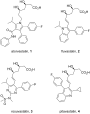
Figure 1: Structures of atorvastatin and other commercial statins.
Figure 2: Structure of compactin.
Scheme 1: Synthesis of pentasubstituted pyrroles.
Scheme 2: [3 + 2] Cycloaddition to prepare 5-isopropylpyrroles.
Scheme 3: Regiospecific [3 + 2] cycloaddition to prepare the pyrrole scaffold.
Scheme 4: Formation of the pyrrole core of atorvastatin via [3 + 2] cycloaddition.
Scheme 5: Formation of pyrrole 33 via the Paal–Knorr reaction.
Scheme 6: Convergent synthesis towards atorvastatin.
Figure 3: Binding pocket of sunitinib in the TRK KIT.
Scheme 7: Synthesis of sunitinib.
Scheme 8: Alternative synthesis of sunitinib.
Scheme 9: Key steps in the syntheses of sumatriptan and zolmitriptan.
Scheme 10: Introduction of the N,N-dimethylaminoethyl side chain.
Scheme 11: Japp–Klingemann reaction in the synthesis of sumatriptan.
Scheme 12: Synthesis of the intermediate sulfonyl chlorides 62 and 63.
Scheme 13: Alternative introduction of the sulfonamide.
Scheme 14: Negishi-type coupling to benzylic sulfonamides.
Scheme 15: Heck reaction used to introduce the sulfonamide side chain of naratriptan.
Scheme 16: Synthesis of the oxazolinone appendage of zolmitriptan.
Scheme 17: Grandberg indole synthesis used in the preparation of rizatriptan.
Scheme 18: Improved synthesis of rizatriptan.
Scheme 19: Larock-type synthesis of rizatriptan.
Scheme 20: Synthesis of eletriptan.
Scheme 21: Heck coupling for the indole system in eletriptan.
Scheme 22: Attempted Fischer indole synthesis of elatriptan.
Scheme 23: Successful Fischer indole synthesis for eletriptan.
Scheme 24: Mechanistic rationale for the Bischler–Möhlau reaction.
Scheme 25: Bischler-type indole synthesis used in the fluvastatin sodium synthesis.
Scheme 26: Palladium-mediated synthesis of ondansetron.
Scheme 27: Fischer indole synthesis of ondansetron.
Scheme 28: Optimised Pictet–Spengler reaction towards tadalafil.
Figure 4: Structures of carvedilol 136 and propranolol 137.
Scheme 29: Synthesis of the carbazole core of carvedilol.
Scheme 30: Alternative syntheses of 4-hydroxy-9H-carbazole.
Scheme 31: Convergent synthesis of etodolac.
Scheme 32: Alternative synthesis of etodolac.
Figure 5: Structures of imidazole-containing drugs.
Scheme 33: Synthesis of functionalised imidazoles towards losartan.
Scheme 34: Direct synthesis of the chlorinated imidazole in losartan.
Scheme 35: Synthesis of trisubstituted imidazoles.
Scheme 36: Preparation of the imidazole ring in olmesartan.
Scheme 37: Synthesis of ondansetron.
Scheme 38: Alternative route to ondansetron and its analogues.
Scheme 39: Proton pump inhibitors and synthesis of esomeprazole.
Scheme 40: Synthesis of benzimidazole core pantoprazole.
Figure 6: Structure of rabeprazole 194.
Scheme 41: Synthesis of candesartan.
Scheme 42: Alternative access to the candesartan key intermediate 216.
Scheme 43: .Medicinal chemistry route to telmisartan.
Scheme 44: Improved synthesis of telmisartan.
Scheme 45: Synthesis of zolpidem.
Scheme 46: Copper-catalysed 3-component coupling towards zolpidem.
Figure 7: Structure of celecoxib.
Scheme 47: Preparation of celecoxib.
Scheme 48: Alternative synthesis of celecoxib.
Scheme 49: Regioselective access to celecoxib.
Scheme 50: Synthesis of pazopanib.
Scheme 51: Syntheses of anastrozole, rizatriptan and letrozole.
Scheme 52: Regioselective synthesis of anastrozole.
Scheme 53: Triazine-mediated triazole formation towards anastrozole.
Scheme 54: Alternative routes to 1,2,4-triazoles.
Scheme 55: Initial synthetic route to sitagliptin.
Figure 8: Binding of sitagliptin within DPP-IV.
Scheme 56: The process route to sitagliptin key intermediate 280.
Scheme 57: Synthesis of maraviroc.
Scheme 58: Synthesis of alprazolam.
Scheme 59: The use of N-nitrosoamidine derivatives in the preparation of fused benzodiazepines.
Figure 9: Structures of itraconazole, ravuconazole and voriconazole.
Scheme 60: Synthesis of itraconazole.
Scheme 61: Synthesis of rufinamide.
Scheme 62: Representative tetrazole formation in valsartan.
Figure 10: Structure of tetrazole containing olmesartan, candesartan and irbesartan.
Scheme 63: Early stage introduction of the tetrazole in losartan.
Scheme 64: Synthesis of cilostazol.
Figure 11: Structure of cefdinir.
Scheme 65: Semi-synthesis of cefdinir.
Scheme 66: Thiazole syntheses towards ritonavir.
Scheme 67: Synthesis towards pramipexole.
Scheme 68: Alternative route to pramipexole.
Scheme 69: Synthesis of famotidine.
Scheme 70: Efficient synthesis of the hyperuricemic febuxostat.
Scheme 71: Synthesis of ziprasidone.
Figure 12: Structure of mometasone.
Scheme 72: Industrial access to 2-furoic acid present in mometasone.
Scheme 73: Synthesis of ranitidine from furfuryl alcohol.
Scheme 74: Synthesis of nitrofurantoin.
Scheme 75: Synthesis of benzofuran.
Scheme 76: Synthesis of amiodarone.
Scheme 77: Synthesis of raloxifene.
Scheme 78: Alternative access to the benzo[b]thiophene core of raloxifene.
Scheme 79: Gewald reaction in the synthesis of olanzapine.
Scheme 80: Alternative synthesis of olanzapine.
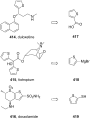
Figure 13: Access to simple thiophene-containing drugs.
Scheme 81: Synthesis of clopidogrel.
Scheme 82: Pictet–Spengler reaction in the preparation of tetrahydrothieno[3,2-c]pyridine (422).
Scheme 83: Alternative synthesis of key intermediate 422.
Figure 14: Co-crystal structures of timolol (left) and carazolol (right) in the β-adrenergic receptor.
Scheme 84: Synthesis of timolol.
Scheme 85: Synthesis of tizanidine 440.
Scheme 86: Synthesis of leflunomide.
Scheme 87: Synthesis of sulfamethoxazole.
Scheme 88: Synthesis of risperidone.
Figure 15: Relative abundance of selected transformations.
Figure 16: The abundance of heterocycles within top 200 drugs (5-membered rings).
Beilstein J. Org. Chem. 2011, 7, 127–134, doi:10.3762/bjoc.7.18
Graphical Abstract
Scheme 1: Synthetic routes to isoxazoles 7a–7e.
Scheme 2: Synthetic routes to isoxazoles 7f–7h.
Scheme 3: Benzaldehyde photocycloaddition to 7a–7e.
Scheme 4: Photochemical ring contraction of isoxazoles 7f–7h.
Scheme 5: Photocycloaddition of aromatic aldehydes to di- and trimethyl isoxazoles 7d and 7e.
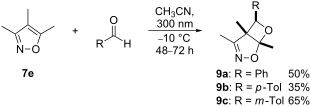
Scheme 6: Preparative photocycloadditions of 7e with aromatic aldehydes.
Figure 1: Structures of the photoproducts 9a–9c in the crystal.
Scheme 7: T-type photochromism of isoxazole–aldehyde pairs.
Scheme 8: Reductive cleavage of the trimethylisoxazole adduct 9a.
Beilstein J. Org. Chem. 2011, 7, 46–52, doi:10.3762/bjoc.7.8
Graphical Abstract
Figure 1: (a) Receptor 1. (b) ORTEP drawing of receptor 1. Thermal ellipsoids are drawn at the 30% probabilit...
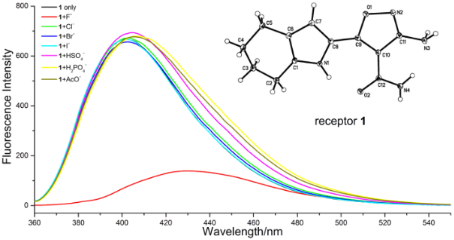
Figure 2: The absorption spectra of receptor 1 (5 μM) in the absence or presence of a 50 equiv of F−, Cl−, Br−...
Figure 3: The fluorescence spectra of receptor 1 (5 μM) in the absence or presence of a 50 equiv of F−, Cl−, ...
Figure 4: Comparison of fluorescence emission of 1 (5 μM) in CH3CN after the addition of 50 equiv of tetrabut...
Figure 5: UV–vis absorption changes of 1 (5 μM) upon the addition of TBAF in CH3CN.
Figure 6: Fluorescence emission changes of 1 (5 μM) upon the addition of TBAF in CH3CN (excited at 340 nm).
Figure 7: The fit of the experimental data of fluorescence emission of 1 (5 μM) upon the addition of F− at 40...
Figure 8: Fluorescence emission changes of 1 (5 μM) upon the addition of F− and OH− (5 equiv) in CH3CN (excit...
Figure 9: Partial 1H NMR (400 MHz) spectra of receptor 1 in the presence of 0, 0.2, 0.6, 1.0, 1.4, 1.6, 2.0, ...
Figure 10: Anionic form a and b of receptor 1.
Beilstein J. Org. Chem. 2010, 6, No. 75, doi:10.3762/bjoc.6.75
Graphical Abstract
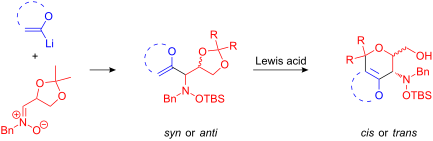
Scheme 1: Synthesis of 3,6-dihydro-2H-pyrans D.
Scheme 2: Addition of lithiated enol ether 1a to nitrone 2c/Et2AlCl.
Scheme 3: Mechanistic proposal for the transformation of syn-4a into cis-5a in the presence of TMSOTf.
Scheme 4: Unsuccessful attempt to cyclize hydroxylamine derivative syn-4f.
Scheme 5: Functionalizations of the enol ether moiety of cis-5a leading to compounds 8–11.
Scheme 6: Transformations of the enol ether moiety of trans-5a leading to products 13–15.
Scheme 7: Bromination of bicyclic dihydropyran trans-5b affording 16.
Scheme 8: Synthesis of epoxypyran 18 by bromination of cis-5d.
Scheme 9: Oxidative cleavage of dihydropyran 19 to lactone 20.
Scheme 10: Transformation of α-bromoketone 15 into nitrone 21 by an internal redox reaction.
Scheme 11: Transformation of α-bromoketone 11 into nitrone 21.
Scheme 12: Synthesis of diastereomeric aminopyrans 24 and 26.
Scheme 13: Synthesis of diastereomeric aminopyrans 28 and 30.
Scheme 14: Synthesis of triamides 31 and 32.
Beilstein J. Org. Chem. 2010, 6, No. 68, doi:10.3762/bjoc.6.68
Graphical Abstract
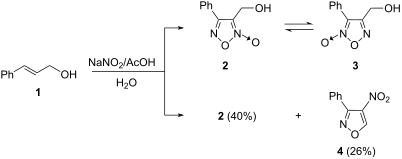
Scheme 1: Preparation of 2 and 4 by treatment of cinnamyl alcohol (1).
Figure 1: The crystal structure of compound 4. Ellipsoids correspond to 50% probability levels.
Figure 2: Packing diagram of compound 4 viewed perpendicular to (101). Hydrogen bonds are indicated by thick ...
Scheme 2: Suggested mechanism for the formation of 4.
Beilstein J. Org. Chem. 2008, 4, No. 31, doi:10.3762/bjoc.4.31
Graphical Abstract
Figure 1: Therapeutic antifungal agents.
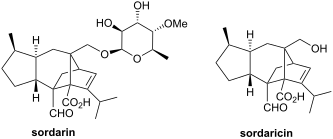
Figure 2: Structure of sordarin (1) and sordaricin (2).
Scheme 1: Kato’s retrosynthetic plan.
Scheme 2: Synthesis of cyclopentadiene 13.
Scheme 3: Synthesis of sordaricin methyl ester.
Scheme 4: Mander’s retrosynthetic plan.
Scheme 5: Synthesis of iodo compound 27.
Scheme 6: Synthesis of sordaricin (2).
Scheme 7: Retrosynthesis of sordarin and sordaricin.
Scheme 8: Synthesis of ketone 43.
Scheme 9: Synthesis of β-keto ethyl ester 45.
Scheme 10: Synthesis of tetracyclic framework 52.
Scheme 11: Synthesis of sordaricin and sordarin.
Figure 3: Modifications of glycosyl part.
Scheme 12: Simplified model of sordarin.
Scheme 13: Synthesis of cyclopentane analog precursors.
Scheme 14: Synthesis of six cyclopentane analogs.
Scheme 15: Retrosynthetic plan of sordarin analog.
Scheme 16: Synthesis of sordarin analog 98.
Scheme 17: Synthesis of sordarin analog 103.