


Search results
Search for "methanolysis" in Full Text gives 51 result(s) in Beilstein Journal of Organic Chemistry.
Diastereoselective functionalisation of benzo-annulated bicyclic sultams: Application for the synthesis of cis-2,4-diarylpyrrolidines
Beilstein J. Org. Chem. 2009, 5, No. 69, doi:10.3762/bjoc.5.69
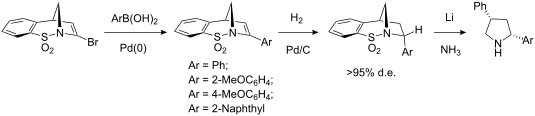
- this bromination reaction, a bromo-methanolysis reaction was carried out (Entry 5). Interestingly, regio- and diastereoselective formation of the cis-16a was observed in good yield. When 13a was taken up in methanol no conversion into 16a, via an SN1-type process, was observed. The use of THF as
- ). Strikingly, none of this rearranged type of product was observed for 5a under identical conditions. The yield for this process was increased to 87% when an excess of Br2 (10 equiv) was employed. The bromo-methanolysis reaction, performed as described above, gave a mixture of compounds 16b and 19b in 58% and
- 16b were formed regioselectively (none of the products resulting from methanolysis of 22 were detected). The regiochemical outcome of this process suggests that either the carbocation adjacent to nitrogen is energetically more stable, or that it is more reactive under these conditions. In relation to


Other Beilstein-Institut Open Science Activities



