


Search results
Search for "nitroalkenes" in Full Text gives 53 result(s) in Beilstein Journal of Organic Chemistry.
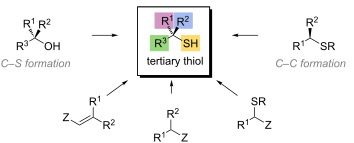
Asymmetric synthesis of tertiary thiols and thioethers
Beilstein J. Org. Chem. 2011, 7, 582–595, doi:10.3762/bjoc.7.68
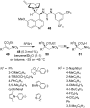
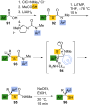
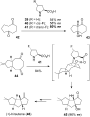
- of the enantiomers of hindered enone 46 by addition, oxidation and elimination of a sulfenic acid under basic conditions (Scheme 18) [45]. Xiao and co-workers developed an organocatalytic process for the addition of thiols to nitroalkenes [46]. Using thiourea organocatalyst 48, conjugate addition of
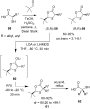
- a variety of thiols to a range of nitroalkenes 49 proceeds to give 50 and hence 51 in good yield and good enantioselectivity (Scheme 19). α-Arylthio-β-amino acid 54 was prepared from Michael adduct 52 in three steps (Scheme 20) in good yield and with full conservation of enantiomeric purity. Palomo
- of enone 46. Organocatalytic conjugate addition to nitroalkenes 49. Preparation of β-amino acid 54. Sulfur migration within oxazolidine-2-thiones 56. Preparation of thiols 62 by self-regeneration of stereocentres. Synthesis of (5R)-thiolactomycin. Preparation of tertiary thiols and thioethers via α








One-pot gold-catalyzed synthesis of 3-silylethynyl indoles from unprotected o-alkynylanilines
Beilstein J. Org. Chem. 2011, 7, 565–569, doi:10.3762/bjoc.7.65
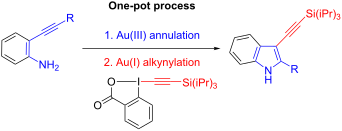
- -alkynylanilines can be followed by 1,4-addition to enones [15][16], iodination [17] or reaction with 1,3-dicarbonyl compounds [18]. Perumal recently demonstrated that aldehydes and nitroalkenes can be used as electrophilic partners [19][20]. Triple bonds can also serve as a second electrophile for the


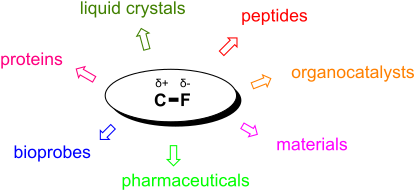
The C–F bond as a conformational tool in organic and biological chemistry
Beilstein J. Org. Chem. 2010, 6, No. 38, doi:10.3762/bjoc.6.38
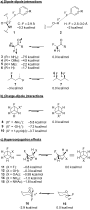
- -generation catalyst for the Stetter reaction between aryl aldehydes (e.g. 47) and nitroalkenes (e.g. 48). Superficially, it seems that the bulky isopropyl group of 49 is solely responsible for the enantioselectivity of this reaction. However, the shape of the bicyclic ring system might also play a role and









Other Beilstein-Institut Open Science Activities



