


Search results
Search for "oxazoles" in Full Text gives 56 result(s) in Beilstein Journal of Organic Chemistry.
Identification and isolation of insecticidal oxazoles from Pseudomonas spp.
Beilstein J. Org. Chem. 2012, 8, 749–752, doi:10.3762/bjoc.8.85
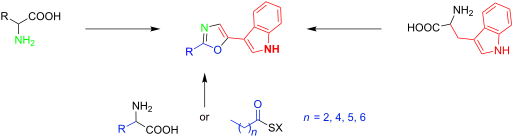
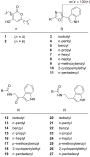
- , Penryn, Cornwall, TR10 9EZ, UK Faculty of Tropical Medicine, Mahidol University, 420/6 Ratchawithi Road, Ratchathewi, Bangkok 10400, Thailand 10.3762/bjoc.8.85 Abstract Two new and five known oxazoles were identified from two different Pseudomonas strains in addition to the known pyrones pseudopyronine
- A and B. Labeling experiments confirmed their structures and gave initial evidence for a novel biosynthesis pathway of these natural oxazoles. In order to confirm their structure, they were synthesized, which also allowed tests of their bioactivity. Additionally, the bioactivities of the synthesis
- additional oxazole derivative, but which was only produced in minute amounts. WS-30581 A (6) was identified by comparing the retention time and the MS fragmentation (Supporting Information File 1, Figure S2) of the product contained in the extract, with a synthesized compound. All oxazoles showed a



Imidazole as a parent π-conjugated backbone in charge-transfer chromophores
Beilstein J. Org. Chem. 2012, 8, 25–49, doi:10.3762/bjoc.8.4
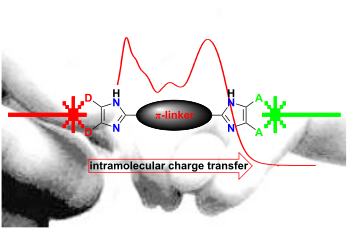
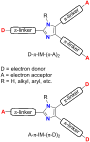
- -A)2 and A-π-IM-(π-D)2 push–pull systems. An initial effort to synthesize and apply azole derivatives as CT chromophores and to study their optical (non)linearities can be ascribed to Moylan, Miller, and co-workers as early as 1993 [31][32]. Donor–acceptor-substituted imidazoles, oxazoles, and




Recent advances in direct C–H arylation: Methodology, selectivity and mechanism in oxazole series
Beilstein J. Org. Chem. 2011, 7, 1584–1601, doi:10.3762/bjoc.7.187
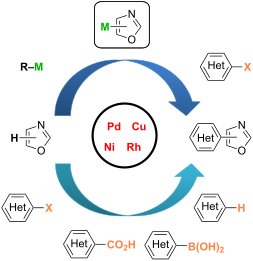
- , direct (hetero)arylation of (benz)oxazoles for the preparation of (hetero)aryl(benz)oxazoles, which are common structural units of numerous natural products and are also employed in pharmaceuticals and materials [27]. Review Stoichiometric direct (hetero)arylation of (benz)oxazoles Dondoni first explored
- the reactivity of the 2-lithio-oxazoles resulting from the ready deprotonation, with n-BuLi at low temperature, of the most acidic C2-proton (pKa = 20–22 was suggested), which is complicated by the coexistence of a ring-open isonitrile tautomer. In particular, the treatment by trimethylstannylchloride
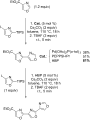
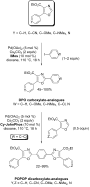
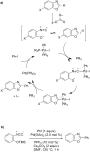
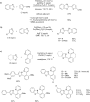
- by the isonitrile function, leading to the ring-close aryloxazol-2-yl palladium complex delivering products after a final reductive elimination step (Scheme 3). Catalytic direct (hetero)arylation of (benz)oxazoles Palladium- and/or copper-catalyzed direct (hetero)arylation with halides: Synthetic






Multistep flow synthesis of vinyl azides and their use in the copper-catalyzed Huisgen-type cycloaddition under inductive-heating conditions
Beilstein J. Org. Chem. 2011, 7, 1441–1448, doi:10.3762/bjoc.7.168
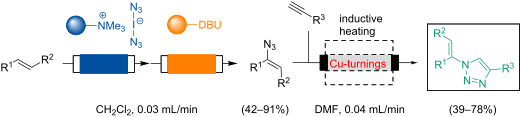
- , vinyl azides can be converted into the corresponding 2H-azirines by thermolysis or alternatively by photolysis [5]. The highly reactive azirines can further react as dipolarophiles, dienophiles, electrophiles or nucleophiles [6] thereby accessing oxazoles and isoxazoles [7]. In addition, 2H-azirines


Photocycloaddition of aromatic and aliphatic aldehydes to isoxazoles: Cycloaddition reactivity and stability studies
Beilstein J. Org. Chem. 2011, 7, 127–134, doi:10.3762/bjoc.7.18
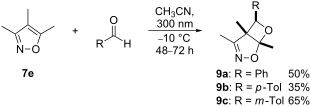
- -1,4-diketones after hydrolysis of the primary photochemical products (photo aldol reaction) [7], whilst the reaction of oxazoles with carbonyl compounds is a convenient protocol for the stereoselective synthesis of α-amino β-hydroxy ketones [8][9] as well as highly substituted α-amino β-hydroxy acids
- reagent on the liberated benzaldehyde. Conclusion The photocycloaddition of electronically excited carbonyl compounds to isoxazoles is clearly less effective than with other five-membered aromatic or non-aromatic heterocycles (furans, thiophenes, pyrroles, oxazoles, dihydrofurans, dihydropyrroles) [1



ADDP and PS-PPh3: an efficient Mitsunobu protocol for the preparation of pyridine ether PPAR agonists
Beilstein J. Org. Chem. 2006, 2, No. 21, doi:10.1186/1860-5397-2-21
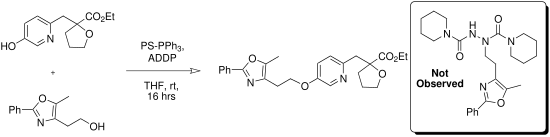
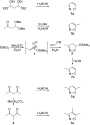
- . As expected, oxazoles, thiazoles, pyrazoles, and pyridines are tolerated in this chemistry. In a limited number of cases, functionality (e.g. basic amines, benzimidazoles, indoles, etc.) caused no reaction to occur and only recovered starting materials were isolated (data not shown). We then shifted


Other Beilstein-Institut Open Science Activities



