


Search results
Search for "HAT" in Full Text gives 78 result(s) in Beilstein Journal of Organic Chemistry.
Damage of polyesters by the atmospheric free radical oxidant NO3•: a product study involving model systems
Beilstein J. Org. Chem. 2013, 9, 1907–1916, doi:10.3762/bjoc.9.225

- transformation processes at night. NO3•, which is formed through reaction of the atmospheric pollutants nitrogen dioxide, NO2•, with ozone, O3 (Scheme 1a) [7][8], reacts with organic compounds through various pathways, such as hydrogen abstraction (HAT) and addition to π systems. Most importantly, NO3• is one of
- the adipic acid derivatives 2. In the case of the former this could be explained by the fact that the aromatic ring is very deactivated due to the two electron-withdrawing ester substituents, so that oxidative electron transfer (ET) by NO3• is not possible. Also, NO3• induced HAT from the ester
- base [23]. It is important to note that the formation of radical intermediate 7 could principally also occur in one step through NO3•-induced benzylic HAT in 3 (not shown). However, it appears from the outcome of the reactions with the neopentyl derivatives of 1 and 2 that HAT by NO3• is not


Metal-free aerobic oxidations mediated by N-hydroxyphthalimide. A concise review
Beilstein J. Org. Chem. 2013, 9, 1296–1310, doi:10.3762/bjoc.9.146
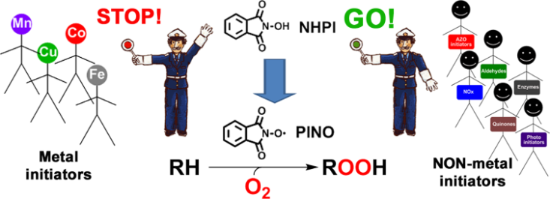
- laccase-ABTS follows an electron transfer (ET) mechanism, NHPI, VLA, HBT, and NHAmediators promote a hydrogen atom transfer (HAT) route through the formation of the corresponding N-oxyl radicals as NHDs-Medox species (Scheme 11). The same research group also emphasized the specialization of mediators
- morphology and the molecular weight of the starting material [48]. Moreover, this catalytic system could be employed with dioxygen in place of NaClO as the ultimate oxidizing agent [49]. In this case, the mechanism follows a radical chain via classical HAT by PINO abstraction (Scheme 17). Aldehydes and the
- of molecular bromine as a co-catalyst [68] (Scheme 24). According to the proposed mechanism, Br2 generates ET processes by oxidizing the o-phenanthroline to the corresponding cation radicals. The latter promote in turn ET and HAT processes with NHPI, leading to the formation of PINO. In 2009 the same


From discovery to production: Scale- out of continuous flow meso reactors
Beilstein J. Org. Chem. 2009, 5, No. 29, doi:10.3762/bjoc.5.29
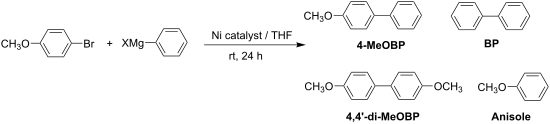
- become deposited on the catalyst beads on standing between studies and that the initial linear increase in yield was a consequence of the salts being washed off in the continuous flow and adsorption of the organobromide on to the newly freed reactive sites. It is seen from Figure 6 hat the production of


Other Beilstein-Institut Open Science Activities



