Search results
Search for "entropy" in Full Text gives 132 result(s) in Beilstein Journal of Organic Chemistry.
Peptide–polymer ligands for a tandem WW-domain, an adaptive multivalent protein–protein interaction: lessons on the thermodynamic fitness of flexible ligands
Beilstein J. Org. Chem. 2015, 11, 837–847, doi:10.3762/bjoc.11.93
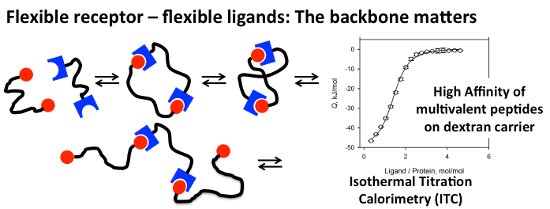
- matched in order to balance enthalpic gain with entropic loss of the system. In such a setting, a rigid multivalent ligand binding to a flexible receptor can be expected to reduce the entropy of the system upon binding, and thus will result in a partial or complete loss of the multivalent affinity
- and almost negligible entropic contributions , all polyhydroxy-based peptide–polymer conjugates showed significantly stronger generation of heat through binding (enthalpy) together with a pronounced loss in entropy. Binding in all cases was driven mainly by enthalpy, which clearly outweighed the
- observed entropy loss. In the seven peptide–polymer conjugates investigated, increased loading density of ligands led consistently to increased affinity of the multivalent ligand (Table 1). The most significant difference between dextran and the two other polymer carriers was the stoichiometry of the





Influence of length and flexibility of spacers on the binding affinity of divalent ligands
Beilstein J. Org. Chem. 2015, 11, 804–816, doi:10.3762/bjoc.11.90
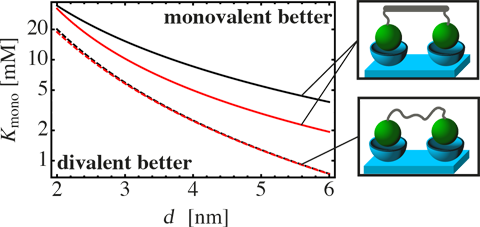
- receptors [1]. Each multivalent ligand consists of several monovalent ligands that are connected via a scaffold. The binding affinity of such a multivalent ligand is determined by the interplay between gain in binding energy and loss of entropy associated with conformational degrees of freedom. The more
- flexible the scaffold is, the better it can adapt to the geometry of the receptor, but the more pronounced on the other hand is the entropy penalty. This simple, qualitative argument shows that the careful choice of the ligand scaffold is essential, in order to benefit from multivalent enhancement. It is
- monovalent ligand binds better than the divalent ligand. In this case the loss in entropy of the spacer is larger than the gain in binding energy due to the multiple binding of ligand units. Inserting the effective concentration from Equation 13 and Equation 23 into Equation 41 and Equation 47, the RBA can


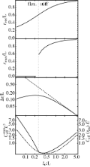

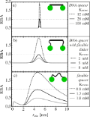

![[Graphic 33]](/bjoc/content/inline/1860-5397-11-90-i83.png?max-width=637&scale=1.18182) is shown for different ligand–spacer constructs. If the monovalent dissociatio...
is shown for different ligand–spacer constructs. If the monovalent dissociatio...
Impact of multivalent charge presentation on peptide–nanoparticle aggregation
Beilstein J. Org. Chem. 2015, 11, 792–803, doi:10.3762/bjoc.11.89

- , and the enthalpy ΔH can be directly obtained from the measured data whereas the entropy ΔS is calculated. Due to very weak or absent interactions of R1A3 or R2A5 with Au/MUA nanoparticles it was not possible to determine thermodynamic parameters. Surprisingly, the obtained binding constants are not in
- energy. Nevertheless, all peptide–nanoparticle interactions are entropically favored processes as entropy increases with along with binding energy. Morphological studies of peptide-induced nanoparticle assemblies Cryo TEM was used to gain insight into the morphology of the peptide–nanoparticle aggregates


Probing multivalency in ligand–receptor-mediated adhesion of soft, biomimetic interfaces
Beilstein J. Org. Chem. 2015, 11, 720–729, doi:10.3762/bjoc.11.82
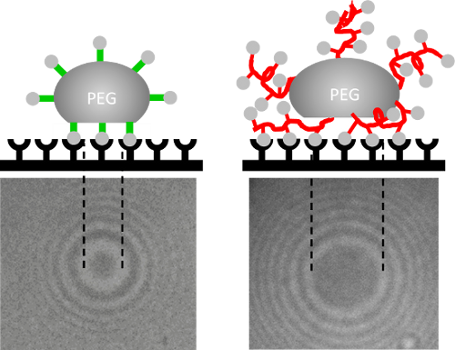
- generally low affinity between sugars and receptors and possibly also by the high flexibility of the polymeric mannose linkers [9]. High molecular flexibility causes a high degree of conformational entropy that negatively affects complex formation between ligands and receptors [23]. Also the design of the


Exploring monovalent and multivalent peptides for the inhibition of FBP21-tWW
Beilstein J. Org. Chem. 2015, 11, 701–706, doi:10.3762/bjoc.11.80
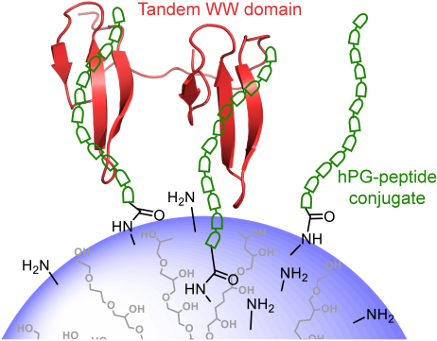
- peptides on the hPG particle are not engaged in the interaction with FBP21-tWW. The enthalpy of the interaction is twice as large for the hPG-peptide conjugate as for the monovalent ligand, while the entropy loss upon interaction (−19.5 cal/mol/deg for the interaction with the monovalent ligand and −45.9


On the strong difference in reactivity of acyclic and cyclic diazodiketones with thioketones: experimental results and quantum-chemical interpretation
Beilstein J. Org. Chem. 2015, 11, 504–513, doi:10.3762/bjoc.11.57
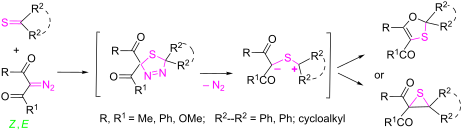
- thermodynamically and kinetically favorable process for DDC with at least one electron-withdrawing acyl group. At higher temperatures, however, due to the entropy contribution, the dominating process becomes the 1,3-cyclization followed by desulfurization of the obtained thiiranes, which leads to the corresponding


Novel biphenyl-substituted 1,2,4-oxadiazole ferroelectric liquid crystals: synthesis and characterization
Beilstein J. Org. Chem. 2015, 11, 233–241, doi:10.3762/bjoc.11.26
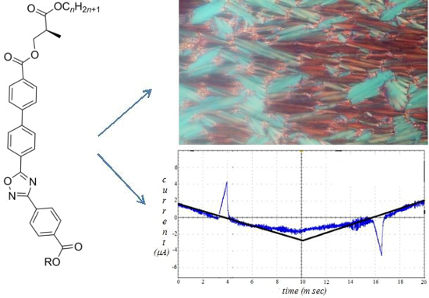
- during the thermal studies at 5 °C/min are given in Supporting Information File 1. It is noticed that the mesomorphic thermal range is almost the same in both cases. The data of transition temperatures (TC), the enthalpy changes (∆H) across the transitions and entropy changes (∆S) of 13a (Ph.Ox.C*Cn) and
- changes (kJ/mol) and entropy changes (J/mol/K) of the 13a (Ph.Ox.C*Cn) series. Phase transition temperatures (°C), enthalpy changes (kJ/mol) and entropy changes (J/mol/K) of the 13b (C12Ox.C*Cn) series. Supporting Information The experimental procedure for the synthesis of 13ap–13as and 13bp–13bs with



Formation of nanoparticles by cooperative inclusion between (S)-camptothecin-modified dextrans and β-cyclodextrin polymers
Beilstein J. Org. Chem. 2015, 11, 147–154, doi:10.3762/bjoc.11.14
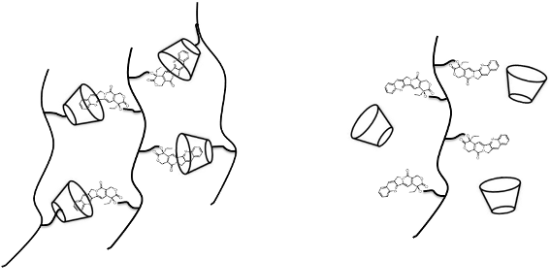
- formation is enthalpy driven in the case of D10GP-CPT1, but mainly entropy driven (|TΔS| > |ΔH|) in the case of D70GP-CPT2. This high positive entropy variation shows a cooperative inclusion of the polymers. No binding between native β-CD and D70GP-CPT2 could be measured by ITC. Figure 1 shows the heat flow


Synthesis of uniform cyclodextrin thioethers to transport hydrophobic drugs
Beilstein J. Org. Chem. 2014, 10, 2920–2927, doi:10.3762/bjoc.10.310
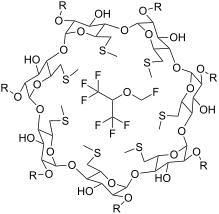
- . This fact was attributed to an increasing loss of entropy upon complexation of the guests. The longer the substituents the higher the conformational freedom of the host leading to higher intrinsic entropy. Also the two statistical derivatives, 2b1 and 2b2 showed somewhat lower binding constants than




Synthesis and characterization of a new photoinduced switchable β-cyclodextrin dimer
Beilstein J. Org. Chem. 2014, 10, 2874–2885, doi:10.3762/bjoc.10.304
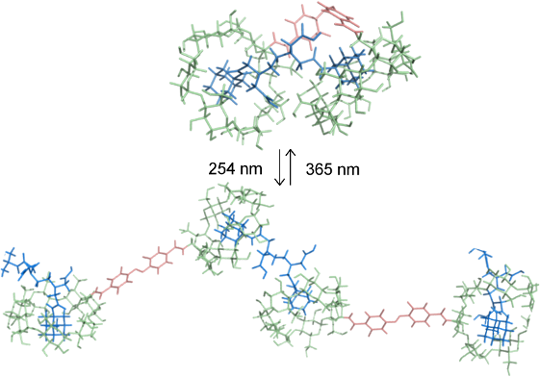
- characterize the interaction of CDs with guests in solution [37][38]. It enables the enthalpy, entropy and equilibrium constants involved in complexation processes to be determined in a single experiment. Moreover, the guest:host molar ratio (i.e., the stoichiometry of the complex) can be measured. First


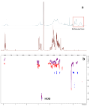

Binding mode and free energy prediction of fisetin/β-cyclodextrin inclusion complexes
Beilstein J. Org. Chem. 2014, 10, 2789–2799, doi:10.3762/bjoc.10.296
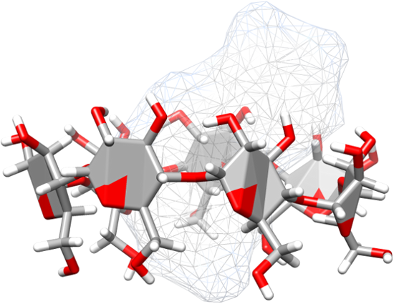
- (ΔG) can be calculated from enthalpy (ΔH) and entropy terms with constant temperature (TΔS). In solution, the ΔH term was divided into enthalpy energy in gas phase upon formation of complex (ΔEMM) and the free energy of solvation (ΔGsol), while the entropy term, T∆S, for conformational entropy change
- is worth to note that in comparison to the QM energy (∆EQM) the MM method was likely found to overestimate the binding interaction by ca. 10 kcal/mol for all snapshots in the three forms of complex (Figure 7). Our results also suggested that for binding free energy prediction, the entropy and


Improving ITC studies of cyclodextrin inclusion compounds by global analysis of conventional and non-conventional experiments
Beilstein J. Org. Chem. 2014, 10, 2630–2641, doi:10.3762/bjoc.10.275
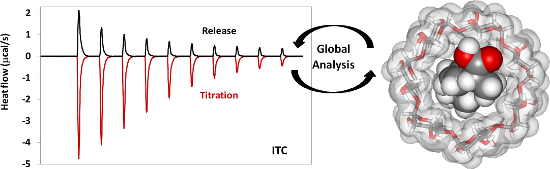
- enthalpy ΔH, inclusion entropy ΔS, heat capacity variation ΔCp ) [5][6][7][8][9][10][11]. On a methodological point of view, most ITC studies are based on the classical titration protocol. While one partner of the studied phenomenon, called titrand, is placed inside the cell, the second partner, called


Microsolvation and sp2-stereoinversion of monomeric α-(2,6-di-tert-butylphenyl)vinyllithium as measured by NMR
Beilstein J. Org. Chem. 2014, 10, 2521–2530, doi:10.3762/bjoc.10.263
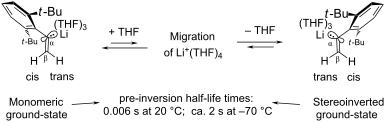
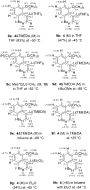
- immoblization of additional ligands by its less negative entropy contribution. If so, this disolvation of monomeric 4 implies that TMEDA did not admit the solvent t-BuOMe to participate in direct microsolvation. After final quenching with DOCH3 (6 equiv), the in situ 1H and 13C NMR spectra showed the
- -stereoinversion through limiting the negative entropy contribution of ligand immoblization: Since 4&3THF needs only one further THF ligand to generate the SSIPs 12 and 13 from 11, this immobilization costs only a one-particle entropy contribution of ca. −11 cal mol−1 K−1 [10], as also known [11] for the
- expense of doubled entropy contributions (ca. −22 cal mol−1 K−1) if generating SSIPs (like 12) with tetrasolvated Li+, which explains why their diastereotopomerization rates remained below our NMR time scales even though the doubled THF fixation would provide an increased negative contribution to ΔHψ




Towards the sequence-specific multivalent molecular recognition of cyclodextrin oligomers
Beilstein J. Org. Chem. 2014, 10, 2428–2440, doi:10.3762/bjoc.10.253
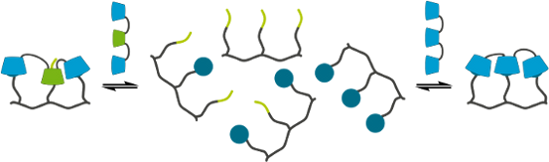
- constant between 17 and β-CD, caused by the symmetry effect of the interaction between two homodivalent systems [1]. The intrinsic complexation enthalpy and entropy show that both complexations are enthalpically as well as entropically driven. The interaction of 8 with the non-complementary CD dimer 1
- higher than the binding constant between 17 and α-CD due to the symmetry effect. The complexation enthalpy and entropy differ from the monovalent interaction α-CD/17 because of the bridging of the host and the guest molecules (Figure 8C). In summary, for none of the divalent strands sequence-specific
- indicate that every inclusion process is mainly driven by the complexation entropy although four molecules are combined in one aggregate. The analysis of the ITC data of the system 7/12 was done with a 1:3 binding model where only the interaction between the adamantane moiety of 12 and the β-CD of 7 was


Autonomous assembly of synthetic oligonucleotides built from an expanded DNA alphabet. Total synthesis of a gene encoding kanamycin resistance
Beilstein J. Org. Chem. 2014, 10, 2348–2360, doi:10.3762/bjoc.10.245
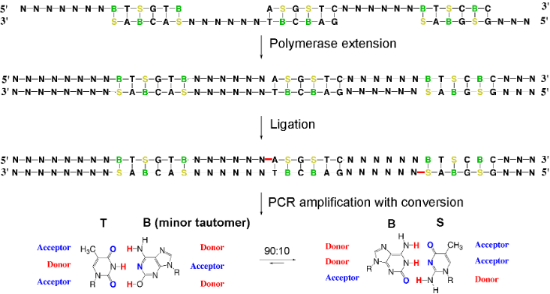
- magnesium; using the nearest neighbor formula from http://www.clinchem.org/content/45/12/2094.long; melting temperatures in 10 mM MgCl2 are expected to be ~10 °C higher) The S:B pair was assumed to contribute to duplex stability the same as the C:G pair. Enthalpy and entropy values for nucleotide pairs in




Expeditive synthesis of trithiotriazine-cored glycoclusters and inhibition of Pseudomonas aeruginosa biofilm formation
Beilstein J. Org. Chem. 2014, 10, 1981–1990, doi:10.3762/bjoc.10.206
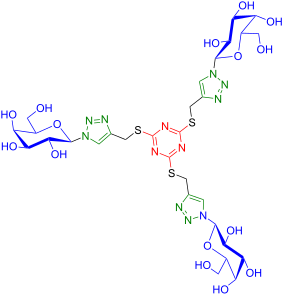
- show a relatively less unfavorable entropy contribution, compared to methyl β-D-galactopyranoside, which is consistent with the contribution of additional hydrophobic interactions. No chelate binding is expected in this first generation cluster, as the arm length is well below the 29 Å distance between


Pyrrolidine nucleotide analogs with a tunable conformation
Beilstein J. Org. Chem. 2014, 10, 1967–1980, doi:10.3762/bjoc.10.205
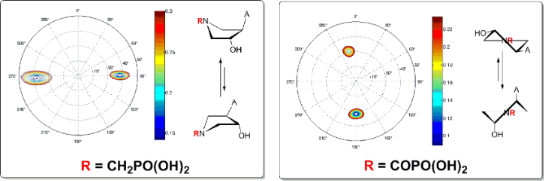
- the entropy of activation ΔS‡ = −190.6 J/(K·mol) (for details, see Supporting Information File 1). The relatively low value of ΔG‡298 = 80.7 kJ/mol implies that the preparative isolation of the individual rotamers A and B at room temperature would not be possible. For the purposes of conformational


Supercritical carbon dioxide: a solvent like no other
Beilstein J. Org. Chem. 2014, 10, 1878–1895, doi:10.3762/bjoc.10.196
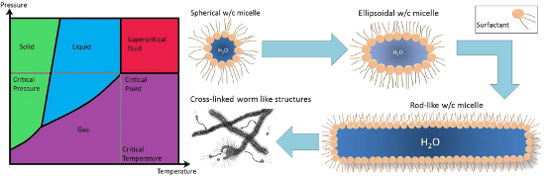
- insoluble systems. Solubility is determined by the balance of intermolecular forces between solvent and solute, along with the entropy change that occurs on dispersal of the solute, so is therefore dependent on both pressure, temperature and system polarity. Solvophilicity could be defined as the affinity a


Structure/affinity studies in the bicyclo-DNA series: Synthesis and properties of oligonucleotides containing bcen-T and iso-tricyclo-T nucleosides
Beilstein J. Org. Chem. 2014, 10, 1840–1847, doi:10.3762/bjoc.10.194
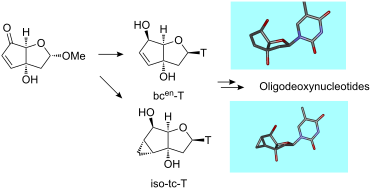
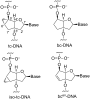
- - and tc-DNA have been conceived to reduce the entropy upon duplex formation with a nucleic acid target by reducing the conformational flexibility around the C3’–C4’ and C4’–C5’ bonds, while achieving as much as possible of a geometric match with the backbone conformation of DNA in duplexed form. From



OligArch: A software tool to allow artificially expanded genetic information systems (AEGIS) to guide the autonomous self-assembly of long DNA constructs from multiple DNA single strands
Beilstein J. Org. Chem. 2014, 10, 1826–1833, doi:10.3762/bjoc.10.192
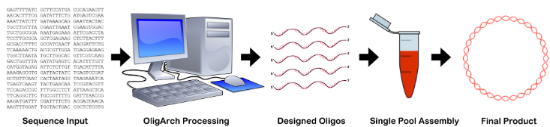
- with unified entropy and enthalpy values from SantaLucia, et al. [14]. AEGIS bases B and P, both purines able to make 3 hydrogen bonds, are treated as G within Tm calculations, while S and Z, both pyrimidines able to form 3 hydrogen bonds, are treated as C. The exact Tm formula is: where R is the
- universal gas constant (1.987 cal/°C·mol) and ΔH and ΔS are the enthalpy and entropy of the base stacking adjusted for initiation factors [14], with ΔS also adjusted for salt concentrations using the formula [15]: AEGIS segments are designed using a bidirectional sliding-window approach. Starting at the


Why a diaminopyrrolic tripodal receptor binds mannosides in acetonitrile but not in water?
Beilstein J. Org. Chem. 2014, 10, 1513–1523, doi:10.3762/bjoc.10.156
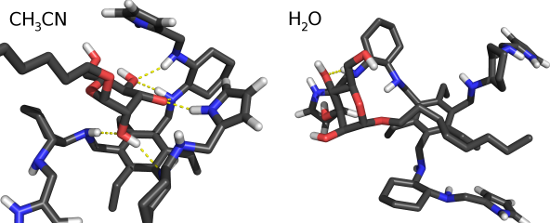
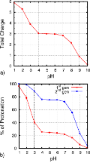
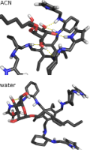
- binding event was never observed in our unrestrained simulations. Since entropy plays a crucial role in binding events they can be too slow and inaccessible in our computational timescale. Hence, to gain better insights into the molecular detail of the interaction between sugar and receptor, we performed




Biantennary oligoglycines and glyco-oligoglycines self-associating in aqueous medium
Beilstein J. Org. Chem. 2014, 10, 1372–1382, doi:10.3762/bjoc.10.140
- glycines. The more flexible core C10 should lead to a entropy driven destabilization. The opposite effect observed in reality is most probably caused by van der Waals interactions of hydrophobic fragments C10 closely situated in the PG II structure. The oligoethylene glycol core abolishes the formation of





Chromatographically separable rotamers of an unhindered amide
Beilstein J. Org. Chem. 2014, 10, 701–706, doi:10.3762/bjoc.10.63
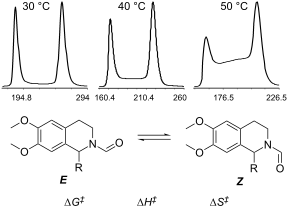
- calculated according to the Eyring equation (vide supra). The activation enthalpy ΔH‡ of the interconversion process was obtained from the slope and the activation entropy ΔS‡ from the intercept of the Eyring plot (Figure 4). Deviations of the activation parameters ΔH‡ and ΔS‡ have been calculated by error


![[Graphic 2]](/bjoc/content/inline/1860-5397-10-63-i3.png?max-width=637&scale=1.18182) ) in 4 (BP-D3/def2-SVP).
) in 4 (BP-D3/def2-SVP).

Substrate dependent reaction channels of the Wolff–Kishner reduction reaction: A theoretical study
Beilstein J. Org. Chem. 2014, 10, 259–270, doi:10.3762/bjoc.10.21
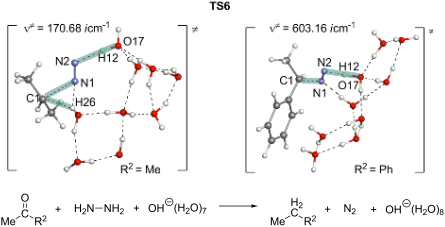
- 2 (+42.72 kcal/mol). The need of the base catalyst OH− to promote the W-K reduction, particularly the nucleophilic elimination of the diimine, was revealed. In parentheses, entropy changes are shown. In the first step, IMe → IIMe, the large entropy decrease (−36.9 e.u.) is noticeable. The decrease
- originates from the formation of the CT complex with an ion-pair character, which results in the surrounding water cluster to adopt a more compact form. In the last step, XIIIMe → XIVMe, the large entropy increase (+38.9 e.u.) is shown, which corresponds to the separated form of C3H8, N2 and OH−(H2O)8
- , hydrazine and OH−(H2O)7. Energy changes of the OH− containing W-K reaction of acetone calculated by B3LYP/6-311+G**. Geometric changes are shown in Figure 3. Values in parentheses are entropy changes ΔS0 in cal/(mol∙K). A trans-diimine → propane conversion step corresponding to TS6 in Figure 3. The system








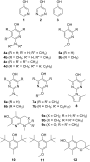
3-Pyridinols and 5-pyrimidinols: Tailor-made for use in synergistic radical-trapping co-antioxidant systems
Beilstein J. Org. Chem. 2013, 9, 2781–2792, doi:10.3762/bjoc.9.313
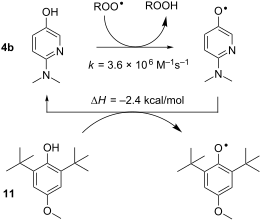
- efficiency of regeneration depends almost entirely on Kr. Moreover, since H-atom transfer between phenols usually proceeds with a negligible change in entropy, α depends largely on the difference in the O–H BDEs of the two co-antioxidants (Equation 3). If Kr << 1, regeneration will be inefficient and no