Search results
Search for "dihydroxylation" in Full Text gives 113 result(s) in Beilstein Journal of Organic Chemistry.
Tandem catalysis of ring-closing metathesis/atom transfer radical reactions with homobimetallic ruthenium–arene complexes
Beilstein J. Org. Chem. 2010, 6, 1167–1173, doi:10.3762/bjoc.6.133
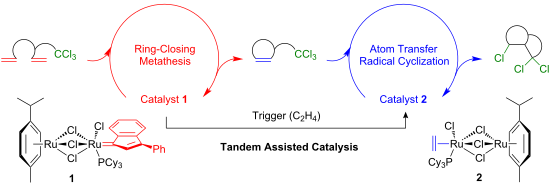
- ][13][14], ATRP [15][16][17][18], cyclopropanation [19], dihydroxylation [20], hydrogenation [21][22][23], hydrovinylation [24], isomerization [25][26][27][28], oxidation [29], or Wittig reactions [30], to name just a few [31]. In this contribution, we investigate the tandem catalysis of RCM/ATRC


Addition of lithiated enol ethers to nitrones and subsequent Lewis acid induced cyclizations to enantiopure 3,6-dihydro-2H-pyrans – an approach to carbohydrate mimetics
Beilstein J. Org. Chem. 2010, 6, No. 75, doi:10.3762/bjoc.6.75
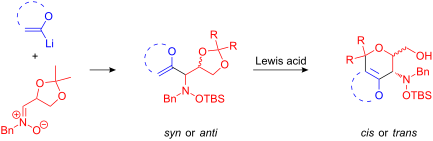
- dihydroxylation or bromination. Bicyclic enol ether 19 was oxidatively cleaved to provide the highly functionalized ten-membered ring lactone 20. The synthesized enantiopure aminopyrans 24, 26, 28 and 30 can be regarded as carbohydrate mimetics. Trimeric versions of 24 and 28 were constructed via their attachment
- and Scheme 6). Starting from cis-5a, acidic hydrolysis with concurrent loss of the TBS-group by treatment with saturated methanolic HCl followed by the addition of a saturated solution of NaHCO3 in water gave ketone 8 in good yield (Scheme 5 and Scheme 6). Dihydroxylation using the K2OsO4/N
- dihydroxylation reagent OsO4, from the sterically less hindered side, leading to incorporation of the bromo substituent trans to the hydroxymethyl and the bulky hydroxylamine moiety. The partial removal of the TBS-group is undoubtedly caused by HBr formed in the course of the reaction. When these reaction


Synthesis of a new class of aminocyclitol analogues with the conduramine D-2 configuration
Beilstein J. Org. Chem. 2010, 6, No. 15, doi:10.3762/bjoc.6.15
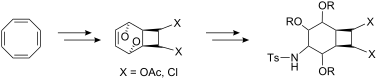
- theoretically form two complexes 15 and 16 after ionization. We assume that the formation of complex 15 is hindered due to the presence of an acetate group in the endo position. cis-Dihydroxylation of 13 with KMnO4 at −15 °C gave a single diol 17, which was converted into the tetraacetate by treatment with


Can we measure catalyst efficiency in asymmetric chemical reactions? A theoretical approach
Beilstein J. Org. Chem. 2009, 5, No. 67, doi:10.3762/bjoc.5.67
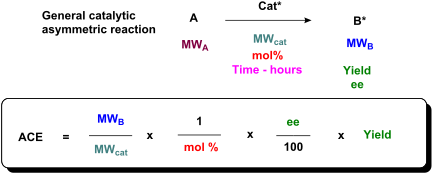
- anecdotally refer to a “good“ or “bad“ reaction, there is no system for comparing those reactions with each other. Well-known examples of asymmetric catalysis such as the Sharpless asymmetric dihydroxylation, the Corey oxazaborolidine ketone reduction or the proline-catalysed aldol reaction are almost


Mitomycins syntheses: a recent update
Beilstein J. Org. Chem. 2009, 5, No. 33, doi:10.3762/bjoc.5.33
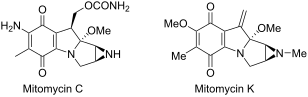
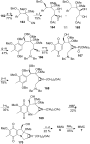
- . Functionalization of the olefin in compound 38 was accomplished first by dihydroxylation with osmium tetroxide. The reaction was stereospecific, resulting in formation of the diol 39 derived from attack of the reagent from the concave face of the molecule. Diol 39 was found to have the undesired stereochemistry for
- sequence using dihydroxylation with osmium tetroxide, mesylation and displacement with azide was used to produce leucoaziridinomitosane 45, whose spectral data matched those of an authentic sample derived from natural mitomycin C. 3.3. Williams. Mitsunobu reaction R.M. Williams successfully used this
- (Scheme 23). First, the phenol acetate was replaced by a benzyl group. Among the different oxidants screened for dihydroxylation, osmium tetroxide was preferred, since it did not effect aromatization of the indoline ring and gave diol 83 as a single isomer. Dihydroxylation occurred selectively from the






Recent progress on the total synthesis of acetogenins from Annonaceae
Beilstein J. Org. Chem. 2008, 4, No. 48, doi:10.3762/bjoc.4.48
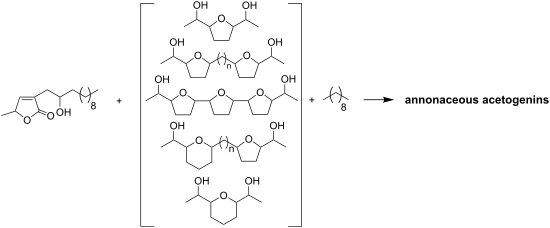
- materials (e.g. amino acids, sugars, tartaric acid, etc.) or on asymmetric reactions {e.g. Sharpless asymmetric epoxidation (AE), Sharpless asymmetric dihydroxylation (AD), diastereoselective Williamson etherification, etc.}. Semi-synthesis of natural ACGs as well as derivatised ACGs (e.g. amines, esters
- ). Asymmetric dihydroxylation with AD-mix-β on 11 and subsequent acid-catalyzed cyclization with camphorsulfonic acid (CSA) resulted in THF ring-containing building block 12, which was converted into alkyne 13. The alkylation of iodide 14 with the sodium enolate of 15 afforded 16. Transformation of 16 following
- ). 130 was obtained by using the Sharpless epoxidation and dihydroxylation of 129. Compound 130 was then subjected to the Mitsunobu inversion to afford 131, which was transformed into 125. Then the THF moiety 125 and γ-lactone moiety 132 were coupled by a Sonogashira cross-coupling, and diimide reduction


End game strategies towards the total synthesis of vibsanin E, 3-hydroxyvibsanin E, furanovibsanin A, and 3-O-methylfuranovibsanin A
Beilstein J. Org. Chem. 2008, 4, No. 34, doi:10.3762/bjoc.4.34
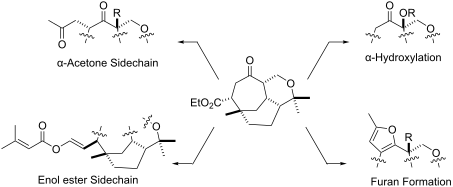
- ) by a Claisen rearrangment (via the silyl enol ether) was not high yielding and produced many side products. Ozonolysis of 25 afforded the acetone sidechain (i.e. 26) in acceptable yield (50%). Other methods to unmask the ketone functionality failed, for example, dihydroxylation followed by oxidative


Total synthesis of the indolizidine alkaloid tashiromine
Beilstein J. Org. Chem. 2008, 4, No. 8, doi:10.1186/1860-5397-4-8
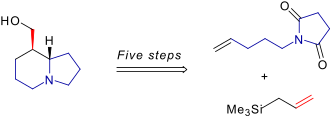
- the resulting carbonyl function and the amide. In the event, attempts to form a C5 aldehyde using either ozonolytic or dihydroxylation/periodate alkene cleavage protocols were unsuccessful, with complex mixtures being obtained in both cases. We suspected that the problem lay in the potential for the


An asymmetric synthesis of all stereoisomers of piclavines A1-4 using an iterative asymmetric dihydroxylation
Beilstein J. Org. Chem. 2007, 3, No. 37, doi:10.1186/1860-5397-3-37
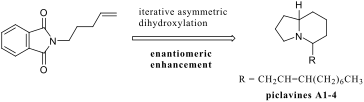
- dihydroxylation with enantiomeric enhancement. Background Indolizidine units are frequently found in many natural products and designed bioactive molecules. [1] Among these alkaloids, piclavines A1-4 (Figure 1), extracted from the tunicate Clavelina picta and the first indolizidine alkaloids to be found in the
- challenge. Our interest in this field has been focused on potential strategies based on the enantiomeric enhancement caused by the twofold or more application of the Sharpless asymmetric dihydroxylation (AD) [5][6] or Brown's asymmetric allylboration[7] reactions. In general, the enantiomeric excesses (ees
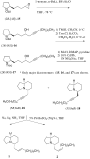
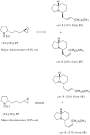
- all stereoisomers of piclavines A1-4 using an iterative asymmetric dihydroxylation. Experimental data which includes experimental details on the spectral instruments. Acknowledgements This work was supported in part by the High Technology Research Program from the Ministry of Education, Sciences



Single and double stereoselective fluorination of (E)-allylsilanes
Beilstein J. Org. Chem. 2007, 3, No. 34, doi:10.1186/1860-5397-3-34

- difluorinated alkene 7 (Scheme 4). The key steps necessary to perform this conversion were a dihydroxylation, the reduction of the ester group and the benzylation of the resulting primary alcohol. Preliminary work revealed that the order of steps was important and that protecting group manipulations were
- required for clean product outcome. The cis-dihydroxylation of 3 was performed employing NMO and catalytic OsO4 in DCM.[35] In the event, the diastereoselectivity was controlled by the two fluorine substituents. Four successful operations separated the newly formed unsymmetrical diol from 7, namely the


The oxanorbornene approach to 3-hydroxy, 3,4-dihydroxy and 3,4,5-trihydroxy derivatives of 2-aminocyclohexanecarboxylic acid
Beilstein J. Org. Chem. 2006, 2, No. 9, doi:10.1186/1860-5397-2-9

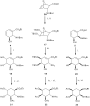
- . 3,4,5-Trihydroxy-2-aminocyclohexanecarboxylic acids The final group of targets we wished to generate was the trihydroxy analogs. Initial attempts addressed the generation of the syn 4,5 set. Consequently, OsO4 mediated dihydroxylation and subsequent peracylation of dienes 4 and 5 proved to be facio
- -specific and afforded cyclohexenyl derivatives 18 and 20 in 75 % yield over the two steps, Scheme 4. Reduction, as previously, afforded the trihydroxy β-aminoacid derivatives in excellent yields. At this stage it is instructive to address the interesting stereochemical outcome of this dihydroxylation
- reaction. Concurring with our results, Donohoe has reported that cyclic homoallylic carbamates give high levels of syn selectivity in the OsO4 mediated dihydroxylation reactions.[25][26] On the other hand, Kishi has established that the OsO4 mediated oxidation of cyclic allylic alcohols led preferentially




Synthesis and glycosidase inhibitory activity of new hexa- substituted C8-glycomimetics
Beilstein J. Org. Chem. 2005, 1, No. 12, doi:10.1186/1860-5397-1-12

- enzymes. The synthesis of these new C8-glycomimetics is described from enantiomerically pure C2-symmetrical polyhydroxylated cyclooctenes. Their obtention notably involved a syn-dihydroxylation, and more extended functionalization through formation of a cis-cyclic sulfate followed by amination and
- cyclic double bond were explored to reach hexa-substituted C8-glycomimetics. Results and discussion From the C2-symmetrical L-ido- or D-manno- cyclooctene, 1 or 2, to obtain the C8 hexa-substitued carbasugars a straightfoward approach seemed to be a dihydroxylation, whereas to obtain the corresponding
- accomplished the synthesis of a range of new hexa-substituted C8-glycomimetics in enantiopure form. Transformation of the cyclic double bond involved syn-dihydroxylation, then introduction of an azido group by opening of a cyclic sulfate followed by reduction and eventual alkylation of the resulting amine




Methods for the synthesis of polyhydroxylated piperidines by diastereoselective dihydroxylation: Exploitation in the two-directional synthesis of aza-C-linked disaccharide derivatives
Beilstein J. Org. Chem. 2005, 1, No. 2, doi:10.1186/1860-5397-1-2
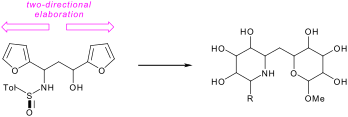
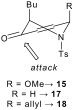
- these enzymes. Results The scope, limitations and diastereoselectivity of the dihydroxylation of stereoisomeric 2-butyl-1-(toluene-4-sulfonyl)-1,2,3,6-tetrahydro-pyridin-3-ols is discussed. In the absence of a 6-substituent on the piperidine ring, the Upjohn (cat. OsO4, NMO, acetone-water) and Donohoe
- corresponding difuran. Selective substitution of its N,O acetal was possible. The stereochemical outcome of a two-directional Luche reduction step was different in the two heterocyclic rings, and depended on the conformation of the ring. Finally, two-directional diastereoselective dihydroxylation yielded seven
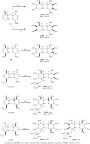
- paper, the final products are labelled according the configuration of the piperidine (A-D) and tetrahydropyran (d, d' or e) ring systems. Note that the ring systems d and d' are enantiomeric.) Results and discussion Synthesis of substrates for model dihydroxylation reactions Methods for the