


Search results
Search for "fluorophore" in Full Text gives 108 result(s) in Beilstein Journal of Organic Chemistry.
A novel high-yield synthesis of aminoacyl p-nitroanilines and aminoacyl 7-amino-4-methylcoumarins: Important synthons for the synthesis of chromogenic/fluorogenic protease substrates
Beilstein J. Org. Chem. 2011, 7, 1030–1035, doi:10.3762/bjoc.7.117
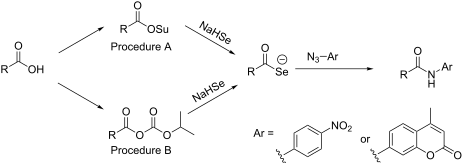
- acid/peptide conjugates liberates the free chromophore or fluorophore, allowing the convenient determination of the rate of enzyme catalysis with a UV or fluorescence spectrophotometer. p-Nitroaniline (pNA) is one of the most commonly used chromogenic reagents. The synthesis of peptide-pNAs usually

Fluorometric recognition of both dihydrogen phosphate and iodide by a new flexible anthracene linked benzimidazolium-based receptor
Beilstein J. Org. Chem. 2011, 7, 254–264, doi:10.3762/bjoc.7.34
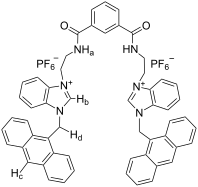
- of 1 with H2PO4− in the gas phase [34]. In the complex, benzimidazolium protons (C+–H) and amide protons are cooperatively involved in hydrogen bonding with H2PO4−. Anthracene, being a fluorophore in 1, has the advantage of being considered as a flat hydrophobic fluorophore probe for sensing of


An easy assembled fluorescent sensor for dicarboxylates and acidic amino acids
Beilstein J. Org. Chem. 2011, 7, 75–81, doi:10.3762/bjoc.7.11
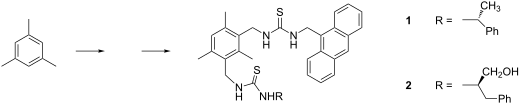
- (i.e., chromophore or fluorophore) as sensing probes for dicarboxylates [8][9][10][11][12][13]. Additionally, chiral recognition of carboxylates has been actively explored in the sensor field [14][15][16]. By using cholic acid as the molecular scaffold for the construction of sensing probes, we have
- -trimethylbenzene with sodium azide in DMSO afforded the corresponding bis-azide. Transformation of the crude bis-azide into bis-isothiocyanate 3 was achieved by treatment with triphenylphosphine in the presence of CS2. The “fluorophore–spacer–receptor” sensing motif for carboxylate was incorporated into the


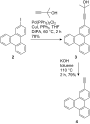
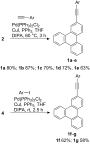
Donor-acceptor substituted phenylethynyltriphenylenes – excited state intramolecular charge transfer, solvatochromic absorption and fluorescence emission
Beilstein J. Org. Chem. 2010, 6, 992–1001, doi:10.3762/bjoc.6.112
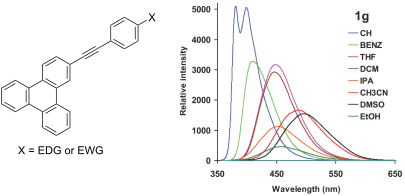
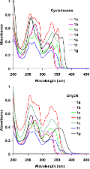
- state rendering its fluorescence emission sensitive to environment and solvent polarity [20][21][22]. Pyrene is a prototypical example of a fluorophore and its monomer emission occurs around 380 nm. It has been shifted to as high as 600 nm by multiple substitution by groups that extend the conjugation
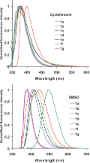
- transfer quenching of fluorescence. Correlation of Stokes shifts with solvent polarity Solvent induced spectral shifts are often interpreted in terms of the Lippert–Mataga [43][44][45] equation, which describes Stokes shifts in terms of the change in the dipole moment of the fluorophore and the dependence
- of the energy of the dipole on the dielectric constant and refractive index of the solvent. The Lippert–Mataga equation accounts for the general solvent effect and does not account for specific solvent–fluorophore interactions, for example, through hydrogen bonding etc. The Lippert–Mataga plot for 1c




Chromo- and fluorophoric water-soluble polymers and silica particles by nucleophilic substitution reaction of poly(vinyl amine)
Beilstein J. Org. Chem. 2010, 6, No. 79, doi:10.3762/bjoc.6.79
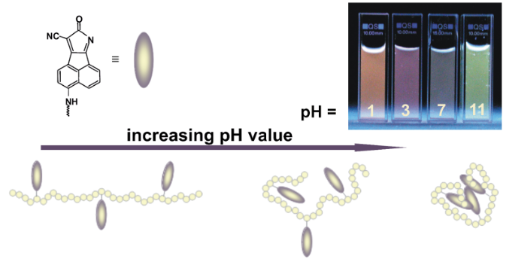
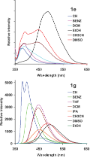
- polymers [2][3][4]. In general, there are two approaches for the synthesis of fluorescent polymers: First, the polymerization of a monomer that contains a fluorescent chromophore is possible. However, in some cases the new fluorophore-carrying polymer [1][5] is accompanied by a non-adequate effort
- with the thiolated RGD peptide cyclo(Arg-Gly_Asp-Phe-Lys(mpa))(c(RGDFK)-SH) leads to a fluorescent sensor for imaging tumor cells [37]. In this paper we report our current studies on the functionalization of PVAm with carbonitrile 1 to introduce a chromophore as well as a fluorophore into the polymer
- NMR spectroscopy. Figure 1 compares the solid state 13C NMR spectra of pure PVAm, fluorophore-functionalized PVAm 1-P and the model compound 1-M. It can be seen that the signals observed for 1-M and pure PVAm are also visible in the 13C-{1H}-CP-MAS NMR spectrum of 1-P. This is an excellent evidence




Synthetic incorporation of Nile Blue into DNA using 2′-deoxyriboside substitutes: Representative comparison of (R)- and (S)-aminopropanediol as an acyclic linker
Beilstein J. Org. Chem. 2010, 6, No. 13, doi:10.3762/bjoc.6.13
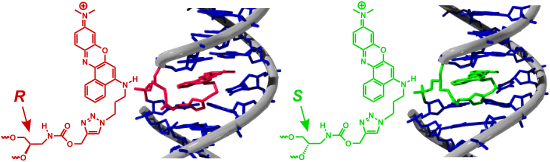
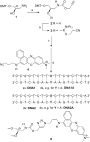
- explore how important the chirality of the 3-amino-1,2-propanediol linker is with respect to the optical properties of an attached fluorophore. We chose Nile Blue as the fluorescent probe for these experiments since the redox properties of this phenoxazinium label exhibit a potential sufficient for
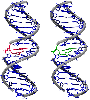
- - and L-threoninol [39][40][41][42] the chirality of the 3-amino-1,2-glycol linker as a substitute for the 2′-deoxyriboside in our studies had no influence on the optical properties of the attached fluorophore. In order to image this result we worked out molecular models for the duplex DNA1A (R




Synthesis of indolo[3,2-b]carbazole-based new colorimetric receptor for anions: A unique color change for fluoride ions
Beilstein J. Org. Chem. 2010, 6, No. 12, doi:10.3762/bjoc.6.12
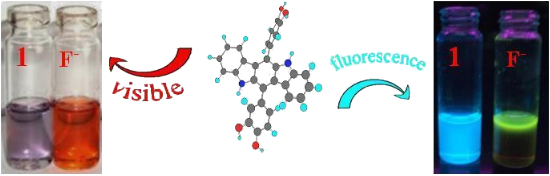
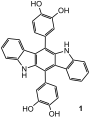
- occurs by forming the anion of receptor 1; the excited state was modified considerably leading to the quenching of fluorescence. A commonly accepted mechanism for the quenching phenomenon involves an inversion between the strongly emissive ππ* and the poorly emissive nπ* states of this fluorophore. Such




Quinoline based receptor in fluorometric discrimination of carboxylic acids
Beilstein J. Org. Chem. 2008, 4, No. 52, doi:10.3762/bjoc.4.52
- for online and real-time analyses [4]. A large number of examples of fluorescent sensors capable of sensing ions and molecules have appeared over the past few years [5][6][7]. In this context, fluorescent sensors, which rely on guest-induced folding of flexible receptors bringing the fluorophore
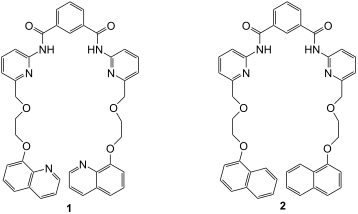
- report here an alternative naphthalene-based receptor 2 (Figure 1), where quinoline has been replaced by naphthalene keeping all the other hydrogen bonding groups fixed. The key in all the designs is the appropriate flexible ether linkage to hold the fluorophore probes viz. quinoline and naphthalene in


Other Beilstein-Institut Open Science Activities



