


Search results
Search for "transesterification" in Full Text gives 114 result(s) in Beilstein Journal of Organic Chemistry.
Synthesis and antiviral activities of spacer-linked 1-thioglucuronide analogues of glycyrrhizin
Beilstein J. Org. Chem. 2012, 8, 705–711, doi:10.3762/bjoc.8.79
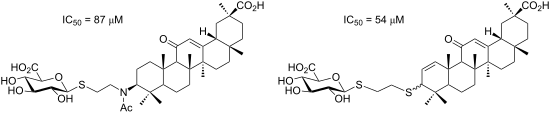
- diphenylmethyl ester group with TFA/anisole (as carbocation scavenger), giving the monoacid derivatives 10 and 11 in 75% and 89% yield, respectively. Subsequent transesterification of 10 and 11 with methanolic NaOMe afforded the deacetylated methyl ester glucuronide derivatives 12 and 14, respectively, which


Gold(I)-catalyzed synthesis of γ-vinylbutyrolactones by intramolecular oxaallylic alkylation with alcohols
Beilstein J. Org. Chem. 2011, 7, 1198–1204, doi:10.3762/bjoc.7.139
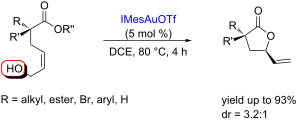
- confirms the allylic SN1 mechanism for the present methodology [44]. The high chemoselectivity guaranteed by the gold catalysts is worthy of note, as it channels the reaction toward the allylic alkylation mechanism without any contamination deriving from transesterification reactions. This evidence is


Synthesis of glycoconjugate fragments of mycobacterial phosphatidylinositol mannosides and lipomannan
Beilstein J. Org. Chem. 2011, 7, 369–377, doi:10.3762/bjoc.7.47
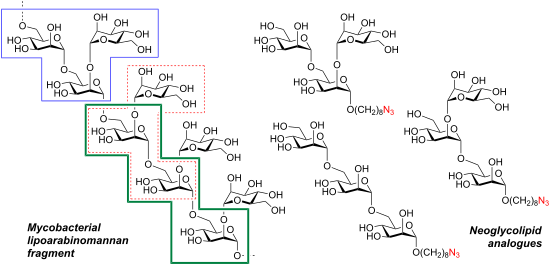
- outcome was obtained using NIS/TfOH activation of thioglycoside donor 17 to furnish disaccharide 26 in 72% yield. Selective deacetylation of 26 was achieved by acidic transesterification using 3% AcCl in MeOH/CH2Cl2 to give the secondary alcohol 27 in 73% yield. Mannosylation of 27 using donor 21 under


About the activity and selectivity of less well-known metathesis catalysts during ADMET polymerizations
Beilstein J. Org. Chem. 2010, 6, 1149–1158, doi:10.3762/bjoc.6.131
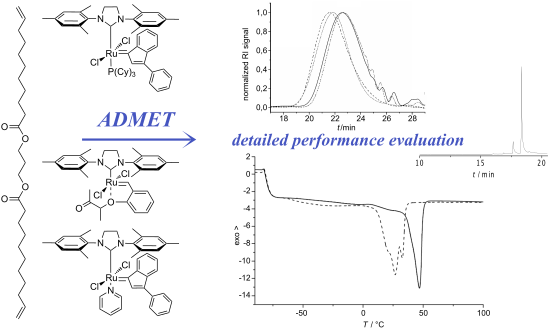
- ADMET polymerizations were studied in detail. The isomerization reactions were investigated by degradation of the prepared polyesters via transesterification with methanol, yielding diesters. These diesters, representing the repeat units of the polyesters, were then quantified by GC-MS. Keywords: ADMET
- room temperature. The crude product was purified by precipitation into cold methanol. Final polymer molecular weights were determined after precipitation with the above mentioned GPC system. Transesterification of the obtained polymers (P1-P26) and GC-MS analysis The respective polymer (30 mg), excess



Development of dynamic kinetic resolution on large scale for (±)-1-phenylethylamine
Beilstein J. Org. Chem. 2010, 6, 823–829, doi:10.3762/bjoc.6.97
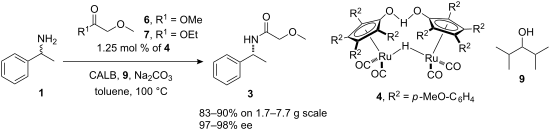
- reaction was observed (Table 2, entries 2 and 3, respectively) indicating that the racemization was slower than the transesterification at these catalyst loadings. An increase in the selectivity was observed when the amount of acyl donor was decreased, however this also coincided with deceleration of the


Systematic investigations on the reduction of 4-aryl-4-oxoesters to 1-aryl-1,4-butanediols with methanolic sodium borohydride
Beilstein J. Org. Chem. 2010, 6, 748–755, doi:10.3762/bjoc.6.94
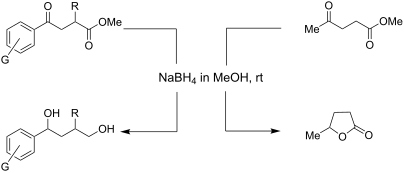
- chemoselective reduction of the oxo-group, occasionally with subsequent transesterification and the formation of the alkoxy-modified β-hydroxyesters. γ-Oxoesters react chemoselectively with sodium borohydride to produce the corresponding γ-hydroxyesters [1][2][17][23][24][25][26][27] (sometimes in the form of γ


Poly(glycolide) multi-arm star polymers: Improved solubility via limited arm length
Beilstein J. Org. Chem. 2010, 6, No. 67, doi:10.3762/bjoc.6.67
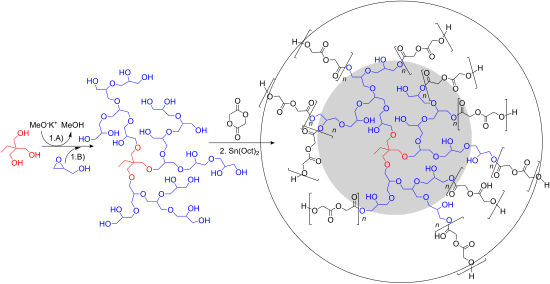
- range of 1.3–1.7 for the series of star polymers prepared, which is moderate. These values can be explained by the non-monodisperse multifunctional initiator (PDI: 1.9–2.0), although transesterification/cyclization reactions during the synthesis cannot be completely excluded. A detailed account of the


Solvent-free and time-efficient Suzuki–Miyaura reaction in a ball mill: the solid reagent system KF–Al2O3 under inspection
Beilstein J. Org. Chem. 2010, 6, No. 7, doi:10.3762/bjoc.6.7
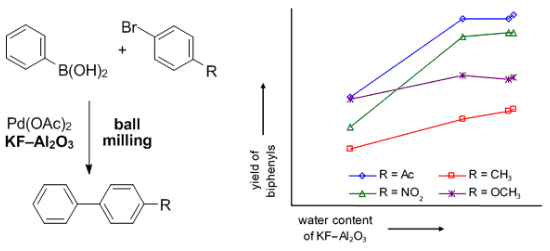
- stoichiometric or catalytic reagent: transesterification of vegetable oils [27], hydrolysis reactions [29], O-methylation of phenol [62], and Michael reactions [63]. In conclusion, it appears that a KF content of 30–40 wt % is sufficient for a mechanochemically initiated conversion of 1 and 2 yielding 3


N-acylation of ethanolamine using lipase: a chemoselective catalyst
Beilstein J. Org. Chem. 2009, 5, No. 10, doi:10.3762/bjoc.5.10
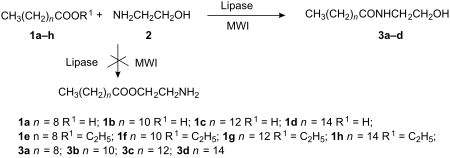
- (triacyl glycerol hydrolases EC 3.1.1.3) catalyze hydrolysis, esterification, transesterification, thioesterification, amidation, epoxidation etc. [5][6][7][8][9][10]. The use of immobilized lipases is on the rise, as these work well with non-aqueous media [11]. Apart from the convenient handling, these


Phase- vanishing halolactonization of neat substrates
Beilstein J. Org. Chem. 2008, 4, No. 29, doi:10.3762/bjoc.4.29
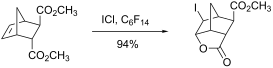
- -dibromopentanoate (4) (Scheme 2). Apparently, 4,5-dibromopentanoic acid underwent hydrogen bromide-catalyzed transesterification with ethyl acetate. In a control experiment, 4-pentenoic acid was transesterified by dissolving it in ethyl acetate and adding a catalytic amount of HBr in acetic acid. The best results


Stereoselective synthesis of (2S,3S,4Z)-4-fluoro- 1,3-dihydroxy- 2-(octadecanoylamino)octadec- 4-ene, [(Z)-4-fluoroceramide], and its phase behavior at the air/water interface
Beilstein J. Org. Chem. 2008, 4, No. 12, doi:10.3762/bjoc.4.12

- provided the desired tert-butyl imino acid ester 5 as a mixture with the ethyl imino acid ester 6 (formed due to a partial transesterification of 4 with the titanium reagent) and four non-identified compounds (among them most likely diastereomers of the title compounds) in a ratio of 57:28:7:1:2:5


Unexpected degradation of the bisphosphonate P-C-P bridge under mild conditions
Beilstein J. Org. Chem. 2008, 4, No. 7, doi:10.1186/1860-5397-4-7
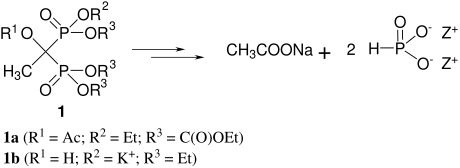
- several times, but the result was always the same (formation of 1a was observed in all experiments), though in some experiments a transesterification of the acetyl group to C(O)OEt group was observed in yields of 0–13% as confirmed by the 1H and 31P NMR spectra. We were unable to provide any direct
- explanation for the variation in the transesterification proportion. Etidronic acid was also tested as a starting material to prepare a derivative such as 1a [C(O)OEt group instead of Ac group], but the reaction did not occur under the same conditions as those used in the preparation of 1a. Our subsequent
- ) partial transesterification of bisphosphonate 1a before degradation of P-C-P bridge, 2) partial esterification of phosphonate group after the carbonate groups (R3) decomposition from compound 1a (this is proposed to occur rapidly after the addition of 40% NaOH) and before the degradation of P-C-P bridge


Large- scale ruthenium- and enzyme- catalyzed dynamic kinetic resolution of (rac)-1-phenylethanol
Beilstein J. Org. Chem. 2007, 3, No. 50, doi:10.1186/1860-5397-3-50
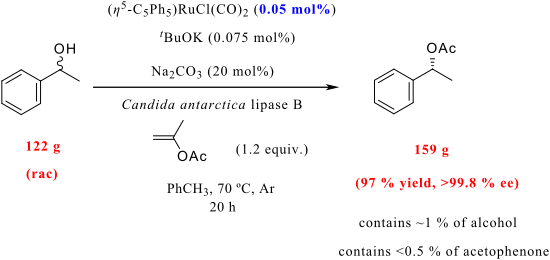
- -phenylethanol (2) is addressed. The immobilized lipase Candida antarctica lipase B (CALB) was employed for the resolution, which shows high enantioselectivity in the transesterification. The ruthenium catalyst used, (η 5-C5Ph5)RuCl(CO)2 1, was shown to possess very high reactivity in the "in situ" redox
- , Candida antarctica lipase B, catalyzes the transesterification with excellent selectivity in the presence of the homogeneous ruthenium racemization catalyst 1. Isopropenyl acetate seems to be an appropriate acyl donor, which makes the purification of the product acetate very easy via simple distillation


Investigation of acetyl migrations in furanosides
Beilstein J. Org. Chem. 2006, 2, No. 14, doi:10.1186/1860-5397-2-14
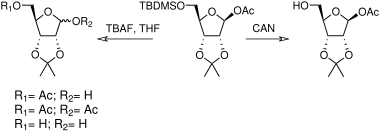
- and Table 4). The proportion of intermolecular transesterification and de-esterification products increased when anhydrous KF conditions were used instead of commercial TBAF in THF (Table 3, condition C). Similarly, longer reaction time of the fluoride-catalysed desilylation reactions resulted in an
- acetyl moieties. Such direct transesterification is intermolecular and while it has been observed in nucleoside-phosphoramidite and glycoside chemistry,[20][21][22][23] this alkoxide-promoted intermolecular acetyl migration process has been overlooked in furanosides. The isolated quantities of 1c and 1d
- decreased by a factor of two upon dilution (1:10) when 1 was reacted with TBAF, while 1b formation remained rapid with no detection of 1a formation. Similarly, complete transesterification took place when riboside 6 was treated with acetyl riboside 1 under basic conditions (Scheme 6). Acetyl migration in





