


Search results
Search for "CuAAC" in Full Text gives 129 result(s) in Beilstein Journal of Organic Chemistry.
Continuous-flow enantioselective α-aminoxylation of aldehydes catalyzed by a polystyrene-immobilized hydroxyproline
Beilstein J. Org. Chem. 2011, 7, 1486–1493, doi:10.3762/bjoc.7.172
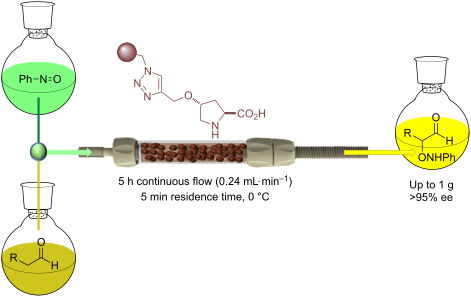
- azides and alkynes (CuAAC) used as the immobilization strategy [44][45][46], led to improved efficiency, both in terms of catalytic activity and asymmetric induction, and different behaviour of the resulting materials in terms of hydrophilicity or hydrophobicity [47][48][49][50]. An even better
- aldehydes. Results and Discussion The preparation of the immobilized catalysts 1a and 1b was easily achieved by a modification of the reported procedure [41][42][43], with the tris(triazolyl)methyl copper complex 3 [76] as the catalyst for the CuAAC reaction between azidomethylpolystyrene, prepared from a


Multistep flow synthesis of vinyl azides and their use in the copper-catalyzed Huisgen-type cycloaddition under inductive-heating conditions
Beilstein J. Org. Chem. 2011, 7, 1441–1448, doi:10.3762/bjoc.7.168
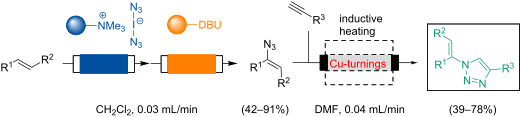
- -type cycloadditions The copper-catalyzed Huisgen-type cycloaddition (CuAAC) is a general and useful method for the synthesis of 1,4-disubstituted-1,2,3-triazoles and is based on the 1,3-dipolar cycloaddition of alkynes and azides [28]. Besides Cu(I) sources also Cu(0) sources, such as copper wire [29
- ] or copper-on-charcoal (Cu/C) [30], can serve as a catalytic source that promotes the CuAAC. Bogdan et al. combined this observation with flow technology by using a custom-made heated copper flow reactor [31]. We successfully implemented the CuAAC by inductively heating copper wire inside a flow


Synthesis of glycoconjugate fragments of mycobacterial phosphatidylinositol mannosides and lipomannan
Beilstein J. Org. Chem. 2011, 7, 369–377, doi:10.3762/bjoc.7.47
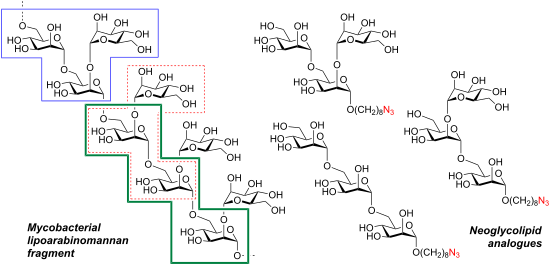
- –alkyne cycloaddition (CuAAC) reaction [33][34]. Results and Discussion Since their introduction by Palcic and co-workers [35], hydrophobic alkyl glycosides have proven to be valuable derivatives for enzymatic assays, as their lipophilic nature allows easy product isolation by either reversed-phase


New amphiphilic glycopolymers by click functionalization of random copolymers – application to the colloidal stabilisation of polymer nanoparticles and their interaction with concanavalin A lectin
Beilstein J. Org. Chem. 2010, 6, No. 58, doi:10.3762/bjoc.6.58
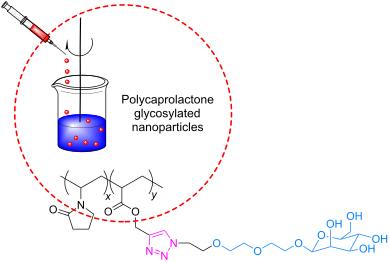
- cycloaddition of azide and alkynes, CuAAC) constitutes another interesting approach. The versatile nature of this reaction has led to a tremendous amount of work, mainly due to the quantitative yields and the possibility of carrying out the synthesis in either organic solvents or water. Moreover, since various
- ), 26.00–26.07 (C-6, C-8), 18.57 (C-3). Coupling of azido functionalized carbohydrates by CuAAC The dry copolymer (100 mg, containing approximately 75 mg, 0.68 mmol of propargyl acrylate) and compound 4 (229 mg, 1.0 equiv vs propargyl acrylate) were dissolved in a 1:1 mixture of THF and water (4 mL) at


Other Beilstein-Institut Open Science Activities



