


Search results
Search for "benzoquinone" in Full Text gives 134 result(s) in Beilstein Journal of Organic Chemistry.
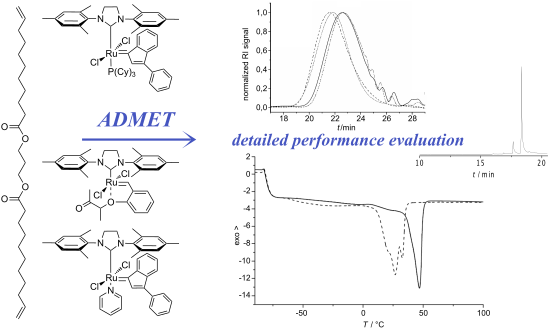
About the activity and selectivity of less well-known metathesis catalysts during ADMET polymerizations
Beilstein J. Org. Chem. 2010, 6, 1149–1158, doi:10.3762/bjoc.6.131
- activity of the catalyst. Furthermore, Johnson and coworkers reported that during a RCM to make a 9-membered ring, chlorinated solvents, such as 1,2-dichloroethane, inhibited olefin isomerization [25]. Grubbs and collaborators showed that catalytic amounts (10 mol %) of 1,4-benzoquinone (BQ) can prevent
- expected in the future. Experimental Materials 10-undecenoic acid (Sigma–Aldrich, 98%), 1,3-propanediol (Sigma–Aldrich, 99.6%), p-toluenesulfonic acid monohydrate (Sigma–Aldrich, 98.5%), ethyl vinyl ether (Sigma–Aldrich, 99%), sulfuric acid (Fluka, 95–97%), p-benzoquinone (Fluka, 98%), (1,3-bis(2,4,6



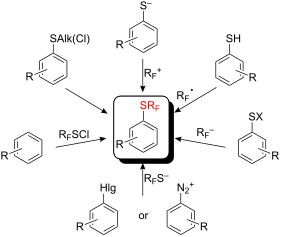
Aromatic and heterocyclic perfluoroalkyl sulfides. Methods of preparation
Beilstein J. Org. Chem. 2010, 6, 880–921, doi:10.3762/bjoc.6.88
- results only in the formation of a chlorohydroquinone pyridinium species [72], and neutral conditions are required in this case [69]. For the synthesis of poly(SCF3) substituted p-hydroquinones, Scribner oxidized 2,6-bis(SCF3)-4-methoxyphenol to generate 2,6-bis(SCF3)-1,4-benzoquinone. The addition of


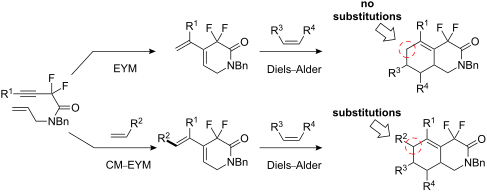
Synthesis of fluorinated δ-lactams via cycloisomerization of gem-difluoropropargyl amides
Beilstein J. Org. Chem. 2010, 6, No. 48, doi:10.3762/bjoc.6.48
- experimentation, it became clear that ethylene gas was crucial for driving this reaction forward (compare entry 4 with 7, Table 1) [21]. 2,6-Dichloro-1,4-benzoquinone, which has been reported to prevent isomerization [22], gave disappointing results (entry 8, Table 1). When our optimized conditions were applied


Pd-catalyzed decarboxylative Heck vinylation of 2-nitrobenzoates in the presence of CuF2
Beilstein J. Org. Chem. 2010, 6, No. 43, doi:10.3762/bjoc.6.43
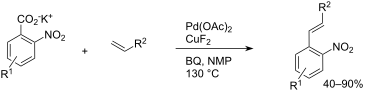
- acids is disclosed. In the presence of a catalyst system generated in situ from Pd(OAc)2 (2 mol %), CuF2 (2 equiv), and benzoquinone (0.5 equiv) in NMP, a wide range of olefins were coupled with various 2-nitrobenzoates at 130 °C with the release of carbon dioxide to afford the corresponding vinyl
- , in which p-benzoquinone is employed as oxidant [24]. However, their protocol is strictly limited to highly activated benzoates. We herein disclose an alternative protocol for the Pd-catalyzed decarboxylative Heck reaction, in which copper(II) fluoride is utilized as the oxidant. This way, various
- oxidants in an attempt to prevent the formation of palladium(0) species, which we assumed to be catalytically inactive in this process. This proved to be a good strategy, as the addition of p-benzoquinone resulted in higher yields of the Heck product, while at the same time suppressing the formation of the


Microwave assisted synthesis of triazoloquinazolinones and benzimidazoquinazolinones
Beilstein J. Org. Chem. 2007, 3, No. 11, doi:10.1186/1860-5397-3-11
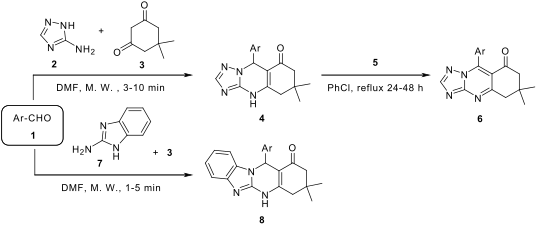
- δ = 28.4 and 26.8 ppm could be assigned to the two methyl carbons (see Supporting Information File 1 for full experimental data). To test the reactivity of compounds 4a-c towards oxidation, we refluxed a mixture of 2,3,5,6-tetrachloro-1,4-benzoquinone (5) and 4a-c in cholorobenzene (Scheme 2). The


Variations in product in reactions of naphthoquinone with primary amines
Beilstein J. Org. Chem. 2007, 3, No. 10, doi:10.1186/1860-5397-3-10
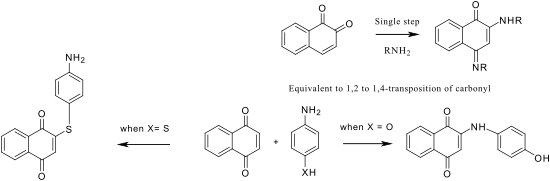
- -benzoquinone reacts with primary amines to give 2,5-diamino 1,4-benzoquinones; similar reaction of 1,4-naphthoquinone with primary amines results in the formation of 2-amino 1,4-naphthoquinones. [13] However, the product formed from such simple reaction of amine with various quinones has much scope for
- formation of products 1 and 2 is interesting as in the case of 1,4-benzoquinone and 1,4-naphthoquinone we did not observe condensation reaction between either of the carbonyl group with amines under ambient conditions (for experimental please see Supporting Information File 1). It was earlier reported in
- progress to establish this. However, at the moment we have evidence that in the reaction between 4-amino-phenol and 1,4-benzoquinone, 1,4-dihydroxybenzene is formed as side product. This suggests involvement of 1,4-benzoquinone in aromatisation by abstracting hydrogen during product formation. In view of






Photosonochemical catalytic ring opening of α-epoxyketones
Beilstein J. Org. Chem. 2007, 3, No. 2, doi:10.1186/1860-5397-3-2
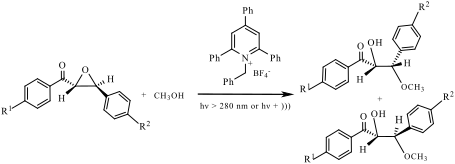
- and α-epoxyketones have also occurred thermally or photochemically by the presence of various electron acceptors. These reactions have been observed thermally by ceric ammonium nitrate (CAN), [28][29] 2,3-dichloro-5,6-dicyano-p-benzoquinone (DDQ) [30] and iron(III) chloride [31] or photo-induced




Effect of transannular interaction on the redox- potentials in a series of bicyclic quinones
Beilstein J. Org. Chem. 2006, 2, No. 26, doi:10.1186/1860-5397-2-26
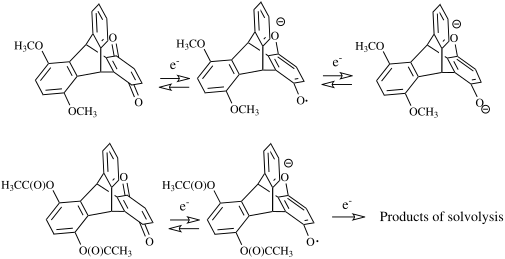
- (Epox) where (Eo' = 1/2(Epred + Epox) [11]. In order to check our process, we measured the first reduction potential of p-benzoquinone to be -0.507 V, which is exactly the same as the value reported in the literature [3]. The cyclic voltammograms (CV) for p-benzoquinone and the quinone 3 are presented
- compounds 1–5 vs. their calculated LUMO+1 energies. LUMO of Compound 1. LUMO+1 of Compound 1. LUMO of Compound 2. LUMO+1 of Compound 2. LUMO of Compound 4. LUMO+1 of Compound 4. LUMO of Compound 5. LUMO+1 of Compound 5. LUMO of the reduced species 5·−. CV for p-benzoquinone and quinone 3. Cyclic Voltammetry


The Elbs and Boyland- Sims peroxydisulfate oxidations
Beilstein J. Org. Chem. 2006, 2, No. 22, doi:10.1186/1860-5397-2-22
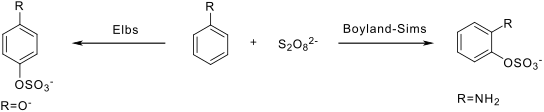
- - and p-benzoquinone where the difference in the redox potential is 0.07 V [11] corresponding to 3 kcal mol-1. It may also be relevant that quinones are subject to attack by the hydroxyl ion to form (eventually) humic acids and that o-quinones are more reactive than p-quinones. [12][13] An analogous


Other Beilstein-Institut Open Science Activities



