


Search results
Search for "reductive elimination" in Full Text gives 182 result(s) in Beilstein Journal of Organic Chemistry.
Synthesis of cross-conjugated trienes by rhodium-catalyzed dimerization of monosubstituted allenes
Beilstein J. Org. Chem. 2011, 7, 578–581, doi:10.3762/bjoc.7.67

- -head manner to form the five-membered rhodacyclic intermediate A [22][23][24][25], which is in equilibrium with another rhodacyclic intermediate B via σ–π–σ isomerization. Then, β-hydride elimination takes place with B to form rhodium hydride C stereoselectively. Finally, reductive elimination from C
- reductive elimination. Under the optimized reaction conditions using dppe as the ligand, various monosubstituted allenes 1b–j were subjected to the catalytic dimerization reaction (Table 2). In most cases, essentially one isomer 3 was formed, and the other isomer 2 was barely detectable in the 1H NMR


Rh(I)-catalyzed intramolecular [2 + 2 + 1] cycloaddition of allenenes: Construction of bicyclo[4.3.0]nonenones with an angular methyl group and tricyclo[6.4.0.01,5]dodecenone
Beilstein J. Org. Chem. 2011, 7, 404–409, doi:10.3762/bjoc.7.52
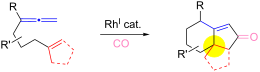
- spiro[4.5]deca-1,6-diene system via β-elimination and subsequent reductive elimination [31][32]. In summary, we have developed the intramolecular Rh(I)-catalyzed PKTR between 1,1-disubstituted allene and 1,1-disubstituted alkene functionalities, which leads to the facile formation of bicyclo[4.3.0


C–C (alkynylation) vs C–O (ether) bond formation under Pd/C–Cu catalysis: synthesis and pharmacological evaluation of 4-alkynylthieno[2,3-d]pyrimidines
Beilstein J. Org. Chem. 2011, 7, 338–345, doi:10.3762/bjoc.7.44
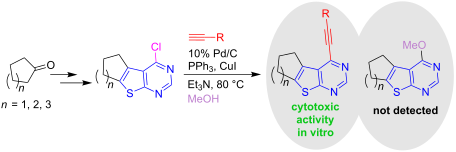
- on the surface of the charcoal. Once generated, the organo-Pd(II) species E then facilitates the stepwise formation of C–C bond via (i) trans organometallation with copper acetylide generated in situ from CuI and the terminal alkyne followed by (ii) reductive elimination of Pd(0) to afford 4


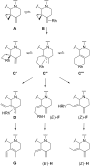
Rh-Catalyzed rearrangement of vinylcyclopropane to 1,3-diene units attached to N-heterocycles
Beilstein J. Org. Chem. 2011, 7, 298–303, doi:10.3762/bjoc.7.39

- bond to form the intermediates C which can undergo metal hydride elimination or 1,3-hydride migration to the rhodium to give, respectively, the allyl- and alkylrhodium(III) hydride complexes D and F. Metal extrusion by reductive elimination leads to the observed dienes and regeneration of the catalyst


Shelf-stable electrophilic trifluoromethylating reagents: A brief historical perspective
Beilstein J. Org. Chem. 2010, 6, No. 65, doi:10.3762/bjoc.6.65
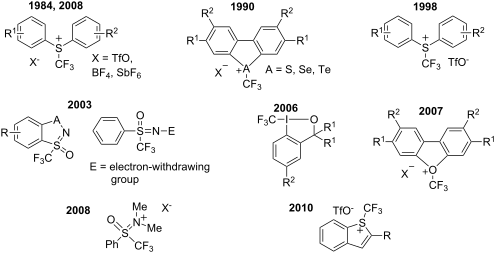
- • radical generated from CF3I [40]. However, the reaction with bench-stable Togni’s reagent is mechanistically distinct from the previous radical approach (Scheme 34). In accord with a similar mechanism proposed by Togni [37], the resulting λ3-iodane species 40 undergo rapid reductive elimination with


C-Arylation reactions catalyzed by CuO-nanoparticles under ligand free conditions
Beilstein J. Org. Chem. 2010, 6, No. 35, doi:10.3762/bjoc.6.35
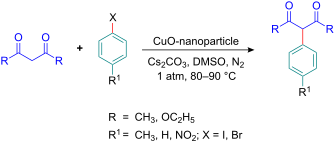
- . The observed decrease in reactivity in the order p-nitroiodobenzene > iodobenzene > p-methyliodobenzene > 1-iodo-4-methoxybenzene suggests that the reaction proceeds by oxidative addition followed by reductive elimination. In addition to this, the order of reactivity suggests that aryl halides having


An exceptional P-H phosphonite: Biphenyl- 2,2'-bisfenchylchlorophosphite and derived ligands (BIFOPs) in enantioselective copper- catalyzed 1,4-additions
Beilstein J. Org. Chem. 2005, 1, No. 6, doi:10.1186/1860-5397-1-6
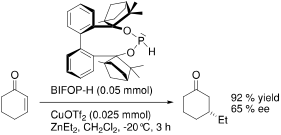
- ligands (L*) exhibit large steric demands and good metal to ligand back bonding abilities. Such ligands generate active R-CuI-L* catalysts and support the rate determining reductive elimination in the catalytic cycle (Scheme 1). [42][43][44][45][46][47] Common basis for diol-based phosphoramidites and
- -rich transition metals, such as CuI. The rate determining reductive elimination was expected to be favored by the good metal to ligand back bonding properties of the σ*(P-Cl) acceptor as is well established in phosphites, i.e. σ*(P-OR), and phosphoramidites, i.e. σ*(P-NR2). Computed anharmonic CO









Other Beilstein-Institut Open Science Activities



