


Search results
Search for "β-silicon effect" in Full Text gives 2 result(s) in Beilstein Journal of Organic Chemistry.
Aryl iodane-induced cascade arylation–1,2-silyl shift–heterocyclization of propargylsilanes under copper catalysis
Beilstein J. Org. Chem. 2025, 21, 1984–1994, doi:10.3762/bjoc.21.154
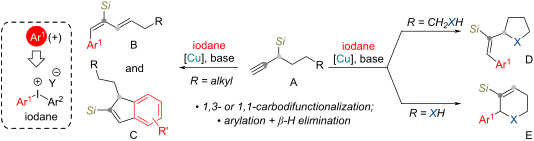
- , LV-1006, Riga, Latvia 10.3762/bjoc.21.154 Abstract A novel copper-catalyzed arylation strategy for propargylsilanes utilizing diaryl-λ3-iodanes has been developed, enabling a cascade sequence involving 1,2-silyl migration and heterocyclization. The β-silicon effect facilitates the formation of
- ) salt reacts with the diaryl-λ3-iodane (ArMesIY) to generate the strongly electrophilic arylcopper(III) species. The latter activates the propargylic system to induce the 1,2-silyl shift, producing the allylic cation intermediate Int-4, which is stabilized by the β-silicon effect. A following attack of


Catalytic aza-Nazarov cyclization reactions to access α-methylene-γ-lactam heterocycles
Beilstein J. Org. Chem. 2023, 19, 66–77, doi:10.3762/bjoc.19.6

- on the success of the catalytic aza-Nazarov reaction. Keywords: α-methylene-γ-lactam; aza-Nazarov reaction; β-silicon effect; heterocycles; intramolecular cyclization; Introduction The rapid construction of aliphatic heterocycles from acyclic building blocks via cyclization or cycloaddition
- N-acyliminium ion 28, the aza-Nazarov cyclization of which would provide the final product 30 through the intermediacy of 29 (Scheme 6). According to our hypothesis, the carbocation of intermediate 29 would be stabilized by the β-silicon effect similar to intermediate 9 (vide supra). Unfortunately
- the β-silicon effect in this aza-Nazarov cyclization. During the course of our studies, we observed occasionally the formation of aldehyde-containing side products, the amount of which increased when the aza-Nazarov cyclizations did not proceed efficiently. We proposed that, if the aza-Nazarov


Other Beilstein-Institut Open Science Activities



