


Search results
Search for "1,2-silyl shift" in Full Text gives 2 result(s) in Beilstein Journal of Organic Chemistry.
Aryl iodane-induced cascade arylation–1,2-silyl shift–heterocyclization of propargylsilanes under copper catalysis
Beilstein J. Org. Chem. 2025, 21, 1984–1994, doi:10.3762/bjoc.21.154
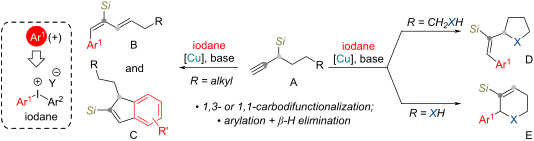
- synthetic potential of iodane-mediated carbofunctionalization under copper catalysis. Keywords: arylation reactions; copper-catalysis; iodanes; propargylsilanes; 1,2-silyl shift; Introduction Highly electrophilic hypervalent iodine(III) reagents are considered as arene electrophilic synthons, making them
- rearrangements via the 1,2-silyl shift, enabled by the β-cation-stabilizing properties of silyl groups [19][20]. This phenomenon has been successfully employed in 1,3-difunctionalization events in both intermolecular [21] and intramolecular fashion [22] (Scheme 1B). Thus far such propargylsilane rearrangements
- have been induced by addition of external halogen or selenium electrophiles and Brønsted acids. This encouraged us to develop a methodology involving a copper-catalyzed terminal alkyne arylation of propargylsilanes by diaryl-λ3-iodanes, followed by 1,2-silyl shift and terminated by nucleophile addition


A survey of chiral hypervalent iodine reagents in asymmetric synthesis
Beilstein J. Org. Chem. 2018, 14, 1244–1262, doi:10.3762/bjoc.14.107
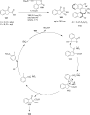
- 115 and 119, respectively, with decent enantioselectivity (Scheme 25) [77]. The formation of an alkylidene carbene 117 and its rapid rearrangement via 1,2-silyl shift (in case of R = silyl group) into the alkylated β-ketoesters 115 can fairly explain the reaction outcome. On the other hand, the ligand



Other Beilstein-Institut Open Science Activities



