


Search results
Search for "HTIB" in Full Text gives 4 result(s) in Beilstein Journal of Organic Chemistry.
Mechanistic insights into hydroxy(tosyloxy)iodobenzene-mediated ditosyloxylation of chalcones: a DFT study
Beilstein J. Org. Chem. 2025, 21, 2703–2715, doi:10.3762/bjoc.21.208
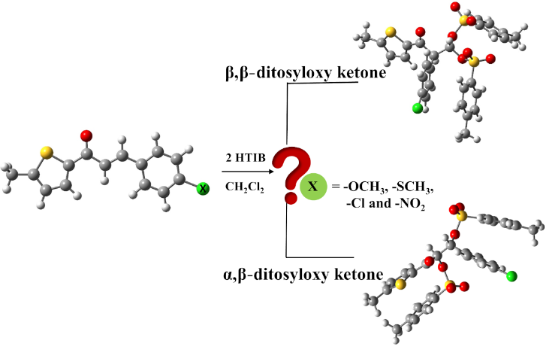
- of the hydroxy(tosyloxy)iodobenzene (HTIB)-mediated conversion of chalcones (α,β-unsaturated carbonyl compounds) to ditosyloxy ketones is investigated. Here, at β-carbon of the chalcone, an aryl group with a para-substituent is present. Our study focuses on investigating the effect of different
- -ditosyloxy ketones. It is found that the mechanism for the formation of α,β-ditosyloxy ketone involves only electrophilic addition of HTIB, and the mechanism is the same for all studied chalcones, irrespective of whether an electron-donating or electron-withdrawing substituent is present on the aryl ring
- group on the migrating aryl ring favours the formation of β,β-ditosyloxy ketones while in case of electron-withdrawing groups, there are nearly equal chances of the formation of α,β-ditosyloxy ketones and β,β-ditosyloxy ketones. Keywords: 1,2-aryl-migration; chalcones; ditosyloxylation; HTIB; para


Transformation of the cyclohexane ring to the cyclopentane fragment of biologically active compounds
Beilstein J. Org. Chem. 2025, 21, 2416–2446, doi:10.3762/bjoc.21.185
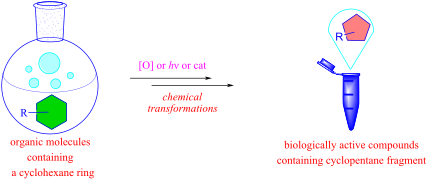
- comparative study of two effective and practical oxidizing agents, hydroxy(tosyloxy)iodobenzene (HTIB) and thallium nitrate trihydrate (TTN·3H2O), was presented in the ring contraction reaction of protected 1,2-dihydronaphthalenes using trimethylorthoformate (TMOF). In addition, various protective groups were
- introduced to substrates, aiming to study their tolerance for both oxidizing agents (Table 1). The yields of the ring contraction products (indanes) 116a–g ranged from 61 to 88% when the reactions were carried out with TTN·3H2O in TMOF. When HTIB was used in TMOF, the yields were significantly lower, ranging
- from 18% to 34% (Scheme 20). Analysis of literature data [58] indicated that the thallium(III) salt is a much better oxidizing agent than iodine(III) for indane syntheses. Similarly, the TTN-mediated reactions are less prone to form addition by-products compared to the HTIB-mediated reactions of 1,2


Solvent-dependent chemoselective synthesis of different isoquinolinones mediated by the hypervalent iodine(III) reagent PISA
Beilstein J. Org. Chem. 2024, 20, 1914–1921, doi:10.3762/bjoc.20.167
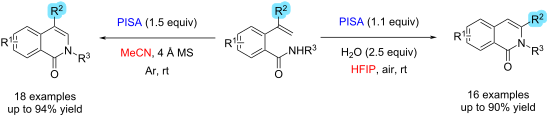
- Na2SO4 (Table 1, entries 3 and 4). Next, different commercially available iodanes were employed as oxidants, such as PIDA, phenyliodine(III) bis(trifluoroacetate) (PIFA), N-tosyliminobenzyliodinane (PhINTs), iodosylbenzene (PhIO), and Koser’s reagent (HTIB) (Table 1, entries 5–9). Of the reagents tested




Oxidative hydrolysis of aliphatic bromoalkenes: scope study and reactivity insights
Beilstein J. Org. Chem. 2024, 20, 1286–1291, doi:10.3762/bjoc.20.111
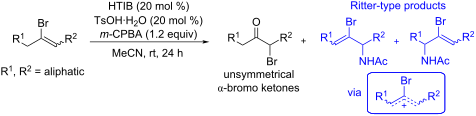
- ], to access α-functionalized ketones. We recently developed the oxidative contraction of 3,4-dihydropyranones to access polysubstituted γ-butyrolactones [17]. In 2015 we demonstrated that [hydroxy(tosyloxy)iodo]benzene (HTIB) could be used to convert chloro- and bromoalkenes into their corresponding α
- substituted substrate which resulted in a low yield of the desired product. Also, this method involved using a stoichiometric amount of HTIB for the transformation. α-Haloketones are 1,2-difunctionalized synthons which are very versatile and essential building blocks for their role in the synthesis of
- reported to access bromoalkenes such as 1 from easily accessible substrates, making the approach even more appealing [31][32]. Results and Discussion Given its low volatility, we initiated our studies by testing the reactivity of (E/Z)-1,8-diphenyl-4-bromooct-4-ene (1a) with HTIB (1.1 equiv) and cat


Other Beilstein-Institut Open Science Activities



