


Search results
Search for "Rhodococcus" in Full Text gives 9 result(s) in Beilstein Journal of Organic Chemistry.
Rhodopyran, a carboxylated hexahydrocyclopenta[b]pyran from Rhodococcus
Beilstein J. Org. Chem. 2026, 22, 1107–1113, doi:10.3762/bjoc.22.89
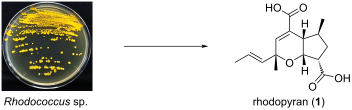
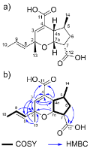
- Rhodococcus sp. strain RD066637. The planar structure was elucidated by 1D/2D NMR analyses and HRMS spectrometry, and the relative configuration was assigned from vicinal coupling constants and NOESY correlations, while the absolute configuration remains undetermined. Rhodopyran represents a structurally
- unusual carboxylated hexahydrocyclopenta[b]pyran and expands the known metabolite diversity of Rhodococcus, highlighting Rhodococcus as a source of uncommon natural-product scaffolds. Keywords: bicyclic compound; cyclopenta[b]pyran; natural products; Rhodococcus; specialized metabolites; Introduction
- Rhodococcus is one such promising but less extensively investigated source. Rhodococcus has traditionally been investigated mainly for its broad catabolic and biotransformation capabilities. However, genome-based studies have indicated that Rhodococcus also possesses a substantial and largely uncharacterized


Enhancing structural diversity of terpenoids by multisubstrate terpene synthases
Beilstein J. Org. Chem. 2024, 20, 959–972, doi:10.3762/bjoc.20.86
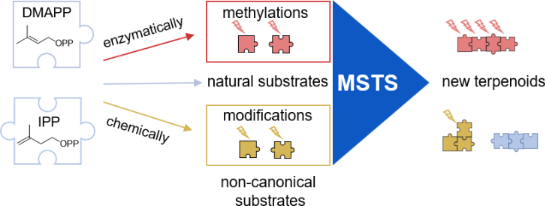
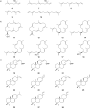
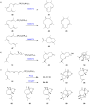
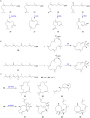
- ; catMT from Streptomyces catenulae produced compounds 93–95 and 98; argMT from Streptomyces argenteolus produced compounds 91–94 and 96; azuMT from Amycolatopsis azurea produced 91; fasMT from Rhodococcus fascians produced 93 and 94; fraMT from Frankia sp. Produced 94 and 95; monMT from Streptomyces






A myo-inositol dehydrogenase involved in aminocyclitol biosynthesis of hygromycin A
Beilstein J. Org. Chem. 2024, 20, 589–596, doi:10.3762/bjoc.20.51
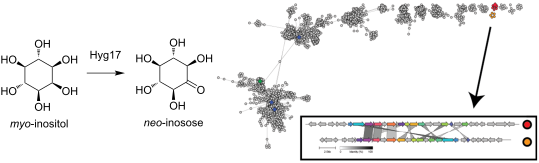
- bodies when recombinantly produced by various E. coli expression strains. However, we were able to obtain pure soluble protein when expressing Hyg17 in a Rhodococcus expression system (Supporting Information File 1, Figure S1) [10][11]. According to the proposed hygromycin A biosynthetic pathway, Hyg17
- restriction sites and verified by DNA sequencing (Eurofins Genomics). pTip-QC1-hyg17 plasmid [10] was transformed into Rhodococcus jostii RHA1 [11]. Cultures were grown in Luria Bertani (LB) media supplemented with 34 µg mL−1 chloramphenicol at 30 °C while shaking at 200 rpm for 48 h reaching an OD600 of ≈1.4
- : Additional tables and figures. Acknowledgements The authors would like to thank Lindsay Eltis (University of British Columbia, Canada) for providing the Rhodococcus expression strain and Tomohiro Tamura (National Institute of Advanced Industrial Science and Technology, Japan) for providing the pTip-QC1


Designed whole-cell-catalysis-assisted synthesis of 9,11-secosterols
Beilstein J. Org. Chem. 2021, 17, 581–588, doi:10.3762/bjoc.17.52
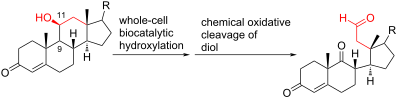
- the chemical oxidative cleavage of the 9,11-C–C bond. For the hydroxylation, we used a biocatalyst derived from an Escherichia coli laboratory strain BL21 (DE3) overexpressing the kshA5 and kshB genes from Rhodococcus. rhodochrous. Cortisol (1) was chosen as a model steroidal structure. Results and


The preparation and properties of 1,1-difluorocyclopropane derivatives
Beilstein J. Org. Chem. 2021, 17, 245–272, doi:10.3762/bjoc.17.25
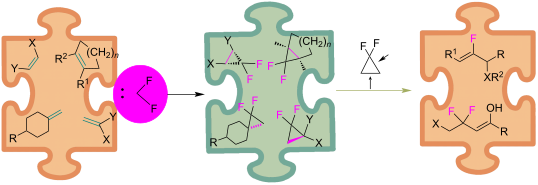
- smooth hydrolysis. Wang et al. reported the enantioselective biotransformations of geminally difluorinated cyclopropanecarbonitriles and amides in 2004 [77]. They transformed gem-difluorocyclopropane derivatives with the help of a soil microorganism, Rhodococcus sp. AJ270, which provided a very effective




Synthesis of 1-indanones with a broad range of biological activity
Beilstein J. Org. Chem. 2017, 13, 451–494, doi:10.3762/bjoc.13.48
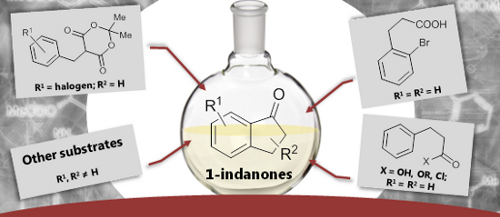
- synthesis of the [14C]indene 176, which was next applied for the examination of the indene bioconversion network expressed in Rhodococcus sp. KY1 [79]. The [14C]1-indanone 175 was obtained in the one-pot synthesis involving the Friedel–Crafts acylation of [14C]benzene 173 with chloropropionic acid chloride


N-Alkyl derivatives of diosgenyl 2-amino-2-deoxy-β-D-glucopyranoside; synthesis and antimicrobial activity
Beilstein J. Org. Chem. 2015, 11, 869–874, doi:10.3762/bjoc.11.97
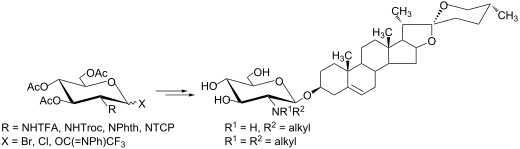
- tested compounds the most active was diosgenyl 2-deoxy-2-ethylamino-β-D-glucopyranoside (9) with MIC of 0.5, 1, 2, and 8 μg/mL against Staphylococcus epidermidis, Enterococcus faecalis, Staphylococcus aureus, and Rhodococcus equi, respectively. Also the N-propyl derivative 11 was found to be active


Synthesis and biological activities of the respiratory chain inhibitor aurachin D and new ring versus chain analogues
Beilstein J. Org. Chem. 2013, 9, 1551–1558, doi:10.3762/bjoc.9.176
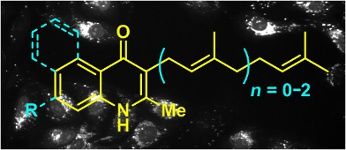
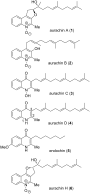
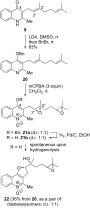
- , namely aurachins E–R, from the same strain [3][6], from Stigmatella erecta [7] or from Rhodococcus sp. Acta 2259 [8]. Initially, aurachins were found to block NADH oxidation in mammalian submitochondrial particles (aurachins C and D being the most active) [1] by the inhibition of complexes I and III of


Regio- and stereoselective oxidation of unactivated C–H bonds with Rhodococcus rhodochrous
Beilstein J. Org. Chem. 2012, 8, 496–500, doi:10.3762/bjoc.8.56
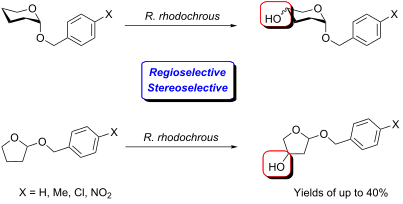
- Chemistry, University of York, Heslington, York, YO10 5DD, UK, Tel: +44 (0)1904 328256 10.3762/bjoc.8.56 Abstract The ability of Rhodococcus rhodochrous (NCIMB 9703) to catalyse the regio- and stereoselective hydroxylation of a range of benzyloxy-substituted heterocycles has been investigated. Incubation
- isomers in yields of up to 26%. Most interestingly, 2-(4-nitrobenzyloxy)tetrahydrofuran and 2-(4-nitrobenzyloxy)tetrahydropyran were transformed in high yields to the 4-hydroxylated and 5-hydroxylated products, respectively. Keywords: biocatalysis; cytochrome P450; hydroxylation; Rhodococcus rhodochrous
- as tools for their preparation [7][8][9][10][11]. Many hydroxylating enzymes have been identified within bacteria belonging to the genus Rhodococcus. These organisms are ubiquitous in the environment and their ability to activate recalcitrant compounds and xenobiotics with an array of mono- and


Other Beilstein-Institut Open Science Activities



