


Search results
Search for "chloroxime" in Full Text gives 3 result(s) in Beilstein Journal of Organic Chemistry.
Synthesis and optical resolution of 4,5-diaminohomoadamantane: a promising scaffold for chiral ligands and bioactive compounds
Beilstein J. Org. Chem. 2026, 22, 1013–1022, doi:10.3762/bjoc.22.80
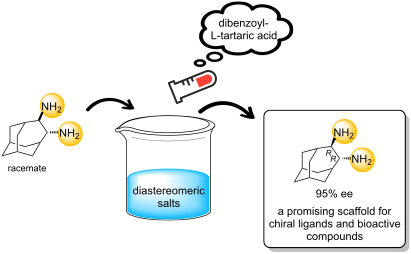
- for the synthesis of compound 2 from alcohol 1 using phosphoric acid, affording the target compound in high yield and purity. In the next step, chloronitrosation of alkene 2 led to α-chloroxime 3 in moderate yield. Substitution of chlorine in 3 with azido and benzylamino groups was then carried out to


Conjugated nitrosoalkenes as Michael acceptors in carbon–carbon bond forming reactions: a review and perspective
Beilstein J. Org. Chem. 2017, 13, 2214–2234, doi:10.3762/bjoc.13.220
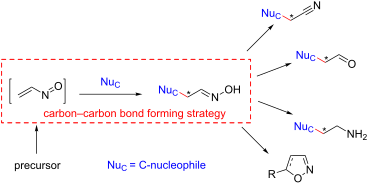
- used as a key stage to construct an important C(7)–C(8) connection in the total synthesis of (+/−)-myrioneurinol (Scheme 15) [34][35]. α-Chloroxime TBS ether 43 (prepared in 10 steps from δ-valerolactam) reacted with a dimethyl malonate anion under Denmark’s conditions via intermediate NSA9 to give the


The rapid generation of isothiocyanates in flow
Beilstein J. Org. Chem. 2013, 9, 1613–1619, doi:10.3762/bjoc.9.184
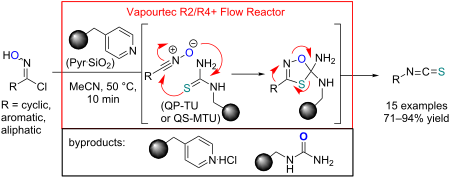
- chemical transformation which typically eliminates the requirements for any conventional work-up or purification of the reaction stream. Keywords: chloroxime; dipolar cycloaddition; flow chemistry; flow synthesis; immobilised reagents; isothiocyanate; nitrile oxide; Introduction Flow based chemical
- weak base and a functionalised thiourea) placed as a 1:1-mixture within a single glass reactor cartridge (Scheme 2). The immobilised base affects the in situ formation of the reactive nitrile oxide from the chloroxime which is immediately captured by the local tethered thiocarbonyl dipolarophile
- for trapping even the small quantities of polar impurities within the matrix thus allowing for the isolation of the desired isothiocyanate product in high purity after only simple solvent removal. Results and Discussion Initially a set of batch experiments was performed using (4-bromophenyl)chloroxime


Other Beilstein-Institut Open Science Activities



