


Search results
Search for "cyanoarene" in Full Text gives 5 result(s) in Beilstein Journal of Organic Chemistry.
Photoorganocatalytic trifluoromethylation of (het)arenes in green conditions
Beilstein J. Org. Chem. 2026, 22, 662–671, doi:10.3762/bjoc.22.50
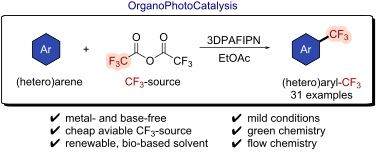
- conditions using an inexpensive and atom-efficient CF3 source, trifluoroacetic anhydride, in ethyl acetate as a green solvent. An organic cyanoarene photocatalyst enables efficient CF3 radical generation under blue-light irradiation, providing a broad range of trifluoromethylated arenes and heteroarenes. The
- ; for detailed results, see Table S3 in Supporting Information File 1). Increasing the loading of 4CzIPN to 3 mol % afforded the desired product in 5% yield (Table 1, entry 2). In contrast, another cyanoarene photocatalyst, 3DPAFIPN (tris(diphenylamino)fluoroisophthalonitrile), provided a significantly
- more expensive compared to cyanoarene derivatives (Table S2, Supporting Information File 1). Considering the absorbance spectrum of 3DPAFIPN [29], violet (400 nm) and blue (450 nm) LEDs were evaluated as alternative light sources, resulting in increased yields of 50% and 54%, respectively (Table 1




Photoredox-catalyzed arylation of isonitriles by diaryliodonium salts towards benzamides
Beilstein J. Org. Chem. 2025, 21, 1480–1488, doi:10.3762/bjoc.21.110
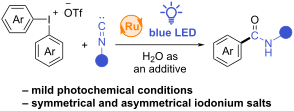
- spectrum of the crude mixture (Supporting Information File 1, Figure S4). Despite its higher reductive potential, fac-Ir(ppy)3 gave a lower yield of 26% for 2aa compared to [Ru(bpy)3](PF6)2 (Table 1, entry 3). Inspired by the first positive results, we tested various cyanoarene-based catalytic systems


Electrocatalytic hydrogenation of cyanoarenes, nitroarenes, quinolines, and pyridines under mild conditions with a proton-exchange membrane reactor
Beilstein J. Org. Chem. 2024, 20, 1560–1571, doi:10.3762/bjoc.20.139
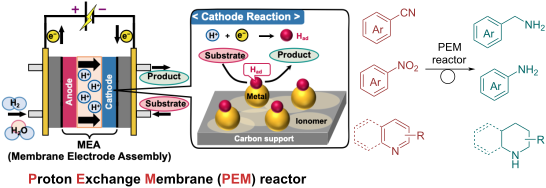
- anilines were obtained. The quinoline reduction was efficiently promoted by adding a catalytic amount of p-toluenesulfonic acid (PTSA) or pyridinium p-toluenesulfonate (PPTS). Pyridine was also reduced to piperidine in the presence of PTSA. Keywords: cyanoarene; nitroarene; PEM reactor; pyridine


Mechanisms for radical reactions initiating from N-hydroxyphthalimide esters
Beilstein J. Org. Chem. 2024, 20, 346–378, doi:10.3762/bjoc.20.35
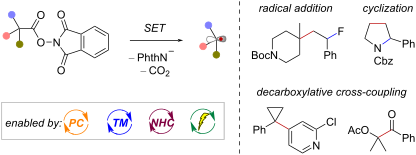
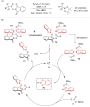
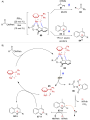
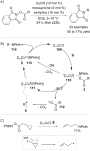
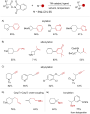
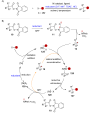
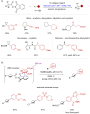
- oxidation of 35 to 36, the photocatalyst is regenerated and product 37 is formed through intramolecular nucleophilic cyclization facilitated by the phosphate base. Importantly, the activation of NHPI esters through PCET may also play a role in transformations mediated by the cyanoarene-based donor–acceptor








One-pot synthesis of 4′-alkyl-4-cyanobiaryls on the basis of the terephthalonitrile dianion and neutral aromatic nitrile cross-coupling
Beilstein J. Org. Chem. 2016, 12, 1577–1584, doi:10.3762/bjoc.12.153

- -dienecarbonitriles 8, and alkylbenzenes 9 (together, up to 25%). According to the total reaction scheme, these byproducts arise via alkylation of the anionic forms of nitriles 1 and 2 [26]. The latter appear in the reaction media due to the electron transfer from 12− to neutral cyanoarene 2 (Scheme 2). Of note, 4,4


Other Beilstein-Institut Open Science Activities



