


Search results
Search for "diaryliodonium(III) salts" in Full Text gives 2 result(s) in Beilstein Journal of Organic Chemistry.
Evaluating the halogen bonding strength of a iodoloisoxazolium(III) salt
Beilstein J. Org. Chem. 2024, 20, 2401–2407, doi:10.3762/bjoc.20.204
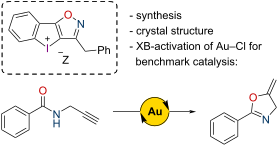
- Dominik L. Reinhard Anna Schmidt Marc Sons Julian Wolf Elric Engelage Stefan M. Huber Fakultät für Chemie und Biochemie, Ruhr-Universität Bochum, Universitätsstraße 150, 44801 Bochum, Germany 10.3762/bjoc.20.204 Abstract Diaryliodonium(III) salts have been established as powerful halogen-bond
- iodoloisoxazolium for halogen-bonding activation and catalysis. Studies on the synthesis and application of chiral and/or bidentate dicationic derivatives are currently underway in our laboratory. Set of literature-known monocationic cyclic diaryliodonium(III) salts that were applied as XB donors (Z = OTf, BArF24




Auxiliary strategy for the general and practical synthesis of diaryliodonium(III) salts with diverse organocarboxylate counterions
Beilstein J. Org. Chem. 2024, 20, 1020–1028, doi:10.3762/bjoc.20.90
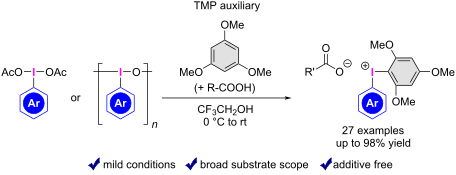
- , Egypt Faculty of Pharmacy, Meijo University, 150 Yagotoyama, Tempaku-ku, Nagoya 468-8503, Japan Department of Chemistry, J. C. Bose University of Science & Technology, YMCA Faridabad, NH-2, Sector-6, Mathura Road, Faridabad, Haryana, 121006, India 10.3762/bjoc.20.90 Abstract Diaryliodonium(III) salts
- . This method allows for the hybridization of complex bioactive and fluorescent-labeled carboxylic acids with diaryliodonium(III) salts. Keywords: auxiliary ligand; diaryliodonium(III) salts; hybridization; hypervalent iodine; organocarboxylates; Introduction Hypervalent iodine compounds are an
- attractive class of reagents due to their stability, accessibility, and diverse chemical reactivity [1]. Diaryliodonium(III) salts, in particular, have been widely recognized as efficient arylating reagents for a range of carbon, nitrogen, oxygen, sulfur, and other nucleophiles, and can be employed in the


Other Beilstein-Institut Open Science Activities



