


Search results
Search for "diazodiketones" in Full Text gives 6 result(s) in Beilstein Journal of Organic Chemistry.
Rh(III)-catalyzed chelation-assisted C–H activation/annulation of 2-arylimidazolines with cyclic diazo-1,3-dicarbonyl compounds: a novel approach to tetracyclic annulated derivatives of 2,3-dihydroimidazo[2,1-a]isoquinoline
Beilstein J. Org. Chem. 2026, 22, 997–1003, doi:10.3762/bjoc.22.78
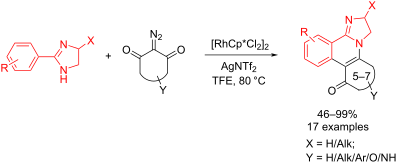
- -heterocycle. Keywords: annulation; 2-arylimidazolines; catalysis; С–H activation; diazodiketones; 2,3-dihydroimidazo[2,1-a]isoquinolines; dimedone; tetraheterocycles; Introduction The advancement of organic synthesis techniques, especially methods for creating nitrogen-containing heterocycles, is essential


Access to 2-oxoazetidine-3-carboxylic acid derivatives via thermal microwave-assisted Wolff rearrangement of 3-diazotetramic acids in the presence of nucleophiles
Beilstein J. Org. Chem. 2024, 20, 1894–1899, doi:10.3762/bjoc.20.164

- -generated ketene, previously described using carbocyclic diazodiketones [35] were also unsuccessful. Of the diazotetramic acids, only the spiro adamantane derivative 1m was not able to form the desired β-lactam. These reactions gave complex mixtures of unidentified products. The benzyl esters 3k and 3n were


Novel photochemical reactions of carbocyclic diazodiketones without elimination of nitrogen – a suitable way to N-hydrazonation of C–H-bonds
Beilstein J. Org. Chem. 2018, 14, 2250–2258, doi:10.3762/bjoc.14.200
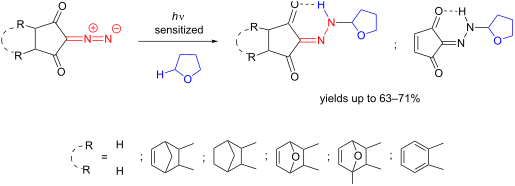
- %. Further irradiation of hydrazones derived from furan-fused tricyclic diazocyclopentanediones culminates in the cycloelimination of furans to yield 2-N-(alkyl)hydrazone of cyclopentene-1,2,3-trione. By contrast, the direct photolysis of carbocyclic diazodiketones gives only Wolff rearrangement products
- compounds. The main objective of our current research was to elucidate the possibility of using carbocyclic diazodiketones in this photochemical process. For this purpose, diazocyclopentanediones 1a–g were tested in the study including unsubstituted diazocyclopentanedione 1a, tricyclic diazodiketones 1b–e
- with CH2- and O-bridges in their structure, diazoindandione 1f, diazocyclopentenedione 1g, and as a С–Н donor tetrahydrofuran was employed in the study (Figure 1). To determine the most efficient conditions for this reaction with diazodiketones 1, three sensitizers, acetophenone, benzophenone, and


Unusual reactions of diazocarbonyl compounds with α,β-unsaturated δ-amino esters: Rh(II)-catalyzed Wolff rearrangement and oxidative cleavage of N–H-insertion products
Beilstein J. Org. Chem. 2016, 12, 1904–1910, doi:10.3762/bjoc.12.180
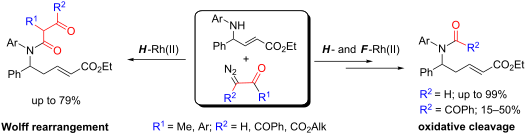
- .12.180 Abstract Rh(II)-сatalyzed reactions of aroyldiazomethanes, diazoketoesters and diazodiketones with α,β-unsaturated δ-aminoesters, in contrast to reactions of diazomalonates and other diazoesters, give rise to the Wolff rearrangement and/or oxidative cleavage of the initially formed N–H-insertion
- these processes. Herein we present the main results of this study. Diazocarbonyl compounds of three classes with dissimilar structures and usually different reactivity were tested in our current research: aroyldiazomethanes 2a–c, diazoketoesters 3a,b and diazodiketones – by the example of


On the strong difference in reactivity of acyclic and cyclic diazodiketones with thioketones: experimental results and quantum-chemical interpretation
Beilstein J. Org. Chem. 2015, 11, 504–513, doi:10.3762/bjoc.11.57
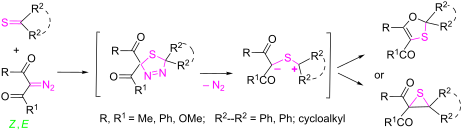
- , carbocyclic diazodiketones are much less reactive under similar conditions due to the locked cyclic structure and are unfavorable for the 1,3-dipolar cycloaddition due to the Z,Z-conformation of the diazo molecule. This structure results in high, positive values of the Gibbs free energy change for the first
- diazodiketones were essentially indifferent to aromatic and aliphatic thioketones under similar reaction conditions (Scheme 1) [14][15][19][20][21]. Generally, the main reaction products formed in these reactions were 1,3-oxathioles 3. However, in some cases, thiiranes 4 and alkenes 5 were isolated from the
- calculations were the same diazodicarbonyl compounds and thioketones that were applied in the earlier experimental studies, namely: acyclic diazodiketones 1a,b, diazoketoester 1c, diazomalonate 1d, and carbocyclic diazodiketones 1e,f, along with thiobenzophenone (2a) and 2,2,4,4-tetramethyl-3


Less reactive dipoles of diazodicarbonyl compounds in reaction with cycloaliphatic thioketones – First evidence for the 1,3-oxathiole–thiocarbonyl ylide interconversion
Beilstein J. Org. Chem. 2013, 9, 2751–2761, doi:10.3762/bjoc.9.309

- diazo-dipoles, selected diazodicarbonyl compounds 2 with different substitution patterns, including acyclic diazodiketones 2a–b, fluoroalkyl-containing (F) and fluorine-free (H) diazoketoesters 2c,d, diazomalonic ester 2e, and carbocyclic diazodiketones 2f–i were tested (Figure 1). The reactions were
- formation of stable 1,3,4-thiadiazolines could also be expected in reactions of the sterically crowded thioketone 1a with bulky diazodiketones. Based on this assumption, additional attempts were undertaken to isolate or at least identify the proposed intermediate 10 by spectroscopic methods in the reaction
- desulfurization of thiirane 8e’ leading to alkene 5e. Reactions of diazodiketones 2 with thioketone 1a. Reactions of diazoketoesters 2c–e with thioketone 1a. The key parameters (δ, ppm) of the 13C NMR spectra of 1,3-oxathioles 3a–e,g and 9a,c (see also [7]). Supporting Information Supporting Information File 503




Other Beilstein-Institut Open Science Activities



