


Search results
Search for "glutaminase" in Full Text gives 2 result(s) in Beilstein Journal of Organic Chemistry.
Structural reassignment of compound 968, an allosteric glutaminase inhibitor
Beilstein J. Org. Chem. 2026, 22, 455–460, doi:10.3762/bjoc.22.33
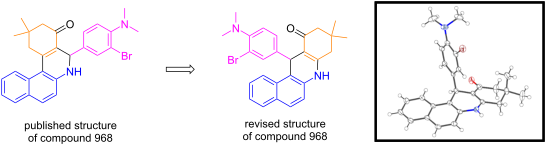
- . Glutaminases catalyze the hydrolysis of glutamine to glutamate, which supports the biosynthesis of amino acids, lipids, and glutathione and can also be oxidatively deaminated to α-ketoglutarate and enter the citric acid cycle. The “glutamine addiction” of cancer cells has made glutaminase an attractive
- anticancer drug target. Compound 968 is a glutaminase inhibitor that is widely used to probe cancer cells’ dependence on glutaminase activity. Here, we show by NMR spectroscopy and X-ray crystallography that the reported benzo[c]phenanthridine structure of compound 968 is incorrect; its true structure is the
- isomeric benzo[c]acridine. The structural reassignment of compound 968 will aid the medicinal chemistry development of this important compound. Keywords: cancer metabolism; compound 968; glutaminase; Introduction Cancer cells often show a strong reliance on glutamine uptake and metabolism [1][2


Synthetic strategies for the preparation of γ-phostams: 1,2-azaphospholidine 2-oxides and 1,2-azaphospholine 2-oxides
Beilstein J. Org. Chem. 2022, 18, 889–915, doi:10.3762/bjoc.18.90
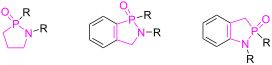
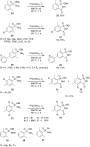
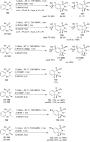
- -azaphospholidine-5-carboxylate 2-oxide (69) was sensible to glutaminase, an enzyme that could ring-open 1,2-azaphospholidine-5-carboxylate 2-oxides (Scheme 12) [32]. Griffiths and co-workers mentioned the synthesis of dimethyl (2-methoxy-1,3-dimethyl-2-oxido-1,3-dihydrobenzo[d][1,2]azaphosphol-3-yl)phosphonate (71








Other Beilstein-Institut Open Science Activities



