


Search results
Search for "para-quinols" in Full Text gives 2 result(s) in Beilstein Journal of Organic Chemistry.
Melifoliox B, a novel phloroglucin derivative isolated from Melicope barbigera (Rutaceae) and synthesis of new oxidation products from melifoliones A and B
Beilstein J. Org. Chem. 2026, 22, 535–546, doi:10.3762/bjoc.22.39
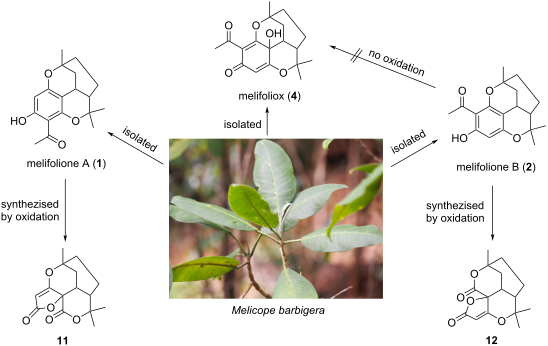
- been described in the literature. Keywords: Melicope barbigera; Melifoliones A and B; new heterocyclic ring systems; new natural compounds; para-quinols; phenol oxidation; Introduction The genus Melicope is a member of the Rutaceae (Citrus family) and contains more than 200 species distributed in the
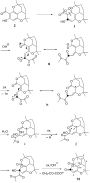
- , reaction with alkaline Lugol’s solution yielded the mono-iodized isomers of both melifolione A (8) and melifolione B (9), identified by their NMR spectra (Figure 2). Reaction with iodosobenzene diacetate – a typical reagent to form para-quinols from phenols [8] – yielded small amounts of a substance, that
- corresponding para quinols. Furthermore, the newly observed oxidative ring contraction of phloroacetophenones to furanone derivatives opens the possibility of more intensive investigation in this reaction with other suitable starting materials to explore scope and limitation of this reaction. This could lead to



Phosphazene-catalyzed desymmetrization of cyclohexadienones by dithiane addition
Beilstein J. Org. Chem. 2017, 13, 762–767, doi:10.3762/bjoc.13.75
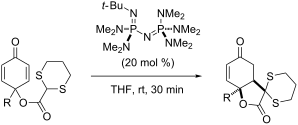
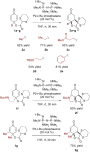
- -carboxylic acid because of its relatively low pKa (compared with non-carboxylate substituted analogs) and the possibility of using an ester linkage as a tether. We found that the heretofore unknown dicyclohexylcarbodiimide (DCC) mediated coupling between para-quinols and 1,3-dithiane-2-carboxylic acid
- proceeds in a straightforward manner in cases where R is unbranched (though it does work for R = Ph). Using this method, we were able to easily generate diversely functionalized dithiane-linked para-quinols to study the intramolecular cyclization. Based on a prior report [30] demonstrating the efficacy of




Other Beilstein-Institut Open Science Activities



