


Search results
Search for "triphenylphosphine oxide (TPPO)" in Full Text gives 2 result(s) in Beilstein Journal of Organic Chemistry.
TMSBr-mediated solvent- and work-up-free synthesis of α-2-deoxyglycosides from glycals
Beilstein J. Org. Chem. 2016, 12, 1758–1764, doi:10.3762/bjoc.12.164
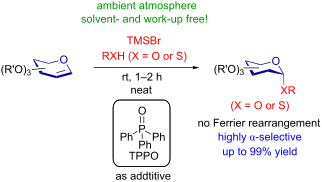
- conditions in good to excellent yields. In addition, with triphenylphosphine oxide as an additive, the TMSBr-mediated direct glycosylations of glycals with a large range of alcohols were highly α-selective. Keywords: 2-deoxyglycosides; glycals; trimethylsilyl bromide (TMSBr); triphenylphosphine oxide (TPPO


Binding of group 15 and group 16 oxides by a concave host containing an isophthalamide unit
Beilstein J. Org. Chem. 2012, 8, 11–17, doi:10.3762/bjoc.8.2
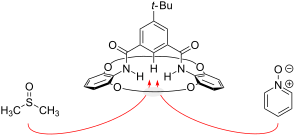
- sulfoxides were chosen as guests, namely pyridine-N-oxide (PyNO) [18][19] and triphenylphosphine oxide (TPPO). PyNO showed the same behaviour as DMSO, i.e., large CIS for concave host 1, and small CIS for the linear compound (Figure 2, PyNO, endo-CH, 0.34 ppm for 1 and 0.14 ppm for 2). In contrast, with TPPO
- and its non-macrocyclic model 2. Expansion of a part of the 1H NMR spectra (200 MHz, 298 K) of pure 1 and 2 in CD2Cl2 (bottom) and after addition of TBACl, DMSO, pyridine-N-oxide (PyNO), triphenylphosphine oxide (TPPO), from bottom to top, respectively. NH proton (red circles), endo-CH proton (red


Other Beilstein-Institut Open Science Activities



