


Search results
Search for "force microscopy" in Full Text gives 650 result(s) in Beilstein Journal of Nanotechnology. Showing first 200.
Vibration-induced dynamic structural superlubricity on MoS2/Au(111) under ultrahigh vacuum
Beilstein J. Nanotechnol. 2026, 17, 1039–1046, doi:10.3762/bjnano.17.71
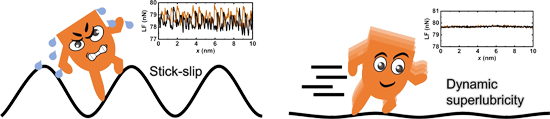
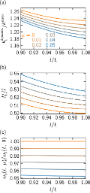
- phononic friction model, reveal that torsional vibrations reduce energy barriers and promote transitions between atomic sites. This strategy provides a universal and reversible approach for active friction control at the nanoscale. Keywords: atomic force microscopy (AFM); dynamic structural superlubricity


Supramolecular one-dimensional conducting nanofibers from a C3-symmetric tetrathiafulvalene derivative
Beilstein J. Nanotechnol. 2026, 17, 872–881, doi:10.3762/bjnano.17.63
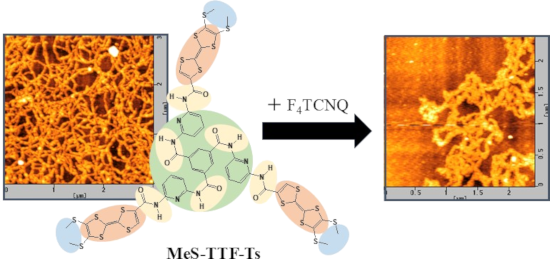
- measurements The structures formed on mica substrates were observed using an atomic force microscopy (AFM) system (Bruker Multi Mode 8). Measurements were performed in non-contact mode using a silicon cantilever with a spring constant of approximately 0.8 N·m−1. Optical spectra UV–vis absorption spectra were
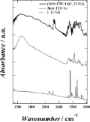
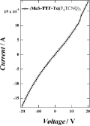
- nanofibers from C3-symmetric MeS-TTF-Ts and the (MeS-TTF-Ts)(F4TCNQ)3 charge-transfer complex In order to form conductive fibers using MeS-TTF-Ts, it was necessary to identify suitable conditions for controlling the formation of supramolecular structures. Atomic force microscopy (AFM) observations of cast


He+ FIBID-fabricated 3D AFM tip architectures: an exploratory study of hollow pillars, helices, and spirals
Beilstein J. Nanotechnol. 2026, 17, 863–871, doi:10.3762/bjnano.17.62
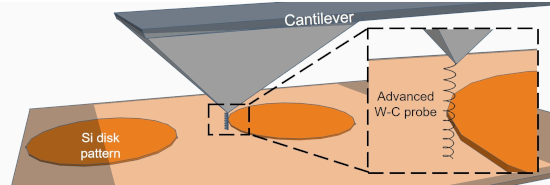
- , Germany 10.3762/bjnano.17.62 Abstract Atomic force microscopy (AFM) relies strongly on tip geometry and mechanical integrity for stable and reproducible surface measurements. Here, we present an exploratory study of tungsten–carbon (W–C) AFM tips with complex three-dimensional (3D) architectures
- exhibit high purity [22][23], making them suitable candidates for magnetic force microscopy (MFM) tips [13][14]. However, the magnetic performance of cobalt-based deposits may be affected by oxidation under ambient conditions, as the formation of cobalt oxide can reduce or suppress ferromagnetic behaviour


Sustainable fabrication of 2D-based devices through reuse of substrates with microfabricated electrodes
Beilstein J. Nanotechnol. 2026, 17, 818–827, doi:10.3762/bjnano.17.58
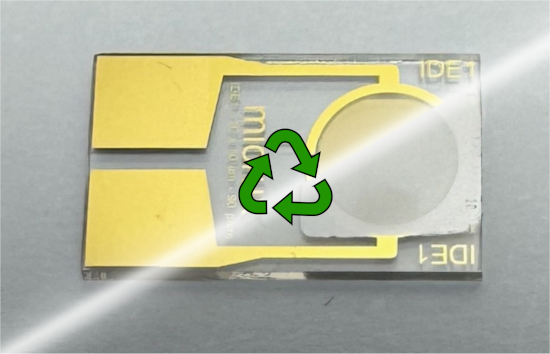
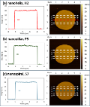
- ), enabling the removal of 2D materials without damaging the electrodes. Electrical measurements, Raman analysis, and Kelvin probe force microscopy measurements collectively confirm the feasibility of repeatedly reusing the same pre-patterned chip, showing that the cleaned regions exhibit no detectable Raman
- interpolation. The Si 520 cm−1 maps in Supporting Information File 1, Figure S9g–i provide additional contrast between the SiO2/Si channel and the Au electrode. In addition, Kelvin probe force microscopy (KPFM) measurements, presented in Supporting Information File 1 (Figures S10 and S11), show that the
- . Kelvin probe force microscopy KPFM measurements were carried out on the same electrode in two states, that is, pristine electrode and electrode after roll-to-roll mechanically exfoliated MoS2 transfer followed by NMP cleaning. Morphology and surface-potential characterization were performed under ambient


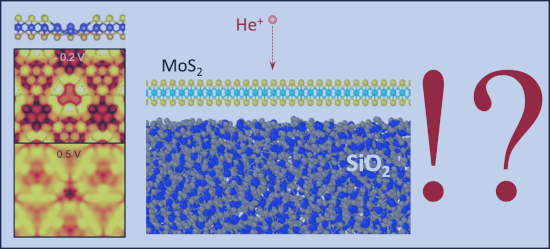
Substrate-dependent pore formation in molybdenum disulfide monolayers under ion irradiation
Beilstein J. Nanotechnol. 2026, 17, 769–780, doi:10.3762/bjnano.17.54
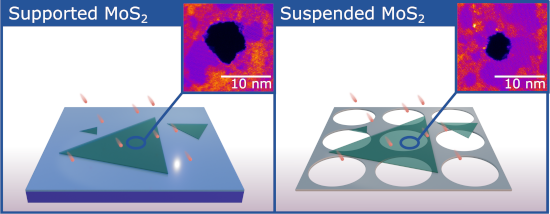
- , high-resolution scanning transmission electron microscopy (STEM) generally requires freestanding membranes, while atomic-resolution atomic force microscopy (AFM) and scanning tunneling microscopy (STM) demand exceptionally clean surfaces; also, substrate effects can further complicate interpretation


Tailoring Ag–Pt nanoalloys through solid-state dewetting: structural and optical insights
Beilstein J. Nanotechnol. 2026, 17, 748–759, doi:10.3762/bjnano.17.52

- plasmonic properties. Results and Discussion As-deposited thin Ag–Pt bilayers exhibit a granular morphology, as evidenced by atomic force microscopy (AFM) measurements shown in Figure 1. This granular character leads to instability of the layers at higher temperatures, causing cracking of the continuous




afspm: A framework for manufacturer-agnostic automation in scanning probe microscopy
Beilstein J. Nanotechnol. 2026, 17, 653–667, doi:10.3762/bjnano.17.45
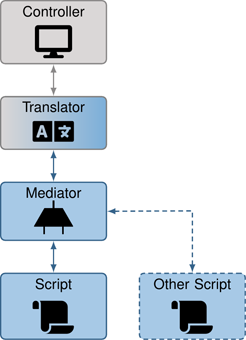
- interfaces types. An automated experiment was run to ensure overall running beyond integration testing. Keywords: atomic force microscopy; automation; manufacturer-agnostic; scanning probe microscopy; software framework; Introduction In scanning probe microscopy (SPM), an atomically sharp tip is scanned
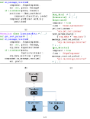
- directly from the computer hard drive, which simplifies the translator logic as it does not need to monitor data live (which is accessible for only some controllers). The exposed level of control assumes the user has pre-configured their “operating mode” (e.g., amplitude-modulated atomic force microscopy
- (AM-AFM) or frequency-modulated atomic force microscopy (FM-AFM)) and spectroscopic mode (e.g., IV curves or force spectroscopy), which we believe is justifiable as part of the experimental setup. This base set of operations gives the user a reasonable degree of flexibility: One could design an image




Recent progress in enhancing built-in electric fields of perovskite solar cells via junction engineering
Beilstein J. Nanotechnol. 2026, 17, 602–621, doi:10.3762/bjnano.17.42
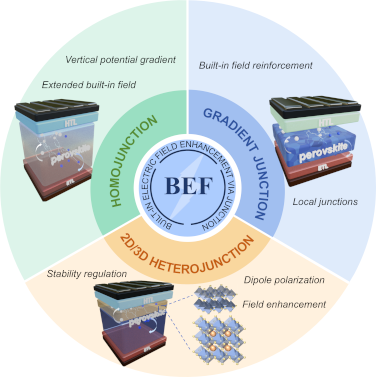
- constructing an n–p homojunction. Accordingly, UPS and Kelvin probe force microscopy (KPFM) measurements showed that the surface work function increased by about 0.5 eV and the potential difference increased by about 0.26 V. Mott–Schottky analysis further revealed an increase in Vbi of roughly 0.1 V



Probing tribological evolution in atomically thin MoS2 at different scales
Beilstein J. Nanotechnol. 2026, 17, 586–597, doi:10.3762/bjnano.17.40
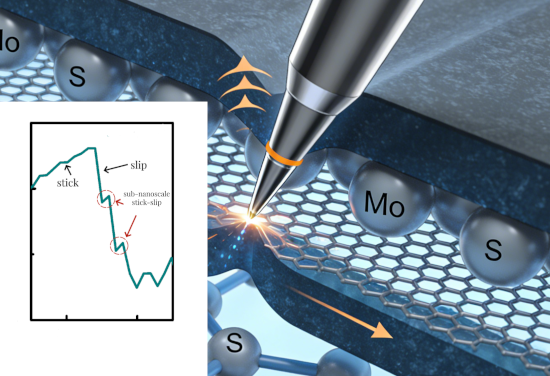
- nanoscale to sub-nanoscale, providing critical insights for designing low-friction coatings and high-performance micro/nanoelectromechanical systems (MEMS/NEMS). Keywords: atomic force microscopy; MoS2; strengthening effect; sub-nanoscale stick–slip motion; Introduction Nanoscale friction is a pivotal
- –slip events driven by in-plane tip apex motion and modulated by contact geometry via molecular dynamics (MD) simulations and frictional force microscopy (FFM) [11][12]. Despite these theoretical and simulation insights, experimental observation and quantification of sub-nanoscale stick–slip motion in


Defects and defect-mediated engineering of two-dimensional materials: challenges and open questions
Beilstein J. Nanotechnol. 2026, 17, 454–488, doi:10.3762/bjnano.17.31
- of defects, for example, TEM [80], STM [81], or atomic force microscopy (AFM) [82]; but, normally, only a small part of the sample can be probed [83][84][85]. Moreover, these techniques can create defects themselves, for example, when the energy of the electron beam exceeds the displacement threshold





Ferroelectric nanodot reservoir for neuromorphic computing
Beilstein J. Nanotechnol. 2026, 17, 352–364, doi:10.3762/bjnano.17.24
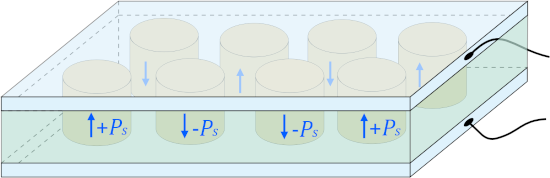
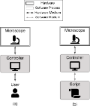
- interfaces. An alternative configuration is shown in Figure 7b, where atomic force microscopy or piezoresponse force microscopy are used for both input and output operations. Here, the localized tip of the microscope is used to inject or sense charges at specific positions in the ferroelectric array
- and readout realized via atomic or piezoresponse force microscopy. Funding This research was funded by the European Union HORIZON action MSCA-SE-3D-TOPO (project number 101236483). A.R. acknowledges the Slovenian Research Agency support (P1-0125). The work of V.V. was supported by Terra Quantum AG.


Calculation of the dynamic stiffness of a cantilever under torsional oscillation
Beilstein J. Nanotechnol. 2026, 17, 303–308, doi:10.3762/bjnano.17.21
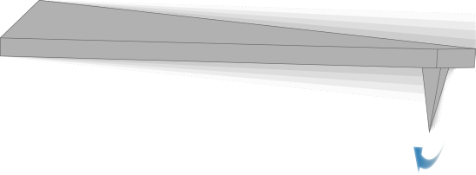
- Keita Nishida Yuuki Yasui Yoshiaki Sugimoto Department of Advanced Materials Science, The University of Tokyo, Chiba 277-8561, Japan 10.3762/bjnano.17.21 Abstract Atomic force microscopy using Si cantilevers provides an effective means for investigating both conservative and dissipative
- : atomic force microscopy; dynamic stiffness; energy dissipation; friction; torsional oscillation mode; Introduction Friction serves as a fundamental mechanism of energy dissipation [1]. While friction typically arises from direct mechanical contact between surfaces, energy dissipation can also occur even
- detailed mechanisms remain not fully understood [5]. Non-contact atomic force microscopy (nc-AFM) is widely employed to investigate non-contact friction through its dissipation channel. Common techniques include pendulum AFM, bimodal AFM, and quartz tuning fork AFM [6][7][8]. Pendulum AFM uses cantilevers

Advancing nanolithography: a comprehensive review of materials for local anodic oxidation with AFM
Beilstein J. Nanotechnol. 2026, 17, 275–291, doi:10.3762/bjnano.17.19
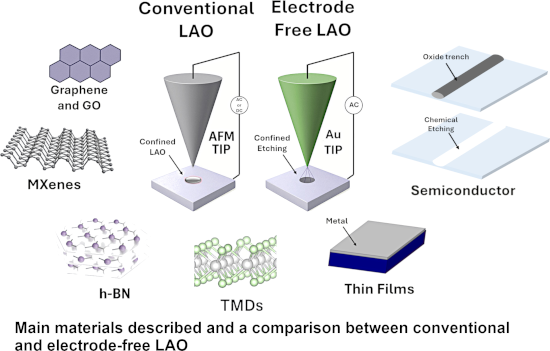
- technique for nanoscale patterning, leveraging the precision of scanning probe microscopy, relying specifically on atomic force microscopy. This review explores the materials utilized in LAO experiments, including semiconductors, metals, insulators, two-dimensional (2D) materials, and emerging
- oxide growth on a silicon surface during LAO, illustrating the formation of a protruding oxide feature and the corresponding buried oxide volume. Reproduced from [8], M. Lorenzoni and F. Pérez-Murano, “Conductive Atomic Force Microscopy for Nanolithography Based on Local Anodic Oxidation,” in Conductive
- Atomic Force Microscopy: Applications in Nanomaterials, with permission from John Wiley and Sons. Copyright © 2017 Wiley-VCH GmbH. This content is not subject to CC BY 4.0. (c) AFM images of square oxide patterns fabricated by LAO on SiC before and after wet etching. (d) Height profile of the top left


Development and in vitro evaluation of liposomes and immunoliposomes containing 5-fluorouracil and R-phycoerythrin as a potential phototheranostic system for colorectal cancer
Beilstein J. Nanotechnol. 2026, 17, 97–121, doi:10.3762/bjnano.17.7
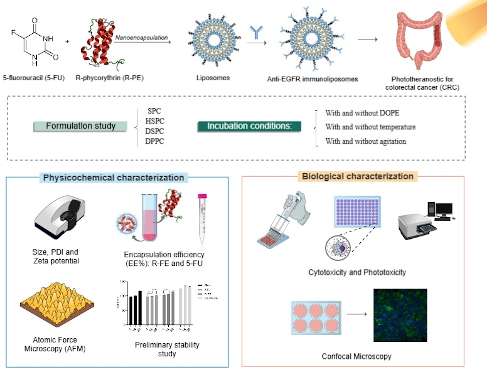
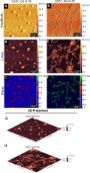
- force microscopy The topographical characterization of liposomal formulations was performed by using atomic force microscopy (AFM) with a Nanosurf® FlexAFM system. The samples analyzed included liposomes and immunoliposomes containing R-PE. Briefly, to avoid vesicle deformation or disruption, liposomes
- images were captured using the Nanosurf C3000i software and subsequently processed and analyzed with the Gwyddion v 2.66 software, which was used for image leveling, coloring, 3D visualization of the specimens, and roughness analysis [26]. 2.3.5.1 Atomic force microscopy roughness calculation. Roughness
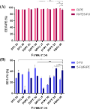
- HSPC IM 07 formulation exhibits the most favorable characteristics for application in delivery systems, balancing nanoscale size, acceptable PDI, and high conjugation efficiency. 3.3 Atomic force microscopy assays Atomic force microscopy assays were used to characterize the surface topography of



Quantitative estimation of nanoparticle/substrate adhesion by atomic force microscopy
Beilstein J. Nanotechnol. 2026, 17, 1–14, doi:10.3762/bjnano.17.1

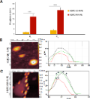
- of copper nanoparticles to silicon substrates deposited under varying conditions using DC magnetron sputter inert gas condensation. Atomic force microscopy was utilized as a tool for the manipulation of the nanoparticles and to measure lateral forces for their displacement, with cantilever
- particles between 6 and 12 nm. In addition, an applied positive substrate bias voltage led to more energetic landing conditions and thus to increased adhesion forces. This study underscores the suitability of atomic force microscopy in characterizing adhesion on the nanoscale and offers insights into future
- strategies for tailoring nanoparticle/substrate interactions. Keywords: adhesion; atomic force microscopy; magnetron sputtering; nanomanipulation; nanoparticles; Introduction Nanoparticles (NPs) are at the forefront of basic research and technological innovation, captivating researchers and engineers from



Chiral plasmonic nanostructures fabricated with circularly polarized light
Beilstein J. Nanotechnol. 2025, 16, 2245–2264, doi:10.3762/bjnano.16.154
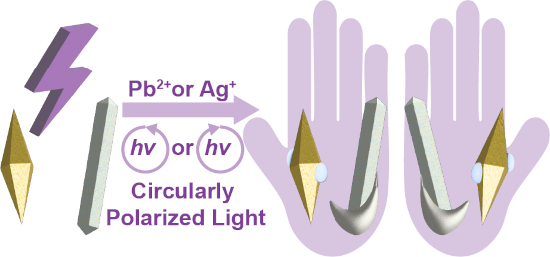
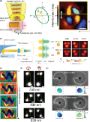
- can lead to a significant displacement of the polymer backbone, with the degree of displacement being dependent on the strength of the electric field under CPL. Chiral topographic changes due to the polymer displacement were observed using atomic force microscopy (AFM). Similar observations were made





Ultrathin water layers on mannosylated gold nanoparticles
Beilstein J. Nanotechnol. 2025, 16, 2183–2198, doi:10.3762/bjnano.16.151
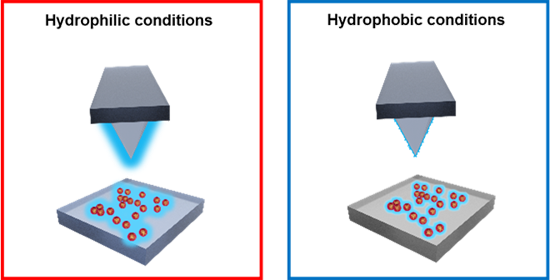
- light scattering, and infrared spectroscopy. We probed particles adsorbed on hydrophilic and hydrophobic surfaces with atomic force microscopy (AFM) and vibrational sum frequency generation (VSFG) spectroscopy, both operated under variable air humidity. For AFM, we additionally tested hydrophilic and
- inorganic surfaces, usually modified with organic layers, and probed by Fourier-transform infrared spectroscopy (FTIR), vibrational sum frequency generation (VSFG), and atomic force microscopy (AFM). For VSFG and AFM, we systematically varied the relative air humidity (RH). DLS and ZP yield particle size



Electron transport through nanoscale multilayer graphene and hexagonal boron nitride junctions
Beilstein J. Nanotechnol. 2025, 16, 2132–2143, doi:10.3762/bjnano.16.147
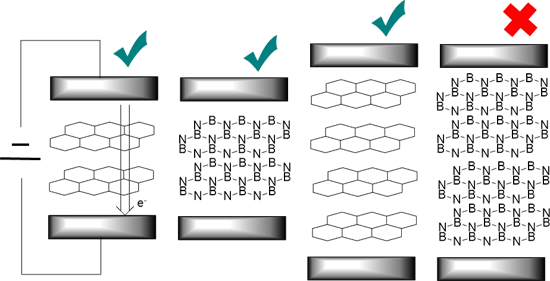
- tunneling behavior. Current–voltage characteristics showed linear dependence at low bias and exponential growth at higher voltages. Conductive atomic force microscopy measurements revealed highly uniform, defect-free tunneling across atomically flat h-BN terraces, with breakdown fields near 1 GV·m−1. These


Toward clinical translation of carbon nanomaterials in anticancer drug delivery: the need for standardisation
Beilstein J. Nanotechnol. 2025, 16, 2092–2104, doi:10.3762/bjnano.16.144

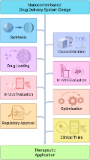
- atomic force microscopy. Surface charge plays a significant role in determining how CNMs interact with biological membranes and intracellular environments. It influences processes such as cellular uptake, cytotoxicity, and inflammatory signalling. For example, BSA-derived negatively charged CDs exhibited



Calibration of piezo actuators and systems by dynamic interferometry
Beilstein J. Nanotechnol. 2025, 16, 2086–2091, doi:10.3762/bjnano.16.143
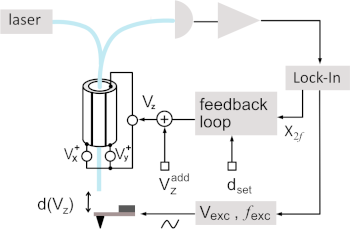
- Knarik Khachatryan Michael Reichling Institut für Physik, Universität Osnabrück, Barbarastr. 7, 49076 Osnabrück, Germany 10.3762/bjnano.16.143 Abstract To achieve precise measurements of small displacements in non-contact atomic force microscopy, it is crucial to control the position of moving
- oscillation amplitude calibration under conditions of various amounts of tube piezo contraction and extension. The merits and limits of accuracy for such type of calibration are discussed. Keywords: cantilever excitation; fiber interferometer; NC-AFM; piezo calibration; non-contact atomic force microscopy
- ; Introduction Interferometric displacement detection stands as a cornerstone in high-precision techniques employed in cantilever-based atomic force microscopy (AFM), since its early days [1][2][3][4][5][6]. This method of cantilever displacement detection is specifically well suited for non-contact atomic force


Multifrequency AFM integrating PeakForce tapping and higher eigenmodes for heterogeneous surface characterization
Beilstein J. Nanotechnol. 2025, 16, 2077–2085, doi:10.3762/bjnano.16.142
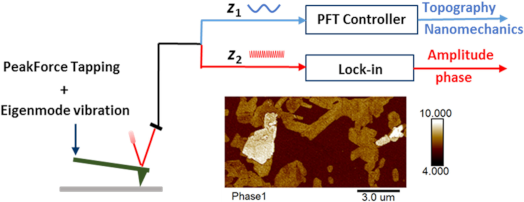
- Yanping Wei Jiafeng Shen Yirong Yao Xuke Li Ming Li Peiling Ke Public Technology Center, Ningbo Institute of Materials Technology and Engineering, Chinese Academy of Sciences, Ningbo 315201, China 10.3762/bjnano.16.142 Abstract This study introduces a multifrequency atomic force microscopy (AFM
- . Keywords: atomic force microscopy (AFM); high eigenmodes; multifrequency AFM; nanoscale material analysis; surface characterization; Introduction Atomic force microscopy (AFM) has become an indispensable tool for characterizing the morphology and surface properties of materials at the micro- and the


Molecular and mechanical insights into gecko seta adhesion: multiscale simulations combining molecular dynamics and the finite element method
Beilstein J. Nanotechnol. 2025, 16, 2055–2076, doi:10.3762/bjnano.16.141
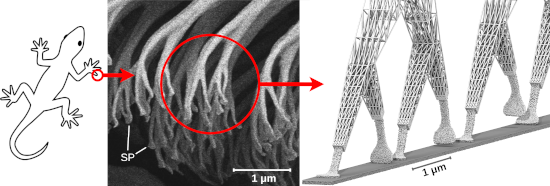
- detachment, thereby enhancing adhesion strength. The computed pull-off forces and observed mechanisms are consistent with atomic force microscopy measurements and previous simulations. These results align with existing experimental and computational studies. They also overcome scale and resolution
- scales involved. In previous research, we used molecular dynamics simulations to explore various aspects of gecko adhesion [10][11][12][13]. We found that humidity increases the force required to pull a spatula off from a substrate [10][12], a phenomenon also observed in high-humidity atomic force
- microscopy (AFM) experiments. Our investigation into how gecko keratin interacts with hydrophilic and hydrophobic substrates [12] supported the importance of the water-mediating effect [10] and elucidated mechanistic differences depending on surface chemistry. A particle-based mesoscale model of a single






Mechanical property measurements enabled by short-term Fourier-transform of atomic force microscopy thermal deflection analysis
Beilstein J. Nanotechnol. 2025, 16, 1952–1962, doi:10.3762/bjnano.16.136
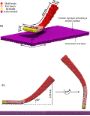
- Contact resonance atomic force microscopy (CR-AFM) has been used in many studies to characterize variations in the elastic and viscoelastic constants of materials along a heterogeneous surface. In almost all experimental work, the quantitative modulus of the surface is calculated in reference to a known
- model, improved matching the cantilever/sample stiffness to obtain a larger variation in contact stiffness with frequency, or investigating the use of higher-order modes that may achieve this improved match. Keywords: atomic force microscopy; contact resonance; highly oriented pyrolytic graphite (HOPG
- ); mechanical property measurements; surface science; Introduction Atomic force microscopy (AFM) has become an indispensable tool for imaging the surface topography on a variety of surfaces [1]. Since the invention of the AFM [2], several other modes of AFM have been developed, including friction force




Low-temperature AFM with a microwave cavity optomechanical transducer
Beilstein J. Nanotechnol. 2025, 16, 1873–1882, doi:10.3762/bjnano.16.130
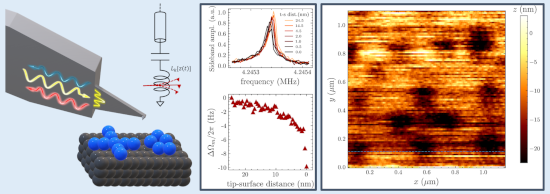
- /bjnano.16.130 Abstract We demonstrate atomic force microscopy (AFM) imaging with a microcantilever force transducer where an integrated superconducting microwave resonant circuit detects cantilever deflection using the principles of cavity optomechanics. We discuss the detector responsivity and added
- feedback in both amplitude-modulation and frequency-modulation modes. Keywords: atomic force microscopy; cavity optomechanics; Introduction The past two decades have seen the emergence of a variety of remarkable microscopic and mesoscopic optomechanical devices. Through innovative design and fabrication
- ], tests of quantum gravity [3][4][5], force microscopy [6][7][8], magnetometry [9][10], and quantum state transfer [11][12][13]. In some cases, further improvement on fundamental figures of merit is required, while, in other cases, the difficulty lies in balancing trade-offs to find an optimal design that


Electrical, photocatalytic, and sensory properties of graphene oxide and polyimide implanted with low- and medium-energy silver ions
Beilstein J. Nanotechnol. 2025, 16, 1794–1811, doi:10.3762/bjnano.16.123
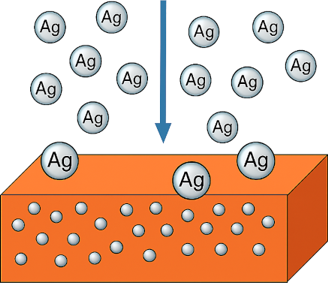
- atomic force microscopy. Electrical properties as a function of air humidity were evaluated using a two-point method, and photocatalytic activity was tested by monitoring the UV-induced decomposition of rhodamine B. The results demonstrate that ion implantation significantly reduces surface resistivity
- amorphization of the material and probably to the carbonization of the polyimide. Surface morphology studied by AFM Changes in the surface morphology of PI implanted with 20 keV and 1.5 MeV Ag ions at different fluences were examined by atomic force microscopy (AFM). The basic parameters arithmetic average





