Search results
Search for "material properties" in Full Text gives 196 result(s) in Beilstein Journal of Nanotechnology.
Nanoglasses: a trail towards uncharted regions of vitreous materials and their properties?
Beilstein J. Nanotechnol. 2026, 17, 1047–1062, doi:10.3762/bjnano.17.72

- important to emphasize that the combination of properties found in glasses with such glass–glass interfaces distinguishes them from all known interfaces in crystalline materials. Given the correlation between excess volume and interatomic interaction potential, significant changes in nearly all material
- properties are expected. This new pathway for the creation of “glasses with a microstructure”, that is, nanoglasses, thus opens up exciting opportunities for the engineering and tailoring of amorphous materials through nanostructuring, potentially also advancing our understanding and application of vitreous


Vibration-induced dynamic structural superlubricity on MoS2/Au(111) under ultrahigh vacuum
Beilstein J. Nanotechnol. 2026, 17, 1039–1046, doi:10.3762/bjnano.17.71
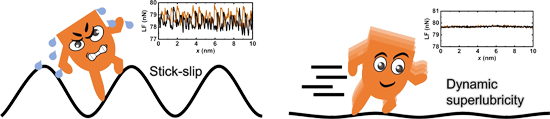
- of the interfacial energy landscape, we demonstrate the ability to switch between distinct frictional states, including a superlubric regime. This approach avoids limitations imposed by material properties and provides a platform to study fundamental friction mechanisms in low-dimensional systems


Synthesis and characterization of RF-sputtered ZnTe/Cu2−xTe thin films for solar cell applications
Beilstein J. Nanotechnol. 2026, 17, 1016–1027, doi:10.3762/bjnano.17.69
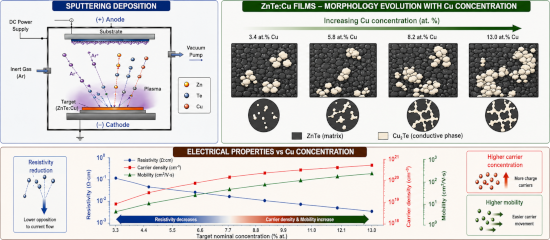
- incorporation and the formation of conductive Cu-rich secondary phases, yielding a biphasic system composed of semiconducting ZnTe and conductive Cu-rich telluride phases. These material properties suggest potential relevance for future studies of back-contact materials in CdTe-based solar cells. Keywords



Materials challenges in solid-state sensors for continuous monitoring of ions in water
Beilstein J. Nanotechnol. 2026, 17, 935–973, doi:10.3762/bjnano.17.66
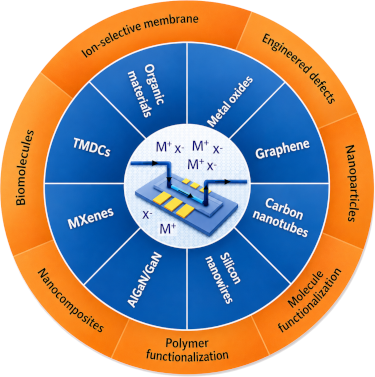
- ) are one-dimensional nanostructures composed of seamless cylinders of sp2-bonded carbon atoms formed by rolling up graphene sheets, with their material properties governed primarily by the number of walls, diameter, chirality, and defect structure. Single-walled carbon nanotubes (SWCNTs) consist of a



Enhanced erosion resistance and radiation stability of WC–WO3 nanocomposite films under 100 keV Kr+ ion irradiation
Beilstein J. Nanotechnol. 2026, 17, 922–934, doi:10.3762/bjnano.17.65
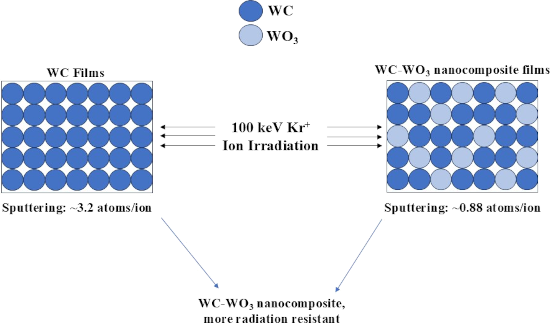
- displacements results in pronounced surface restructuring. Similar phenomena, including ripple formation and surface roughening, have been widely reported and are known to depend on parameters such as ion energy, fluence, and target material properties [89][90]. The SEM and GIXRD results show strong correlation



He+ FIBID-fabricated 3D AFM tip architectures: an exploratory study of hollow pillars, helices, and spirals
Beilstein J. Nanotechnol. 2026, 17, 863–871, doi:10.3762/bjnano.17.62
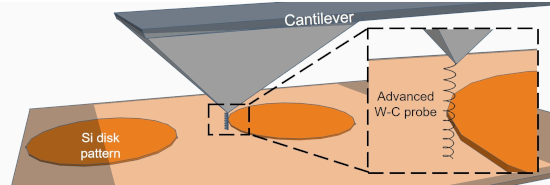
- ][16][17][18][19], or tungsten-based precursors [20][21]. The resulting probes can be attractive because they allow for site-specific growth directly on the cantilever and can, in principle, combine tailored geometry with functional material properties. For instance, cobalt- and iron-based deposits
- nanostructures, their implementation in AFM tips must balance improvements in material properties with the preservation of the original nanoscale geometry. For high-aspect-ratio AFM imaging, carbon nanotube (CNT) tips remain an important benchmark because of their small effective radii, flexibility, and long


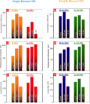
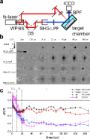
Beam shaping techniques for pulsed laser ablation in liquids: Unlocking tunable control of nanoparticle synthesis in liquids
Beilstein J. Nanotechnol. 2026, 17, 309–342, doi:10.3762/bjnano.17.22







Advancing nanolithography: a comprehensive review of materials for local anodic oxidation with AFM
Beilstein J. Nanotechnol. 2026, 17, 275–291, doi:10.3762/bjnano.17.19
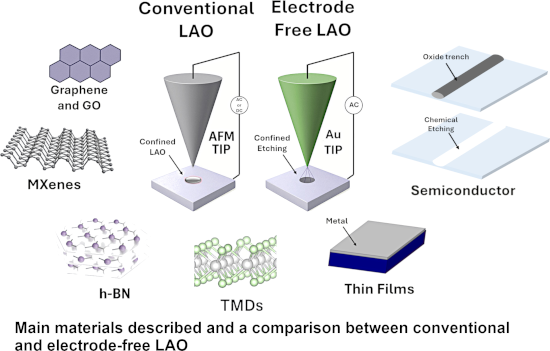
- the fabricated device and preserving the intrinsic material properties [35][36]. For semiconductors, the method allows for precise control over oxide thickness, critical for applications in microelectronics and sensor technology. Oxide thickness can be precisely controlled, enabling the formation of
- of MoTe2 in both its semiconducting (2H) and semi-metallic (1T′) phases using a tip-based lithographic approach; examples of such patterns are shown in Figure 5d–f. The method does not induce measurable phase transitions, preserving the intrinsic material properties and is, therefore, suitable for


Micro- and nanoscale effects in biological and bioinspired materials and surfaces
Beilstein J. Nanotechnol. 2026, 17, 214–217, doi:10.3762/bjnano.17.14
- Chimica, Biologia e Biotecnologie, University of Perugia, Via Elce di Sotto 8, 06121 Perugia, Italy 10.3762/bjnano.17.14 Keywords: adhesion; bioengineering; functional morphology; material properties; medical coatings; microstructures; nanostructures; optics; structure–function relationships; Micro- and
Safe and sustainable by design with ML/AI: A transformative approach to advancing nanotechnology
Beilstein J. Nanotechnol. 2026, 17, 176–185, doi:10.3762/bjnano.17.11
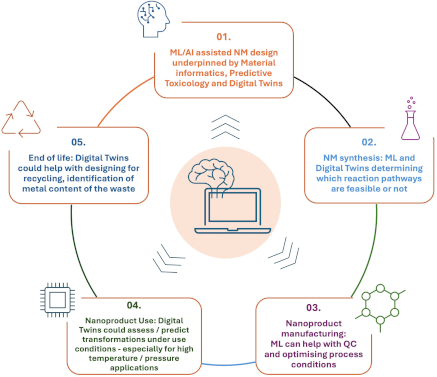
- development – one that secures both innovation and safety. Perspective Safe and sustainable by design Safe and sustainable by design can be defined as “a pre-market approach to chemicals and materials design that focuses on providing a function (or service), while avoiding volumes and chemical and material
- properties that may be harmful to human health or the environment in particular groups of chemicals likely to be (eco)toxic, persistent, bio-accumulative, or mobile. Overall sustainability should be ensured by minimizing the environmental footprint of chemicals and materials in particular in relation to


Chiral plasmonic nanostructures fabricated with circularly polarized light
Beilstein J. Nanotechnol. 2025, 16, 2245–2264, doi:10.3762/bjnano.16.154
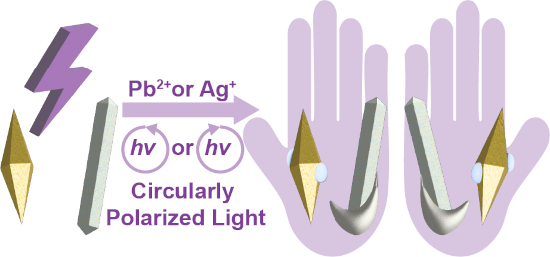
- representative applications of cPNSs based on the related types of material properties. We refer the readers to the comprehensive reviews [18][120][121][122] for applications of cPNSs categorized by interest. 4.1 Applications based on the geometrical chirality of cPNSs Several recent studies have shown that the




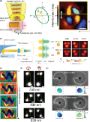

Multifrequency AFM integrating PeakForce tapping and higher eigenmodes for heterogeneous surface characterization
Beilstein J. Nanotechnol. 2025, 16, 2077–2085, doi:10.3762/bjnano.16.142
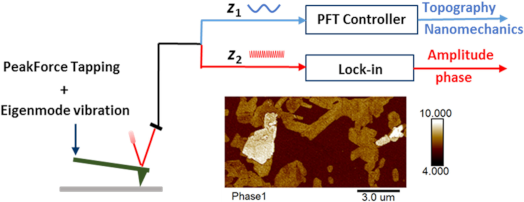
- interacting intermittently with the sample surface. By monitoring and controlling the cantilever’s amplitude and phase, topographical and phase images can be generated, providing insights into material properties and enabling the differentiation of regions or components within heterogeneous samples [7][8][9


Mechanical property measurements enabled by short-term Fourier-transform of atomic force microscopy thermal deflection analysis
Beilstein J. Nanotechnol. 2025, 16, 1952–1962, doi:10.3762/bjnano.16.136
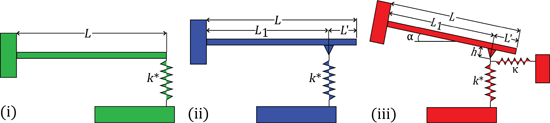
- 5.0 with the JKR model [29], we use the COS model, which has been shown to more accurately fit contacts having material properties between the DMT and JKR extremes. The fits to the experimental data are provided in Figure 5. In each case, all materials for tip and substrate were pure amorphous




Current status of using adsorbent nanomaterials for removing microplastics from water supply systems: a mini review
Beilstein J. Nanotechnol. 2025, 16, 1837–1850, doi:10.3762/bjnano.16.127
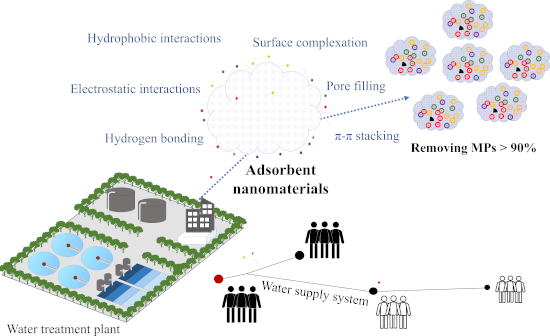
- can recovery. Their effectiveness depends on material properties and environmental factors, but challenges remain in scale-up and related risks. Adsorbent nanomaterials show promising potential to enhance MP removal through specific properties. Although some related risks are discussed, these


Beyond the bilayer: multilayered hygroscopic actuation in pine cone scales
Beilstein J. Nanotechnol. 2025, 16, 1695–1710, doi:10.3762/bjnano.16.119
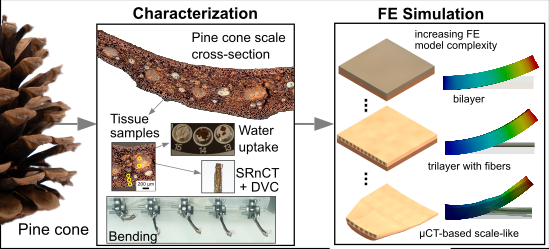
- . In order to refine our understanding of the hygroscopic material properties of tissue samples, future studies should include larger sample sizes. Nevertheless, the use of DVC-assisted sample evaluation has proven to be a very useful complementary method to classical ways for analyzing and comparing
- ). However, the chosen material properties of the tissues, and in particular the cross-sectional area of the more rigid sclerenchyma fiber layer, play a crucial role. For example, the simulation of the bilayer geometry showed that a considerably lower bending is achieved compared to other geometries. This is
- ], the obtained results must be taken with caution. However, if the sclerenchyma fibers’ Young’s modulus is decreased, or if they are considered as discrete fiber elements embedded in an intermediate tissue, higher bending angles can be achieved with the same material properties and more closely


Bioinspired polypropylene-based functionally graded materials and metamaterials modeling the mistletoe–host interface
Beilstein J. Nanotechnol. 2025, 16, 1592–1606, doi:10.3762/bjnano.16.113
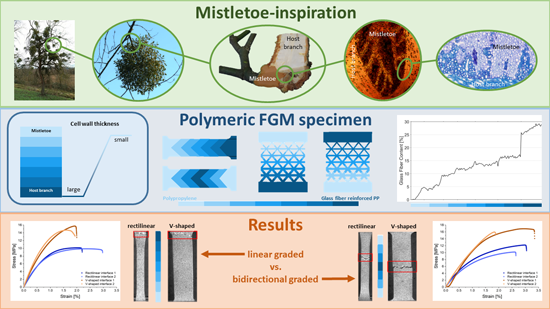
- failure locations can be introduced, which should have little or no effect on the overall mechanical properties in the regular product environment. A class of materials characterized by a high degree of flexibility and distribution of material properties, which enables locally adapted behavior and, thus
- ) materials, and the constant parameter of Poisson’s ratio was set to ν = 0.3 for both materials. The metamaterial geometry was divided vertically into seven subsections, as shown in Figure 2G–I. Each subsection was assigned distinct material properties based on a linear interpolation of the elastic modulus
- material properties of the base materials and the ratio at which the gradients are designed. At the same time, it has been shown that the stiffness can be increased, if desired, by interfacial structuring, so that there is very little difference to the base materials. The knowledge of the failure locations


Laser processing in liquids: insights into nanocolloid generation and thin film integration for energy, photonic, and sensing applications
Beilstein J. Nanotechnol. 2025, 16, 1428–1498, doi:10.3762/bjnano.16.104
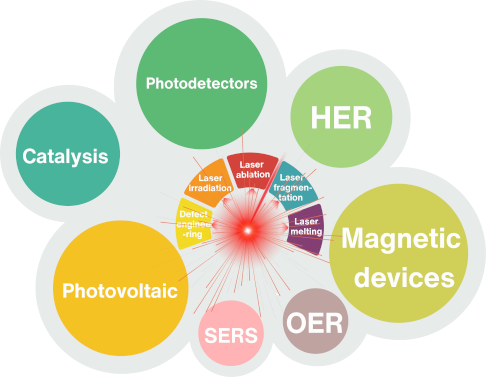
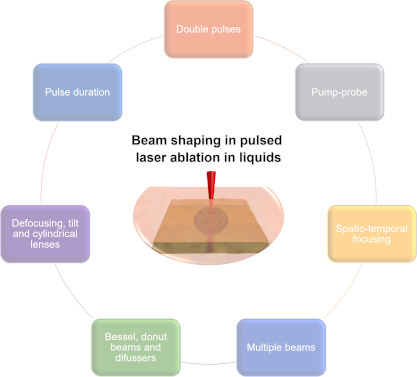
- ] and optical monitoring, could provide deeper insights into the ablation process and facilitate more precise control over the material properties. Overall, laser processing in liquids (LPL) remains a rapidly evolving and promising field [27], with significant opportunities for future innovation in
- researchers and industries seeking precise control over material properties. LFL can be utilized to produce larger volumes of nanocolloids even fulfilling the demands for industrial applications. 1.3 Laser melting in liquids A novel approach to synthesizing submicrometer spherical particles (SMSPs) involves






The role of biochar in combating microplastic pollution: a bibliometric analysis in environmental contexts
Beilstein J. Nanotechnol. 2025, 16, 1401–1416, doi:10.3762/bjnano.16.102
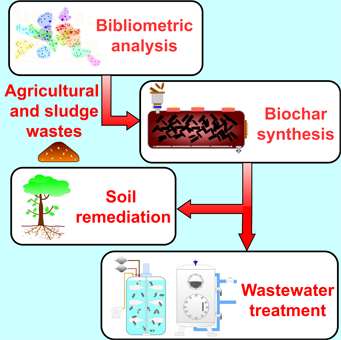
- particles. These studies contribute to a deeper understanding of adsorption mechanisms based on biochar material properties. While these findings demonstrate significant progress in MP treatment, they also highlight the limitations of current research, which primarily focuses on single-component MP removal



Mechanical stability of individual bacterial cells under different osmotic pressure conditions: a nanoindentation study of Pseudomonas aeruginosa
Beilstein J. Nanotechnol. 2025, 16, 1171–1183, doi:10.3762/bjnano.16.86
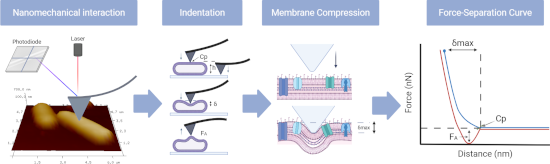
- performed in solution in a fluid chamber under controlled environmental conditions. Thus, critical structural changes on the lifestyle of the pathogen can be investigated [38][39][40][41][42]. Beyond imaging, AFM force spectroscopy capabilities are essential to extract material properties of the


Influence of ion beam current on the structural, optical, and mechanical properties of TiO2 coatings: ion beam-assisted vs conventional electron beam evaporation
Beilstein J. Nanotechnol. 2025, 16, 1097–1112, doi:10.3762/bjnano.16.81
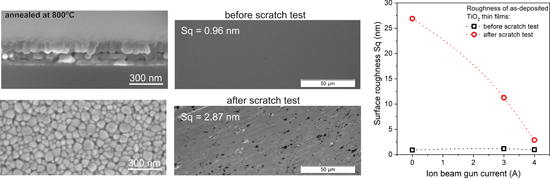
- on material properties. Abrasion resistance tests showed that the TiO2 film deposited using the EBE method was the least abrasion-resistant compared to the IBAD films. To conclude, the use of additional ion-beam assistance during thin film deposition by the EBE method significantly increases the




Time-resolved probing of laser-induced nanostructuring processes in liquids
Beilstein J. Nanotechnol. 2025, 16, 968–1002, doi:10.3762/bjnano.16.74
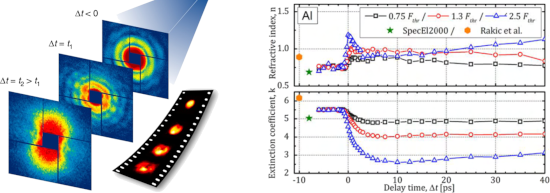
- ultrafast phenomena, enabling precise control of material properties [55][56][57][58]. This advancement has catalyzed new directions in nanomaterial processing and synthesis, such as producing controlled NPs through ultrafast laser–matter interactions. A notable example is the production of monodisperse NPs
- structural inhomogeneities drive emergent material properties, the ability to observe such local fluctuations is increasingly vital. Single-particle imaging with several nanometers spatial and several tens of nanoseconds temporal resolution has been demonstrated using electron microscopy [71]. By integrating
- parameters, improving reproducibility, and tailoring material properties for specific applications. Ultrafast optical techniques such as transient absorption spectroscopy (TAS) [84][85][86][87] have been applied to investigate the influence of the liquid environment on the energy relaxation processes of


Characterization of ion track-etched conical nanopores in thermal and PECVD SiO2 using small angle X-ray scattering
Beilstein J. Nanotechnol. 2025, 16, 899–909, doi:10.3762/bjnano.16.68
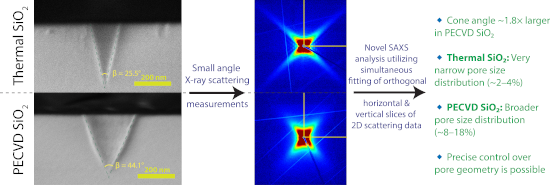
- , and nanofluidic applications. The characterization of the pore morphology and size distribution, along with its dependence on the material properties and fabrication parameters, is crucial to designing nanopore systems for specific applications. Here, we present a comprehensive study of track-etched
- variations in material properties. While thermal SiO2 typically exhibits high homogeneity in local material properties, factors such as the etching process and the ion irradiation energy straggling may introduce an effective narrow size distribution of pores. Although we apply a Schulz–Zimm distribution to


Ar+ implantation-induced tailoring of RF-sputtered ZnO films: structural, morphological, and optical properties
Beilstein J. Nanotechnol. 2025, 16, 872–886, doi:10.3762/bjnano.16.66
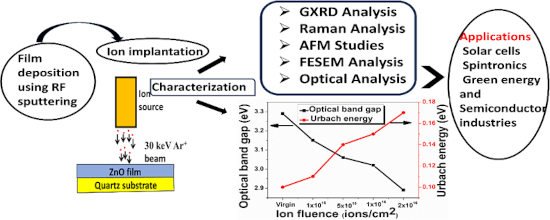
- control material properties by inducing damage and introducing defects in the host matrix in a controlled manner [8]. It offers the advantage of controlling the amount of energy transferred to the host system by selecting the desired ion energy, mass, and fluence [9]. Different types of lattice vacancies




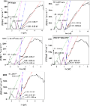


Synthesis and magnetic transitions of rare-earth-free Fe–Mn–Ni–Si-based compositionally complex alloys at bulk and nanoscale
Beilstein J. Nanotechnol. 2025, 16, 823–836, doi:10.3762/bjnano.16.62
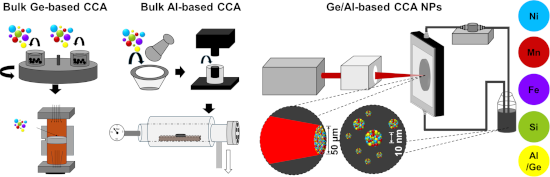
- ). This difference can be attributed to variations in alloy composition and material properties, which influence the ablation plume dynamics and particle formation kinetics during PLAL. Specifically, the thermal properties, such as melting point and heat conductivity, and the volatility of the alloy


Nanostructured materials characterized by scanning photoelectron spectromicroscopy
Beilstein J. Nanotechnol. 2025, 16, 700–710, doi:10.3762/bjnano.16.54
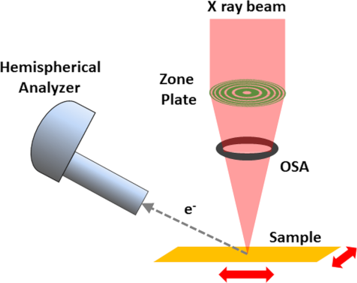
- 1i–k). Operando characterization of InP nanowire p–n junctions Semiconductor nanowires offer unprecedented possibilities in utilizing, combining, and modifying material properties for application in electronic, photonic, energy harvesting, or quantum information devices [15][16]. Their small