


Search results
Search for "orientation" in Full Text gives 646 result(s) in Beilstein Journal of Nanotechnology. Showing first 200.
Synthesis and characterization of RF-sputtered ZnTe/Cu2−xTe thin films for solar cell applications
Beilstein J. Nanotechnol. 2026, 17, 1016–1027, doi:10.3762/bjnano.17.69
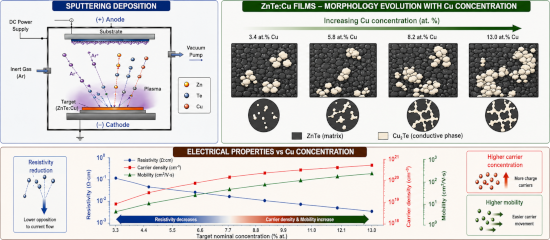
- glass substrate and n-type silicon wafers with (100) orientation. Silicon substrates were chosen to avoid interference from oxygen signals originating from the glass substrate during compositional analysis and to ensure reliable chemical quantification. Targets of two inches diameter were prepared by



Light-driven ammonia electrooxidation via carbon nitride–ruthenium molecular interfaces
Beilstein J. Nanotechnol. 2026, 17, 854–862, doi:10.3762/bjnano.17.61
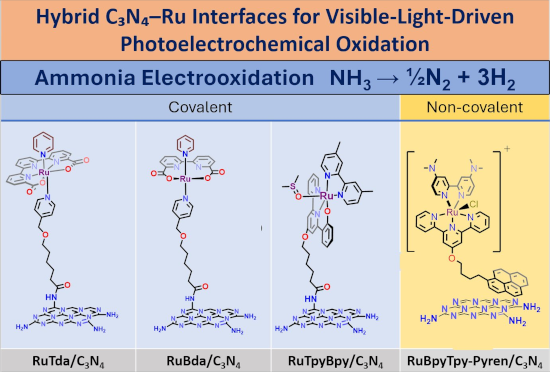
- geometrically regular array of π-stacking sites that can accommodate the flat pyrene anchor in a defined orientation, maximising electronic coupling between the catalyst and the semiconductor. Covalent and non-covalent bonding are not competing alternatives but complementary tools. Covalent anchoring


Glycerol photoelectrochemical oxidation reaction at carbon nitrides/BiVO4 materials
Beilstein J. Nanotechnol. 2026, 17, 806–817, doi:10.3762/bjnano.17.57
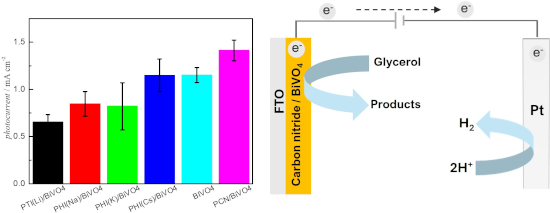
- oxidation depicted higher photocurrents and provided a protective effect against photocorrosion. The photoelectrochemical activity and selectivity of glycerol oxidation on BiVO4 are influenced by several factors, including pH [26], electrolyte cation and anion [28], BiVO4 surface crystallography orientation

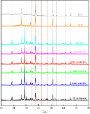


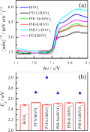
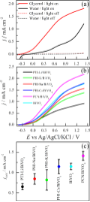

Tuning the electronic properties of defect-rich MoS2
Beilstein J. Nanotechnol. 2026, 17, 796–805, doi:10.3762/bjnano.17.56
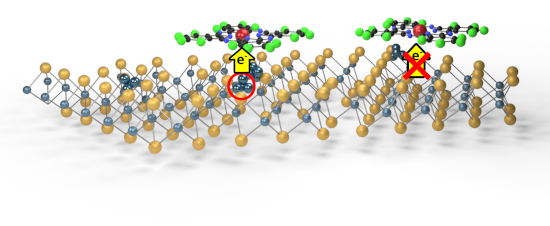
- spectroscopy (XAS), and angle-resolved photoelectron spectroscopy (ARPES) are powerful techniques for studying interfacial electronic structures with different surface sensitivities, the orientation of molecules in a heterostructure, and the band structure in proximity to the Fermi level. Using these
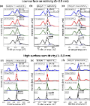
- XAS at the Co L2,3 edge. Co L2,3 edge XAS is sensitive to the interfacial electronic structure and provide information on molecular orientation. Co L2,3 spectra of CoPcF16 exhibit a typical multiplet structure, analogously to [11][33], with three primary features:, namely, A (polarized orthogonal to


Recent progress in enhancing built-in electric fields of perovskite solar cells via junction engineering
Beilstein J. Nanotechnol. 2026, 17, 602–621, doi:10.3762/bjnano.17.42
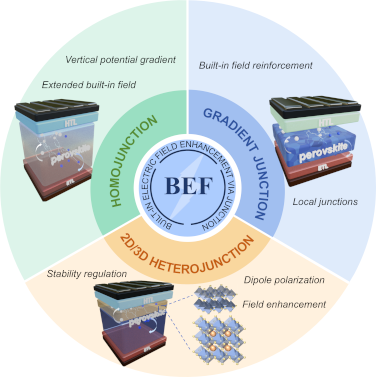
- controlled doping and orientation modulation, thereby suppressing nonradiative recombination and improving carrier extraction. Gradient junctions introduce continuous compositional or bandgap tilts across the film thickness, enabling depth-extended electric fields and improved spatial continuity of charge
- groundwork for the present review. Homojunctions focus on constructing continuous band bending and Fermi level gradients within the same material system using methods such as doping, surface reconstruction, or orientation induction, thereby smoothly extending the BEF from the interface into the bulk. Their
- simultaneously achieve bulk defect passivation and phase-order control, several studies have proposed an ionic-gradient strategy to establish a potential gradient while optimizing crystal orientation and carrier transport pathways [51]. Zhao et al. [41] introduced a gradually decreasing concentration of Ge2



Impacts of annealing on structural and photophysical properties of zinc phthalocyanine adsorbed on graphene
Beilstein J. Nanotechnol. 2026, 17, 576–585, doi:10.3762/bjnano.17.39
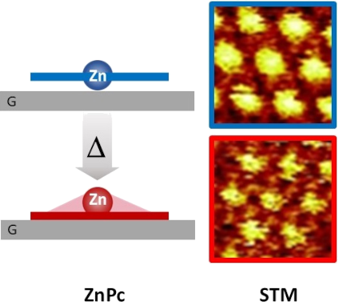
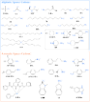
- molecular media, and are strongly influenced by various structural parameters at the molecular scale [13]. For example, face-on or edge-on orientation of π-conjugated molecules on graphene turns on or off π-stacking interactions with large consequences on hole conductivity and rectifying properties [14]. It
- forces, face-on versus edge-on molecule orientation, and planar-square versus shuttlecock molecule shape. Although the importance of thermal treatment on the interfacial structure of H2Pc [37] and ZnPc [38] on highly oriented pyrolytic graphite (HOPG) and graphene has been demonstrated, its mechanisms
- ; this experiment permits an evaluation of molecular orientation [25][47][48]. This analysis clearly shows that the vectors of transition dipole moments for the Q-band peak of ZnPc are oriented in-plane both before and after annealing. With respect to molecule geometry, the transition dipole moments for


Synthesis of Cu–Mo/TiO2 and Co–Mo/TiO2 photocatalysts for the efficient degradation of organic pollutants in water
Beilstein J. Nanotechnol. 2026, 17, 559–570, doi:10.3762/bjnano.17.37
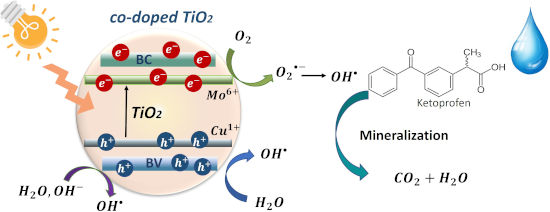
- only to the anatase phase, with a preferential orientation along the (101) plane. The photocatalytic activity of both anatase and rutile crystalline phases has been widely discussed in the literature, and it is generally accepted that anatase exhibits higher photocatalytic activity due to its higher



First-principles study on elastic properties of Cu, (Cu1−x,Nix)3Sn and interfacial mechanical properties of (Cu1−x,Nix)3Sn/Cu in the lead-free solder joint
Beilstein J. Nanotechnol. 2026, 17, 428–439, doi:10.3762/bjnano.17.29
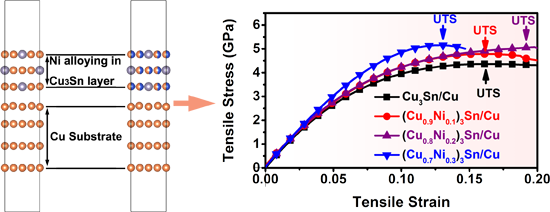
- orientation relationship of ε-Cu3Sn/Cu interfaces as (001)ε//(111)Cu and [100]ε//[−110]Cu [13], that is, the interface was constructed by attaching the (001) facet of ε-Cu3Sn to the (111) facet of the Cu substrate and making the [100] axis of ε-Cu3Sn parallel to the [−110] axis of Cu substrate. Based on the
- orientation relationship of the ε-Cu3Sn/Cu interface, an attempt to reveal the effects of Ni alloying on the strength and toughness of (Cu1−xNix)3Sn/Cu interface has been made in this study. At first, the elastic properties of (Cu1−xNix)3Sn and Cu were calculated, followed by evaluation of the intrinsic
- ductility in terms of elastic moduli. Subsequently, the orientation-dependent Young’s moduli of Cu and (Cu1−xNix)3Sn were calculated. Finally, tensile modulus, ultimate tensile stress, work of adhesion, and interfacial toughness of (Cu1−xNix)3Sn/Cu were calculated based the interface model with the


Biomimetic nanoparticles in cancer photodynamic therapy: a review of targeted delivery systems and therapeutic outcomes
Beilstein J. Nanotechnol. 2026, 17, 396–422, doi:10.3762/bjnano.17.27
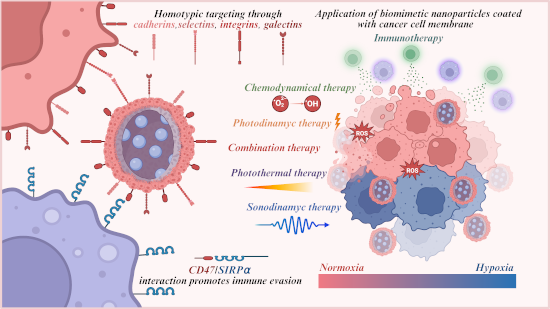
- % cell composition). Various methods exist for coating synthetic nanoparticle cores with biomimetic shells, each with unique advantages and limitations. A crucial factor is ensuring the correct “right-side-out” orientation of membrane proteins, which preserves system stability and enables proper
- interaction with target cells [58]. Common techniques include (i) physical co-extrusion, where nanoparticles and membranes are forced through porous membranes to form uniform coatings; (ii) sonication, which uses ultrasonic energy to induce membrane fusion and often favors correct protein orientation; and


Ferroelectric nanodot reservoir for neuromorphic computing
Beilstein J. Nanotechnol. 2026, 17, 352–364, doi:10.3762/bjnano.17.24
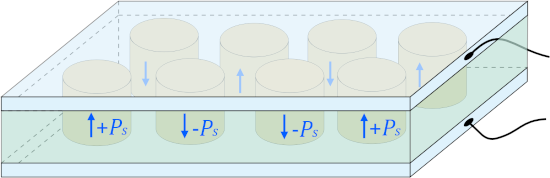
- orientation, either “up” or “down”, denoted as mi = ±1. The corresponding bound charges on the surfaces of the nanodots are equal to Qbi = miPsSi, where Si is the cross-sectional area of the i-th nanodot. The total free charge, Q = ±ΣiPsSimi ± Qe, redistributes over the electrodes to maintain equipotentiality


Calculation of the dynamic stiffness of a cantilever under torsional oscillation
Beilstein J. Nanotechnol. 2026, 17, 303–308, doi:10.3762/bjnano.17.21
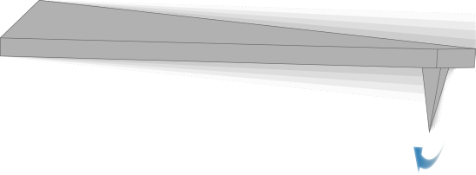
- the lateral interactions [7][12][13][14]. The torsional oscillation modes of AFM cantilevers are sensitive to in-plane interaction [15][16][17]. This method enabled highly accurate imaging of the in-plane crystalline orientation by utilizing friction information [14]. Quartz tuning fork AFM is useful

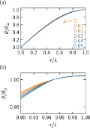
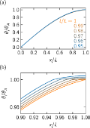
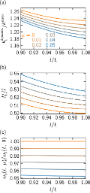
Advancing nanolithography: a comprehensive review of materials for local anodic oxidation with AFM
Beilstein J. Nanotechnol. 2026, 17, 275–291, doi:10.3762/bjnano.17.19
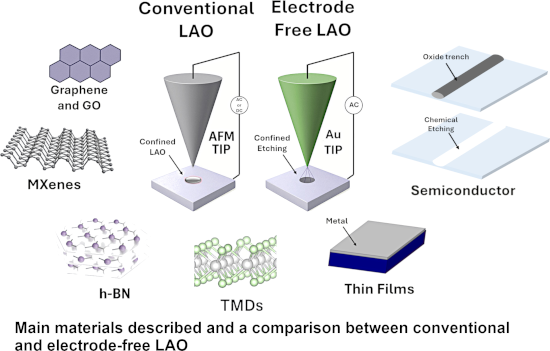
- . Additionally, the stability and integration of SiO2 within semiconductor workflows make it a reliable choice for robust electronic devices. However, silicon’s limitations include dependence on stringent surface preparation, Si crystal orientation (higher reaction rate on the (111) surface than on the other
- , which is critical for nanoscale patterning. Experimental observations report self-limiting oxide growth exceeding 100 nm [34]. As crystal orientation affects LAO on Si, the oxidation rate on c-plane 4H-SiC is higher than on other planes [92]. Challenges with SiC include the incorporation of residual


Micro- and nanoscale effects in biological and bioinspired materials and surfaces
Beilstein J. Nanotechnol. 2026, 17, 214–217, doi:10.3762/bjnano.17.14

- ]. For instance, Farran et al. [21] characterized orientation-dependent photonic bandgaps in scales of gold-dust weevils and titania-based artificial mimics of these scales obtained from sol–gel replication, aiding in the production of customizable photonic bandgaps for novel optical materials. On the
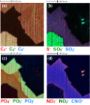
Time of flight secondary ion mass spectrometry imaging of contaminant species in chemical vapour deposited graphene on copper
Beilstein J. Nanotechnol. 2026, 17, 200–213, doi:10.3762/bjnano.17.13
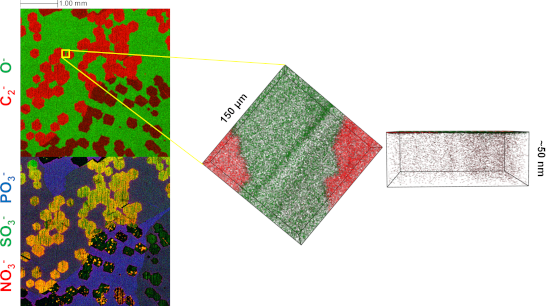
- ambient exposure detected on the surface. This is of note as the graphene/Cu interaction strength is known to depend on the Cu crystal orientation as well as the epitaxial relationship [49][50][51], which leads to anisotropy in the Cu oxidation rate at the graphene/Cu interface for different Cu
- industry application. It also appears that there are variations in the presence and distribution of these species, depending on the grain orientation of the underlying copper foil; the grain structure evident in Figure 4a as a change in intensity of the C2− signal due to crystal orientation enhancement of
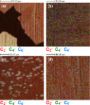
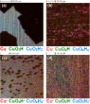
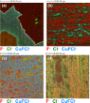
- the ion signal. This can further add to the potential variation in chemical composition of a grown graphene layer on copper foils, where crystal orientation is not well controlled [54]. To explore some of these species in more detail, Figure 5 shows 500 µm × 500 µm 2D ToF-SIMS surface images of the





Structure-dependent thermochromism of PAZO thin films: theory and experiment
Beilstein J. Nanotechnol. 2026, 17, 186–199, doi:10.3762/bjnano.17.12
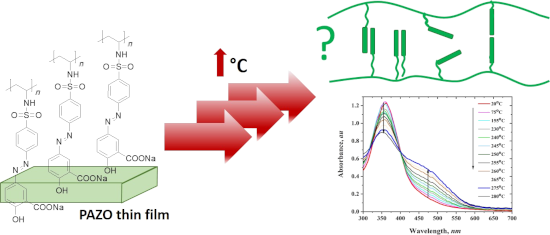
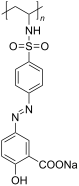
- isomerization leads to various effects, including molecular orientation, formation of surface relief structures, and photomechanical deformations. Consequently, azo polymers have been intensively studied as interesting photoresponsive materials [7][8][9][10][11]. One of the widely studied azo polymers is the
- rearrange upon external impact [16][24]. It is known that photoinduced birefringence in thin films containing azobenzene derivatives is generated by the orientation of chromophores in response to repeating cycles of E–Z–E photoisomerization [15]. After a given photoisomerization cycle, chromophores can be
- the PAZO polymer with a relatively accurate but computationally expensive method (DFT calculations), models of a fragment of the polymer main chain with four side chains were considered (Figure 7). PAZO is a polymer with ionized end groups and the orientation of PAZO chromophores is highly dependent


Development and in vitro evaluation of liposomes and immunoliposomes containing 5-fluorouracil and R-phycoerythrin as a potential phototheranostic system for colorectal cancer
Beilstein J. Nanotechnol. 2026, 17, 97–121, doi:10.3762/bjnano.17.7
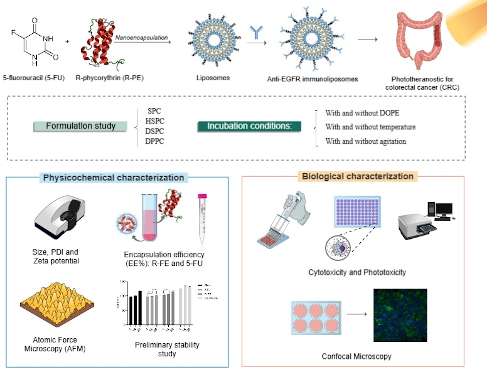
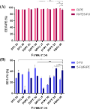
- efficiency than the formulation prepared at room temperature (25.22% vs 19.29%). This finding is supported by other studies, which demonstrated that elevated temperatures could alter the bilayer structure, negatively affecting ligand orientation and compromising functionalization efficiency [56]. Thus, the



Quantitative estimation of nanoparticle/substrate adhesion by atomic force microscopy
Beilstein J. Nanotechnol. 2026, 17, 1–14, doi:10.3762/bjnano.17.1

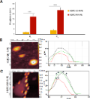
- energy, NP surface termination, relative orientation of the NP upon landing, and mechanical properties of NP and substrate [46][47]. However, a very decisive parameter is the impact velocity, which can be controlled by the substrate bias voltage applied during deposition. A higher bias voltage results in
- reality, the NPs are unlikely to be perfectly spherical; they likely possess facetted surfaces due to their crystalline nature. Consequently, both the interface energy and the mechanical properties can vary depending on the particle orientation and contacting facet, such as (001) and (111), as shown in [4



Chiral plasmonic nanostructures fabricated with circularly polarized light
Beilstein J. Nanotechnol. 2025, 16, 2245–2264, doi:10.3762/bjnano.16.154
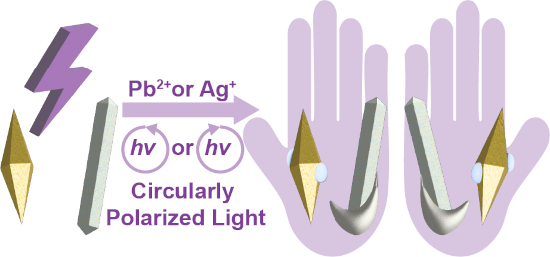
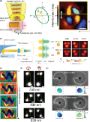
- orientation of the polarization plane of linearly polarized light when traveling through a chiral medium. It is related to the real part of the material refractive index, and a chiral material has a different index for LCPL and RCPL. CB is measured through ORD expressed by Equation 3: where nRCPL and nLCPL





Ultrathin water layers on mannosylated gold nanoparticles
Beilstein J. Nanotechnol. 2025, 16, 2183–2198, doi:10.3762/bjnano.16.151
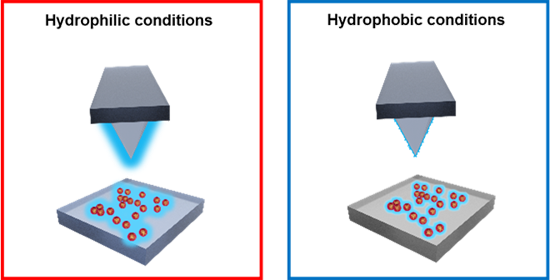
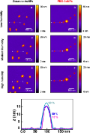
- CH2). Moreover, the peak is unusually broad, possibly due to the complex shape of the disordered PEG chains. However, this type of disorder refers to the conformation of the PEG chains only; altogether, the C–H stretching vibrations must have a preferred orientation with respect to the gold surface
- either to the other dipole orientation of the CH group between the two samples [27], or to the charges of the molecules being opposite [28]. The latter seems unlikely since the isoelectric points of the two samples are similar. From symmetry rules and the ssp-polarization, one can deduce that the CH2
- , surface composition, and controlled orientation of the dimanno-AuNPs suggest suitable candidates for emulating viral surface glycoproteins, such as influenza hemagglutinin, under hydration–dehydration cycles in air, which correspond to the conditions of viral transmission. Indeed, several viral pathogens



Molecular and mechanical insights into gecko seta adhesion: multiscale simulations combining molecular dynamics and the finite element method
Beilstein J. Nanotechnol. 2025, 16, 2055–2076, doi:10.3762/bjnano.16.141
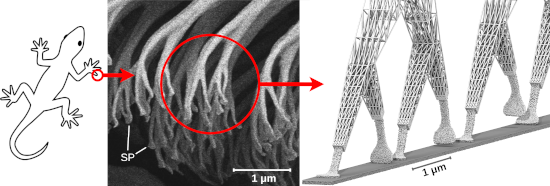
- . The model reproduces key aspects of spatula behavior during adhesion and detachment, showing that spatula–substrate contact evolves through a combination of bending, sliding, and peeling, depending on the spatula’s initial orientation. Our results further demonstrate that lateral sliding can delay
- , differences in adhesion originate from structure and geometry rather than interface chemistry. We analyzed the 16 spatulae individually. Figure 10, Figure 11, and Figure 12 report, respectively, their force, contact, and displacement profiles in a representative run. Across runs, orientation (pad- vs tip
- full pad contact without requiring shearing. Pull-off phase During pull-off, spatulae experienced bending, shearing, and detachment, depending on their orientation and distance from the pulling point: As pull-off began, odd-numbered spatulae (tip-dominated contact) unbent (Figure 12), restoring the tip






Laser ablation in liquids for shape-tailored synthesis of nanomaterials: status and challenges
Beilstein J. Nanotechnol. 2025, 16, 1963–1997, doi:10.3762/bjnano.16.137





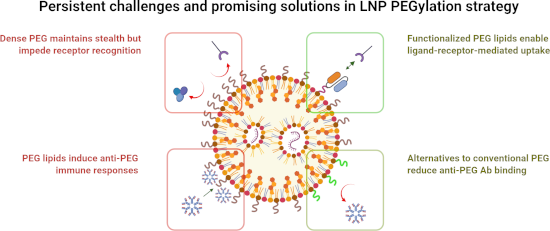
PEGylated lipids in lipid nanoparticle delivery dynamics and therapeutic innovation
Beilstein J. Nanotechnol. 2025, 16, 1914–1930, doi:10.3762/bjnano.16.133
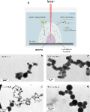
- of motional freedom could correspond to a brush conformation signature, where adjacent PEG chains force them into a linear orientation. In contrast, PEG chains in mushroom conformation would exhibit restricted motion and thus broader peaks [13]. While direct investigations into PEG conformations on



Targeting the vector of arboviruses Aedes aegypti with nanoemulsions based on essential oils: a review with focus on larvicidal and repellent properties
Beilstein J. Nanotechnol. 2025, 16, 1894–1913, doi:10.3762/bjnano.16.132
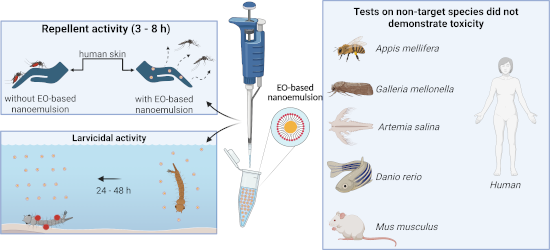
- , volatility, and skin permeation of the active compounds, prolonging the repellent effect due to the controlled release of these compounds [151][152]. The mechanism of action may involve interference with the olfactory system of the mosquitoes, masking host signals and disrupting orientation behavior [147


Beyond the bilayer: multilayered hygroscopic actuation in pine cone scales
Beilstein J. Nanotechnol. 2025, 16, 1695–1710, doi:10.3762/bjnano.16.119
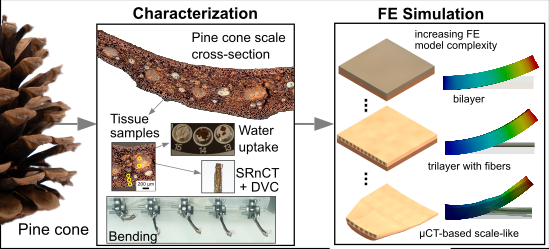
- measurements should include more cells to avoid conflicting results for the radial shrinkage. In addition, the original orientation during specimen preparation and imaging should remain traceable in order to differentiate between ab-/adaxial and lateral directions in the resulting images. The tissue average


Bioinspired polypropylene-based functionally graded materials and metamaterials modeling the mistletoe–host interface
Beilstein J. Nanotechnol. 2025, 16, 1592–1606, doi:10.3762/bjnano.16.113
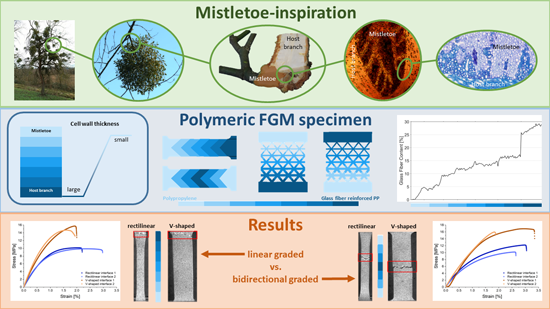
- -reinforced polypropylene and exhibits a continuously graded mistletoe-inspired V-shaped interface. Microtomographic analyses quantified the gradual transition of the glass fiber content along one specimen from 0 to 30%, further revealing the random fiber orientation in the polymer matrix. Tensile tests
- and the glass fibers [42][43]. All scans reveal the random orientation of the glass fibers in the PP matrix, with small areas of identical orientation being explained by the fiber alignment in the raw pellets (Figure 4C). Some distinct bright areas are visible at the edges of the specimen (Figure 4B
- the data sheet values were obtained by testing injection-molded test specimens, whereas our specimens were produced by hot pressing. Each method has an effect on the direction of the glass fibers; injection molding results in an anisotropic orientation of the fibers, whereas hot pressing results in





