


Search results
Search for "NIR light" in Full Text gives 38 result(s) in Beilstein Journal of Nanotechnology.
Near-infrared light harvesting of upconverting NaYF4:Yb3+/Er3+-based amorphous silicon solar cells investigated by an optical filter
Beilstein J. Nanotechnol. 2018, 9, 2788–2793, doi:10.3762/bjnano.9.260
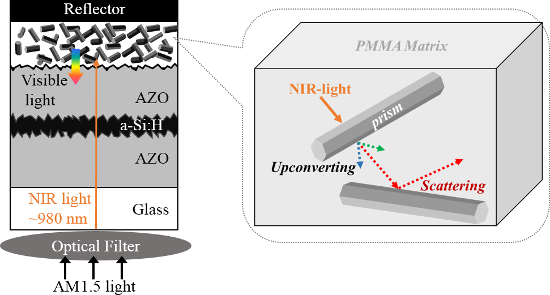
- the visible range; however, they are almost transparent for near-infrared radiation (NIR, 700–2500 nm), which constitutes 52% of the energy of the entire solar spectrum [2][3]. The transmittance of NIR light is one of the major energy-loss mechanisms for conventional a-Si:H solar cells [4][5]. This
- energy loss can be substantially reduced through spectral upconversion (UC) [6]. Spectral UC describes nonlinear anti-Stokes optical processes that can convert two (or more) NIR photons to a visible photon. In terms of its application in solar cells, UC is expected to convert the sub-bandgap NIR light to
- can be easily implemented on the rear side of solar cells, separated from the actual physics of the operating device [6]. Although the idea of using UC for improving the cell performance is obvious, relatively little work has been done so far [11]. Due to the relatively weak intensity of NIR light and


Fabrication of photothermally active poly(vinyl alcohol) films with gold nanostars for antibacterial applications
Beilstein J. Nanotechnol. 2018, 9, 2040–2048, doi:10.3762/bjnano.9.193
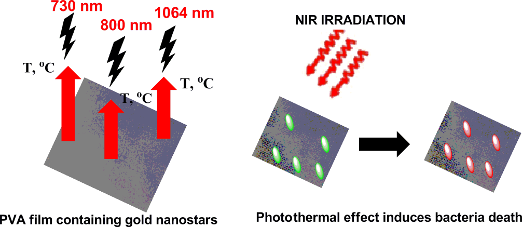
- materials that can coat surfaces and are capable of eradicating biofilms with remote physical activation. Even though gold nanoparticles are not intrinsically antibacterial, the thermal relaxation upon NIR light activation can be a major force of antibacterial action as it was shown for monolayers of GNSs
- photothermal effect [6][24]. Moreover, the LSPR peak located in the second biotransparent window (1000–1400 nm) is more attractive for in vivo applications due to the deeper penetration of NIR light [26]. Since GNSs are weakly stable if coated only with surfactant, and also considering the cytotoxicity of
- irradiation The films were irradiated with NIR light at λ = 800 nm (Tsunami, Spectra Physics, CA, USA; pulse repetition rate 80 MHz, pulse width 200 fs), at λ = 730 nm (Mai Tai, Spectra Physics, USA) and at λ = 1064 nm (temperature-controlled laser diodes, ThorLabs, Germany or 1064 Ventus, Laser Quantum, UK


Mechanistic insights into plasmonic photocatalysts in utilizing visible light
Beilstein J. Nanotechnol. 2018, 9, 628–648, doi:10.3762/bjnano.9.59
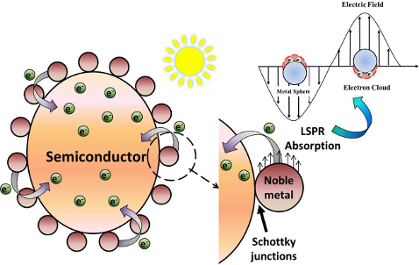
- spatial charge separation of photoinduced carriers by creating an alternate permutation of band edges at the interface [146]. Some researchers found that both titanium nitride (TiN) and zirconium nitride (ZrN) displayed similar optical properties as Au and can replace Au NPs for vis–NIR light absorption
- [147][148]. Bio-inspired plasmonic nanostructures/architectures The pioneering works of several research groups have revealed that by mimicing biological systems, such as butterfly wings [149] and snake skin [150], systems can be designed that are cable of absorbing NIR light due to their distinctive





Sugarcane juice derived carbon dot–graphitic carbon nitride composites for bisphenol A degradation under sunlight irradiation
Beilstein J. Nanotechnol. 2018, 9, 353–363, doi:10.3762/bjnano.9.35
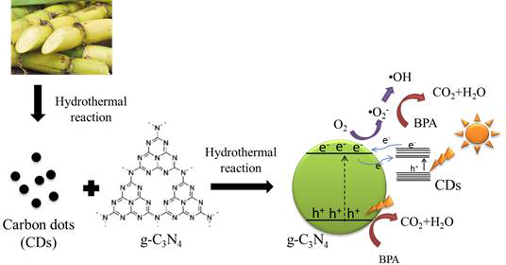
- absorption spectra after titanium dioxide (TiO2) loading [28] and acid treatment [29], the incorporation of CDs into g-C3N4 consistently red-shifted the absorption spectra towards the visible and NIR region. However, the photocatalytic performance of the composites is possibly limited under NIR light
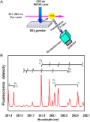
- irradiation because the UCPL properties of CDs (which could overcome the low energy of NIR-light photons to initiate the excitation of electrons) are not detected in Figure 3b. The PL spectra in Figure 3d were evaluated to determine the charge separation efficiency of all composites. The recombination of
- well with the UV DRS results (Figure 3c), in which the increasing concentration of CDs resulted in stronger photosensitizing effect in the composite, thus leading to a broader absorption band in the visible and NIR light region compared to that of pure g-C3N4. This indicates that the electrons can be


Synthesis and functionalization of NaGdF4:Yb,Er@NaGdF4 core–shell nanoparticles for possible application as multimodal contrast agents
Beilstein J. Nanotechnol. 2017, 8, 1815–1824, doi:10.3762/bjnano.8.183
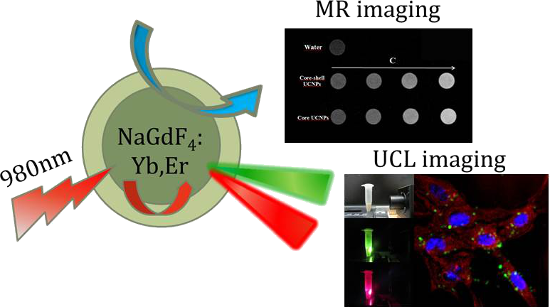
- detectors from reflected and scattered NIR light. Cell viability assay: MCF-7 and MDA-MB-231 human breast cancer cells were seeded on a 96-well plate at a density of 20,000 cells/well. After 24 h, the old medium was replaced with a fresh medium containing 5, 10, 20, 50 and 100 µg/mL core–shell UCNPs. 12


Near-infrared-responsive, superparamagnetic Au@Co nanochains
Beilstein J. Nanotechnol. 2017, 8, 1680–1687, doi:10.3762/bjnano.8.168
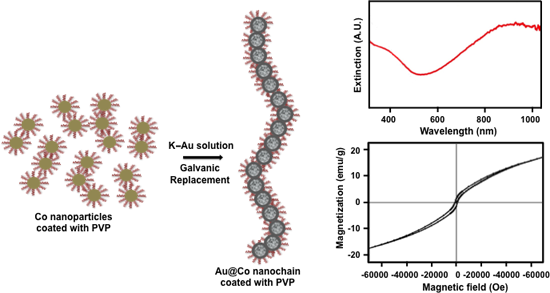
- minimally absorbed by tissue chromophores and water [24]. Therefore, tunable plasmonic nanoparticles that can respond to NIR light and can be manipulated with a magnetic field hold great promise. Among various magnetic nanoparticles, cobalt nanoparticles have attracted much interest due to their strong


Nanostructured germanium deposited on heated substrates with enhanced photoelectric properties
Beilstein J. Nanotechnol. 2016, 7, 1492–1500, doi:10.3762/bjnano.7.142
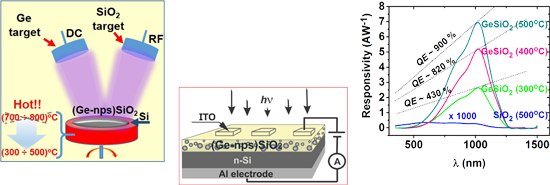
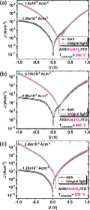
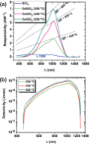
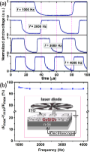
- and 500 °C have very similar values we present in the following the response speed data obtained on the samples deposited at 400 °C. Figure 8a presents the response speed characteristics of the photodetector test structure fabricated at 400 °C, exposed to pulsed NIR light (808.5 nm) with different
- bias respectively; b) spectral detectivity for Al/n-Si/Ge:SiO2/ITO structures obtained at different temperatures. Photovoltaic response speed of the photodetector structure (fabricated at 400 °C) under pulsed (Pin = 7.6 mW) NIR light (808.5 nm laser): (a) with frequency of 1000, 2000, 3000 and 4000 Hz




Silica-coated upconversion lanthanide nanoparticles: The effect of crystal design on morphology, structure and optical properties
Beilstein J. Nanotechnol. 2015, 6, 2290–2299, doi:10.3762/bjnano.6.235
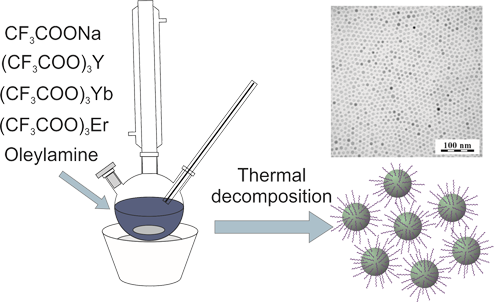
- as low toxicity [11], sharp emission bandwidths, large anti-Stokes shifts [12] and high resistance to photobleaching and photoblinking [13]. NIR light can non-invasively penetrate living organisms deeply because the excitation wavelength is within the optical transparency window of tissues (700–1000






Nonlinear optical properties of near-infrared region Ag2S quantum dots pumped by nanosecond laser pulses
Beilstein J. Nanotechnol. 2015, 6, 1781–1787, doi:10.3762/bjnano.6.182
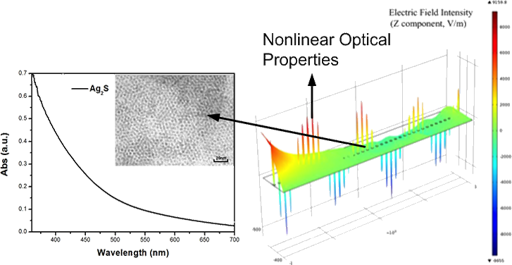
- -infrared region (NIR) emission, such as PbSe, PbS, and CuInS2 [7][8]. These are non-cadmium-based QDs, and the use of NIR light solves the autofluorescence problem through the reduction of the fluorescence background [9][10][11]. Previous research has demonstrated that Ag2S QDs may be good candidates for



Polymer blend lithography for metal films: large-area patterning with over 1 billion holes/inch2
Beilstein J. Nanotechnol. 2015, 6, 1205–1211, doi:10.3762/bjnano.6.123
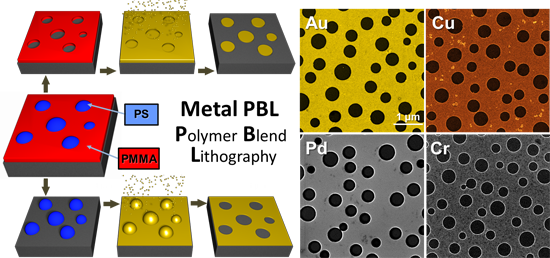
- wavelength-selective optical filters. In the case of our examples they let NIR light pass and block photons with longer wavelengths. It is also possible to combine the perforated metal films with micelle lithographic technique [34][35] to implant gold dots with diameter of 10 nm into the holes to form


Tm-doped TiO2 and Tm2Ti2O7 pyrochlore nanoparticles: enhancing the photocatalytic activity of rutile with a pyrochlore phase
Beilstein J. Nanotechnol. 2015, 6, 605–616, doi:10.3762/bjnano.6.62
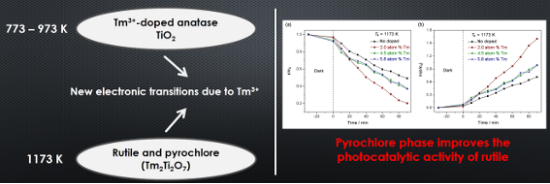
- , USB4000+) with a UV–vis–NIR light source (Ocean Optics, DH-2000-BAL). Results and Discussion Inductively coupled plasma–atomic emission spectroscopy Table 1 shows the weight percentage values of Tm with respect to TiO2, obtained by ICP–AES and calculated as the arithmetic average of the values obtained


Overview about the localization of nanoparticles in tissue and cellular context by different imaging techniques
Beilstein J. Nanotechnol. 2015, 6, 263–280, doi:10.3762/bjnano.6.25
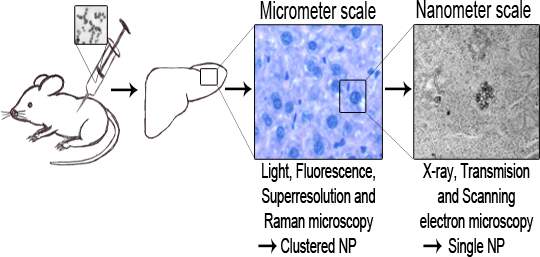
- emission of light at shorter wavelength than the excitation wavelength [91]. UCNP feature a reduced cytotoxicity compared to QD and are, in contrast to fluorescent dyes or QD, excited by near infrared (NIR) light. By using long-wavelength NIR instead of ultra violet (UV) light, background autofluorescence
- typically caused by collagen and other autofluorescent structures of tissues is dramatically reduced [92]. NIR light penetrates deeper into biological tissue and thus in vivo tracking of UCNP holds promising applications [93]. The properties, synthesis as well as options of modifications and applications of



In vitro toxicity and bioimaging studies of gold nanorods formulations coated with biofunctional thiol-PEG molecules and Pluronic block copolymers
Beilstein J. Nanotechnol. 2014, 5, 546–553, doi:10.3762/bjnano.5.64
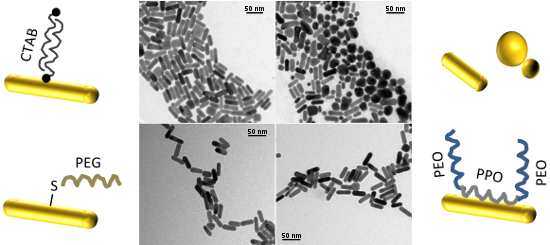
- longitudinal absorption peak within the range from 600 to 1500 nm [6]. It is well recognized that near infrared (NIR) light is able to penetrate the human tissue up to a few centimeters since water and blood cells absorb light only minimally at this region. AuNRs can be designed to absorb light specifically in





