


Search results
Search for "ORR" in Full Text gives 36 result(s) in Beilstein Journal of Nanotechnology.
From lithium to sodium: cell chemistry of room temperature sodium–air and sodium–sulfur batteries
Beilstein J. Nanotechnol. 2015, 6, 1016–1055, doi:10.3762/bjnano.6.105
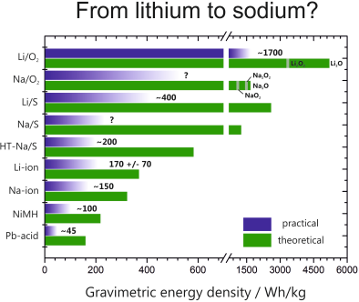
- , lithium is oxidized at the negative electrode and oxygen is reduced on the positive electrode. Similar to a fuel cell cathode, the positive electrode is a porous, electron-conducting support (gas diffusion layer, GDL) that enables oxygen transport, oxygen reduction (ORR) and oxygen evolution (OER) during
- ORR/OER reactions in metal–air batteries is not sufficient as also plating/stripping of the alkali metal needs to be reversible in order to achieve a long cycle life. Cell discharge using this IL based electrolyte at 25 µA/cm2 was characterized by a sloping decrease, charging (250 µA/cm2) mainly


Materials and characterization techniques for high-temperature polymer electrolyte membrane fuel cells
Beilstein J. Nanotechnol. 2015, 6, 68–83, doi:10.3762/bjnano.6.8
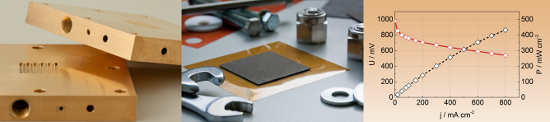
- specific adsorption of the phosphoric acid electrolyte is known to hamper the oxygen reduction reaction activity on the cathode side. Moreover, the low solubility and diffusivity of oxygen in concentrated phosphoric acid has a negative effect on the ORR [14][15]. These problems are specific to phosphoric
- higher than the typical Pt loading reported for LT-PEMFCs (0.1–0.4 mg/cm2). The high noble-metal loading is mainly accounted to the pure utilization of platinum because the electrolyte partially floods the catalyst layer. In addition, the anion adsorption impedes the ORR in concentrated phosphoric acid




Manganese oxide phases and morphologies: A study on calcination temperature and atmospheric dependence
Beilstein J. Nanotechnol. 2015, 6, 47–59, doi:10.3762/bjnano.6.6
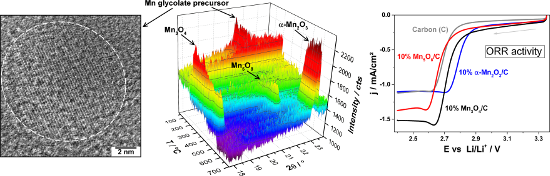
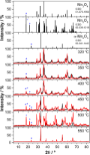
- oxygen reduction reaction (ORR), linear sweep measurements were carried out. Figure 9 shows linear sweep measurements recorded at 50 mV/s comparing the activity of various 10% MnOx/carbon electrodes to a pure carbon electrode as a reference material for the ORR in aprotic electrolyte. The ORR peak
- of transferred electrons, F is the Faraday constant, and CO2 = 2.1∙10−6 mol cm−3 is the oxygen solubility in DMSO [39]. The mean ORR peak potential of the carbon reference material given in Table 2 is observed at 2.58 V. The only MnOx species with a significant increase of the ORR potential of 100 mV
- with respect to the carbon as well as the other MnOx/C electrodes is the mesoporous α-Mn2O3 catalyst. The obvious activity is reflected in the approximately four- and two-fold larger apparent ORR rate constant compared to the carbon and the other MnOx/C electrodes, respectively. A detailed kinetic and





Donor–acceptor graphene-based hybrid materials facilitating photo-induced electron-transfer reactions
Beilstein J. Nanotechnol. 2014, 5, 1580–1589, doi:10.3762/bjnano.5.170
- EDTA and re-complexes after fresh addition of Fe(II) (Scheme 2). Furthermore, Fe–tpy–GO was tested as a catalyst for the oxygen reduction reaction (ORR) and found to be durable against carbon monoxide poisoning and to exhibit a higher fuel selectivity compared with commercially available Pt/C electro
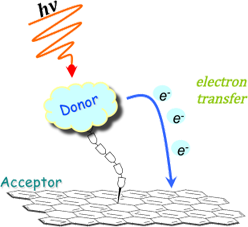
- -catalysts. The ORR reactivity is tightly connected to electron transfer processes, thus indicating indirectly the occurrence of such phenomena. Ruthenium(II) was also employed as a coordinating cation and resulted in a Ru–tpy–GO hybrid material with an enhanced photocurrent response, higher than GO and Fe


Liquid fuel cells
Beilstein J. Nanotechnol. 2014, 5, 1399–1418, doi:10.3762/bjnano.5.153
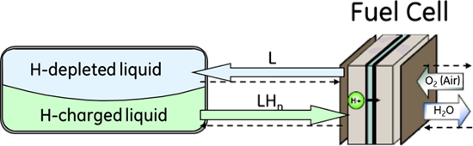
- reaction (HOR) and oxygen reduction reaction (ORR), but it is very expensive. To reduce the Pt loading and therefore the cost for the electrocatalyst, Pt-containing alloys and structured nanoparticles, e.g., “core–shell” materials with less expensive metals are being investigated. Alkaline fuel cells are
- based on the transport of hydroxide ions through an anion-exchange membrane (AEM); the anode and cathode reactions are shown in Equation 4 and Equation 5, respectively (Figure 2b). They have the advantage of a lower redox potential for ORR in basic media (Equation 5). First such cells were developed at
- interesting concept of an EG fuel cell using a LaSr3Fe3O10 ceramic disk as a membrane and ORR catalyst was demonstrated in a cell with 10 wt % EG, 10% KOH and FeCoNi/C anode catalyst to give oxalic acid as a major product (Equation 15) and a power density of 27 mW/cm2 [106]. Direct glycerol fuel cells

Synthesis, characterization, and growth simulations of Cu–Pt bimetallic nanoclusters
Beilstein J. Nanotechnol. 2014, 5, 1371–1379, doi:10.3762/bjnano.5.150
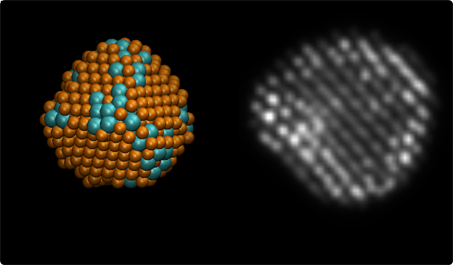
- bimetallic (Pt–Co, Pt–Fe, Pt–Ni, Pt–Pd) nanocrystals with octahedral and cubic shape and examined their facet-dependent catalytic performance for the oxygen reduction reaction (ORR). Guo and co-workers [33] synthesized FePt and CoPt nanowires by organic-phase decomposition and demonstrated that these systems
- are good catalysts for the ORR. Yun and co-workers [34] developed a unified embedded atom model to investigate the most energetically favorable atomic arrangements of Pd–Pt, Cu–Pt, Au–Pt and Ag–Pt nanoalloys using Monte Carlo simulations, obtaining intermetallic compounds for the Pd–Pt system, onion
- , formic acid electro-oxidation, and ORR, in comparison with other Pt-based nanoparticles [40][41][42]. In this paper, we describe the synthesis of monodispersed sub-3 nm Cu–Pt BM nanoclusters, and their characterization by spherical aberration (Cs)-corrected scanning transmission electron microscopy (STEM


Constant-distance mode SECM as a tool to visualize local electrocatalytic activity of oxygen reduction catalysts
Beilstein J. Nanotechnol. 2014, 5, 141–151, doi:10.3762/bjnano.5.14
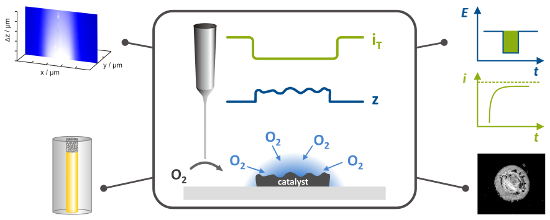
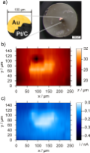
- elevated temperatures was recently described in [18]. In this contribution, we demonstrate the feasibility of 4D SF/CD-SECM to the topography-corrected investigation of the oxygen consumption profile of catalyst spots using commercially available model catalyst for the oxygen reduction reaction (ORR
- ) [29][30] with the 4D SF/CD mode (by analogy named as 4D SF/CD-RC-SECM) for high-resolution SECM investigations of heterogeneous oxygen reduction catalysts is introduced as a strategy to further adapt the SECM detection scheme towards local visualization of ORR catalyst activity with high resolution
- . Results and Discussion Constant-distance mode imaging of catalyst spots The investigation of the activity of catalysts for ORR using SECM is commonly performed in a competition arrangement. A scheme of this variation of the generator/collector mode is shown in Figure 1a. The sample is polarized at a




Design criteria for stable Pt/C fuel cell catalysts
Beilstein J. Nanotechnol. 2014, 5, 44–67, doi:10.3762/bjnano.5.5
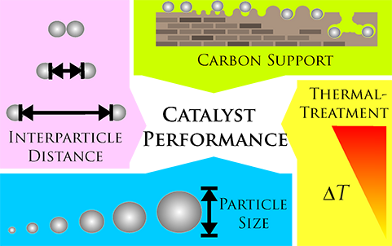
- facile hydrogen oxidation reaction (HOR) at the anode side as well as the more sluggish oxygen reduction reaction (ORR) at the cathode side of the fuel cell [2]. The state of the art electrocatalyst for both electrodes are Pt or Pt-alloys dispersed in the form of nanoparticles on a carbon support, in
- order to achieve a maximum of active sites. Practical performance, however, not only demands high activities per mass for the ORR, but also stability against the aggressive conditions that occur in the fuel cell under operation, particularly on the cathode side [3]. While significant knowledge on
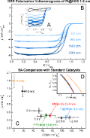
- the activity comparison and was manufactured by mild thermal treatment of the Pt/Vulcan 3–4 nm material. Results and Discussion Activity of Pt/C materials Before focusing on stability, it is essential to compare the activity of the synthesized materials for the ORR (Pt@HGS 1–2 nm, Pt@HGS 3–4 nm and Pt




Some reflections on the understanding of the oxygen reduction reaction at Pt(111)
Beilstein J. Nanotechnol. 2013, 4, 956–967, doi:10.3762/bjnano.4.108
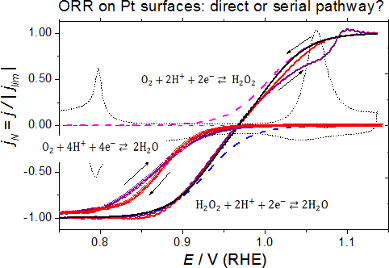
- Ana M. Gomez-Marin Ruben Rizo Juan M. Feliu Instituto de Electroquímica, Universidad de Alicante, Apt. 99, Alicante, E-03080, Spain 10.3762/bjnano.4.108 Abstract The oxygen reduction reaction (ORR) is a pivotal process in electrochemistry. Unfortunately, after decades of intensive research, a
- fundamental knowledge about its reaction mechanism is still lacking. In this paper, a global and critical view on the most important experimental and theoretical results regarding the ORR on Pt(111) and its vicinal surfaces, in both acidic and alkaline media, is taken. Phenomena such as the ORR surface
- structure sensitivity and the lack of a reduction current at high potentials are discussed in the light of the surface oxidation and disordering processes and the possible relevance of the hydrogen peroxide reduction and oxidation reactions in the ORR mechanism. The necessity to build precise and realistic


Lithium peroxide crystal clusters as a natural growth feature of discharge products in Li–O2 cells
Beilstein J. Nanotechnol. 2013, 4, 758–762, doi:10.3762/bjnano.4.86
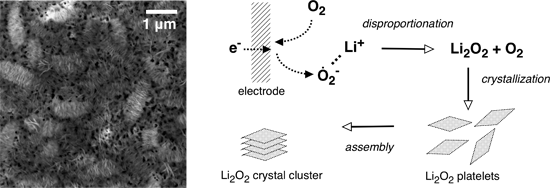
- oxygen reduction reaction (ORR). This feature limits the rechargeability of Li–O2 cells, but at the same time it can be beneficial for both capacity improvement and gain in recharge rate if a proper liquid phase mediator can be found. Keywords: lithium–air batteries; lithium peroxide; oxygen reduction
- similar crystal clusters composed of thin platelets. This finding suggests that lithium peroxide particles can be formed right upon the formation of superoxide anions without the influence of the surface of the electrode. After being produced by either the electrochemical ORR or the chemical reaction with


Electrochemical and electron microscopic characterization of Super-P based cathodes for Li–O2 batteries
Beilstein J. Nanotechnol. 2013, 4, 665–670, doi:10.3762/bjnano.4.74
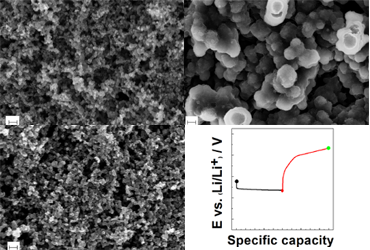
- products during the operation of a typical Li–O2 battery. In this context, recently published literature [1][2][3] gives new insights about the mechanism through which the reduction and the oxidation of oxygen occur in aprotic environments. During discharge, the oxygen reduction reaction (ORR) proceeds in





