Search results
Search for "Young’s modulus" in Full Text gives 155 result(s) in Beilstein Journal of Nanotechnology.
Laser-processed antiadhesive bionic combs for handling nanofibers inspired by nanostructures on the legs of cribellate spiders
Beilstein J. Nanotechnol. 2022, 13, 1268–1283, doi:10.3762/bjnano.13.105
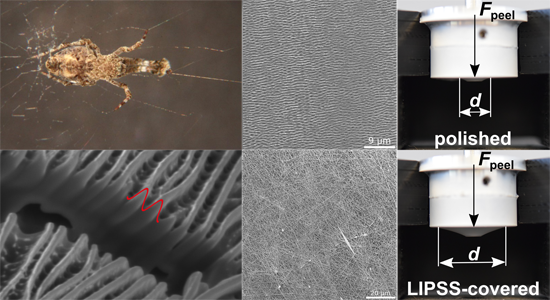
- quite significantly from spider silk fibers regarding diameter and material properties (e.g., Young’s modulus). In this work, we present a theoretical model of the interaction of nanofibers with a sinusoidal surface based on an energy approach. This model allows for a prediction of the adhesive







Biomimetic chitosan with biocomposite nanomaterials for bone tissue repair and regeneration
Beilstein J. Nanotechnol. 2022, 13, 1051–1067, doi:10.3762/bjnano.13.92
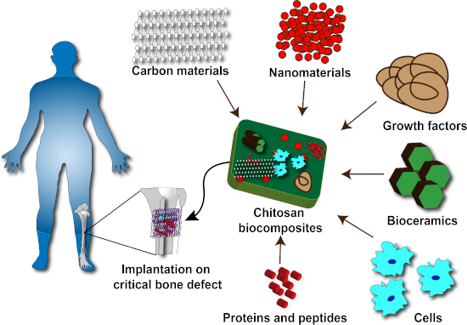
- -linker either with acetic acid or lactic acid. The physicochemical characterisation of the composites was evaluated to prove that the composites were suitable for bone tissue engineering applications. The mechanical strength of the composites was proven through increased Young’s modulus. The surface
Interaction between honeybee mandibles and propolis
Beilstein J. Nanotechnol. 2022, 13, 958–974, doi:10.3762/bjnano.13.84
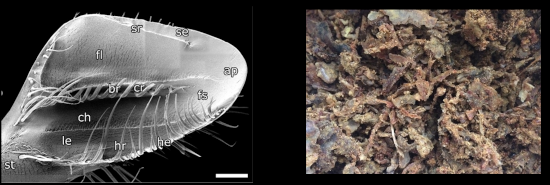
- of propolis adhesion under different conditions and on different substrates was performed with a one-way ANOVA and a pairwise multiple comparison procedure (Tukey test). An unpaired two-sample t-test was performed to compare the mean Young’s modulus of propolis at 24 and 26 °C. Correlation analysis
- of Young’s modulus and work of adhesion obtained from adhesion experiments was performed by calculating the Pearson correlation coefficient. Results Honeybee mandible When bees handle propolis, the mandibles are the first surfaces that will come into contact with plant resin or propolis. They were


Micro-structures, nanomechanical properties and flight performance of three beetles with different folding ratios
Beilstein J. Nanotechnol. 2022, 13, 845–856, doi:10.3762/bjnano.13.75
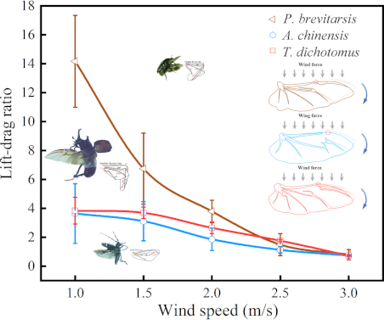
- nanomechanical characteristics were tested using a nanoindenter (TriboIndenter, Hysitron Inc., USA). The reduced Young’s modulus, Er, is calculated as where β is a constant related to the shape of the head (for a Berkovich indenter, the value is 1.034). Ac is contact the area and a polynomial function of
- [42]. Nanomechanical analysis of the hind wings Nanomechanical test results are shown in Figure 4. The nanomechanical properties of the hind wings of the three beetles change according to the same trend. The maximum values of the reduced Young’s modulus, Er, were all measured at test point II (the end
- and the nanomechanical properties of the hind wings of the three beetles and the cross-sectional morphology of different wing veins were observed and tested with super depth-of-field microscopy, nanoindentation, and scanning electron microscopy. Thus, the folding ratios, reduced Young’s modulus, and





Gelatin nanoparticles with tunable mechanical properties: effect of crosslinking time and loading
Beilstein J. Nanotechnol. 2022, 13, 778–787, doi:10.3762/bjnano.13.68
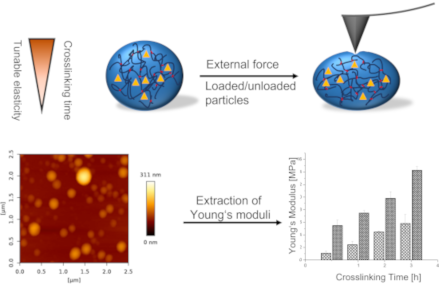
- . Keywords: atomic force microscopy; drug delivery; elasticity; gelatin nanoparticles; Young’s modulus; Introduction Developing nanoparticulate drug carriers for various diseases and application routes requires establishing controllable systems, matching the needs of the respective application to achieve
- tumor [8]. This behavior might be exploited for targeting or evading specific cell types. In this context, the cell type also plays a crucial role [7]. Overall, looking at the differences exhibited by the use of different materials for nanoparticle preparation, the favorable Young’s modulus should be
- determination of the Young’s modulus of single particles. The resulting mechanical properties could be correlated with the crosslinking time and extent. Additionally, loading of the macromolecule FITC-dextran 70 kDa into the particle matrix showed no statistically significant effect on particle sizes but


Electrostatic pull-in application in flexible devices: A review
Beilstein J. Nanotechnol. 2022, 13, 390–403, doi:10.3762/bjnano.13.32
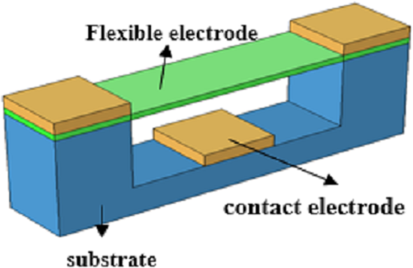
- functionality of nanostructures to process external stimuli applied to the device controlling the electrical current [12]. The lower pull-in voltage and the improved durability of the NEM switches require electrode materials with high Young’s modulus, conductivity, and Poisson's ratio. The flexible suspension


Micro- and nanotechnology in biomedical engineering for cartilage tissue regeneration in osteoarthritis
Beilstein J. Nanotechnol. 2022, 13, 363–389, doi:10.3762/bjnano.13.31
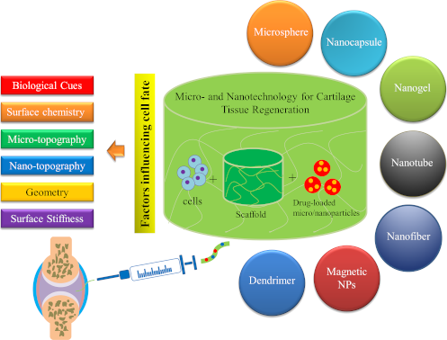
- tissue engineering. The results demonstrated that the incorporation of CNTs into PCL scaffolds improved the mechanical properties, such as failure stress, yield stress, and Young’s modulus, and had no adverse effects on MSC survival [136]. Due to the specific orientation of chondrocytes, tissue
- engineering faces a limitation to mimic the architecture of cartilage. Therefore, Janssen et al. used VA–MWCNT micropillars to induce an unidirectional orientation of chondrocytes [137]. The Young’s modulus of the VA–MWCNT micropillars was in the range of the natural ECM of articular cartilage. The


Theoretical understanding of electronic and mechanical properties of 1T′ transition metal dichalcogenide crystals
Beilstein J. Nanotechnol. 2022, 13, 160–171, doi:10.3762/bjnano.13.11
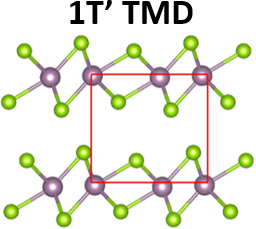
- ′ polytype; anisotropy; density functional theory; layered transition metal dichalcogenide crystals; shear modulus; Young’s modulus; Introduction Layered transition metal dichalcogenides (TMDs) have received increasing attention as important and versatile materials for new applications in different sectors
- relate to interlayer interactions [30][31]. The research by Liu et al. also demonstrated a correlation between interlayer sliding and Young’s modulus [32]. Therefore, it is imperative to have a comprehensive understanding of the electronic and mechanical characteristics of 1T′ TMD materials in relation
- ability to predict the mechanical characteristics of 1T′ TMD materials [33]. In this comparative study, the electronic and mechanical properties including shear modulus (G), bulk modulus (B), Young’s modulus (Y), Poisson’s ratio (ν), and microhardness (H), of MoS2, MoSe2, WS2, and WSe2 crystals with the



Alteration of nanomechanical properties of pancreatic cancer cells through anticancer drug treatment revealed by atomic force microscopy
Beilstein J. Nanotechnol. 2021, 12, 1372–1379, doi:10.3762/bjnano.12.101
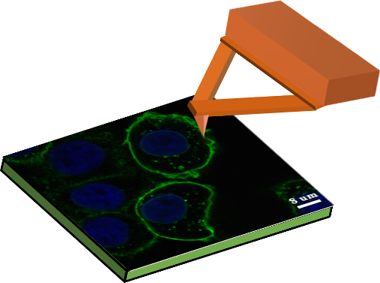
- cells of each type were measured for statistical analysis. The Hertz model is used in the calculation of cell mechanical properties. The force (F) exerted by the probe on the cell can be expressed by the following equation, where E is the Young’s modulus, ν is the poisson ratio, α is the half-opening
- angle of the probe, and δ is the indentation depth. Thus the E can be calculated by transforming the above equation: Hence the Young’s modulus can be calculated by fitting the linear part of the force–distance curves, that is, the slope of the force–distance curve. Energy dissipation is the loss of
- the cancer cells from the normal ones, the mechanical properties underneath the topography of different cells were evaluated. Figure 3 shows the nanomechanical mapping, typical force–distance curve and the corresponding Young’s modulus distributions of single cells of different types. For the


An overview of microneedle applications, materials, and fabrication methods
Beilstein J. Nanotechnol. 2021, 12, 1034–1046, doi:10.3762/bjnano.12.77
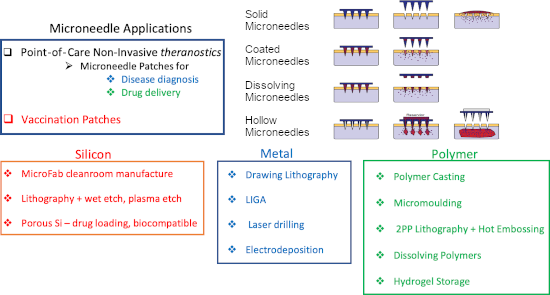
- crystal silicon and provide a degree of biodegradability, but their fabrication methods are relatively complex and involve the use of toxic and corrosive chemicals like HF. In addition, the mechanical properties of materials, including Young’s modulus, significantly degrade with increasing porosity. (Note


Numerical analysis of vibration modes of a qPlus sensor with a long tip
Beilstein J. Nanotechnol. 2021, 12, 82–92, doi:10.3762/bjnano.12.7
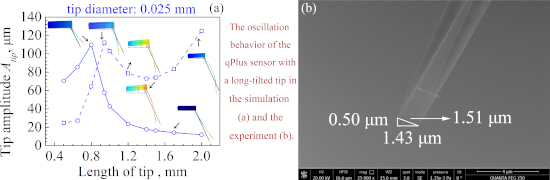
- . Table 1 summarizes the parameters used, including Young’s modulus, Poisson’s ratio, mass density, and damping coefficients for all materials considered. The values for Torr seal epoxy were chosen as in the papers by Dennis van Vörden et al. [25] and Omur E. Dagdeviren and co-workers [26]. The parameters






Application of contact-resonance AFM methods to polymer samples
Beilstein J. Nanotechnol. 2020, 11, 1714–1727, doi:10.3762/bjnano.11.154
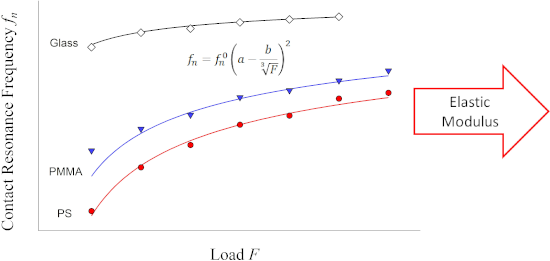
- b, density ρ, and Young’s modulus Et. The tip mass, being typically much smaller than the cantilever mass, is neglected. The tip is located at a distance L1 < L from the clamped end of the cantilever. The flexural spring constant of the cantilever is [2]. The tip–sample interaction can be modeled
- analysis, scanning CR-AFM modes such as DART are affected by problems such as sudden jumps in the recorded CR frequency, which are probably caused by the collection of dirt particles by the tip during scanning [13]. This means that not only quantities calculated from the CR frequency, for example, Young’s
- modulus, but also the measured CR frequency itself are affected by large uncertainties and are often not reproducible. Therefore, several CR-AFM studies on polymers are limited to the mere detection of contrasts in CR frequency, without further calculations and, hence, without a quantitative determination


Out-of-plane surface patterning by subsurface processing of polymer substrates with focused ion beams
Beilstein J. Nanotechnol. 2020, 11, 1693–1703, doi:10.3762/bjnano.11.151
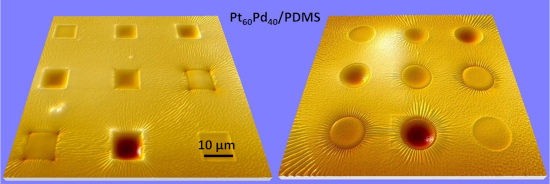
- irradiation dose, the PDMS material first shrinks, then swells, and then shrinks again. The concave shapes of the surface inside of the irradiated PDMS regions can, to a large extent, be attributed to the elasticity of this material. A very low Young’s modulus for the Sylgard-184 PDMS material, ranging from


Design of V-shaped cantilevers for enhanced multifrequency AFM measurements
Beilstein J. Nanotechnol. 2020, 11, 1525–1541, doi:10.3762/bjnano.11.135
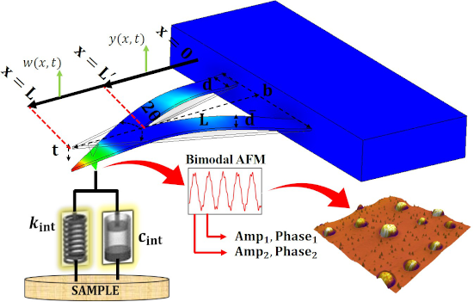
- , y(x,t), ϕ(x,t), ρ, I, E and c are shear coefficient, shear modulus, area of cross section, transverse deflection of the beam, bending angle of the beam, mass density of the beam, moment of inertia of cross section, Young’s modulus, and internal damping of the cantilevers, respectively. The cross


![[Graphic 4]](/bjnano/content/inline/2190-4286-11-135-i26.svg?max-width=637&scale=1.18182) = 15 µm, bref = 8...
= 15 µm, bref = 8...


![[Graphic 17]](/bjnano/content/inline/2190-4286-11-135-i39.svg?max-width=637&scale=1.18182) ) of V-shaped cantilevers for...
) of V-shaped cantilevers for...


Wet-spinning of magneto-responsive helical chitosan microfibers
Beilstein J. Nanotechnol. 2020, 11, 991–999, doi:10.3762/bjnano.11.83
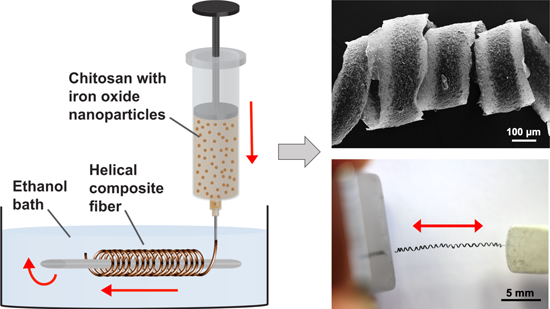
- helical chitosan microfibers exhibited an average Young’s modulus of 14 MPa. By taking advantage of the magnetic properties of the feedstock solution, the production of the helical fibers could be automated. The fabrication of the helical fibers was achieved by utilizing the magnetic properties of the
- plastic deformation (Figure 4, range IV) and eventually led to failure when the fiber ruptured (Figure 4, range V). The fibers were reasonably stable during the experiment and had an average Young’s modulus of 14 MPa. In addition, a control experiment was performed in which straight bare chitosan fibers
- were submitted to mechanical testing. The results revealed that those fibers had a Young’s modulus of 166 MPa which was in the same range as the values obtained for the IOP-embedded helical fibers. This observation shows that an IOP concentration of 10 mg·mL−1 did not significantly change the


Multilayer capsules made of weak polyelectrolytes: a review on the preparation, functionalization and applications in drug delivery
Beilstein J. Nanotechnol. 2020, 11, 508–532, doi:10.3762/bjnano.11.41



Interactions at the cell membrane and pathways of internalization of nano-sized materials for nanomedicine
Beilstein J. Nanotechnol. 2020, 11, 338–353, doi:10.3762/bjnano.11.25
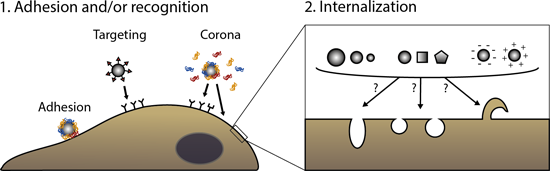
- higher numbers [154]. In this latter study, it was also shown that the more rigid nanomaterial (Young’s modulus above 13.8 MPa) was internalized by cells at least in part via clathrin-mediated endocytosis, as opposed to the softer material [154]. Similarly, in another study, lipid covered PGLA particles
- with different Young’s modulus values in the range of gigapascals were also partially internalized by clathrin-mediated endocytosis [151]. Understanding how nanoparticle properties affect the mechanism of uptake by cells: Overall, the examples presented show that the effect of tunable nanoparticle


Size effects of graphene nanoplatelets on the properties of high-density polyethylene nanocomposites: morphological, thermal, electrical, and mechanical characterization
Beilstein J. Nanotechnol. 2020, 11, 167–179, doi:10.3762/bjnano.11.14
- superior inherent properties, such as its thermal (1000–5000 W/mK [5]) and electrical conductivity (6000 S/cm [6]), and mechanical properties (a Young’s modulus of 1 TPa and a tensile strength of 130 GPa [7]). However, the mass production of graphene with high quality at a low cost is still challenging
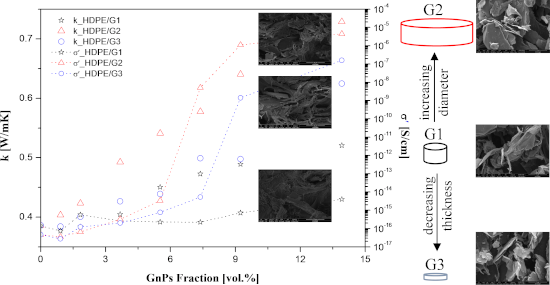
- 114.36%, 168.21%, and 184.58%, respectively. As seen in Figure 6a, the highest Young’s modulus was achieved by the HDPE/G3 nanocomposite, with an increment of up to 2.37 GPa. It can be seen that the Young’s modulus of the HDPE/G1 nanocomposite was the lowest, while the value of the Young’s modulus of the
- electrical conductivity compared to those with thicker GnPs. Additionally, it was found that G1, with smaller lateral size and larger thickness (and the lowest aspect ratio and surface area), showed the lowest enhancement of the Young’s modulus and tensile strength due to worse distribution in the HDPE



Nonclassical dynamic modeling of nano/microparticles during nanomanipulation processes
Beilstein J. Nanotechnol. 2020, 11, 147–166, doi:10.3762/bjnano.11.13
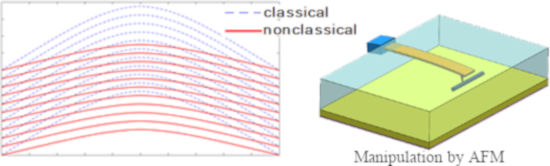
- of protein bonds and Young’s modulus of nanoparticles, Clifford and Seah determined the AFM cantilever normal spring constant [6]. Korayem and Zakeri studied the effects of different parameters on the times and forces in a 2D manipulation. Using their proposed algorithm, the location of the
- , curvature and couple stress matrices along with the non-zero elements of the rotation vector. Additionally, the strain and kinetic energy and the work of external force applied on the beam element are, respectively, defined as [27]. where E is the Young’s modulus, L, A and I are length, cross-sectional area







A review of demodulation techniques for multifrequency atomic force microscopy
Beilstein J. Nanotechnol. 2020, 11, 76–91, doi:10.3762/bjnano.11.8

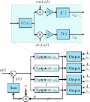
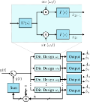
- theoretical foundations for determining secondary sample properties such as Young’s modulus [13][22]. Applications include the imaging of secondary properties of proteins [23] and polymers [24]. Intermodulation AFM actively drives the cantilever slightly below and above resonance with a two-tone drive


pH-Controlled fluorescence switching in water-dispersed polymer brushes grafted to modified boron nitride nanotubes for cellular imaging
Beilstein J. Nanotechnol. 2019, 10, 2428–2439, doi:10.3762/bjnano.10.233
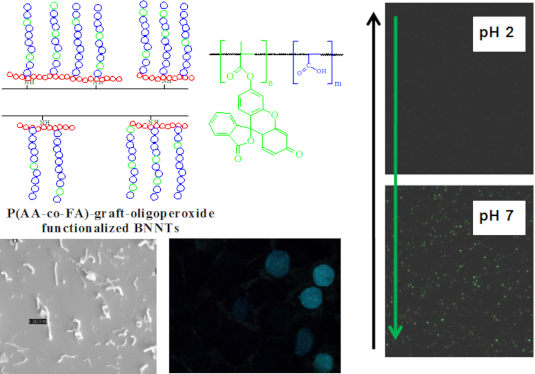
- in several fields [1][2][3][4][6][7][11][12][13][14][15][16]. BNNTs were first synthesized by Chopra et al. [20] in 1995 and they are considered as the structural analog to CNTs. BNNTs are of particular interest due to their remarkable mechanical properties (e.g., Young’s modulus of 1.22 TPa) and low



Integration of sharp silicon nitride tips into high-speed SU8 cantilevers in a batch fabrication process
Beilstein J. Nanotechnol. 2019, 10, 2357–2363, doi:10.3762/bjnano.10.226
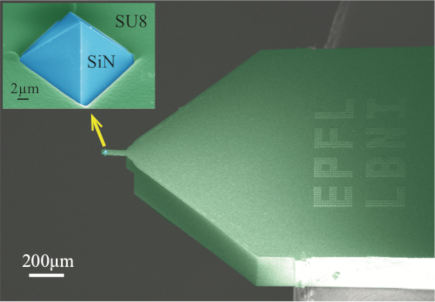
- -factor of the cantilever is aggravated by the fact that the chip body is also made of SU8 instead of a stiff conventional material. One technique to approach this challenge would be to make the cantilever chip body out of a SU8 nanocomposite with higher Young’s modulus instead of pure SU8. For instance
- , M. Kandpal et al. [42] have shown that embedding ZnO nanoparticles into a pure SU8 matrix increases its Young’s modulus from 8 to 30 GPa. The stiffer cantilever chip body will probably yield better mechanical tuning properties and hence an improved ease of use. Conclusion In this article, a batch


Atomic force acoustic microscopy reveals the influence of substrate stiffness and topography on cell behavior
Beilstein J. Nanotechnol. 2019, 10, 2329–2337, doi:10.3762/bjnano.10.223
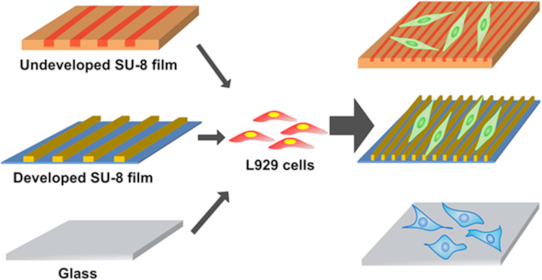
- with increasing exposure dose. This could be attributed to the increase of the surface stiffness. To further characterize the elasticity of the substrate the Young’s moduli of the undeveloped arrays were calculated using the Hertzian model. Here, the Young’s modulus measurements were repeated twenty


First principles modeling of pure black phosphorus devices under pressure
Beilstein J. Nanotechnol. 2019, 10, 1943–1951, doi:10.3762/bjnano.10.190
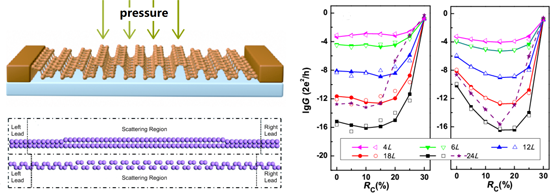
- direction vertical to the 2D plane. Normally, a vertical pressure causes the expansion of BP in both zigzag and armchair directions, although the deformation along the latter is much easier than that along the former because the Young’s modulus in the armchair direction (44 GPa) is much smaller than that in
- from RC = 0 to RC = 5%, the Young’s modulus vertical to the BP plane was obtained with a value equal to 127 GPa. Electric properties of BP under pressure In this section, we show the electric behavior of 2D pressure-related monolayer BP. Figure 3a–c shows the band structures of a partially relaxed




Subsurface imaging of flexible circuits via contact resonance atomic force microscopy
Beilstein J. Nanotechnol. 2019, 10, 1636–1647, doi:10.3762/bjnano.10.159
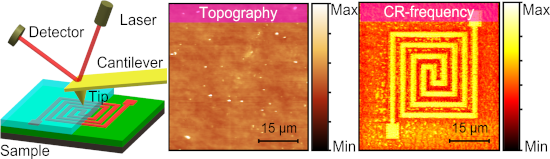
- calculate the contact stiffness. Because the probe tip has a modulus that is not infinite, we modified the apparent contact stiffness Mapp to the effective contact modulus Meff as, where Etip and vtip are the Young’s modulus and the Poisson’s ratio of the AFM tip, respectively. The normal contact stiffness
- (PC) and polyimide (PI) for the bottom and top layers, and Au, Cu, Ti, Ag and Mg for the middle layer. The mechanical parameters of these materials are listed in Table 2. The Young’s modulus and Poisson’s ratio of the silicon substrate are 160 GPa and 0.278, respectively. Cantilever vibration model
- top and bottom layers, while the metallic materials Au, Cu, Ti, Ag and Mg were used for the circuits. The Young’s modulus and Poisson’s ratio of the considered materials are listed in Table 2. The thicknesses were 50, 300 and 3500 nm for the top, middle and bottom layers, respectively. The calculated