Search results
Search for "chirality" in Full Text gives 66 result(s) in Beilstein Journal of Nanotechnology.
Structural and optical properties of penicillamine-protected gold nanocluster fractions separated by sequential size-selective fractionation
Beilstein J. Nanotechnol. 2019, 10, 955–966, doi:10.3762/bjnano.10.96
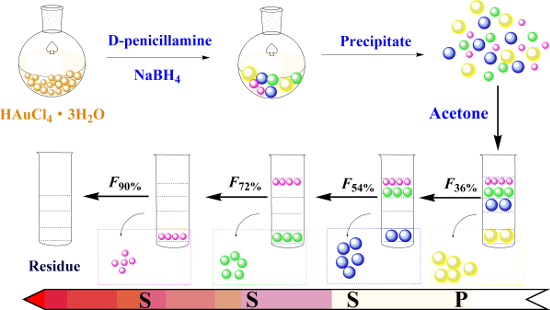
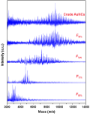
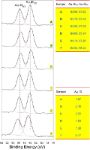
- 1.44 and 1.53 ppm, respectively, are chemically different in the 1H NMR spectrum due to the chirality effect [22] of the adjacent carbon (C* in the right panel of Figure 5). Peak splitting is also observed due to chiral induction in the 1H NMR spectrum of the crude product (spectrum 2) and size



Hydrophilicity and carbon chain length effects on the gas sensing properties of chemoresistive, self-assembled monolayer carbon nanotube sensors
Beilstein J. Nanotechnol. 2019, 10, 565–577, doi:10.3762/bjnano.10.58
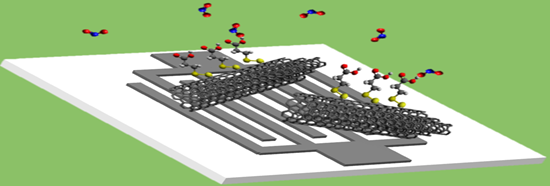
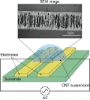
- onto Au-decorated CNTs [28], in order to enhance the properties required to detect toxic gases. Additionally, the electronic properties of single-wall CNTs heavily depend on chirality, and the conduction properties of single-wall CNT films on top of interdigitated electrodes change dramatically


Nanocellulose: Recent advances and its prospects in environmental remediation
Beilstein J. Nanotechnol. 2018, 9, 2479–2498, doi:10.3762/bjnano.9.232
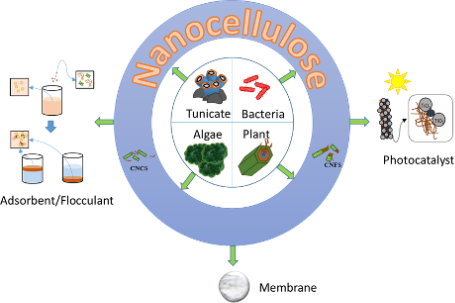
- exceptional properties of chirality, hydrophilicity, and broad chemical variability [110]. Besides, cellulose is usually considered as a good host material for nanoparticles because cellulose can improve the stability and control the growth of nanoparticles while retaining its special morphology [111


Circular dichroism of chiral Majorana states
Beilstein J. Nanotechnol. 2018, 9, 1194–1199, doi:10.3762/bjnano.9.110
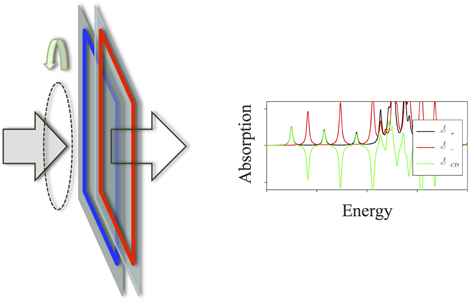
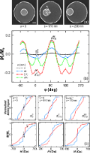
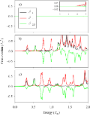
- of any chirality preference exactly vanishes. Results and Discussion Chiral bands Figure 1 shows the evolution of the eigenvalue spectrum as a function of the magnetic field parameter ΔB. The results reproduce already known results [17]. At vanishing ΔB the spectrum around zero energy is gapped, a


![[Graphic 14]](/bjnano/content/inline/2190-4286-9-110-i18.svg?max-width=637&scale=1.18182) . Panels a) and b) correspond to the phases in Figure 1d with one (ΔB = 2...
. Panels a) and b) correspond to the phases in Figure 1d with one (ΔB = 2...
![[Graphic 15]](/bjnano/content/inline/2190-4286-9-110-i19.svg?max-width=637&scale=1.18182) ,
, ![[Graphic 16]](/bjnano/content/inline/2190-4286-9-110-i20.svg?max-width=637&scale=1.18182) and
and ![[Graphic 17]](/bjnano/content/inline/2190-4286-9-110-i21.svg?max-width=637&scale=1.18182) defined in the main text. The shown results correspond to the spe...
defined in the main text. The shown results correspond to the spe...

![[Graphic 19]](/bjnano/content/inline/2190-4286-9-110-i23.svg?max-width=637&scale=1.18182) ,
, ![[Graphic 20]](/bjnano/content/inline/2190-4286-9-110-i24.svg?max-width=637&scale=1.18182) and
and ![[Graphic 21]](/bjnano/content/inline/2190-4286-9-110-i25.svg?max-width=637&scale=1.18182) for (a) a square of Lx = Ly = 20 LU), and for (b) a rectangle of L...
for (a) a square of Lx = Ly = 20 LU), and for (b) a rectangle of L...
Valley-selective directional emission from a transition-metal dichalcogenide monolayer mediated by a plasmonic nanoantenna
Beilstein J. Nanotechnol. 2018, 9, 780–788, doi:10.3762/bjnano.9.71
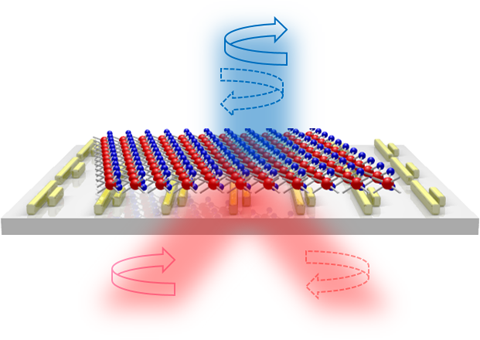
- ) measurements [12][13][14], where the chirality of the PL emission is the same as the pumping light, since different valleys are addressed by the angular momentum of the excitation. Hence, one can switch the chirality of the PL emission from left to the right (and the other way around) by changing the
- directed either to the left or to the right, depending on its chirality. In contrast, for the case without the nanoantenna, the radiation does not show preferred directionality (shown in Figure S2, Supporting Information File 1). Importantly, the directionality could be effectively switched by changing the
- weaker than for the azimuthal component because of contributions from higher order modes excited in the long bar. Since the valley polarization of the monolayer TMDCs (corresponding to the chirality of the point-dipole emitters) depends on the polarization states of the pumping laser, we could easily


Kinetics of solvent supported tubule formation of Lotus (Nelumbo nucifera) wax on highly oriented pyrolytic graphite (HOPG) investigated by atomic force microscopy
Beilstein J. Nanotechnol. 2018, 9, 468–481, doi:10.3762/bjnano.9.45
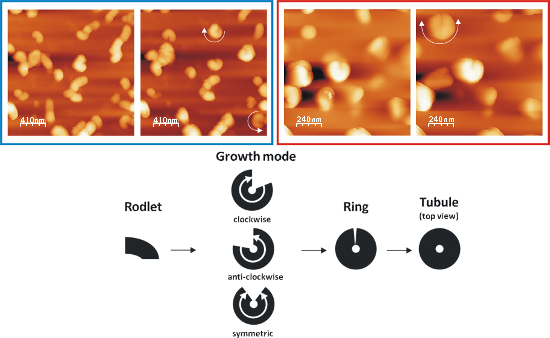
- HOPG (nonpolar, crystalline) and horizontally oriented tubules on glass (polar, amorphous). They also found that pure nonacosan-10-ol does not form tubules, but that an admixture of 3-4% of corresponding diols is needed for tubules to form. In addition, they also portrayed the effect of chirality by


Engineering of oriented carbon nanotubes in composite materials
Beilstein J. Nanotechnol. 2018, 9, 415–435, doi:10.3762/bjnano.9.41
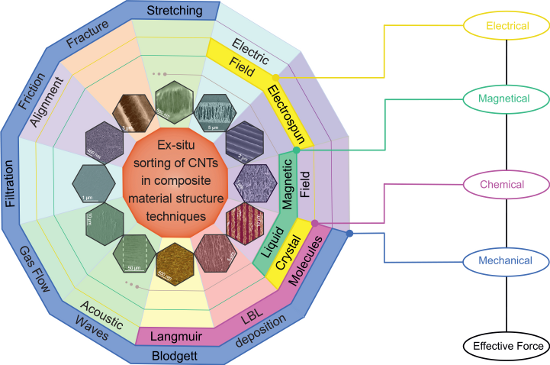
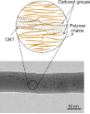
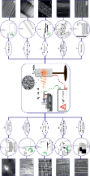
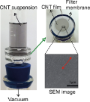
- , concentration, interactions of CNTs with polymeric and metallic materials, impact of internal and external CNT walls and the effect of physical properties, such as chirality, length and diameter on alignment needs to be understood. Furthermore, to achieve uniform composite structures, the separation of metallic








Liquid-crystalline nanoarchitectures for tissue engineering
Beilstein J. Nanotechnol. 2018, 9, 205–215, doi:10.3762/bjnano.9.22
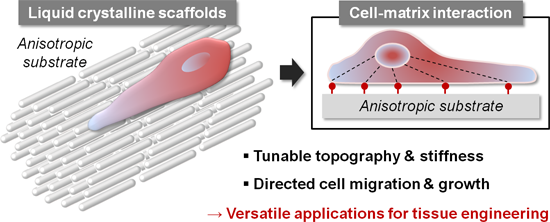
- less parallel to one another. The mean direction of this long-range orientational order is called the director. If the constituent rods have intrinsic chirality, the cholesteric phase (also termed as chiral nematic phase) is induced by continuously twisting the nematic alignment, which can be
- are also widely-used raw materials in biomedicine [40][41]. All of these macromolecular chains can be considered as semiflexible rod-like particles that exhibit intrinsic chirality [23]. Consequently, the cholesteric phase is the most commonly found LC organization in living matter [42]. Collagen type


Investigation of growth dynamics of carbon nanotubes
Beilstein J. Nanotechnol. 2017, 8, 826–856, doi:10.3762/bjnano.8.85
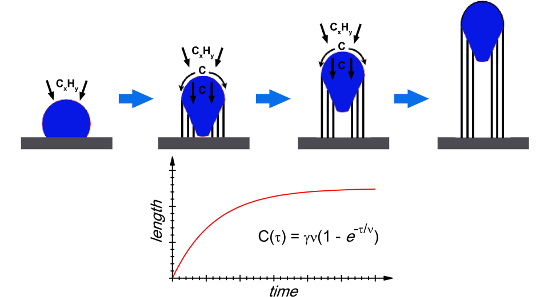
- peculiarities of the growth mechanism of carbon nanotubes. The physical and chemical states of the catalyst during the nanotube growth are discussed. The chirality selective growth of nanotubes is described. The main part of the review is dedicated to the analysis and systematization of the reported results on
- –solid–solid models, the tip- and base-growth models as well as the tangential and perpendicular growth modes. The physical and chemical states of the catalyst during the nanotube growth are considered. The chirality selective growth of nanotubes is described. The main part of the review is dedicated to
- modes relying on the diameter ratio between SWCNT and catalyst particle size has become more and more important in controlling SWCNT diameter and even chirality [102][103][104]. In [102], the statistical analysis of the TEM data was conducted in order to elucidate the correlation between the sizes of


Computing the T-matrix of a scattering object with multiple plane wave illuminations
Beilstein J. Nanotechnol. 2017, 8, 614–626, doi:10.3762/bjnano.8.66
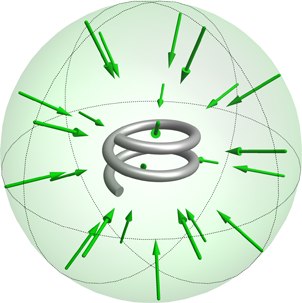
- conservation and electromagnetic chirality [46]. The helix was optimized to express a strong electromagnetic chirality at a specific frequency and, thus, shows a strong contrast in the scattering cross section for two opposite circular polarized incident fields. The major radius of the helix is 6.48 μm, the
- magnetic dipole excitation and vice versa. All these properties lead to the approximate duality symmetry of the object. As stated above, we can calculate measures for the duality breaking, electromagnetic chirality and the scattering cross section contrast for general plane wave illuminations from the T
- different circular polarizations, and χ is a measure for the electromagnetic chirality [46]. The values for the chosen helix are shown in Figure 12. We clearly see the anticipated minimum in the duality breaking. This means that the helix is approximately dual at the resonance frequency. Simultaneously the


Tunable plasmons in regular planar arrays of graphene nanoribbons with armchair and zigzag-shaped edges
Beilstein J. Nanotechnol. 2017, 8, 172–182, doi:10.3762/bjnano.8.18
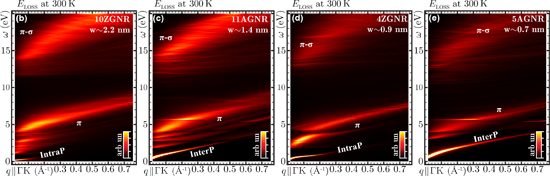
- width, chirality and unit-cell length of each ribbon, as well as the in-plane vacuum distance between two contiguous ribbons. Our predictions, based on time-dependent density functional theory, in the random phase approximation, are expected to be of immediate help for measurements of plasmonic features
- , width and chirality of each GNR, or the in-plane distance between contiguous GNRs. Our study is carried out using time-dependent (TD) density functional theory (DFT), within the random phase approximation (RPA). The computations are performed at room temperature (T = 300 K), including both intrinsic and
- GNR plasmons. In particular, (i) GNR widths (w) of around 0.7–2.2 nm are sorted out; (ii) zigzag and armchair edges are considered, to elucidate the role played by chirality; (iii) in-plane vacuum distances from 5 to 20 Å are tested; and (iv) different unit-cell extensions are simulated by changing


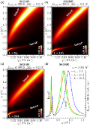
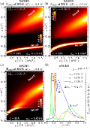
![[Graphic 8]](/bjnano/content/inline/2190-4286-8-18-i16.png?max-width=637&scale=1.18182) , Equation 6) and EL function (ELOSS, Equation 8) at room temperature for the GNR arrays of Figure 1 ...
, Equation 6) and EL function (ELOSS, Equation 8) at room temperature for the GNR arrays of Figure 1 ...

A dioxaborine cyanine dye as a photoluminescence probe for sensing carbon nanotubes
Beilstein J. Nanotechnol. 2016, 7, 1991–1999, doi:10.3762/bjnano.7.190
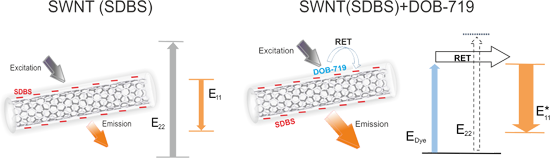
- in Table 1. The variations of redshifts for different SWNT chiralities can be explained by a structural matching of the π-electron systems of SWNTs with particular chirality and the developed π-electron system of DOB-719. The different redshifts provide not only sensitivity, but also selectivity of
- have increased (approximately five-fold) for the as-prepared mixtures comparing those of neat SWNTs. However, the PL intensity for the (8,4) chirality at λEX = 735 nm has grown approximately 2.5-times for the as prepared mixtures. This indicates that the RET from the dye attached to the (6,5) and (7,5
- ) chiralities SWNT is more efficient than the RET for the (8,4) chirality. Thus, we can well discriminate the excitation peaks from excitonic levels of SWNTs and the RET from the dye complexed to the SWNT, where the RET has maximum at λEX = 735 nm. Finally, the ageing of the mixtures affects severely the


Fracture behaviors of pre-cracked monolayer molybdenum disulfide: A molecular dynamics study
Beilstein J. Nanotechnol. 2016, 7, 1411–1420, doi:10.3762/bjnano.7.132
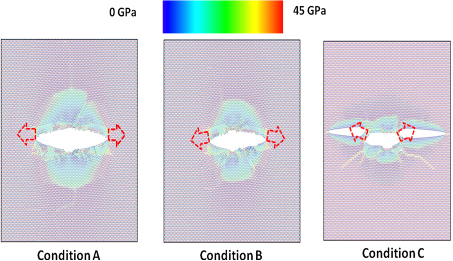
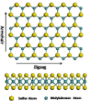
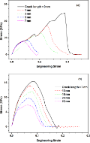
- ][12][13][14]. Jiang et al. [15] presented a parameterization of the Stillinger–Weber (SW) potential to describe the interatomic interactions within single-layer MoS2 (SLMoS2). And based on this potential, they studied chirality, size, and strain effects on the Young’s modulus and the thermal




Reasons and remedies for the agglomeration of multilayered graphene and carbon nanotubes in polymers
Beilstein J. Nanotechnol. 2016, 7, 1174–1196, doi:10.3762/bjnano.7.109
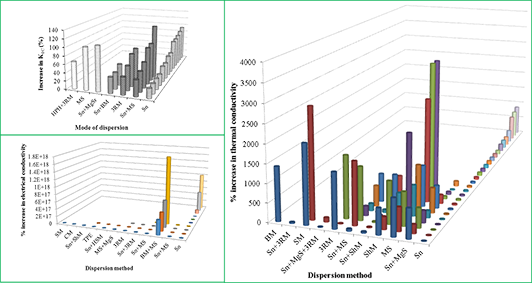
- rolled as shown in Figure 4 [36][40]. There are three main conformations with one conformation being helical, i.e., having axial chirality: (1) armchair, (2) zigzag, and (3) chiral. The geometry and/or chirality of a tube is defined by Equation 3, where Ch is the chiral vector, and n and m are the steps
- in the hexagonal lattice along the vectors a1 and a2, respectively [40]. If n = m, the nanotube is called “armchair”. If m = 0, it is called “zigzag”, and in all other cases it is chiral. The chirality affects the transport properties, especially electronic properties. If (2n + m) is a multiple of 3
- 1.8 eV and 0.18 eV have been reported of bandgap for small and large diameters nanotubes, respectively [2]. About two third SWNT behave as semiconductor while remaining as metals. It is interesting to note that in MWNT, each graphene layer can have different chirality [40]. Unfortunately, all the


Photocurrent generation in carbon nanotube/cubic-phase HfO2 nanoparticle hybrid nanocomposites
Beilstein J. Nanotechnol. 2016, 7, 1075–1085, doi:10.3762/bjnano.7.101
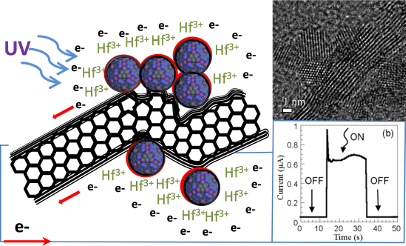
- nanotube structure, thus optical absorption and emission spectroscopy allow identification of the CNT chirality and diameter as well as quality in terms of nontubular carbon content and structural defects. The characterization of multiwalled CNTs, however, is challenging because of the involvement of
- electronic properties of CNTs are known to vary depending upon the chirality (wrapping angle) and diameter of the graphene sheet, generally exhibiting either semiconducting, or metallic behavior [46][47][48], the latter being observed in part of single-walled and in all multiwalled CNTs. In metallic CNTs


Large-scale fabrication of achiral plasmonic metamaterials with giant chiroptical response
Beilstein J. Nanotechnol. 2016, 7, 914–925, doi:10.3762/bjnano.7.83
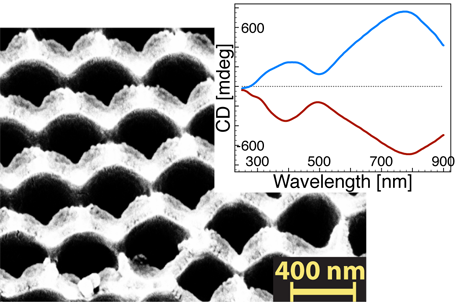
- optical activity [9] such as circular dichroism (CD) [10]. Among other things, this makes them useful for the production of sensing devices for organic molecules and biomolecules [10]. Recently, the phenomena of the long proposed extrinsic chirality dating back to 1945 [11] have been observed
- 0° (Figure 5). The observed response from the bare sample when irradiated with light at a normal incident angle may have three different causes: 1) various structural imperfections, 2) a spread in structure size, 3) the 3D nature of the ECM structure causing some intrinsic chirality. However, this
- towards angular rotation about the θ angle plane (Figure 6a), it exhibited a lower angular dependence on the angle plane (Figure 6b). Furthermore, it is evident from the angular scans (Figure 6) that the ECM has an intrinsic left-hand chirality. Hence, the zero-response angle is not identified by the

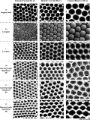


![[Graphic 2]](/bjnano/content/inline/2190-4286-7-83-i2.png?max-width=637&scale=1.18182) , of incident light with respect to the ECM structures.
, of incident light with respect to the ECM structures.



Reorientation of single-wall carbon nanotubes in negative anisotropy liquid crystals by an electric field
Beilstein J. Nanotechnol. 2016, 7, 825–833, doi:10.3762/bjnano.7.74
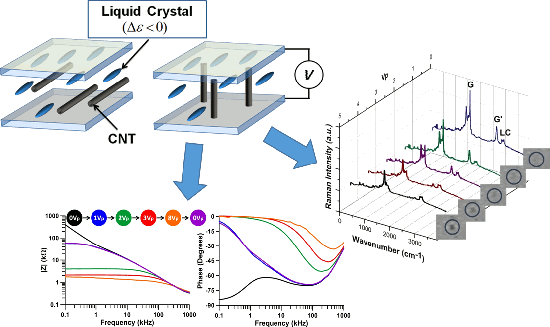
- ; Introduction Single-wall carbon nanotubes (SWCNTs) are highly anisotropic nanoparticles (NPs) formed from a single, wrapped graphene sheet. SWCNTs may be metallic or semiconductive, depending on the rolling angle (chirality) and diameter [1]. The SWCNT one-dimensional structure leads to an anisotropic


Hierarchical coassembly of DNA–triptycene hybrid molecular building blocks and zinc protoporphyrin IX
Beilstein J. Nanotechnol. 2016, 7, 697–707, doi:10.3762/bjnano.7.62
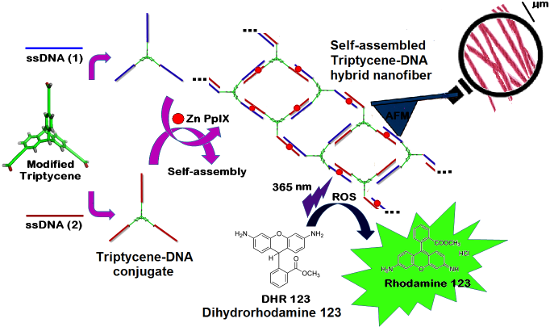
- [56]. Hence, the positioning of Zn PpIX in a DNA–TPA scaffold stipulates the study of induced chirality in the above constructed nanostructure. The chirality and conformational changes induced in DNA after conjugation with TPA as well as after the self-assembly and coassembly with Zn PpIX was
- nanofibers (S1 DNA–TPA/S2 DNA–TPA triconjugate Zn PpIX coassembly) from self-assembly of DNA–TPA triconjugates from absorbance of DNA in solution at 260 nm. CD spectra showing the chirality and conformation of nanofiber (S1 DNA–TPA/S2 DNA–TPA triconjugate Zn PpIX coassembly) and their controls. UV–vis


Rigid multipodal platforms for metal surfaces
Beilstein J. Nanotechnol. 2016, 7, 374–405, doi:10.3762/bjnano.7.34
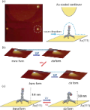
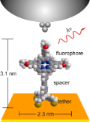
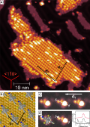
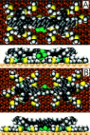
- , while the methylene groups induce the chiral arrangement of 17 on the Au(111) surfaces. The chirality is attributed to the methylene spacers of the anchoring legs, which are a slightly mismatched between neighboring molecules and formed both clockwise and counter-clockwise pinwheels in the chiral
- tripods. The surface-induced chirality in a self-assembled monolayer of 17 was confirmed by STM measurements and both possible mirror configurations were observed. It turned out, that the surface chirality is strongly dependent on the surface coverage of the substrate. The formation of the racemic mixture










Synthesis and applications of carbon nanomaterials for energy generation and storage
Beilstein J. Nanotechnol. 2016, 7, 149–196, doi:10.3762/bjnano.7.17
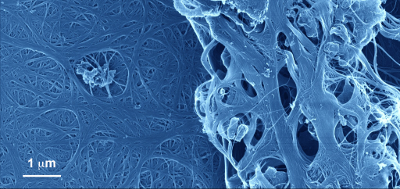
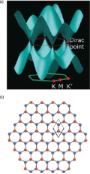
- of graphene could be easier when compared to CNTs. Fewer manufacturing parameters, such as chirality and the nature of the nanotubes (SWNTs vs MWNTs), need to be considered and a larger availability of synthesis processes makes it very attractive in the field of material science. Graphene is the















Sub-monolayer film growth of a volatile lanthanide complex on metallic surfaces
Beilstein J. Nanotechnol. 2015, 6, 2412–2416, doi:10.3762/bjnano.6.248
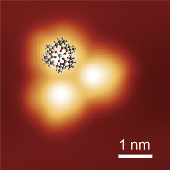
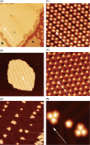
- Figure 2a closely, we find two kinds of films, labeled by R and L, which are −11° and +11° rotated from the direction, respectively. The domains are related by a mirror operation along . Thus, taking into account the symmetry of the substrate, the two domains represent opposite chirality regarding the
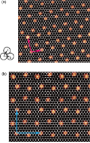
- ) surfaces. The labels R and L in (a) show the chirality of the film. Set point: (a,b) −0.8 V, 70 pA, (c) −0.8 V, 100 pA, (d) −1 V, 50 pA, (e,f) 1 V, 50 pA. STM topographies of Tb(thd)3 films (a) on Cu(111) and (b) on Ag(111) with the model of the substrate lattices. The white circles represent Cu or Ag


Possibilities and limitations of advanced transmission electron microscopy for carbon-based nanomaterials
Beilstein J. Nanotechnol. 2015, 6, 1541–1557, doi:10.3762/bjnano.6.158
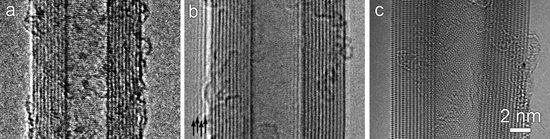
- and dynamic scattering of electrons when interacting with the unique structure of CNTs. Fundamental understanding of the physics during the interaction between the electrons and the carbon lattice is crucial. Together with the real space imaging at higher voltages, the nanostructure and the chirality
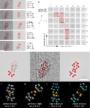
- single-walled CNT (SWCNT) at atomic resolution using AC-TEM operated at 80 kV is able to reveal atomic displacements with picometer precision [60], as demonstrated in Figure 5a–d. The CNT is determined to have a chirality of (28,0) as shown in Figure 5b. By comparing to a simulated CNT with the same
- chirality (Figure 5a), a displacement map can be obtained (Figure 5c–d) at picometer precision, which further reveals the strain distribution. Strain induced by bending can be mapped in two dimensions, and further proposed to be a dominant non-uniform shear strain. The strain in the nanotube is associated


Electronic interaction in composites of a conjugated polymer and carbon nanotubes: first-principles calculation and photophysical approaches
Beilstein J. Nanotechnol. 2015, 6, 1138–1144, doi:10.3762/bjnano.6.115
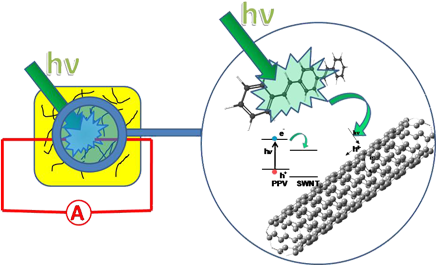
- bandgap depending of their chirality. This fundamental physical difference will have tremendous importance as concerns the electronic coupling, the energy transfer and the migration of excitons between the semi-conducting polymer and the nanotubes [15]. Therefore, the results are compared with original


Production, detection, storage and release of spin currents
Beilstein J. Nanotechnol. 2015, 6, 736–743, doi:10.3762/bjnano.6.75
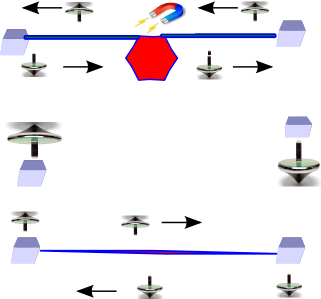
- current in the external circuit selects a chirality in the ring and produces a magnetic moment. As we shall see, the reverse is also true, namely, a chiral current in the ring can pump charge in the wire. By the same token, a symmetrically connected quantum ring inserted in a circuit cannot choose a
- chirality and has zero magnetic moment when a current flows through it. A symmetric connection (Figure 1 right) is unfavorable for quantum pumping. This is why a maximally asymmetrical connection is relevant in this respect. I call this geometry a laterally connected ring (see Figure 1 left). The effects
- the graph is bipartite, see below.) The flow of a current in the external wire selects a chirality in the ring and produces a magnetic moment. Right: a symmetric connection to the external wire. No magnetic moment is produced. Pattern in the y–z-plane of the electric field produced by a pure spin



Manipulation of magnetic vortex parameters in disk-on-disk nanostructures with various geometry
Beilstein J. Nanotechnol. 2015, 6, 697–703, doi:10.3762/bjnano.6.70
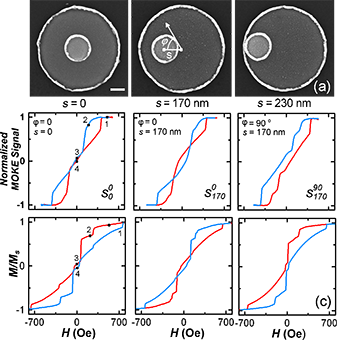
- applied during measurements. It is found that manipulation of the magnetic vortex chirality and the trajectory of the vortex core in the big disk is only possible in asymmetric nanostructures. Experimentally studied peculiarities of a motion path of the vortex core and vortex parameters by the magneto
- different combinations of polarity and chirality [2]. Polarity (up or down out-of-plane component of magnetization in the central core of the vortex state) can be controlled by an external magnetic field aligned perpendicular to a disk plane. This method is complicated to be used for microelectronic
- applications due to the high value of an applied field (usually, larger than 1 kOe [3]). The in-plane component of the vortex state is characterized by the clockwise (CW) or counterclockwise (CCW) magnetization rotation or chirality. The majority of methods of chirality manipulation are based on an application