Search results
Search for "electrode" in Full Text gives 612 result(s) in Beilstein Journal of Nanotechnology. Showing first 200.
Transient electronics for sustainability: Emerging technologies and future directions
Beilstein J. Nanotechnol. 2025, 16, 1545–1556, doi:10.3762/bjnano.16.109

- , published by Springer Nature), with permission from SNCSC. This content is not subject to CC BY 4.0. (d) Biodegradable and self-deployable electrode (left) for minimally invasive large-area brain interfacing (right). Figure 1d was adapted from [27] (J.-Y. Bae et al., “A biodegradable and self-deployable
- electronic tent electrode for brain cortex interfacing”, Nat. Electron., vol. 7, pages 815–828, 2024, published by Springer Nature), with permission from SNCSC. This content is not subject to CC BY 4.0. (e) Biodegradation of transient electronics in biological domain. Figure 1e was adapted from [27] (J.-Y
- . Bae et al., “A biodegradable and self-deployable electronic tent electrode for brain cortex interfacing”, Nat. Electron., vol. 7, pages 815–828, 2024, published by Springer Nature), with permission from SNCSC. This content is not subject to CC BY 4.0. (f) Biodegradation of transient electronics in


Influence of laser beam profile on morphology and optical properties of silicon nanoparticles formed by laser ablation in liquid
Beilstein J. Nanotechnol. 2025, 16, 1533–1544, doi:10.3762/bjnano.16.108
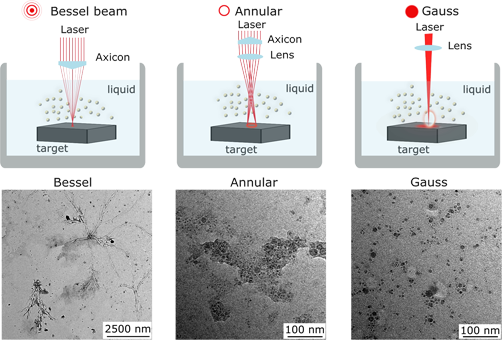
- morphology. The synthesized colloidal Si NPs are suggested for applications as a component of electrode materials in supercapacitors and batteries. Keywords: laser ablation; laser beams with Bessel, annular, Gaussian profiles; laser-induced modification; silicon nanoparticles; Introduction Silicon, due to
- that the obtained results are important for the preparation of silicon-based nanocomposites as electrode materials with enhanced performance. Materials and Methods The laser ablation experiments were performed using a nanosecond Nd:YAG laser (LS2131D, LOTIS TII, Belarus) as an excitation source
- laser ablation with the Bessel beam profile. Another application of the nanofilaments prepared using Bessel beams can be the electrode material of Li-ion batteries. Experiments on the preliminary evaluation of the electrochemical properties of the prepared nanomaterials for their potential application


Laser processing in liquids: insights into nanocolloid generation and thin film integration for energy, photonic, and sensing applications
Beilstein J. Nanotechnol. 2025, 16, 1428–1498, doi:10.3762/bjnano.16.104
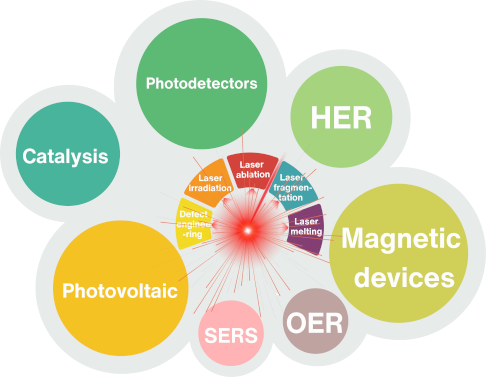
- ][87]. For example, laser irradiation has been utilized to precisely and controllably introduce a variety of structural defects, such as vacancies and interstitials, within electrode materials for electrochemical energy storage and conversion applications [85][86][88]. By carefully tuning the laser
- parameters, researchers have been able to selectively create and stabilize the desired type and distribution of defects within the electrode materials, leading to improvements in energy density, power density, and cycling stability of electrochemical energy storage devices [88][89][90][91]. Furthermore, LDL
- has emerged as a powerful approach to fabricate advanced heterostructures and integrated electrode architectures, which are challenging to achieve through conventional synthesis methods in the development of high-performance energy storage and conversion devices [85][88][92][93][94][95][96]. The






Parylene-coated platinum nanowire electrodes for biomolecular sensing applications
Beilstein J. Nanotechnol. 2025, 16, 1392–1400, doi:10.3762/bjnano.16.101
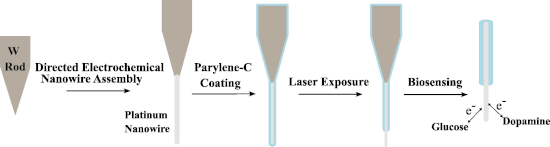
- recent years due to their unique characteristics and size. Manufacturing steps, cost, and other shortcomings limit the widespread use and commercialization of nanoscale electrodes. In this work, a nano-size electrode fabricated by directed electrochemical nanowire assembly and parylene-C insulation is
- introduced. Results show that the diameter of the platinum nanowire and electrode tip length can be tuned down to 120 nm and 1.2 µm, respectively, where the exposed nanowires on the electrode tips are chemically active and their surfaces can be modified for specific biosensing applications. The biosensing
- biocompatibility, catalytic efficiency, and stability [24]. Parylene-C was utilized for the encapsulation and insulation of the electrodes. Dopamine and glucose were selected as analytes for testing biosensing capabilities of the electrodes. Nanoscale electrode growth steps are explained including nanowire growth


Enhancing the photoelectrochemical performance of BiOI-derived BiVO4 films by controlled-intensity current electrodeposition
Beilstein J. Nanotechnol. 2025, 16, 1289–1301, doi:10.3762/bjnano.16.94
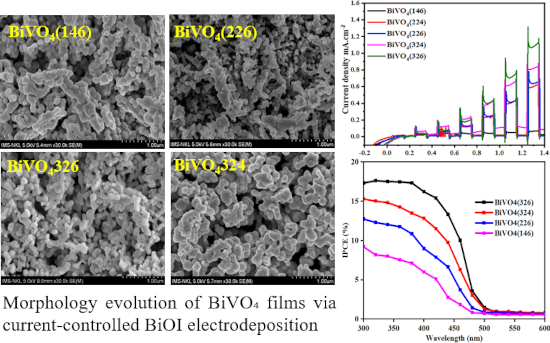
- ) using a reference electrode saturated with Ag/AgCl and platinum foil at various potentials vs Ag/AgCl. This process was adapted from the p-benzoquinone-based method reported by McDonald and Choi [19], in which benzoquinone serves as a redox mediator for BiOI formation. However, unlike the original study
- 2 h. Finally, the BiVO4 electrode was rinsed with 1 M NaOH to remove excess V2O5 from the surface, followed by rinsing with distilled water and drying at room temperature. The photoanode BiVO4 was named BiVO4(xy), where x indicates the current intensity for BiOI deposition, and y denotes the
- ) was employed to determine the chemical states of each photoanode. All photoanode morphologies were examined using field-emission transmission electron microscopy (FESEM, Hitachi SU8010). Photoelectrochemical measurements PEC experiments were performed in a conventional three-electrode cell using an



Transfer function of an asymmetric superconducting Gauss neuron
Beilstein J. Nanotechnol. 2025, 16, 1160–1170, doi:10.3762/bjnano.16.85
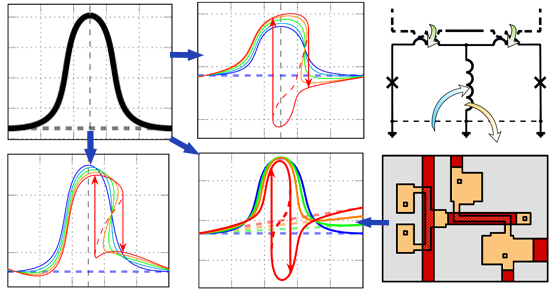
- in favor of superconducting neuromorphic devices. The subject of this study is the Gauss neuron [1][7][8][9][11][12][14], schematically depicted in Figure 1. It consists of three arms connected at a common point O and grounded to a shared electrode (Gnd). Two arms (“Josephson” or “input” ones) each



Soft materials nanoarchitectonics: liquid crystals, polymers, gels, biomaterials, and others
Beilstein J. Nanotechnol. 2025, 16, 1025–1067, doi:10.3762/bjnano.16.77
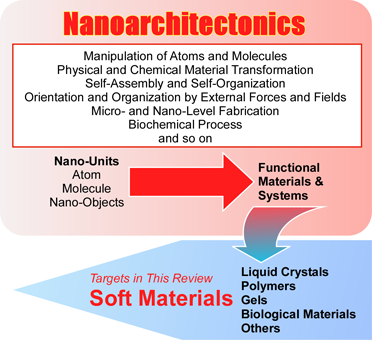
- , electronic devices, and electrochemical energy conversion and storage. Marmisollé and colleagues conducted research on “electrochemical nanoarchitectonics through polyaminobenzylamine–dodecyl phosphate complexes” and proposed a straightforward strategy for modifying electrode surfaces with self-assembled
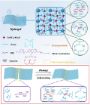
- involved the sequential organization of a colloidal suspension comprising polyaniline/polystyrene sulfonate and ZIF-8 MOF nanocrystals coated with polyallylamine hydrochloride (Figure 14). This functional electrode was designed to combine two key elements, that is, high surface area and porosity with






A calix[4]arene-based supramolecular nanoassembly targeting cancer cells and triggering the release of nitric oxide with green light
Beilstein J. Nanotechnol. 2025, 16, 1003–1013, doi:10.3762/bjnano.16.75
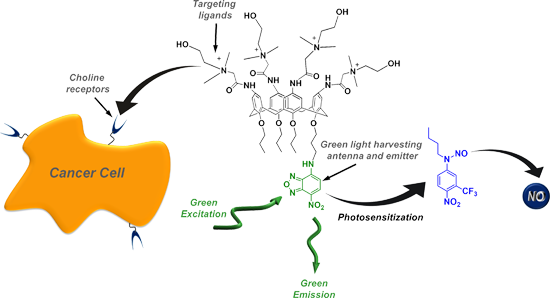
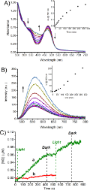
- amperometric detection of this radical species through an ultrasensitive NO electrode while alternating cycles of light/dark. Figure 5C shows that the NO generation is achieved exclusively upon green light excitation of the nanoassembly and stops once the irradiation source is switched off. The quantum yield
- (λexc = 532 nm, 200 mW). NO measurements were carried out under stirring with the electrode positioned outside the light path to avoid NO signal artifacts due to photoelectric interference on the ISO-NO electrode. Fluorescence and photodecomposition quantum yields In a manner analogous to [71


Shape, membrane morphology, and morphodynamic response of metabolically active human mitochondria revealed by scanning ion conductance microscopy
Beilstein J. Nanotechnol. 2025, 16, 951–967, doi:10.3762/bjnano.16.73
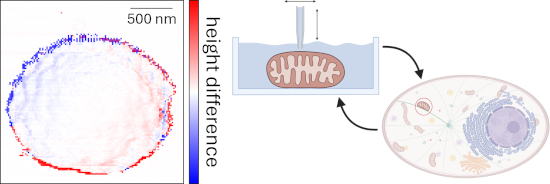
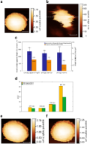
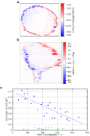
- each pixel, and upon detecting a preset current drop of 2% relative to the standby current, it retracts to a defined height (hopping height) [27][35]. In our measurements, the standby current was approximately 1 nA by applying a voltage of 0.15–0.40 V between the bath electrode and the nanopipette
- electrode, depending on the opening diameter of the nanopipette. The nanopipettes were fabricated using a P-2000 (Sutter Instrument, USA) from borosilicate capillaries with an outer diameter of 1 mm and an inner diameter of 0.58 mm. The resulting opening diameter of the pipettes ranged from 45 to 100 nm
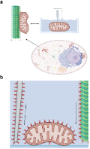
- microtubule. Nanopipette, mitochondrion, and microtubule have negative ζ-potentials. In a physiological medium, a cation layer forms on the surface (its hydration shell is represented by the water molecules). These cations on the glass of the pipette move through the pipette electrode into the pipette. A



Synthesis of biowaste-derived carbon-dot-mediated silver nanoparticles and the evaluation of electrochemical properties for supercapacitor electrodes
Beilstein J. Nanotechnol. 2025, 16, 933–943, doi:10.3762/bjnano.16.71
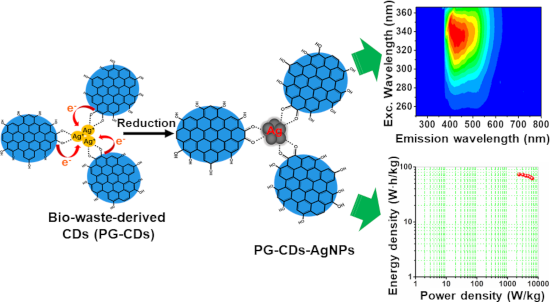
- of Korea 10.3762/bjnano.16.71 Abstract Herein, biowaste- (from Pongammia pinnata leaves) derived carbon dots (CDs) have been utilized as a mediator for the production of silver nanoparticles (PG-CDs-AgNPs) as a superior supercapacitor electrode. The methodology presented here is inexpensive and
- environmentally friendly as CDs play a role as capping, reducing, and stabilizing agent without addition of any chemicals. PG-CDs-AgNPs showed a particle size of 10 nm having excellent fluorescence emission in the blue region, and it has been explored as an electrode material for supercapacitor applications. The
- as-synthesized PG-CDs-AgNPs electrode exhibited the maximum specific capacitance of 540 F/g in a three-electrode study. The asymmetric supercapacitor (ASC) device with PG-CDs-AgNPs as the positive electrode reached the maximum specific capacitance of 200 F/g having a superior energy density of 71 W·h


Structural and magnetic properties of microwave-synthesized reduced graphene oxide/VO2/Fe2O3 nanocomposite
Beilstein J. Nanotechnol. 2025, 16, 921–932, doi:10.3762/bjnano.16.70
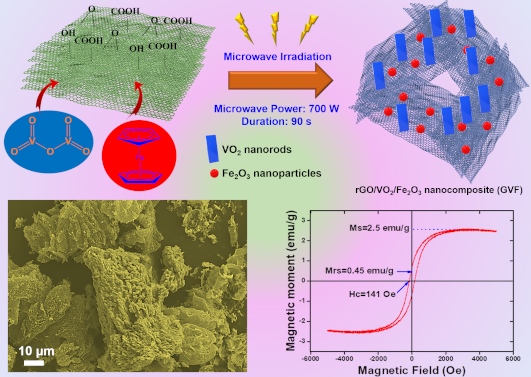
- with graphene by applying MW irradiation for certain time intervals. In this context, Zhang et al. reported the synthesis of Ni-Co sulfide/graphene NC through MW irradiation at a power of 1000 W for 60 s [12]. As a supercapacitor (SC) electrode, the MW-synthesized NC displayed a specific capacitance of
- NC displayed good electrochemical performance as the SC electrode [13]. In another work, Kumar et al. reported the MW-assisted synthesis of Fe3O4/rGO NC using FeCl3 aqueous salt as the precursor [14]. Ferrocene, an Fe-based organometallic compound, was also utilized as the precursor for developing



Synchrotron X-ray photoelectron spectroscopy study of sodium adsorption on vertically arranged MoS2 layers coated with pyrolytic carbon
Beilstein J. Nanotechnol. 2025, 16, 847–859, doi:10.3762/bjnano.16.64
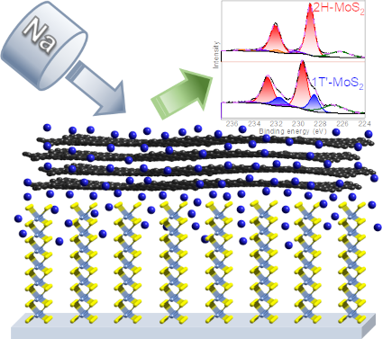
- /desorption; sodium vapor; XPS; Introduction Sodium-ion batteries (SIBs) attract increasing interest as a low-cost alternative to lithium-ion batteries due to the abundance and wide availability of sodium. Research in this field is currently focused on developing new electrode materials to increase the


Facile one-step radio frequency magnetron sputtering of Ni/NiO on stainless steel for an efficient electrode for hydrogen evolution reaction
Beilstein J. Nanotechnol. 2025, 16, 837–846, doi:10.3762/bjnano.16.63
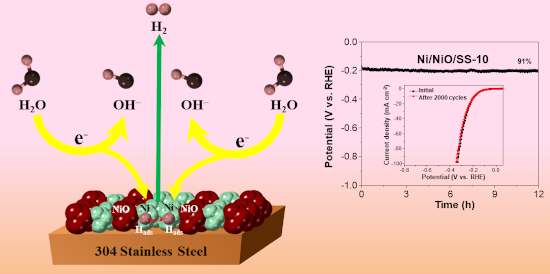
- 700000, Vietnam 10.3762/bjnano.16.63 Abstract The advancement of affordable, ultrastable, and efficient electrode materials for basic hydrogen evolution reaction (HER) plays a crucial role in industrial hydrogen manufacture, resolving problems caused by carbon dioxide emissions. Ni-based
- efficiency. The evaluation of catalytic activities revealed that the optimal sample of Ni/NiO/SS-10 displayed a higher HER performance than bare SS. To produce H2 at a current density of 10 mA·cm−2, this electrode required a low overpotential of 184 mV and demonstrated remarkable durability over 12 h of
- synthesizing electrode materials in recent years because they offer a cleaner pathway than solution-based synthetic processes [20][21][22]. Among vacuum deposition methods, magnetron sputtering has been widely applied in industrial applications for fabricating thin films because of its advantages, such as good


Morphology and properties of pyrite nanoparticles obtained by pulsed laser ablation in liquid and thin films for photodetection
Beilstein J. Nanotechnol. 2025, 16, 785–805, doi:10.3762/bjnano.16.60
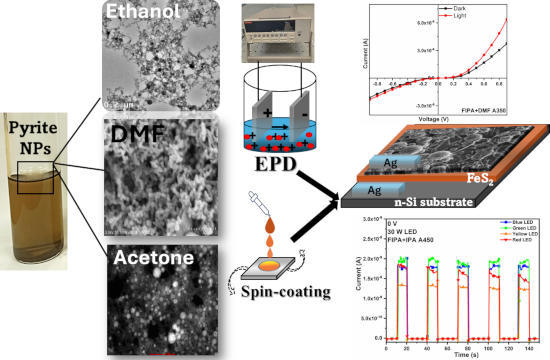
- -effective method in which charged particles, dispersed in an organic medium, migrate towards the countercharged electrode upon the application of voltage, resulting in the formation of a thin coating [25]. Due to the vast variety of dimensions in terms of thickness of the deposit that is created, EPD spans
- electrode was coated with FeS2 nanoparticles. Spin coating of FeS2 nanoparticles Following EPD, FeS2 nanocolloids in IPA and DMF were individually spin-coated onto thin films for seeded growth, improved thickness, and to avail the use of the morphological characteristics of FeS2 nanoparticles in both






Nanostructured materials characterized by scanning photoelectron spectromicroscopy
Beilstein J. Nanotechnol. 2025, 16, 700–710, doi:10.3762/bjnano.16.54
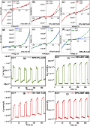
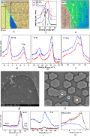
- - and n-doped ends. In practice, the electrode with the n-doped segment was grounded, while a bias of +0.4, 0, or −0.3 V was applied to the electrode with the p-doped segment, resulting in forward-biased, unbiased, and backward-biased conditions of the p–n junction. High-resolution In 3d core-level


The impact of tris(pentafluorophenyl)borane hole transport layer doping on interfacial charge extraction and recombination
Beilstein J. Nanotechnol. 2025, 16, 678–689, doi:10.3762/bjnano.16.52
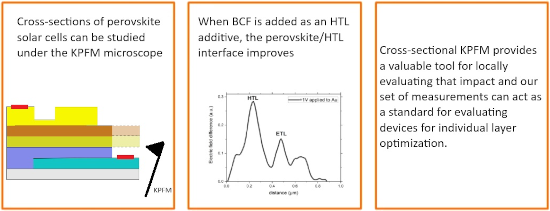
- measured potential under 1 V bias minus the potential at dark/short-circuit conditions and x is the distance. For these measurements, we applied +1 V to the Au electrode to forward bias the device (Figure 3e–h and Supporting Information File 1, Section 5). The resulting magnitude of the electric field
- solution containing 15 mg PTAA, 7.5 μL, LiTFSI solution (170 mg in 1 mL acetonitrile), and 7.5 μL tBP solution (1:1 in acetonitrile), dissolved in 1 mL toluene. For the BCF batch, instead of LiTFSI and tBP, BCF was added in at an 8% mol ratio to PTAA. After the HTL deposition, an Au electrode was


A formulation containing Cymbopogon flexuosus essential oil: improvement of biochemical parameters and oxidative stress in diabetic rats
Beilstein J. Nanotechnol. 2025, 16, 617–636, doi:10.3762/bjnano.16.48
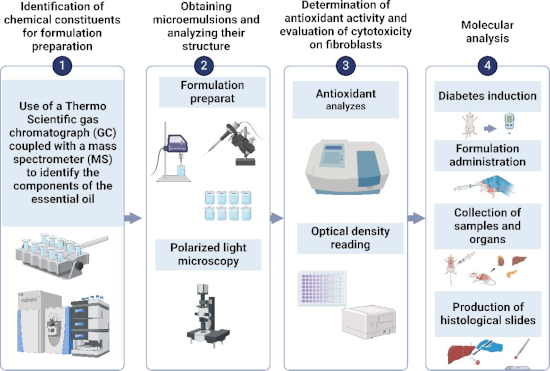
- carried out in triplicate at room temperature and at 37 °C. The pH analyses were carried out after diluting the MEs (1:10). A digital pH meter (model Analion PM 608) containing a glass electrode and temperature sensor (Phtek PH 3B), previously calibrated with buffer solution (pH 4.0 and 7.0), was used at




Feasibility analysis of carbon nanofiber synthesis and morphology control using a LPG premixed flame
Beilstein J. Nanotechnol. 2025, 16, 581–590, doi:10.3762/bjnano.16.45
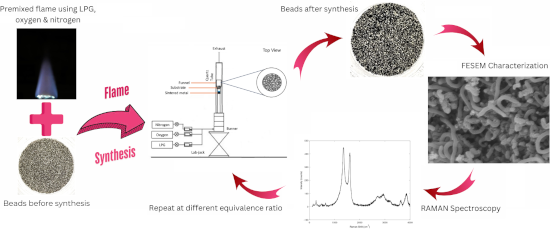
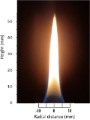
- . discussed several applications of CNFs. Thin CNFs have a large surface area and are used for adsorptive hydrogen storage. Also, CNFs are used as electrode materials in supercapacitors. They can also be used for water purification and carbon capture and storage [20]. LPG gas contains a flammable mixture of



Nanomaterials in targeting amyloid-β oligomers: current advances and future directions for Alzheimer's disease diagnosis and therapy
Beilstein J. Nanotechnol. 2025, 16, 561–580, doi:10.3762/bjnano.16.44
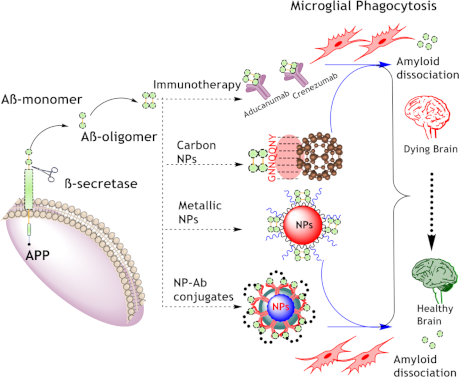
- improved associated neurotoxicity [52]. Shifting from imaging to electrochemical approaches, researchers have developed biosensors comprising immobilized thiolated PrPC peptides on a graphene oxide/gold nanoparticle hydrogel electrode. This nanobiosensor displayed high specificity and sensitivity for
- to the development of diagnostic strategies for NDs. Zhou and colleagues introduced an advanced electrochemical aptasensor that utilizes metal-organic frameworks (MOFs) as signal probes for detecting AβOs. They engineered an electrode modified with gold nanoflowers to capture targets, employing


Functionalized gold nanoflowers on carbon screen-printed electrodes: an electrochemical platform for biosensing hemagglutinin protein of influenza A H1N1 virus
Beilstein J. Nanotechnol. 2025, 16, 540–550, doi:10.3762/bjnano.16.42
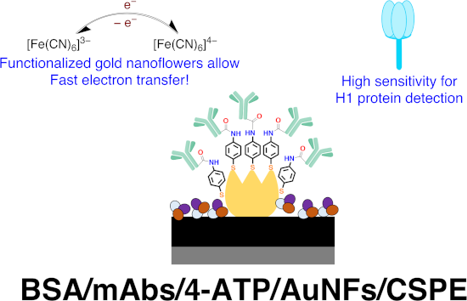
- .16.42 Abstract An electrochemical biosensor based on modified carbon screen-printed electrodes was developed for the detection of hemagglutinin of influenza A H1N1 virus (H1). Gold nanoflowers were electrodeposited on the electrode to increase conductivity and surface area. The electrochemical signal
- current across the electrode as a function of H1 concentration. This was performed on a series of samples of artificial saliva containing H1 protein in a clinically relevant concentration range. In these experiments, the biosensor showed a limit of detection of 19 pg/mL. Finally, the biosensor platform
- electron charge transfer at the surface of the electrode. To the best of our knowledge, this is the first time that the charge transfer enhancement with 4-ATP, a small organic molecule with delocalized π-electron system, has been employed to improve the sensitivity of electrochemical biosensing of proteins


Performance optimization of a microwave-coupled plasma-based ultralow-energy ECR ion source for silicon nanostructuring
Beilstein J. Nanotechnol. 2025, 16, 484–494, doi:10.3762/bjnano.16.37

- a strong electric field generated in the cavity, the ECR-based ion sources equipped with microwave cavities neither contain any filament nor any type of electrode [26]. The high plasma density within a quartz cup is confined by solenoid magnets surrounding it, creating a multi-cusp magnetic field


Effect of additives on the synthesis efficiency of nanoparticles by laser-induced reduction
Beilstein J. Nanotechnol. 2025, 16, 464–472, doi:10.3762/bjnano.16.35
- including electrode materials [1], conductive pastes [2][3], catalysts [4][5], sensors [6][7][8], and drug delivery systems [9]. The chemical reduction [10] and the solvothermal methods [11][12] are well known for synthesizing nanoparticles in large quantities at low cost, but these methods require the use
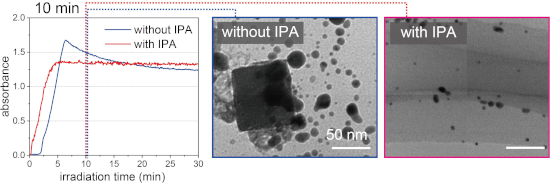
- radical scavengers In laser-induced reduction, laser irradiation breaks down water molecules to produce various radical species. The standard electrode potentials of solvated electrons (e−aq) and hydrogen radicals (H•) are E0 = −2.77 V and E0 = −2.1 V, respectively [33]. It has been reported that solvated
- electrons reduce metal ions and contribute to the formation of nanoparticles [25][26]. On the other hand, the standard electrode potential of the hydroxyl radical (•OH) is +2.7 V, and it is a strong oxidizing species [33], so it is thought that it oxidizes the reduced metal atoms and clusters, inhibiting


Quantification of lead through rod-shaped silver-doped zinc oxide nanoparticles using an electrochemical approach
Beilstein J. Nanotechnol. 2025, 16, 422–434, doi:10.3762/bjnano.16.33
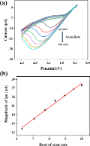
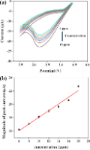
- different types of oxygen species (one at 528 eV due to lattice oxygen of ZnO and another at 530 eV due to presence of surface hydroxy group) [25][26]. Cyclic voltammetry of modified Ag@ZnO nanorods/gold electrode Figure 8 presents the results of an impedance analysis using a frequency-response analyzer
- (FRA) potentiostat on both fabricated Ag–ZnO/Au electrodes and bare gold electrodes. The modified Ag@ZnO NRs electrode exhibits higher impedance than that of the bare gold electrode. This higher impedance leads to better sensitivity, better electron exchange, and can provide more information about the
- electrochemical process. The higher impedance of the modified Ag@ZnO NRs electrode improved signal-to-noise ratio, which means that the electrode can better distinguish the electrochemical signal of the analyte from background noise, resulting in more accurate results. Furthermore, a higher impedance of the





ReactorAFM/STM – dynamic reactions on surfaces at elevated temperature and atmospheric pressure
Beilstein J. Nanotechnol. 2025, 16, 397–406, doi:10.3762/bjnano.16.30
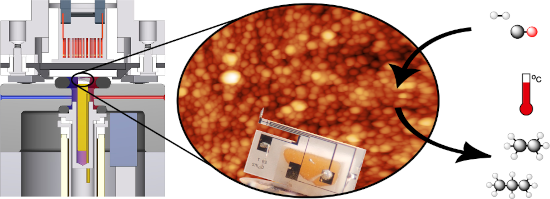
- , and current signal. The fourth electrode (on the back) is connected to one of the AFM contacts. The sensor is glued to a ceramic block with a non-conductive glue (EpoTek H770E), which is mounted on the slider. The slider is made of a high-speed steel rod, which is partitioned in three and isolated by
- a CaCl2 electrolytic solution (CaCl2 5 g, H2O 30 mL, acetone 2 mL). An alternating current (AC) voltage (50 Hz, 1–10 V) is applied between the tip and a gold ring electrode with the etching solution in suspension resulting in a sharp tip, which serves as the probe. In a second step, the etched Pt/Ir


Pulsed laser in liquid grafting of gold nanoparticle–carbon support composites
Beilstein J. Nanotechnol. 2025, 16, 349–361, doi:10.3762/bjnano.16.26
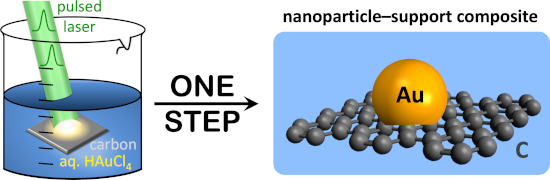
- electrocatalytic hydrogen evolution in aqueous bicarbonate reduction. Keywords: catalysis; composite; electroreduction; gold nanoparticles; impedance; Introduction The main challenge in the manufacturing of nanocatalyst-containing electrodes is the attachment of nanoparticles on electrode supports. Nanoparticles
- the need for synthesizing, collecting, and attaching nanoparticles separately. This way, composite fabrication becomes more time-saving, cost-effective, and environmentally friendly. A premier electrode support material is carbon because it is affordable, scalable, and stable under many
- . Results and Discussion Carbon fiber paper served as electrode support material because graphite is cost-effective, scalable, and the premier electrode support material for reduction reactions [21]. Gold nanoparticles were laser grafted from aqueous HAuCl4 solution. The use of an aqueous liquid requires