


Search results
Search for "high temperature" in Full Text gives 348 result(s) in Beilstein Journal of Nanotechnology. Showing first 200.
A formulation containing Cymbopogon flexuosus essential oil: improvement of biochemical parameters and oxidative stress in diabetic rats
Beilstein J. Nanotechnol. 2025, 16, 617–636, doi:10.3762/bjnano.16.48
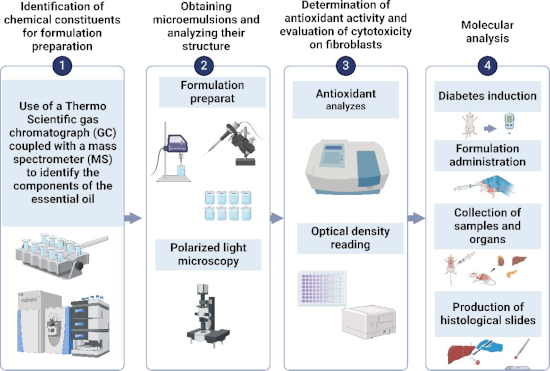
- microcapsules, showed a reduction in the antioxidant activity of the formulation when compared to the oil alone. However, the authors defend the idea that the high temperature used in the process altered the compounds in the oil and reduced the antioxidant activity. In the microemulsion formulation in this




Feasibility analysis of carbon nanofiber synthesis and morphology control using a LPG premixed flame
Beilstein J. Nanotechnol. 2025, 16, 581–590, doi:10.3762/bjnano.16.45
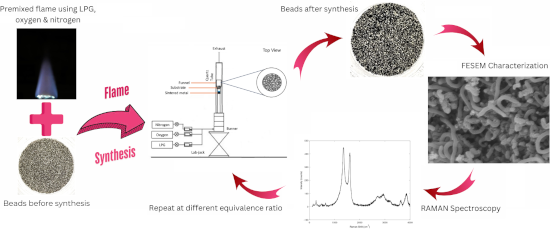
- diameter of the CNFs increases as the equivalence ratio decreases, which eventually leads to the formation of amorphous carbon as observed at an equivalence ratio of 1.60. At an equivalence ratio of 1.6 in a high-temperature environment, the hydrocarbons dissociate to carbon atoms very rapidly. These free



N2+-implantation-induced tailoring of structural, morphological, optical, and electrical characteristics of sputtered molybdenum thin films
Beilstein J. Nanotechnol. 2025, 16, 495–509, doi:10.3762/bjnano.16.38
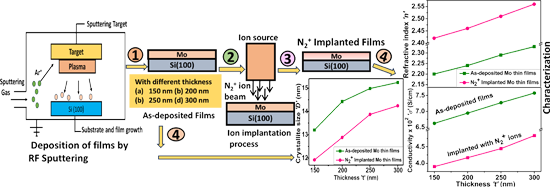
- tensile after annealing. Lee et al. [24] efficiently incorporated nitrogen ions into epitaxial Mo films, forming a buried superconducting layer. They deposited atomically flat epitaxial Mo(110) films on Al2O3(0001) substrates. Carreri et al. [25] investigated high-temperature (800–1200 °C) plasma-based


Effect of additives on the synthesis efficiency of nanoparticles by laser-induced reduction
Beilstein J. Nanotechnol. 2025, 16, 464–472, doi:10.3762/bjnano.16.35
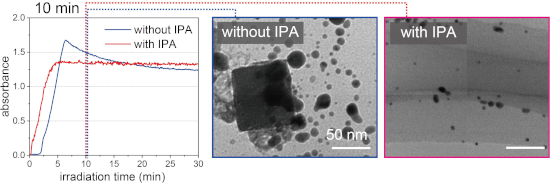
- irradiating a solution containing metal ions with a high-intensity laser. It is simple and environmentally friendly, as it does not require reducing agents or high-temperature, high-pressure environments. In this method, nanoparticles are synthesized by reducing metal ions with short-lived radical species


Size control of nanoparticles synthesized by pulsed laser ablation in liquids using donut-shaped beams
Beilstein J. Nanotechnol. 2025, 16, 407–417, doi:10.3762/bjnano.16.31
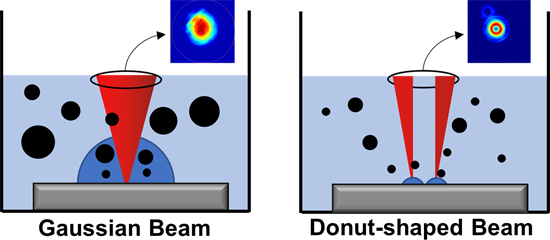
- medicine for gold [9][29], strengthened ceramics and steels for high-temperature applications for Y2O3 [45][46][47], and catalysis and energy storage for HEAs [48][49]. The produced NPs are compared with those obtained with Gaussian beams. The evolution of the PLAL-generated cavitation bubble dynamics was


ReactorAFM/STM – dynamic reactions on surfaces at elevated temperature and atmospheric pressure
Beilstein J. Nanotechnol. 2025, 16, 397–406, doi:10.3762/bjnano.16.30
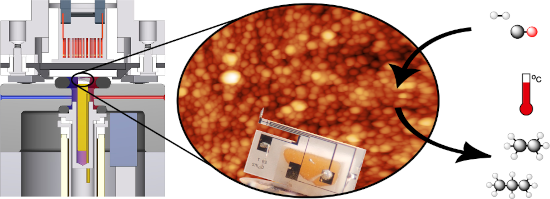
- these techniques are photon-based [4][5][6][7][8][9]. Even though they provide valuable insights, the development of surface-sensitive techniques that can image the catalyst at the atomic scale under high-pressure and high-temperature conditions remains crucial. In attempting to close the pressure gap
- ) under 0.5 bar of oxygen at 450 K was carried out using nc-AFM while simultaneously recording the electrical current signal of the formed oxide. Furthermore, we show high-temperature and high-pressure images just below our current temperature limit for an industrially relevant catalyst undergoing Fischer
- hall. The AFM/STM is contained in a high-pressure cell and sealed off from the UHV chamber by a Kalrez elastomer seal, which exhibits outstanding thermal stability and chemical resistance together with improved sealing performance in both high-pressure and high-temperature environments. Being in direct


Vortex lattices of layered HTSCs at different vortex–vortex interaction potentials
Beilstein J. Nanotechnol. 2025, 16, 362–370, doi:10.3762/bjnano.16.27
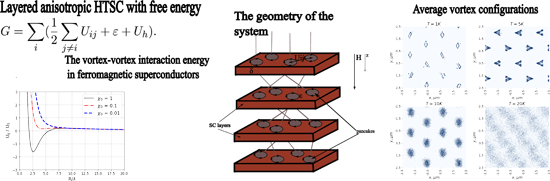
- using the Monte Carlo method within the framework of a two-dimensional model of a layered high-temperature superconductor. Interaction potentials close to the potential applicable in superconductors with the Ginzburg–Landau parameter κ = 1/2 (intertype superconductors) and in ferromagnetic
- superconductors have been analyzed. Clustering of the vortex system is demonstrated. The melting of a vortex lattice with increasing temperature has been studied. Keywords: high-temperature superconductor; HTSC; intertype superconductors; Monte Carlo method; vortex lattice; vortex–vortex interaction potential
- the magnetic field penetrates the superconductor in the form of Abrikosov vortices [1]. In high-temperature superconductors (HTSCs), such as Y- and Bi-based cuprates, the vortex lattice is further complicated since these compounds have a layered structure [2][3][4][5][6]. The vortex filament in these


A review of metal-organic frameworks and polymers in mixed matrix membranes for CO2 capture
Beilstein J. Nanotechnol. 2025, 16, 155–186, doi:10.3762/bjnano.16.14
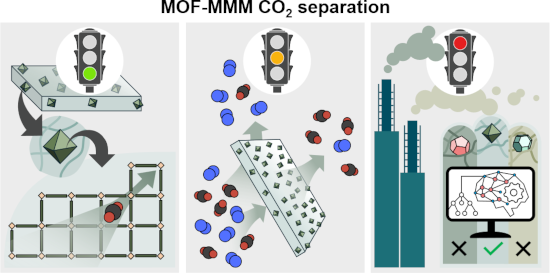
- modification of the synthesized MOFs and allows for the synthesis of multifunctional frameworks [32][33][34][35]. Alternatively, MOFs can undergo post-synthetic modification to achieve similar functionalization without the risk of degrading functionalized linkers during high-temperature and high-pressure MOF




Comparison of organic and inorganic hole transport layers in double perovskite material-based solar cell
Beilstein J. Nanotechnol. 2025, 16, 119–127, doi:10.3762/bjnano.16.11
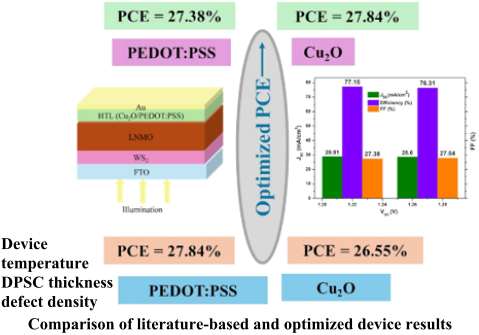
- both HTL materials (Table 3 and Figure 3). The increase of the PCE with Cu2O signifies a better absorption of light with minimum reflection and, hence, increased carrier transportation across the interface. Cu2O is inorganic, and the high temperature leads to improved hole mobility and better charge


Orientation-dependent photonic bandgaps in gold-dust weevil scales and their titania bioreplicates
Beilstein J. Nanotechnol. 2025, 16, 1–10, doi:10.3762/bjnano.16.1
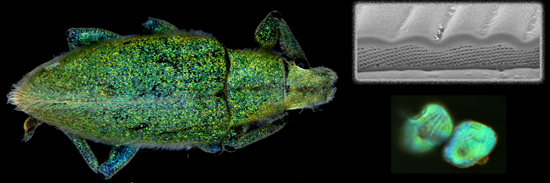
- , during templating, it unfortunately introduces lattice breakage and shrinkage. Therefore, a calcination process at high temperatures is likely not the best option for pure titania [24], although it seems to work better for silica [18]. The replication process used here had a modestly high temperature


Fabrication of hafnium-based nanoparticles and nanostructures using picosecond laser ablation
Beilstein J. Nanotechnol. 2024, 15, 1639–1653, doi:10.3762/bjnano.15.129
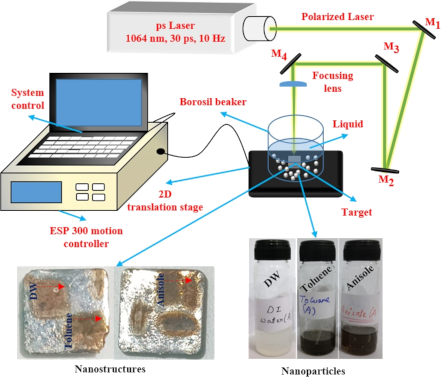
- them to be used in high-temperature alloys and ceramics. Hf compounds are widely used in microelectronics because of their high dielectricity values [2]. In recent years, NPs derived from Hf have gained significant interest in biomedical fields because of their superior optical and thermal properties




Heterogeneous reactions in a HFCVD reactor: simulation using a 2D model
Beilstein J. Nanotechnol. 2024, 15, 1627–1638, doi:10.3762/bjnano.15.128
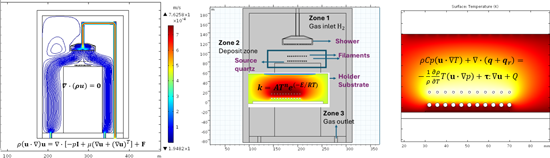
- chemical vapor deposition reactor for the growth of polycrystalline SiO2 [23]. Most of these models describe CVD reactors at low pressure and low temperature, but there are not enough models regarding CVD systems at high temperature (>800 K) and high pressure (atmospheric pressure). In this investigation
- , which are activated by an externally applied voltage generating a current; these filaments have a temperature of approximately 2300 K. The second zone includes the region where the chemical reactions takes place. Here, molecular hydrogen, exposed to the high temperature of the filaments, dissociates to
- the deposition time but not of the position. From the theoretical results, the temperature increases from 300 K at the substrate to 1000 K near the quartz sources, that is 3–5 mm away from the sources in the steady state. The results obtained show us that the HFCVD is a high-temperature system


Bolometric IR photoresponse based on a 3D micro-nano integrated CNT architecture
Beilstein J. Nanotechnol. 2024, 15, 1030–1040, doi:10.3762/bjnano.15.84
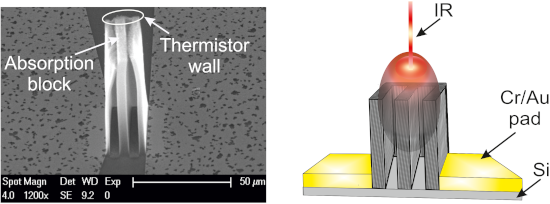
- thermistor region, can be fabricated in a single chemical vapor deposition process step. The thermistor resistance is mainly determined by the high junction resistances of the adjacent aligned CNTs. This configuration also provides low lateral thermal conductivity and a high temperature coefficient of
- for non-cryogenic IR microbolometer technology, carbon nanotubes (CNTs) have emerged as highly promising candidates [2] with broadband blackbody absorption [3], high resistance perpendicular to the CNT orientation [4], low lateral thermal conductivity [5], a high temperature coefficient of resistance
- applications [3]. The device resistance perpendicular to the CNT orientation is mainly determined by the high junction resistances of the neighboring aligned CNTs [4]. This configuration allows for high device resistance, low thermal conductivity, and high temperature coefficient of resistance, thus, enabling


Atomistic insights into the morphological dynamics of gold and platinum nanoparticles: MD simulations in vacuum and aqueous media
Beilstein J. Nanotechnol. 2024, 15, 995–1009, doi:10.3762/bjnano.15.81
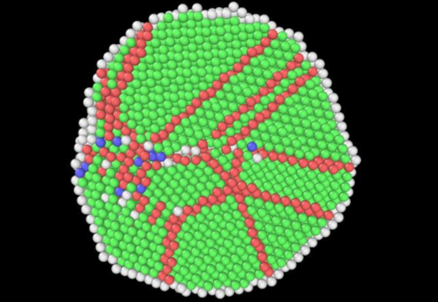
- diameters of 2 and 8 nm are presented. A simple visual inspection confirms the formation of a multifaceted crystal surface at low temperature, while a smoother and uniform surface is seen at high temperature. The temperature dependence of the average coordination number as a function of the NP diameter is
- distribution, the obtained diffraction pattern predictions at high temperature share the same characteristics regardless of the NP diameter and the chemical constitution. We observe two pairs of peaks and valleys, which are rather broad and relatively wide. For the Au NPs, the peaks are located at roughly 40
- the NPs are amorphous. The diffraction patterns of the small NPs at 100 K are still similar to each other. They are also analogous to the patterns at high temperature, however, the peaks have become sharper, and a third distinct peak at roughly 135° is clear now. These findings support the idea that


Facile synthesis of Fe-based metal–organic frameworks from Fe2O3 nanoparticles and their application for CO2/N2 separation
Beilstein J. Nanotechnol. 2024, 15, 897–908, doi:10.3762/bjnano.15.74
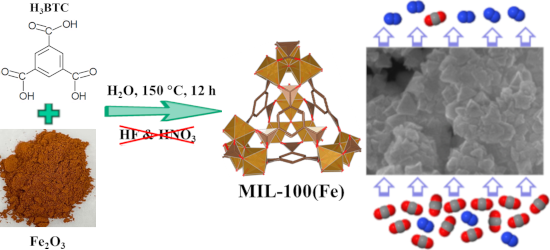
- trimesic acid [19]. These factors caused an immense rise in production cost. Further efforts were made to enhance both product quality and yield by using FeCl3·6H2O and iron(III) nitrate nonahydrate (Fe(NO3)3·9H2O) as iron precursors in a high-temperature reactor without HF and HNO3. The findings revealed





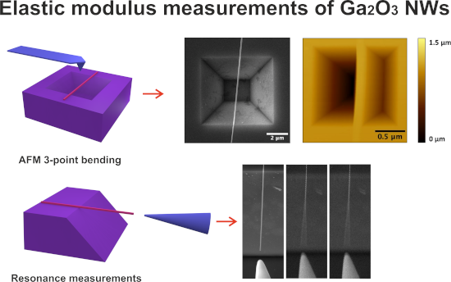
Elastic modulus of β-Ga2O3 nanowires measured by resonance and three-point bending techniques
Beilstein J. Nanotechnol. 2024, 15, 704–712, doi:10.3762/bjnano.15.58
- with Au nanoparticles (NPs, 100 nm of diameter, water suspension, Alfa Aesar) were positioned in a lower-temperature region 10 cm away from the furnace centre. Au NPs served as catalysts for the vapour–liquid–solid (VLS) growth mechanism. The reactor was heated to 1010 °C (high-temperature zone) under


Gold nanomakura: nanoarchitectonics and their photothermal response in association with carrageenan hydrogels
Beilstein J. Nanotechnol. 2024, 15, 678–693, doi:10.3762/bjnano.15.56

- , we chose one shorter and one longer nanorod to make the current study conclusive [29]. Interestingly, CTAB-AuNR and DTAB-AuNR showed a significant temperature rise of 16.7 and 20 °C, respectively, as shown in Figure 8b at colloidal state. The high temperature change in case of DTAB-AuNR clearly






Laser synthesis of nanoparticles in organic solvents – products, reactions, and perspectives
Beilstein J. Nanotechnol. 2024, 15, 638–663, doi:10.3762/bjnano.15.54





Fabrication of nanocrystal forms of ᴅ-cycloserine and their application for transdermal and enteric drug delivery systems
Beilstein J. Nanotechnol. 2024, 15, 465–474, doi:10.3762/bjnano.15.42
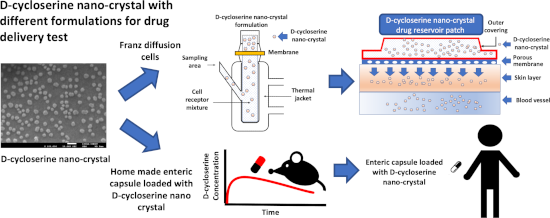
- stability of DCS nanocrystals under these experimental conditions. This is the first time that DCS nanocrystals were successfully developed and applied in a transdermal system. Stability tests of these formulations under high temperature and high humidity for final formulations can be conducted in the


Potential of a deep eutectic solvent in silver nanoparticle fabrication for antibiotic residue detection
Beilstein J. Nanotechnol. 2024, 15, 426–434, doi:10.3762/bjnano.15.38
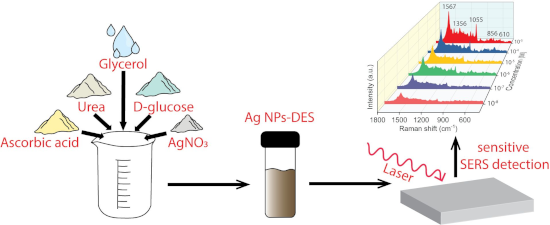
- synthesis because of the Cl− anions in choline chloride, which may unintentionally cause AgCl precipitation. Here, we chose an alternative DES [56] without any anions precipitating with Ag+ cations. ᴅ-glucose, urea, and glycerol (molar ratio 1:1:2) were mixed and magnetically stirred at relatively high
- temperature until a homogenous liquid formed. Then, the mixture was cooled down gradually to room temperature while keeping the vigorous stirring. 0.025 g of AA was dissolved in 10.195 g of fabricated DES, and 0.006 g of AgNO3 was added later, which helped the reaction to occur. After 30 min of constant


Determining by Raman spectroscopy the average thickness and N-layer-specific surface coverages of MoS2 thin films with domains much smaller than the laser spot size
Beilstein J. Nanotechnol. 2024, 15, 279–296, doi:10.3762/bjnano.15.26
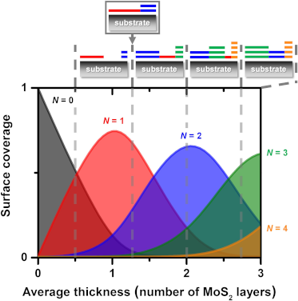
- . However, the high temperature used in the CVD synthesis and interaction with the substrate can lead to lattice distortion and the presence of vacancies and doping. In the following, we limit our study to a number of layers N ≤ 4. Figure 4a compares the values of ΔωA−E measured on exfoliated (Figure 4a


Influence of conductive carbon and MnCo2O4 on morphological and electrical properties of hydrogels for electrochemical energy conversion
Beilstein J. Nanotechnol. 2024, 15, 57–70, doi:10.3762/bjnano.15.6
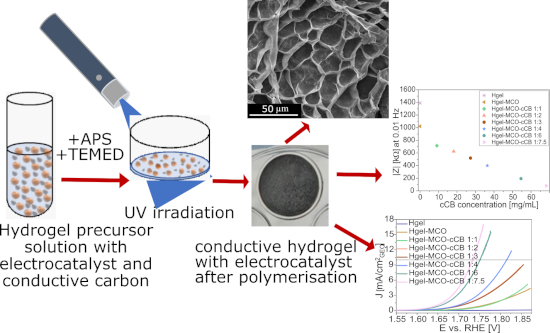
- . Conclusion The article presents a one-stage method for the fabrication of polymer composites based on a hydrogel in which MnCo2O4 as the catalyst (MCO) and conductive carbon black particles as conductive fillers have been embedded. In the developed synthesis method, the need to use high temperature was
- cooling bath to eliminate the high temperature generated by UV irradiation. In both cases, we protected the PNIPAAm polymer from reaching the lower critical solution temperature (LCST) by cooling. The LCST of PNIPAM in pure water is approx. 32 °C [59][60][61]. Polymerisation reactions performed at a


Measurements of dichroic bow-tie antenna arrays with integrated cold-electron bolometers using YBCO oscillators
Beilstein J. Nanotechnol. 2024, 15, 26–36, doi:10.3762/bjnano.15.3
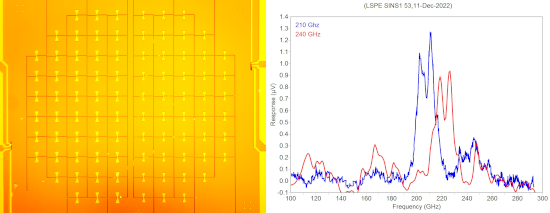
- based on high-temperature YBCO Josephson junctions [27][28][29]. Long junctions based on YBCO thin films were fabricated by the preliminary topology mask method [30][31]. Specifically, YBCO film was deposited on a 24° [001]-tilt Zr1−xYxO2 bicrystal substrate by magnetron sputtering with preliminary


TEM sample preparation of lithographically patterned permalloy nanostructures on silicon nitride membranes
Beilstein J. Nanotechnol. 2024, 15, 1–12, doi:10.3762/bjnano.15.1
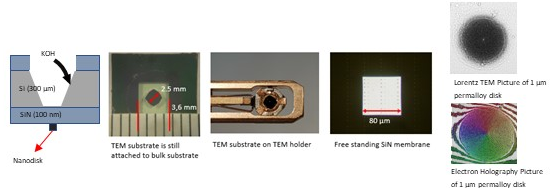
- sides of the resist. There are, however, a few limitations to consider: The spin-coated resist may be inhomogeneous (edge bead effect) on smaller substrates, reducing the region where high-quality structures may be obtained. Furthermore, one cannot deposit metals at high temperature, and one has to


In situ magnesiothermic reduction synthesis of a Ge@C composite for high-performance lithium-ion batterie anodes
Beilstein J. Nanotechnol. 2023, 14, 751–761, doi:10.3762/bjnano.14.62
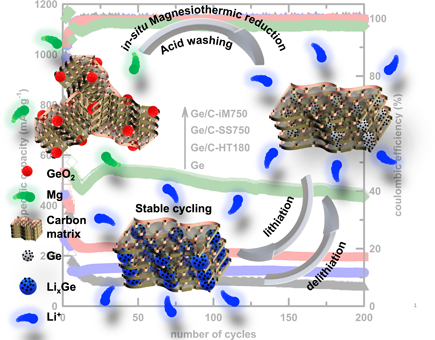
- results indicate that this chemical contact is enhanced by the high-temperature treatment, which is in agreement with the improved behavior of Ge/C-SSS750 compared to Ge/C-HT180. In addition, the in situ synthesis induces an improved contact between Ge and the carbon matrix, leading to enhanced electronic





