


Search results
Search for "hydrogen production" in Full Text gives 33 result(s) in Beilstein Journal of Nanotechnology.
Two-dimensional carbon-based nanocomposites for photocatalytic energy generation and environmental remediation applications
Beilstein J. Nanotechnol. 2017, 8, 1571–1600, doi:10.3762/bjnano.8.159
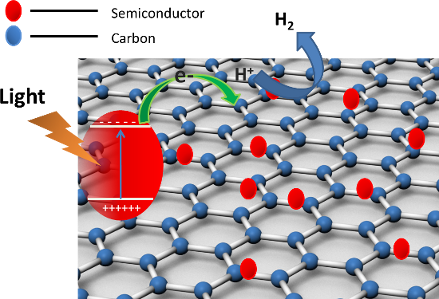
- nature in the form of water, its production from water using solar energy is therefore an area of immense interest for researchers because of its potential to fulfil the global energy demand and related environmental issues [5]. For the first time, photoelectrochemical (PEC) hydrogen production was
- achieved in 1972 by Fujishima and Honda on a TiO2 anode and Pt cathode under ultraviolet (UV) light irradiation [6]. After this, research interest in exploring semiconductors for hydrogen production has grown significantly and many research groups have focussed their studies in this direction [7][8][9][10
- attracted much attention in this field. In order to efficiently utilize the solar energy, many photoelectrochemical cells have been developed for hydrogen production [100][101]. Basically, in the process of photocatalytic water splitting, photons with energy greater than the band gap energy of the chosen


Growth, structure and stability of sputter-deposited MoS2 thin films
Beilstein J. Nanotechnol. 2017, 8, 1115–1126, doi:10.3762/bjnano.8.113
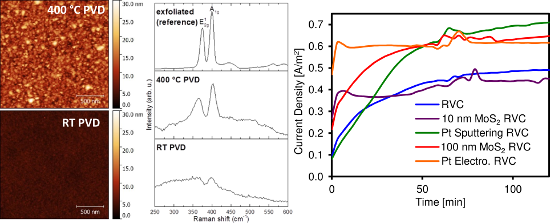
- HER performance for hydrogen production [18]. Intercalation and adsorption of species was also shown to lead to metallic 1T phase regions in semiconducting 2H MoS2 [48]. If a large enough fraction of 1T structure is formed in a semiconducting 2H film this could lead to a metallic percolation network


Palladium nanoparticles anchored to anatase TiO2 for enhanced surface plasmon resonance-stimulated, visible-light-driven photocatalytic activity
Beilstein J. Nanotechnol. 2015, 6, 428–437, doi:10.3762/bjnano.6.43
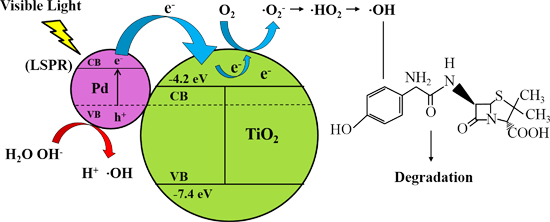
- compare to TiO2 nanotubes (250 min) [28]. Similarly, Kwak et al. found that by incorporating Pd into TiO2 led to an improved hydrogen production compared to pure TiO2 [29]. Hence, it is clear that the inclusion of noble metals either as dopant or composite contributes to an enhanced visible-light


Enhanced photocatalytic hydrogen evolution by combining water soluble graphene with cobalt salts
Beilstein J. Nanotechnol. 2014, 5, 1167–1174, doi:10.3762/bjnano.5.128
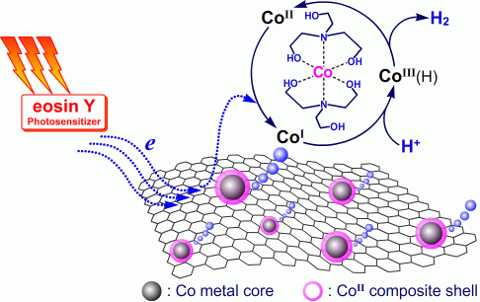
- ][27][28][29][30][31][32][33]. Specifically, graphene has been involved in photocatalytic hydrogen production systems [34], such as TiO2-(N)RGO-Pt [35][36][37][38], g-C3N4-RGO-Pt [39], CdS-RGO-Pt [40][41][42][43], MoS2-NRGO [44][45], EY-RGO-Pt [46] and BiVO4-RGO-Ru/SrTiO3:Rh [47] (RGO: reduced graphene


Functionalized nanostructures for enhanced photocatalytic performance under solar light
Beilstein J. Nanotechnol. 2014, 5, 994–1004, doi:10.3762/bjnano.5.113
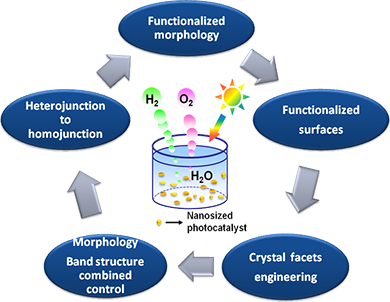
- ][2][3][4]. Photocatalytic hydrogen production from water by using solar energy is one of the most acceptable routes for this aim, since only abundant water and solar energy are needed for hydrogen production in the process. If the economic viability for industrial application is successfully
- satisfied, it will ultimately solve the energy and environmental problems [5][6]. Since the first report by Fujishima and Honda in 1972 [7], hydrogen production from water over semiconducting powders or films by using solar energy has been extensively studied. Thermodynamically, the reaction of producing
- (corresponding to an absorption threshold larger than 420 nm). Efficient utilization of these huge amounts of "low energy" photons is crucial to the realization of commercial solar photocatalytic hydrogen production. To this end, band engineering is necessary to design semiconductor photocatalysts with


A visible-light-driven composite photocatalyst of TiO2 nanotube arrays and graphene quantum dots
Beilstein J. Nanotechnol. 2014, 5, 689–695, doi:10.3762/bjnano.5.81
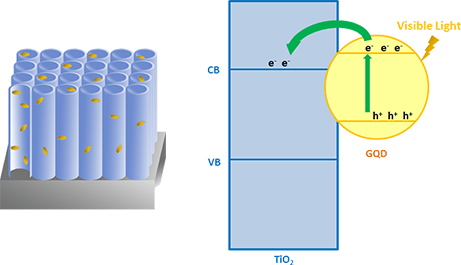
- visible-light-driven photocatalysis [35][36]. Very recently, the combination of GQDs with CdS-modified TNAs was reported for photoelectrochemical hydrogen production. However, GQDs did not enhance the activity of bare TNAs in the study [37]. GQDs have also been chemically coupled with ZnO nanowires for


High activity of Ag-doped Cd0.1Zn0.9S photocatalyst prepared by the hydrothermal method for hydrogen production under visible-light irradiation
Beilstein J. Nanotechnol. 2014, 5, 587–595, doi:10.3762/bjnano.5.69
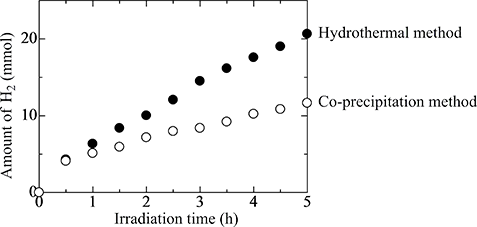
- activity of Cd0.1Zn0.9S was studied for the hydrogen production from water reduction under visible light irradiation. Results: Compared to the series prepared by the co-precipitation method, samples prepared by the hydrothermal method performed with a better photocatalytic activity. The sample with the
- optimum amount of Ag doping showed the highest hydrogen production rate of 3.91 mmol/h, which was 1.7 times higher than that of undoped Cd0.1Zn0.9S. With the Ag doping, a red shift in the optical response was observed, leading to a larger portion of the visible light absorption than that of without doping
- Cd0.1Zn0.9S photocatalyst. Keywords: Ag doping; Cd0.1Zn0.9S; hydrogen production; hydrothermal; visible light; Introduction The development of clean and renewable hydrogen energy through a sustainable production process is still a big issue to be addressed. Solar energy is a very attractive option as it is


Preparation of NiS/ZnIn2S4 as a superior photocatalyst for hydrogen evolution under visible light irradiation
Beilstein J. Nanotechnol. 2013, 4, 949–955, doi:10.3762/bjnano.4.107
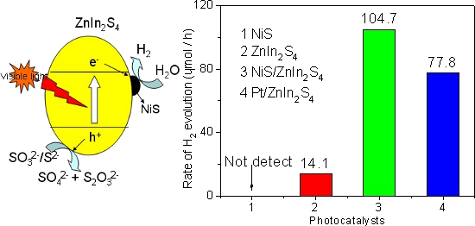
- electrodes for water splitting by Fujishima and Honda in 1972, great efforts have been devoted to the development of highly efficient semiconductor photocatalysts for hydrogen production [4]. So far, a variety of active photocatalysts for hydrogen production, including metal oxides [5][6][7][8], sulfides [9


Other Beilstein-Institut Open Science Activities



