Search results
Search for "irradiation" in Full Text gives 590 result(s) in Beilstein Journal of Nanotechnology. Showing first 200.
Microplastic pollution in Himalayan lakes: assessment, risks, and sustainable remediation strategies
Beilstein J. Nanotechnol. 2025, 16, 2144–2167, doi:10.3762/bjnano.16.148
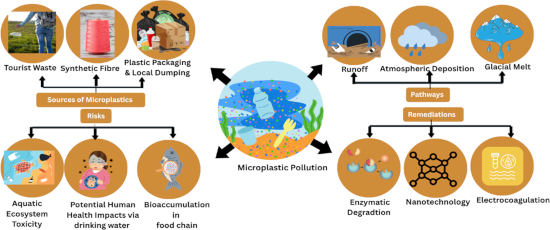
- application of nanomaterials for microplastic removal is elaborated in detail, and case studies validated their effectiveness, especially in cold environments with strong UV irradiation. In the face of increasing worldwide research into microplastic contamination, there remains a huge knowledge gap concerning
- is particularly problematic at high altitudes, including the Himalayas. Implementation of sophisticated analysis methods and sampling is limited due to extreme climatic conditions like below-freezing temperatures, strong UV irradiation, and poor infrastructure [31]. Portable and robust field-friendly
- Case studies of nanomaterial efficiency The effectiveness of nanomaterials in the remediation of MPs has been confirmed in numerous experimental studies and real-world practical applications. Jeyaraj et al. found that after 12 h of UV irradiation, TiO2 nanoparticles degraded PP MPs with an efficiency


Laser ablation in liquids for shape-tailored synthesis of nanomaterials: status and challenges
Beilstein J. Nanotechnol. 2025, 16, 1963–1997, doi:10.3762/bjnano.16.137
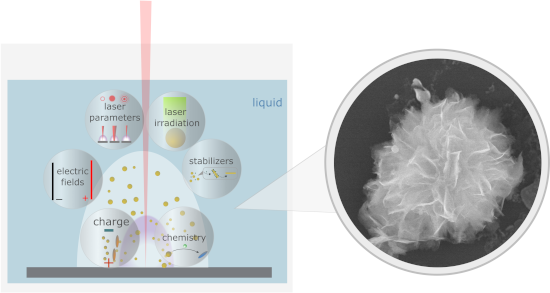
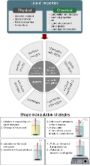
- liquids; laser irradiation; nanofabrication; nanoparticles; shape control; Perspective 1 Introduction: Mechanisms and key parameters influencing the morphology of laser-produced NPs The precise control and tailoring of NP parameters has long been an aim of the laser ablation synthesis in liquids
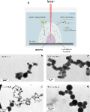
- . However, the additional 248 nm laser irradiation of the spherical NPs in methanol could transform NPs into nanowires. This underlines the importance of controlling chemical reactions during all stages of laser ablation and laser modification processes. Chemical interactions can become key parameters if
- by unfocused laser irradiation as a second step. This strategy has developed into several methods usually categorized as laser-induced fragmentation, laser-induced melting, or laser-induced modification. Such multistep processes open up ways for precise manipulation and fine tuning of NP parameters




Evaluating metal-organic precursors for focused ion beam-induced deposition through solid-layer decomposition analysis
Beilstein J. Nanotechnol. 2025, 16, 1942–1951, doi:10.3762/bjnano.16.135
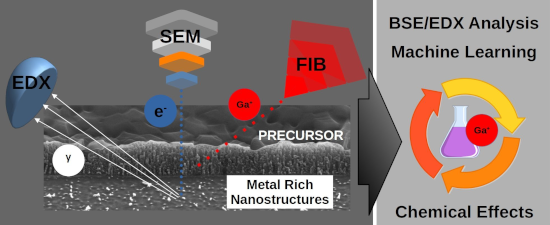
- new metal-organic precursors, in the form of supported thick layers, to the ion beam irradiation is studied through analysis of the chemical composition and morphology of the resulting structures. This is done using SEM backscattered electron/energy-dispersive X-ray spectroscopy along with machine
- learning data processing techniques. This approach enables a comprehensive fast examination of precursor decomposition processes during FIB irradiation and provides valuable insights into how the precursor’s composition influences the final properties of the metal-rich deposits. Although solid-layer
- irradiation differs from gas-phase deposition, we think that our method can be employed to optimize pre-screen and score new potential precursors for FIB applications by significantly reducing the time required and conserving valuable resources. Keywords: backscattered electrons (BSE); carboxylates; energy


Quantum circuits with SINIS structures
Beilstein J. Nanotechnol. 2025, 16, 1931–1941, doi:10.3762/bjnano.16.134
- ; and Neptune 2.34 arcsec, 117.4 K, 3.57 Jy. At this stage, the necessary equipment and elements of the quasi-optical path in the “Nasmyth 1” cabin of the BTA telescope have been installed. Also, primary tests of the quasi-optical path for focusing incoming radiation and irradiation of the source
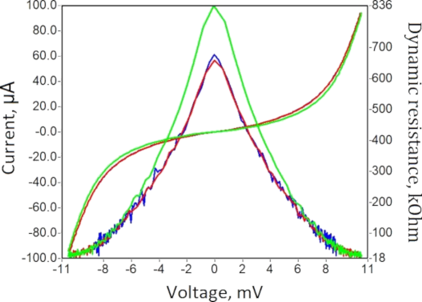
- characteristics of the SINIS detector matrix installed inside the cryostat with a closed optical window and under irradiation by the source; The lower part demonstrates a PT2 temperature of 2.6 K and a 3He pot temperature of 263 mK. Transmission spectrum of the cold mesh filter. (a) I–V curves and dynamic


Piezoelectricity of layered double hydroxides: perspectives regarding piezocatalysis and nanogenerators
Beilstein J. Nanotechnol. 2025, 16, 1812–1817, doi:10.3762/bjnano.16.124

- biocompatibility might exhibit a piezoelectric effect under ultrasound irradiation and generate superoxide anion radicals [5]. The results confirmed the potential of the selected LDH for application in novel piezocatalytic tumor therapy as an effective sonosensitizer. The obtained data indicated that the
- different thicknesses were investigated for the piezo-photocatalytic degradation of carbamazepine [6]. The ultrathin samples achieved an efficiency of 95.8% with a reaction rate constant of 0.148 min−1. This effect was attributed to the higher sensitivity of ultrathin LDH sheets to both light irradiation

Electrical, photocatalytic, and sensory properties of graphene oxide and polyimide implanted with low- and medium-energy silver ions
Beilstein J. Nanotechnol. 2025, 16, 1794–1811, doi:10.3762/bjnano.16.123
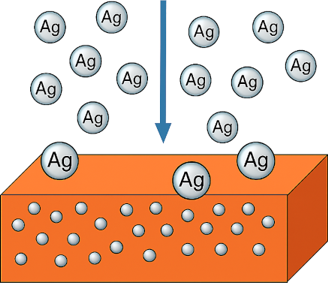
- bandgap and an increased density of states near the Fermi level, promotes absorption in the visible region and facilitates the generation of electron–hole (e−–h+) pairs upon light irradiation. The silver clusters also exhibit plasmonic resonances, which amplify the local electromagnetic field and promote
- structural analysis of GO before and after ion irradiation was conducted using Raman spectroscopy [28]. This spectroscopic technique, known for its effectiveness in probing disorders and defects within crystal structures, proved particularly valuable in characterizing graphite and its derivatives [29]. The
- Figure 7a, irradiation of GO with 20 keV Ag ions leads to significant changes in the structure and vibrational states of GO. One can see a significant decrease in the D peak; this decrease is the same for arbitrary ion fluences, and the ID/IG ratio reaches values of 0.94. The D peak in the Raman spectrum


Photocatalytic degradation of ofloxacin in water assisted by TiO2 nanowires on carbon cloth: contributions of H2O2 addition and substrate absorbability
Beilstein J. Nanotechnol. 2025, 16, 1567–1579, doi:10.3762/bjnano.16.111
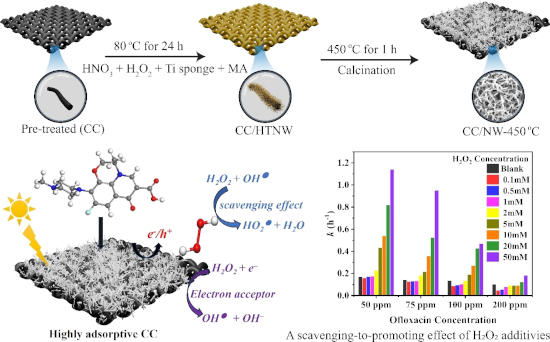
- nanowires remove 90–97% OFL in water with a high initial concentration of 50 ppm in 6 h under UV light irradiation for up to six cycles. The contributions of the hydrogen peroxide (H2O2) additive were also studied. An enhanced efficiency could be achieved only when the H2O2 in water reaches a critical
- 200 ppm, utilizing carbon cloth coated with nanowires with a nominal area of 5 cm × 10 cm in a Pyrex reactor. A UV lamp with a power of 18 W was positioned 5.5 cm above the fluid to provide irradiation. The average UV intensity at the solution level was approximately 5.0 mW·cm−2, measured using an
- was examined through repetitive degradations of 50 ppm OFL solution under UV light irradiation (Figure 5d). Unlike the experiment in Figure 5a, which included a dark adsorption (from −3 to 0 h) allowing OFL to adsorb onto the photocatalyst before light exposure, the cycling experiments in Figure 5d


Influence of laser beam profile on morphology and optical properties of silicon nanoparticles formed by laser ablation in liquid
Beilstein J. Nanotechnol. 2025, 16, 1533–1544, doi:10.3762/bjnano.16.108
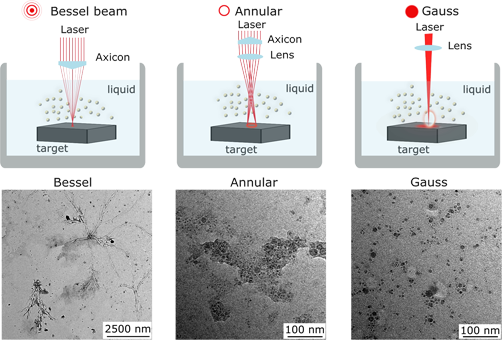
- magnified image of the area exposed to irradiation from the outer rings (Supporting Information File 1, Figure S5c) shows individual twisted nanofilaments. This observation confirms the participation of the outer rings in nanofilament formation and proves melting of the target by the outer rings. In


Laser processing in liquids: insights into nanocolloid generation and thin film integration for energy, photonic, and sensing applications
Beilstein J. Nanotechnol. 2025, 16, 1428–1498, doi:10.3762/bjnano.16.104
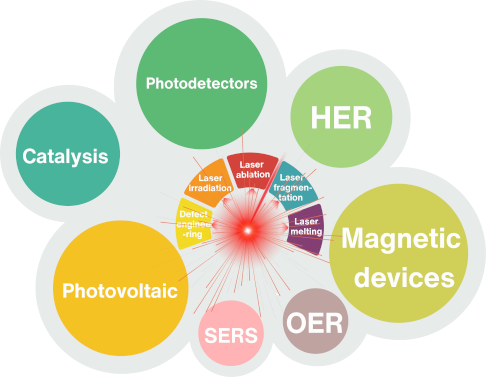
- Nanoparticles in their pure colloidal form synthesized by laser-assisted processes such as laser ablation/fragmentation/irradiation/melting in liquids have attained much interest from the scientific community because of their specialties like facile synthesis, ultra-high purity, biocompatibility, colloidal
- ; nanocolloids to thin films; photocatalysis; photovoltaics and photodetection; surface-enhanced Raman spectroscopy (SERS); Review 1 Introduction This section provides a brief introduction to the fundamental laser processing techniques used in liquids, including ablation, fragmentation, melting, irradiation; it
- detailed discussion of their resulting applications is also available [11]. One of the earlier review articles (published in the year 2012) on laser ablation/irradiation explains how to attain nanostructures with various compositions (e.g., metals, alloys, oxides, carbides, and hydroxides) and morphologies






Photochemical synthesis of silver nanoprisms via green LED irradiation and evaluation of SERS activity
Beilstein J. Nanotechnol. 2025, 16, 1417–1427, doi:10.3762/bjnano.16.103
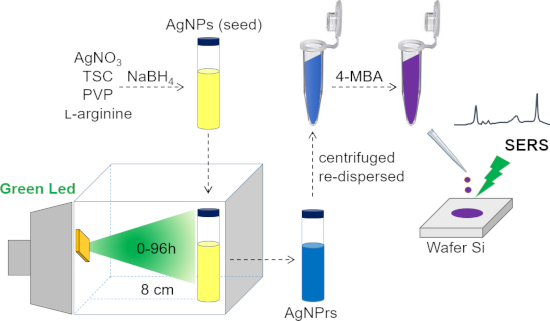
- AgNPrs. Optimal conversion was observed after 72 h of irradiation, producing well-defined AgNPrs with an average size of 78 nm. The SERS activity of the AgNPrs was evaluated using 4-mercaptobenzoic acid as a probe molecule. Compared to spherical AgNPs, AgNPrs exhibited a significantly higher SERS
- -MBA) as a probe molecule. In this study, AgNPrs were synthesized photochemically using green LED 10 W irradiation. Seeds were prepared using 1 mM AgNO3 and stabilized with a trisodium citrate (TSC)/AgNO3 molar ratio of 5. Physicochemical analyses confirmed the successful formation of AgNPrs with high
- ) irradiating the seeds with green LEDs to form AgNPrs with the aid of ʟ-arginine (L-A) [9]. Due to the different SPR properties between AgNPs and AgNPrs, the morphological transformation of silver nanostructures in sample can be observed through UV–vis spectra in Figure 2. After 6 h of LED irradiation, the UV


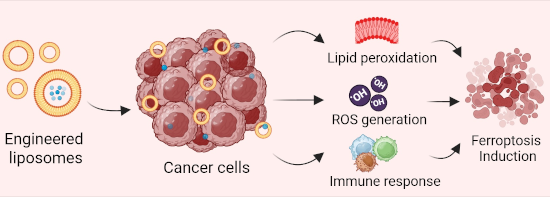
Ferroptosis induction by engineered liposomes for enhanced tumor therapy
Beilstein J. Nanotechnol. 2025, 16, 1325–1349, doi:10.3762/bjnano.16.97


Wavelength-dependent correlation of LIPSS periodicity and laser penetration depth in stainless steel
Beilstein J. Nanotechnol. 2025, 16, 1302–1315, doi:10.3762/bjnano.16.95
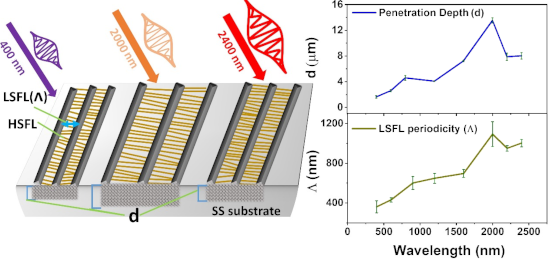
- This research paper delves into the exploration of laser-induced periodic surface structures (LIPSS) on a 100 µm thin stainless steel (SS) sheet. Through the application of laser irradiation with wavelengths spanning from 400 to 2400 nm, we systematically generate ladder-like LIPSS across a substantial
- structure with laser irradiation wavelengths ranging from 400 to 2200 nm. From this, a linear trend in LIPSS characteristics was observed up to 2000 nm, and the threshold of the LIPSS formation was determined [52]. In the present work, we extend the LIPSS over a large area, instead of a single line, using
- 400 to 2400 nm laser irradiation. This enabled the examination of the cross-sectional zone where the cumulative effect of the laser irradiation occurs. We analyzed how these effects correlate with the incident laser wavelength. The manuscript delves into the critical parameter of penetration depth, or




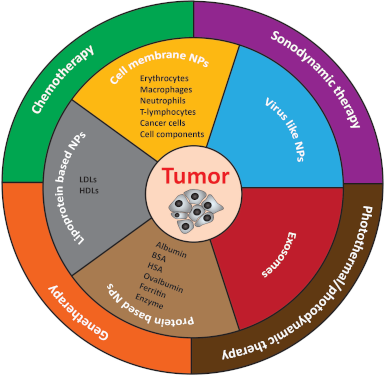
Better together: biomimetic nanomedicines for high performance tumor therapy
Beilstein J. Nanotechnol. 2025, 16, 1246–1276, doi:10.3762/bjnano.16.92
- . RBC membrane was also conjugated with gold nanostars to control the release with near-infrared irradiation. Also, RBC and platelet hybrid membrane-coated gold nanostars achieved targeted delivery to melanoma cells while avoiding macrophage phagocytosis [129]. Although RBC-camouflage nanomedicines are
- nm) fluorescence and PTT, consisting of tumor cell-derived exosomes (EXO) and TT3-oCB nanoparticles. The TT3-oCB NP-EXOs showed promising and stable photothermal conversion capacity under 808 nm irradiation to be used as biomimetic NPs for NIR-II fluorescence imaging-guided PTT of tumors. The TT3-oCB






Hydrogels and nanogels: effectiveness in dermal applications
Beilstein J. Nanotechnol. 2025, 16, 1216–1233, doi:10.3762/bjnano.16.90
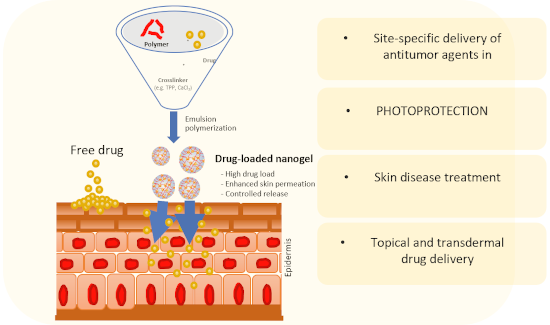
- polymer chains accomplished by irradiation, condensation reaction, radical polymerization, or chemical reactions [14][43][47]. Cross-linking agents or cross-linkers are symmetrical bifunctional compounds that contain two or more reactive ends capable of chemically attaching to specific functional groups
- by electronic beam irradiation. Polyvinyl alcohol hydrogels can be used for wound healing. Suhaeri et al. (2018) manufactured an adhesive hydrogel with PVA and a derivative of human pulmonary fibroblasts, in addition to ciprofloxacin, for treating infected wounds [95]. For the preparation of the


Crystalline and amorphous structure selectivity of ignoble high-entropy alloy nanoparticles during laser ablation in organic liquids is set by pulse duration
Beilstein J. Nanotechnol. 2025, 16, 1141–1159, doi:10.3762/bjnano.16.84
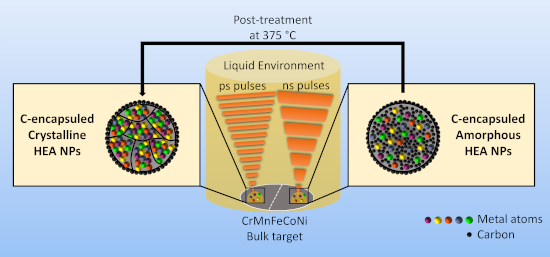
- loss spectroscopy, in situ heating, post-irradiation experiments, and differential scanning calorimetry we demonstrate that a pulse-duration-driven structural difference occurs during laser ablation in liquid is observable to the three utilized solvents. While picosecond-pulsed laser ablation in liquid
- -irradiation experiments to pinpoint HEA NP formation pathways into thermodynamically favored or kinetically stabilized structures. Results and Discussion Picosecond-LAL (wavelength: 1064 nm, pulse energy: 0.15 mJ, repetition rate: 100 kHz, incident fluence: 0.1 J/cm2) and ns-LAL (wavelength: 1064 nm, pulse
- fluence, and post-irradiation effects. One assumption may be that amorphous phase formation is ruled by the particle diameter as it is well-known that smaller NPs may appear amorphous in diffraction-based techniques due to less coherent conditions for Bragg reflection from their crystalline domains [80




Fabrication of metal complex phthalocyanine and porphyrin nanoparticle aqueous colloids by pulsed laser fragmentation in liquid and their potential application to a photosensitizer for photodynamic therapy
Beilstein J. Nanotechnol. 2025, 16, 1088–1096, doi:10.3762/bjnano.16.80
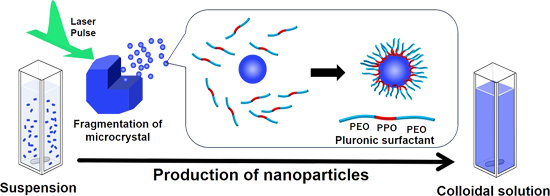
- suspended in a poor solvent is fragmented into nanoparticles by intense pulsed laser irradiation, and the sample suspension is directly converted in to a colloidal dispersion without any chemical additives in one step. It has been demonstrated that several hydrophobic dyes such as metal complex Pcs (MPcs
- spectrometer, and the sample was irradiated with laser pulses until the absorption spectrum stopped changing. The sample was muddy blue, and most of the AlClPc precipitated to the bottom of the cuvette before laser irradiation. After irradiation with nanosecond laser pulses for 40 min (Figure 2a), the sample
- turned to deep clear blue. A broad absorption with peaks at 620 and 800 nm appeared and increased with laser irradiation time; the absorbance stopped changing after around 30 min irradiation as shown in Figure 2b. The two peaks that appeared at short and long wavelengths relative to the isolated


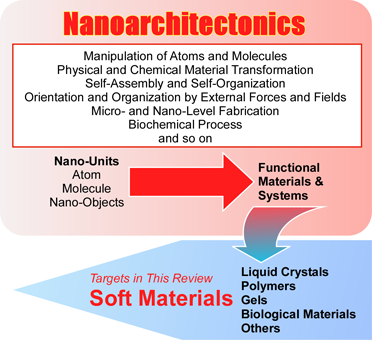
Soft materials nanoarchitectonics: liquid crystals, polymers, gels, biomaterials, and others
Beilstein J. Nanotechnol. 2025, 16, 1025–1067, doi:10.3762/bjnano.16.77






A calix[4]arene-based supramolecular nanoassembly targeting cancer cells and triggering the release of nitric oxide with green light
Beilstein J. Nanotechnol. 2025, 16, 1003–1013, doi:10.3762/bjnano.16.75
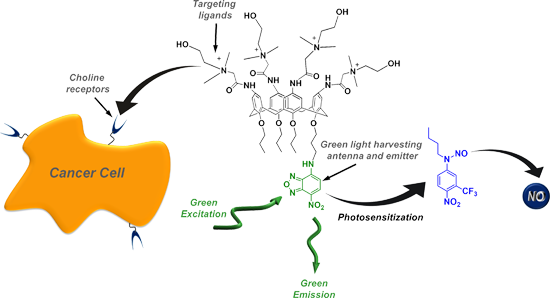
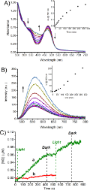
- methanol/water (1:1) and, for comparison, that of its non-nitrosated derivative 2b. Both compounds exhibit similar molar absorptivity, but the absorption maximum of 2 is by almost 100 nm blue-shifted due to the loss of the push−pull character of the nitroaniline chromophore. Irradiation of 2 with blue
- does not absorb green light (see Figure 3A) and, therefore, is unreactive to this excitation wavelength. However, irradiation of the 1·2 supramolecular complex leads to a photochemical transformation characterized by the increase of the typical absorption of the non-nitrosated derivative 2b (Figure 5A
- amperometric detection of this radical species through an ultrasensitive NO electrode while alternating cycles of light/dark. Figure 5C shows that the NO generation is achieved exclusively upon green light excitation of the nanoassembly and stops once the irradiation source is switched off. The quantum yield


Time-resolved probing of laser-induced nanostructuring processes in liquids
Beilstein J. Nanotechnol. 2025, 16, 968–1002, doi:10.3762/bjnano.16.74
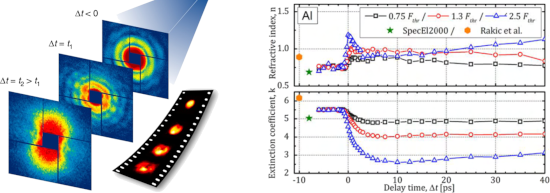
- reactions that span from atomic to macroscopic length scales. Consequently, it is paramount to understand the complex cascades that follow laser irradiation of condensed matter. Of particular importance here is the processing in the presence of liquids surrounding the irradiated material, but also
- , it is important to understand and quantify such processes that may occur concomitantly and will affect each other. First, we develop a basic hypothesis of how laser irradiation with significant energy deposition into the system of interest (for example an aqueous colloid or solid surface in contact


Structural and magnetic properties of microwave-synthesized reduced graphene oxide/VO2/Fe2O3 nanocomposite
Beilstein J. Nanotechnol. 2025, 16, 921–932, doi:10.3762/bjnano.16.70
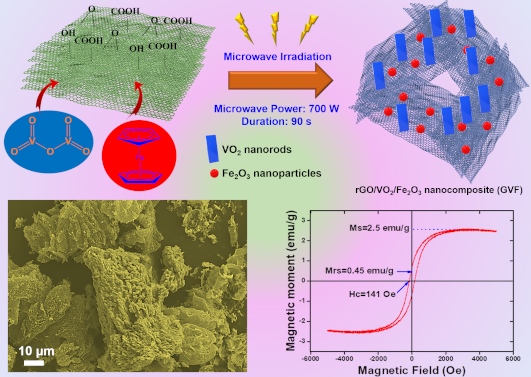
- gained considerable research attention. In this context, the current work demonstrates a facile rGO-supported solid-state MW synthetic route for fabricating a ternary nanocomposite of VO2, Fe2O3, and rGO. Here, the MW irradiation for 90 s was found to be suitable for the reduction and exfoliation of
- . Keywords: Fe2O3; magnetism; microwave irradiation; reduced graphene oxide; VO2; Introduction Graphene-based materials have been significantly explored in various fields of materials science due to their unique physical and chemical characteristics [1][2][3][4]. The special arrangement of carbon materials
- with graphene by applying MW irradiation for certain time intervals. In this context, Zhang et al. reported the synthesis of Ni-Co sulfide/graphene NC through MW irradiation at a power of 1000 W for 60 s [12]. As a supercapacitor (SC) electrode, the MW-synthesized NC displayed a specific capacitance of



Characterization of ion track-etched conical nanopores in thermal and PECVD SiO2 using small angle X-ray scattering
Beilstein J. Nanotechnol. 2025, 16, 899–909, doi:10.3762/bjnano.16.68
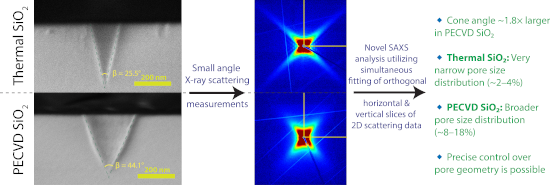
- nanopores in different materials, which is essential for optimizing membrane performance in applications that require precise pore geometry. Keywords: etched ion tracks; SiO2; small angle X-ray scattering (SAXS); swift heavy ion irradiation; track-etched nanopores; Introduction Solid-state nanopores have
- and a wider size distribution. Results and Discussions Figure 1 shows plan-view scanning electron microscopy (SEM) images of nanopores fabricated in thermal (Figure 1a) and PECVD (Figure 1b) SiO2 by etching ion tracks produced with 1.6 GeV Au ion irradiation (see Experimental and Theory section for
- typically differ in morphology, density, and stoichiometry compared to thermally grown SiO2. The electronic energy loss (Se) in the thermal and PECVD SiO2 layers was calculated using the SRIM2008 code [49]. The average Se values for thermal SiO2 for 1.6 GeV, 185 MeV, and 89 MeV Au irradiation are 21.1, 16.6


Ar+ implantation-induced tailoring of RF-sputtered ZnO films: structural, morphological, and optical properties
Beilstein J. Nanotechnol. 2025, 16, 872–886, doi:10.3762/bjnano.16.66
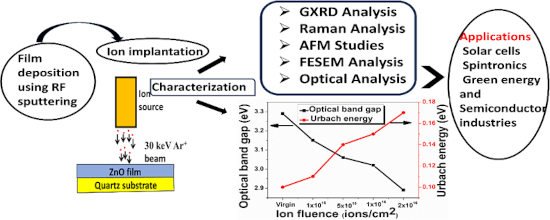
- with 30 keV Ar+ ions. The energy used here was a low energy; also, argon is lighter than zinc. Because of this, the irradiation did not cause a significant shift in peak positions with increasing ion fluence, but it is observable. The shift in peak position and the variation in peak intensity of the






Insights into the electronic and atomic structures of cerium oxide-based ultrathin films and nanostructures using high-brilliance light sources
Beilstein J. Nanotechnol. 2025, 16, 860–871, doi:10.3762/bjnano.16.65

- -ray irradiation. The observed effect was identified as responsible for the enhanced catalytic activity of mixed ceria–zirconia materials in the applications [39]. Photoemission is a technique with a sensitivity limited to the topmost surface layers. In typical resonant photoemission experiments on


Synthesis and magnetic transitions of rare-earth-free Fe–Mn–Ni–Si-based compositionally complex alloys at bulk and nanoscale
Beilstein J. Nanotechnol. 2025, 16, 823–836, doi:10.3762/bjnano.16.62
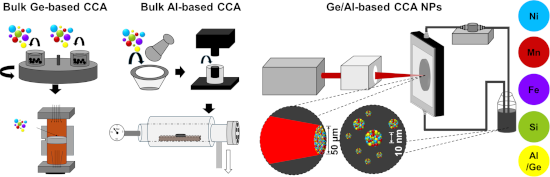
- irradiation of the target material submerged in a liquid environment. This makes PLAL a safe, scalable and environmentally friendly approach [46][47][48]. Research on the synthesis of CoCrFeMnNi Cantor alloy NPs by PLAL demonstrated that this method consistently produces NPs with near-equiatomic compositions


Thickness dependent oxidation in CrCl3: a scanning X-ray photoemission and Kelvin probe microscopies study
Beilstein J. Nanotechnol. 2025, 16, 749–761, doi:10.3762/bjnano.16.58
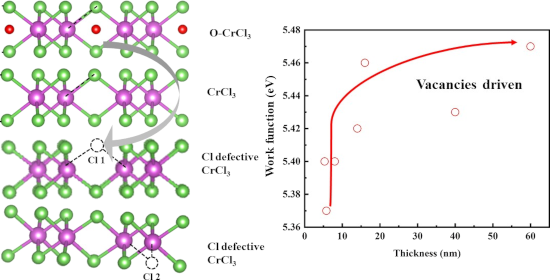
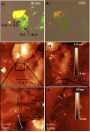
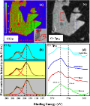
- processes and the lower number of defects present per unit volume that can be exploited in the process. These numbers are increased under beam irradiation, when damages occurs as shown by the light blue area in Figure 5. These results are consistent with previous studies on bulk samples cleaved in vacuum
- silicon oxide substrate would help the determination of flakes thickness, we used also a more conductive substrate to measure photoemission under X-ray irradiation, that is, 1 nm thick native oxide Si substrates. Another convenient substrate for SPEM was 190 nm thick indium-doped tin oxide on glass