Search results
Search for "laser" in Full Text gives 905 result(s) in Beilstein Journal of Nanotechnology. Showing first 200.
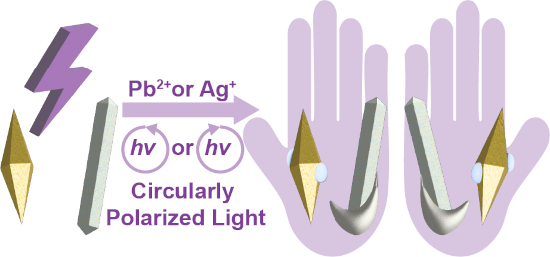
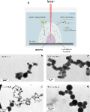
Chiral plasmonic nanostructures fabricated with circularly polarized light
Beilstein J. Nanotechnol. 2025, 16, 2245–2264, doi:10.3762/bjnano.16.154
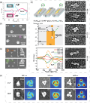
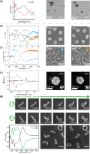
- -assisted hydrolysis with relatively low-energy electrons (≈1.5 eV compared to >10 eV at the hot spots) at the lateral sides of AuNRs. In contrast, polymethyl(methacrylate) (PMMA) decomposed preferentially at the hot spots of the AuNRs under femtosecond laser excitation by high-energy hot electrons
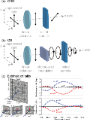
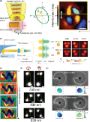
- ) measures the interaction between electrons and cPNSs upon laser excitation by mapping the EELS within an electron microscope [135] (Figure 8e). In summary, we have reviewed the nanoscale characterization tools correlating structure to chiroptical activity of PNSs in this section. CD and ORD are handy tools





Optical bio/chemical sensors for vitamin B12 analysis in food and pharmaceuticals: state of the art, challenges, and future outlooks
Beilstein J. Nanotechnol. 2025, 16, 2207–2244, doi:10.3762/bjnano.16.153
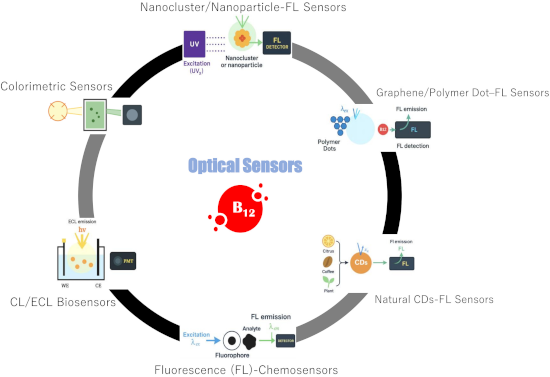
- newer studies on the ECL sensors compared to CL sensors to detect VB12. Bhaiyya et al. have recently fabricated a novel laser-induced graphene (LIG)-based ECL system with two and three channels to detect H2O2, VB12, and vitamin C (VC) from real samples. VB12 and VC acted as the recognition analytes, the


Ultrathin water layers on mannosylated gold nanoparticles
Beilstein J. Nanotechnol. 2025, 16, 2183–2198, doi:10.3762/bjnano.16.151
- evaporated under nitrogen flow. The VSFG experiments were achieved under dry air flushing at room temperature (24 °C) at four different center frequencies to measure the complete CH and OH stretching region in the broadband infrared. The tunable infrared laser produced femtosecond pulses of ca. 5.5 mW (at
- for ppp polarization (all beams polarized normal to the surface) and 2 min for ssp (laser beams polarized parallel to the surface, sum frequency emission and up-conversion polarized perpendicular and infrared parallel to the plane of incidence). Electron microscopy imaging SEM and STEM images were



Toward clinical translation of carbon nanomaterials in anticancer drug delivery: the need for standardisation
Beilstein J. Nanotechnol. 2025, 16, 2092–2104, doi:10.3762/bjnano.16.144

- , laser ablation, or electrochemical techniques, among others. These CNMs must then be thoroughly characterised to confirm their structural and physicochemical properties, including size, shape, charge, surface functionality, stability, and potential toxicity. Following characterisation, anticancer
- main issues is the wide variety of methods that can be used to synthesise CNMs, which can lead to variations in their properties and performance. For example, carbon nanotubes can be synthesised using arc discharge, laser ablation, and chemical vapour deposition, among others [30]. Each method can




Calibration of piezo actuators and systems by dynamic interferometry
Beilstein J. Nanotechnol. 2025, 16, 2086–2091, doi:10.3762/bjnano.16.143
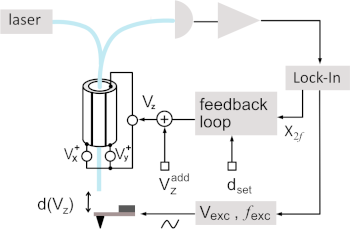
- . Experiments are performed with laser light of wavelength λ = λvac = 780.41 nm and the excitation frequency is kept at the cantilever eigenfrequency fexc = 169.667 kHz determined at the beginning of the measurements. The piezoelectric tube (PZT-8, EBL Products Inc., East Hartford, CT, USA) used for fiber
- measurement has been performed many weeks earlier. The difference in calibration results for measurements taken with significant time elapsed between can be explained by slight differences in the alignment of the laser spot on the cantilever due to manual adjustment or drift. Although, in our models, light is
- treated as a plane wave, in reality the light beam exiting the fiber end has a divergence of about 9°. As a consequence, light diffracted at the edges of the cantilever acts back on the reflected light sampled by the fiber. Furthermore, the partially coherent light of the laser produces speckle patterns


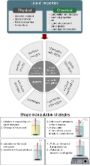
Laser ablation in liquids for shape-tailored synthesis of nanomaterials: status and challenges
Beilstein J. Nanotechnol. 2025, 16, 1963–1997, doi:10.3762/bjnano.16.137
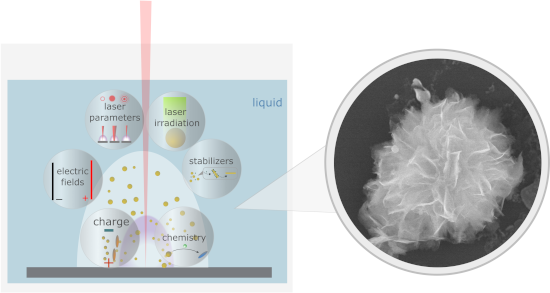
- . Despite many synthesis methods are still mainly focused on the production of near-spherical NPs, a number of emerging applications require nanomaterials of nonspherical shape and developed surface, which determine the functional performance of nanostructured devices. Laser ablation in liquids has been
- demonstrated as a clean, simple, and versatile NP synthesis method. However, the conditions of NP formation and growth are favouring the production of spherical NPs. There are fewer studies of shape control during laser ablation. With that in mind, this perspective article represents a view on the current
- stage of the development of laser ablation in liquids from the perspective of shape control of the forming nanomaterials. The key parameters influencing the NP shape are highlighted, including the composition of a liquid, laser focusing conditions and introduction of external fields, and the mechanism




Evaluating metal-organic precursors for focused ion beam-induced deposition through solid-layer decomposition analysis
Beilstein J. Nanotechnol. 2025, 16, 1942–1951, doi:10.3762/bjnano.16.135
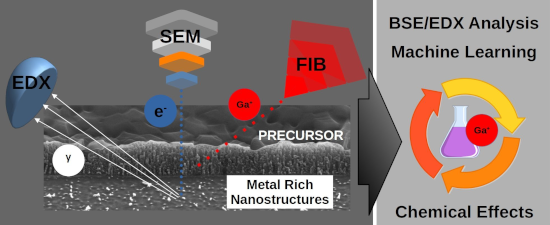
- deposition, chemical mechanical polishing, and laser nanopatterning, enable the creation of nanostructures and nanoscale devices. However, a major limitation of these methods is their inability to effectively produce high-resolution three-dimensional nanostructures [1][2][3][4]. In contrast, focused electron


Further insights into the thermodynamics of linear carbon chains for temperatures ranging from 13 to 300 K
Beilstein J. Nanotechnol. 2025, 16, 1818–1825, doi:10.3762/bjnano.16.125
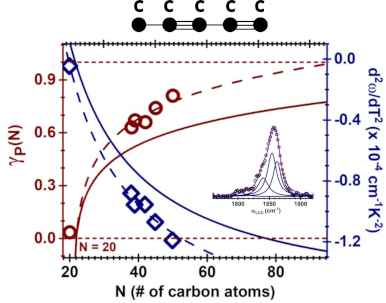
- 0.86) were identified using 514.5 nm, while two LCC with N = 40 and 50 (γP = 0.67 and 0.81, respectively) were identified using 568.2 nm. In agreement with the literature [29][30], the use of different laser lines does not influence the response of the LCC@MWCNT to different T, but it might excite LCC


![[Graphic 23]](/bjnano/content/inline/2190-4286-16-125-i25.svg?max-width=637&scale=1.18182)
Electrical, photocatalytic, and sensory properties of graphene oxide and polyimide implanted with low- and medium-energy silver ions
Beilstein J. Nanotechnol. 2025, 16, 1794–1811, doi:10.3762/bjnano.16.123
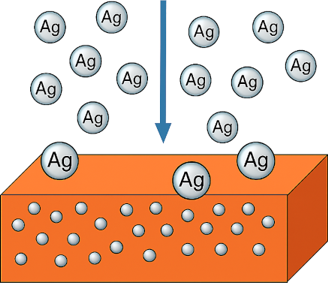
- laser (532 nm, 50 mW) and a 50× magnification objective. For ATR-FTIR measurements, a NICOLET iS50R FTIR spectrometer (Thermo Scientific, USA) was employed. The measurements, spanning the range of 4000–400 cm−1 at a resolution of 4 cm−1, utilized a diamond ATR crystal and a DTGS detector for precise


Bioinspired polypropylene-based functionally graded materials and metamaterials modeling the mistletoe–host interface
Beilstein J. Nanotechnol. 2025, 16, 1592–1606, doi:10.3762/bjnano.16.113
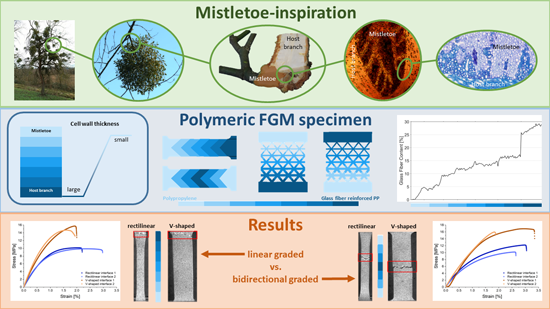
- outside. Once the molding grids had been filled with the base material, they were carefully removed, and hot compression was carried out. Tensile specimens were cut from the laminate using a laser cutter (MT-7050W100, Maitech, Milan, Italy) with a single cycle at a laser speed of 10 mm/s and a power of 30
- could be cut out of the laminate in the width. Figure 2 provides an overview of the tensile specimen designs and their respective fiber content distribution and dimensions. Furthermore, two 2D metamaterials with triangular unit cell configurations were laser cut from the hot-pressed laminates of graded
- ., inversely graded metamaterial, Figure 2I). Glass fiber content analysis X-ray microtomographic (μCT) scans were used to determine the glass fiber content along a linearly graded specimen with rectilinear interfaces and to estimate the heating effects of laser cutting at the specimen edges. Sections of about


Photocatalytic degradation of ofloxacin in water assisted by TiO2 nanowires on carbon cloth: contributions of H2O2 addition and substrate absorbability
Beilstein J. Nanotechnol. 2025, 16, 1567–1579, doi:10.3762/bjnano.16.111
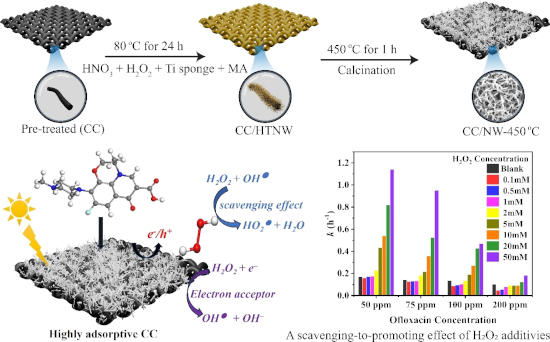
- diffractometer (Rigaku Corporation) with Cu Kα radiation, operating at 40 kV and 35 mA. Raman spectra were obtained using an Alpha300R UV system (WITec, Germany) equipped with a TEM00 laser at a wavelength of 532 nm. X-ray photoelectron spectroscopy (XPS) characterizations were conducted using a Kratos AXIS


Influence of laser beam profile on morphology and optical properties of silicon nanoparticles formed by laser ablation in liquid
Beilstein J. Nanotechnol. 2025, 16, 1533–1544, doi:10.3762/bjnano.16.108
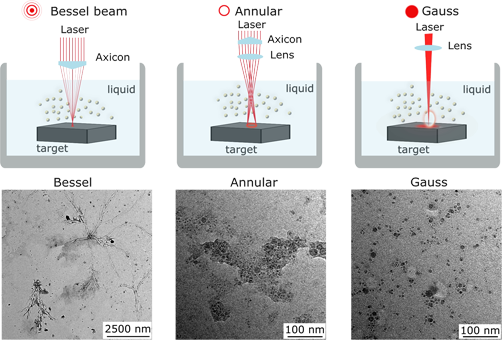
- Abstract In this study, silicon nanoparticles (NPs) were produced by pulsed laser ablation in a liquid, aiming to investigate the influence of a laser beam profile on the properties of the resultant NPs. Morphology, inner structure, and phase composition of the formed NPs were characterized by means of
- ultraviolet–visible spectroscopy, high-resolution transmission electron microscopy, and Raman and photoluminescence spectroscopies, and the correlation of the NP properties with the laser beam profile was studied. Three different beam profiles were selected, namely, a Bessel beam produced using an axicon, an
- annular profile formed using a combination of an axicon and a converging lens, and a Gaussian beam focused on the surface of a Si target using the same converging lens. In all the schemes, a nanosecond Nd3+:YAG laser with a pulse duration of 10 ns operating at its fundamental harmonic (1064 nm) was used


Dendrimer-modified carbon nanotubes for the removal and recovery of heavy metal ions from water
Beilstein J. Nanotechnol. 2025, 16, 1522–1532, doi:10.3762/bjnano.16.107

- spectrometer with a 532 nm diode laser to detect structural changes and defects in the CNTs after Diels–Alder reaction. FTIR spectroscopy was employed using a Bruker Tensor 27 spectrometer in the 4000–500 cm−1 region, which confirmed the change in functional groups during dendrimer functionalization. XRD


Nanomaterials for biomedical applications
Beilstein J. Nanotechnol. 2025, 16, 1499–1503, doi:10.3762/bjnano.16.105
- nanoparticles are most often used in photothermal therapy. These nanomaterials can capture specific wavelengths of light from the near-infrared spectrum and then use that energy to generate heat. This heat from the laser points causes cancer cells to be damaged or destroyed, while reducing the damage to nearby
Laser processing in liquids: insights into nanocolloid generation and thin film integration for energy, photonic, and sensing applications
Beilstein J. Nanotechnol. 2025, 16, 1428–1498, doi:10.3762/bjnano.16.104
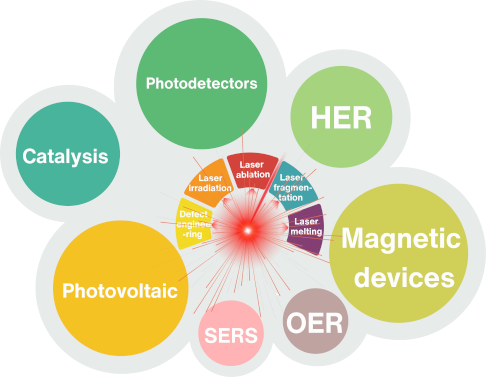
- Nanoparticles in their pure colloidal form synthesized by laser-assisted processes such as laser ablation/fragmentation/irradiation/melting in liquids have attained much interest from the scientific community because of their specialties like facile synthesis, ultra-high purity, biocompatibility, colloidal
- Raman spectroscopy (SERS) substrates, and solar cells. In this review article, we describe different methods of nanocolloidal synthesis using laser-assisted processes and corresponding thin film fabrication methods, particularly those utilized for device fabrication and characterization. The four
- sections start with an introduction to the common laser-assisted synthesis for nanocolloids and different methods of thin film fabrication using these nanocolloids followed by devices fabricated and characterized for applications including photovoltaics, photodetectors, catalysis, photocatalysis






Photochemical synthesis of silver nanoprisms via green LED irradiation and evaluation of SERS activity
Beilstein J. Nanotechnol. 2025, 16, 1417–1427, doi:10.3762/bjnano.16.103
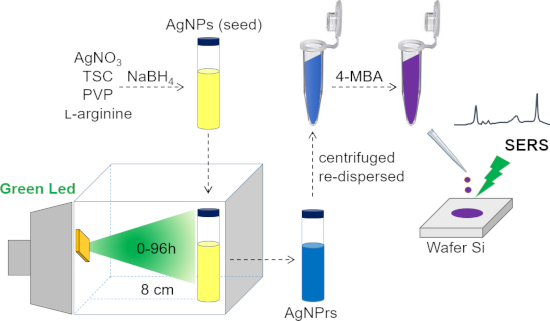
- SERS activity compared to AgNPs (seeds). The measurements were performed under identical experimental conditions, including fixed laser polarization, to ensure consistency and the current comparison is intended to be qualitative in nature. The enhancement factor (EF) was calculated using Equation 3 [23
- ]: where ISERS and Ibulk are the Raman intensities of 4-MBA in the presence and absence of silver nanomaterials, respectively. NSERS and Nbulk are the number of 4-MBA molecules excited by the laser under SERS and non-SERS conditions, respectively. Since the same volume (20 µL) and method were used, NSERS
- performed (HORIBA XploRA ONE TM, France) using a 532 nm laser source and a 10× magnification microscope. Measurements were taken at ten random positions, and the average intensity was recorded. (a) UV–vis spectrum, (b) TEM image and (c) size distribution of seeds. UV–vis spectra of silver nanoparticles at


Parylene-coated platinum nanowire electrodes for biomolecular sensing applications
Beilstein J. Nanotechnol. 2025, 16, 1392–1400, doi:10.3762/bjnano.16.101
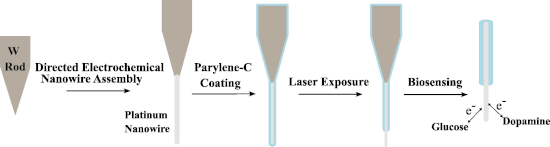
- , parylene-C encapsulation, and laser-assisted nanowire tip exposure. The nanowire electrode structure and the corresponding functionality are described. Electrochemical testing results of dopamine and glucose detection are also presented. Results and Discussion After optimization of the growth parameters
- , which can be coated with parylene-C polymer and the tip can be exposed by a focused laser beam. An electrochemical copper deposition test was performed to verify that the platinum electrode was fully exposed after evaporation of the parylene-C polymer at the tip. The test also demonstrated that the
- remaining parylene-C polymer on the rest of the electrode acted as an insulator. As shown in Figure 2a, a copper nodule was observed on the tip of the nanowire. Copper deposition on the tungsten metal part after parylene deposition and laser evaporation indicated that the parylene insulation was not


Wavelength-dependent correlation of LIPSS periodicity and laser penetration depth in stainless steel
Beilstein J. Nanotechnol. 2025, 16, 1302–1315, doi:10.3762/bjnano.16.95
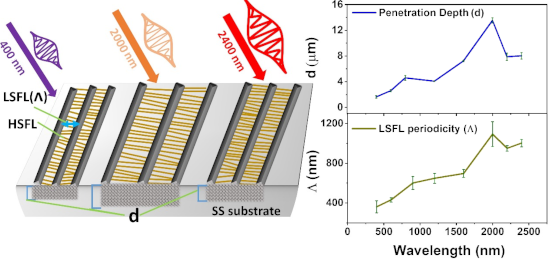
- This research paper delves into the exploration of laser-induced periodic surface structures (LIPSS) on a 100 µm thin stainless steel (SS) sheet. Through the application of laser irradiation with wavelengths spanning from 400 to 2400 nm, we systematically generate ladder-like LIPSS across a substantial
- observed. By employing cross-sectional electron microscopy, we scrutinize the penetration depth of laser radiation or laser-affected zone, in the LIPSS-formed SS sheets, revealing a parallel trend with LSFL and HSFL spatial periodicity. Specifically, the penetration depth increases with wavelength up to
- our comprehension of laser–material interactions and hold potential implications for surface engineering and material science applications. Keywords: cross section of LIPSS; high spatial frequency LIPSS (HSFL); laser-induced periodic surface structures (LIPSS); low spatial frequency LIPSS (LSFL




Better together: biomimetic nanomedicines for high performance tumor therapy
Beilstein J. Nanotechnol. 2025, 16, 1246–1276, doi:10.3762/bjnano.16.92
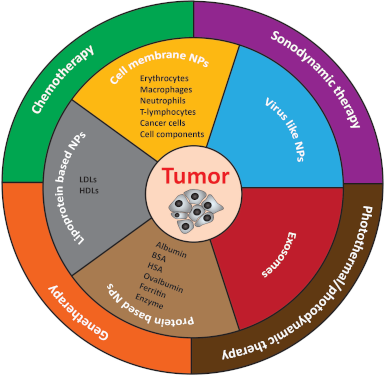
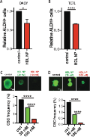
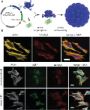
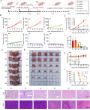
- membrane, the IR780 (NIR) fluorescence dye was loaded as a photosensitizer for PTT to generate biomimetic “IR780-rRBC” NPs. The antitumor effect of IR780-rRBC was also evaluated. After laser treatment, the tumor temperatures in mice treated with IR780-rRBC and IR780-rRBC NPs increased up to 60 and 70 °C







Crystalline and amorphous structure selectivity of ignoble high-entropy alloy nanoparticles during laser ablation in organic liquids is set by pulse duration
Beilstein J. Nanotechnol. 2025, 16, 1141–1159, doi:10.3762/bjnano.16.84
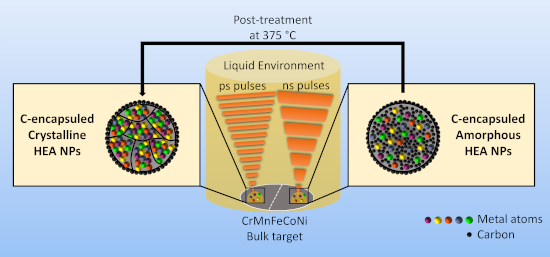
- catalysis or magnetic devices. This is due to their exceptional compositional tunability arising from the synergistic interplay of multiple elements within a single particle. While laser-synthesized, surfactant-free colloidal HEA NPs have already been reported, the underlying formation mechanism remains
- unknown, particularly the underexplored preference of amorphous over crystalline structures warrants further investigation. Herein, we present a systematic study of laser-generated equimolar CrMnFeCoNi nanoparticles, focusing on structural differences, arising from varying pulse durations during synthesis
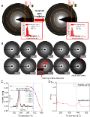
- loss spectroscopy, in situ heating, post-irradiation experiments, and differential scanning calorimetry we demonstrate that a pulse-duration-driven structural difference occurs during laser ablation in liquid is observable to the three utilized solvents. While picosecond-pulsed laser ablation in liquid




Fabrication of metal complex phthalocyanine and porphyrin nanoparticle aqueous colloids by pulsed laser fragmentation in liquid and their potential application to a photosensitizer for photodynamic therapy
Beilstein J. Nanotechnol. 2025, 16, 1088–1096, doi:10.3762/bjnano.16.80
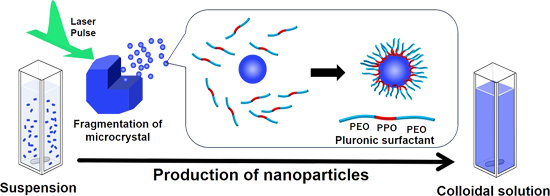
- = AlCl, Fe, Co, Zn) and Pt complex octaethylporphyrin (PtOEP) by nanosecond laser fragmentation of the corresponding microcrystalline powders in an aqueous solution of the amphiphilic polymer Pluronic® F-127. All nanoparticles dispersed stably in phosphate-buffered saline and cell culture media without
- generation of reactive oxygen species by AlClPc, ZnPc, and PtOEP nanoparticles and the photocytotoxicity for PC12 and HeLa cells, and demonstrated that the nanoparticles can be used as photosensitizers for photodynamic therapy. Keywords: aqueous colloid; photosensitizer; phthalocyanine; pulsed laser
- the activity of the target substance in general. An alternative and promising method for dispersing hydrophobic organic compounds as colloids is pulsed laser fragmentation in liquids (PLFL) [9][10]. This relatively new fabrication method has advantages because a microcrystalline sample powder


Piezoelectricity of hexagonal boron nitrides improves bone tissue generation as tested on osteoblasts
Beilstein J. Nanotechnol. 2025, 16, 1068–1081, doi:10.3762/bjnano.16.78
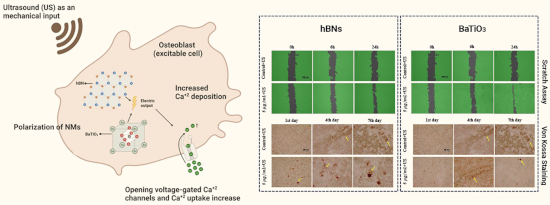
- drop-casting 1 μL of hBN suspension (prepared in deionized water) onto a TEM grid. Fourier-transform infrared spectroscopy (FTIR, Shimadzu IRAffinity-1S) and Raman spectroscopy (Renishaw, 532 nm laser) were used to analyze chemical bonds and assess crystallinity. UV–visible spectroscopy (Varian Cary UV


A calix[4]arene-based supramolecular nanoassembly targeting cancer cells and triggering the release of nitric oxide with green light
Beilstein J. Nanotechnol. 2025, 16, 1003–1013, doi:10.3762/bjnano.16.75
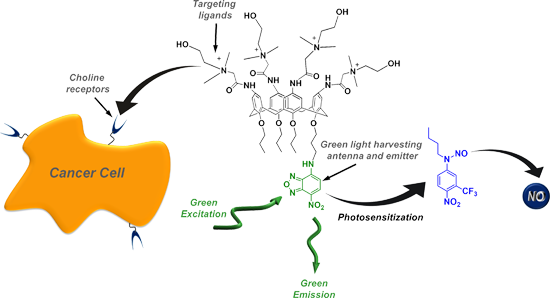
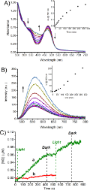
- equation: Dynamic light scattering measurements were performed on a ZetaSizer NanoZS90 (Malvern Instrument, UK), equipped with a 633 nm laser, at a scattering angle of 90° and at 25 °C. In a manner analogous to [70], photolysis experiments were performed by irradiating the samples in solution in a
- thermostated quartz cell (1 cm pathlength, 3 mL capacity) under gentle stirring, by using a blue-light-emitting diode (λexc = 415–420 nm) having an irradiance on the samples of ca. 60 mW·cm−1 or with a green laser (λexc = 532 nm, 200 mW). Direct monitoring of NO release in solution was performed by
- and transferred to a computer. The sensor was accurately calibrated by mixing standard solutions of NaNO2 with 0.1 M H2SO4 and 0.1 M KI according to the reaction: Irradiation was performed in a thermostated quartz cell (1 cm path length, 3 mL capacity, 25 °C) by using the above mentioned green laser


Time-resolved probing of laser-induced nanostructuring processes in liquids
Beilstein J. Nanotechnol. 2025, 16, 968–1002, doi:10.3762/bjnano.16.74
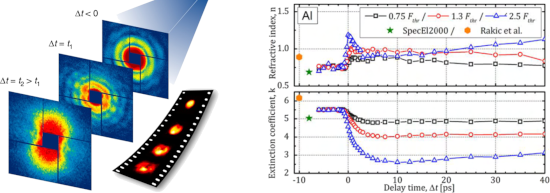
- Maximilian Spellauge David Redka Mianzhen Mo Changyong Song Heinz Paul Huber Anton Plech Laser Center Hochschule Munich, Munich University of Applied Sciences, Lothstr. 34, 80335 Munich, Germany Technical Chemistry I and Center for Nanointegration Duisburg-Essen (CENIDE), University of Duisburg
- Institute of Technology (KIT), Postfach 3640, D-76021 Karlsruhe, Germany 10.3762/bjnano.16.74 Abstract Laser synthesis and processing of colloids (LSPC) in liquids has gained widespread applications in producing nanomaterials of different classes of solids. While the technical processes in different cases
- of ablation, fragmentation or colloidal fusion may look macroscopically different in each application, the underlying fundamental mechanisms are always the same cascade of laser interaction with matter, non-thermal or thermal energy deposition, phase transitions, and the subsequent structure


Structural and magnetic properties of microwave-synthesized reduced graphene oxide/VO2/Fe2O3 nanocomposite
Beilstein J. Nanotechnol. 2025, 16, 921–932, doi:10.3762/bjnano.16.70
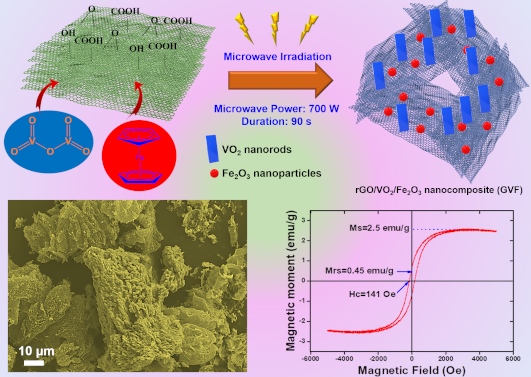
- the NCs. The Raman spectra of rGO and the related NCs were recorded through the “XploRA plus HORIBA” instrument with a laser excitation of 532 nm. Additionally, the surface analysis was performed using X-ray photoelectron spectroscopy measurements (XPS, Thermofisher Scientific) functioning at 12 kV