Search results
Search for "nanomaterial" in Full Text gives 210 result(s) in Beilstein Journal of Nanotechnology. Showing first 200.
Feasibility analysis of carbon nanofiber synthesis and morphology control using a LPG premixed flame
Beilstein J. Nanotechnol. 2025, 16, 581–590, doi:10.3762/bjnano.16.45
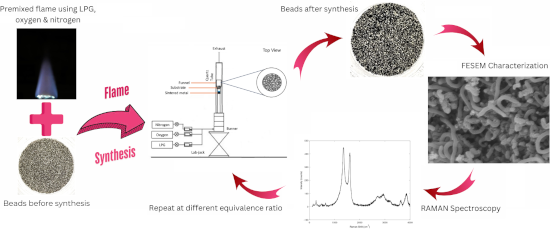
- synthesis; liquefied petroleum gas (LPG); nanomaterial synthesis; Introduction Carbon nanotubes (CNTs) and carbon nanofibers (CNFs) have gained significant interest because of their distinctive properties and their wide range of applications in nanotechnology [1][2][3]. CNTs are a modified version of CNFs
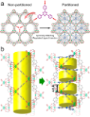
- graphene sheath. These nanofibers can have three different structural configurations including herringbone, tubular, and platelet configurations [4][5]. A premixed flame of liquefied petroleum gas (LPG) can be used as a fuel source for carbon nanomaterial growth processes. A premixed flame is a specific
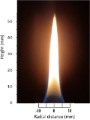
- al. used temperatures around 550 °C for CNF growth [15]. As the height increases from 1 mm, where decomposition occurs around 650 °C (Figure 4b), the premixed flame temperature drops in the absence of a secondary diffusion flame. Nanomaterial growth and characterization The equivalence ratio values



Nanomaterials in targeting amyloid-β oligomers: current advances and future directions for Alzheimer's disease diagnosis and therapy
Beilstein J. Nanotechnol. 2025, 16, 561–580, doi:10.3762/bjnano.16.44


Pulsed laser in liquid grafting of gold nanoparticle–carbon support composites
Beilstein J. Nanotechnol. 2025, 16, 349–361, doi:10.3762/bjnano.16.26
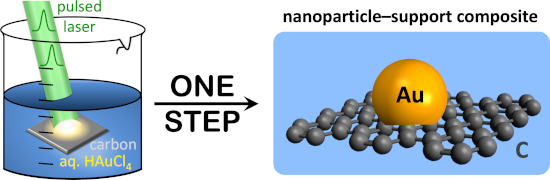
- reactive pulsed laser in liquid nanomaterial fabrication [1]. Reductive and oxidative solution chemistries are widely available and well investigated in wet chemistry contexts [17][77][78][79][80][81]. Our novel ability to utilize general solution chemistry toolkits to prepare tailored nanoparticles


Recent advances in photothermal nanomaterials for ophthalmic applications
Beilstein J. Nanotechnol. 2025, 16, 195–215, doi:10.3762/bjnano.16.16
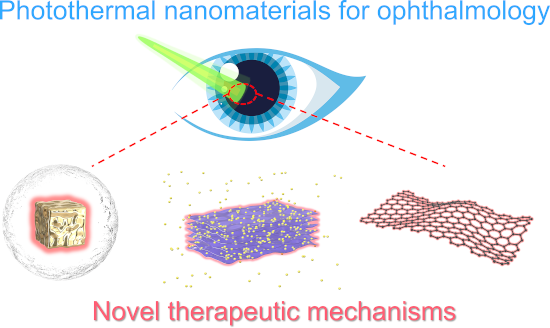
- the photothermal properties of these nanomaterials and their innovative therapeutic mechanisms. We review the latest research on photothermal nanomaterial-based treatments for various eye diseases. Additionally, we discuss the current challenges and future perspectives in this field, with a focus on
- enhancing global visual health. Keywords: multifunctional composite; ophthalmology; photothermal nanomaterial; thermal field distribution; vapor nanobubble; Review 1 Introduction The human eye, serving as a primary organ for information acquisition, is vulnerable to various diseases over a lifetime [1
- an aim to contribute to the improvement of global visual health. 2 Photothermal treatment mechanisms and nanomaterial properties of ophthalmic nanomedicines Nanomaterials with highly tunable photothermal conversion properties are referred to as photothermal nanomaterials [22]. These materials are


Nanocarriers and macrophage interaction: from a potential hurdle to an alternative therapeutic strategy
Beilstein J. Nanotechnol. 2025, 16, 97–118, doi:10.3762/bjnano.16.10
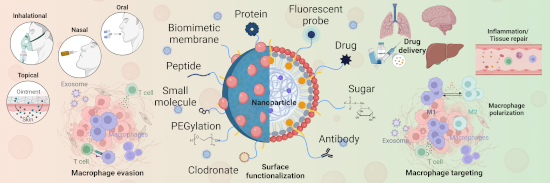
- affect NP internalization. They actively engulf NCs and accelerate their clearance, acting differentially in a time-dependent manner and altering the fate of nanomaterials [26]. In addition to immune-related barriers, the physicochemical properties of the nanomaterial itself can impair the NCs’ ability


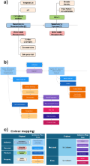
Instance maps as an organising concept for complex experimental workflows as demonstrated for (nano)material safety research
Beilstein J. Nanotechnol. 2025, 16, 57–77, doi:10.3762/bjnano.16.7

- approach and the tool are highlighted. Keywords: data collection and quality control; data provenance; experimental workflow visualisation; FAIR; nanomaterial life cycle stages; study design; Introduction The manipulation of matter at the nanoscale and the emergence of nanoscale materials, whose
- nanomaterial properties, which can change as the surroundings change (such as zeta potential, which depends on the pH value and ionic strength of the surrounding medium [17]), and intrinsic nanomaterial properties, which are not affected by the surroundings (such as bandgap and structural arrangement) [18
- chemicals are currently being revised for the use with nanomaterials [26]. Development of the instance map concept The complexity and transformability of nanomaterials also has consequences for the databases used to organise and store nanomaterial characterisation and (eco)toxicity data. Databases needed to


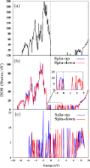
Theoretical study of the electronic and optical properties of a composite formed by the zeolite NaA and a magnetite cluster
Beilstein J. Nanotechnol. 2025, 16, 44–53, doi:10.3762/bjnano.16.5
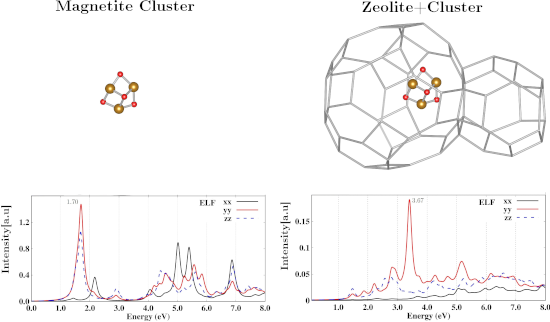
- because of the migration and coalescence of nanoparticles on the carrier material [21][22]. Such changes can significantly modify the physicochemical properties of the original nanomaterial. Also, the most interesting physicochemical properties are exhibited by clusters with subnanometer dimensions. For




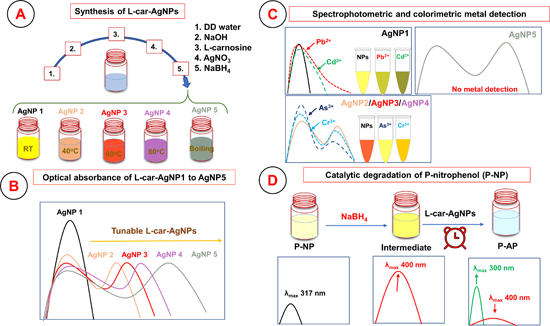
Facile synthesis of size-tunable L-carnosine-capped silver nanoparticles and their role in metal ion sensing and catalytic degradation of p-nitrophenol
Beilstein J. Nanotechnol. 2024, 15, 1576–1592, doi:10.3762/bjnano.15.124
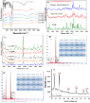
- Akash Kumar Ridhima Chadha Abhishek Das Nandita Maiti Rayavarapu Raja Gopal Nanomaterial Toxicology Laboratory, Drug and Chemical Toxicology Group, Food, Drug and Chemical, Environment and Systems Toxicology (FEST) Divison, CSIR-Indian Institute of Toxicology Research (CSIR-IITR), Vishvigyan




Green synthesis of silver nanoparticles derived from algae and their larvicidal properties to control Aedes aegypti
Beilstein J. Nanotechnol. 2024, 15, 1566–1575, doi:10.3762/bjnano.15.123
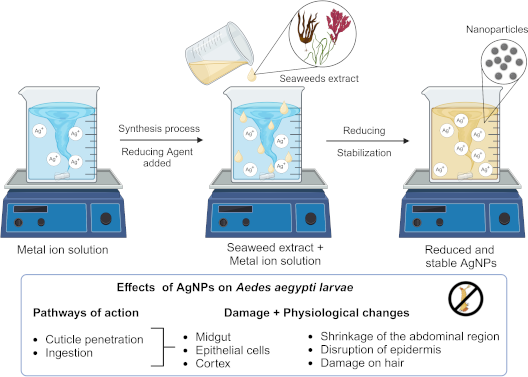
- vectors are nanomaterials or nanomaterial-based formulations as so-called nanopesticides, providing new, modern, and low-cost formulations [9][10] with the ability to penetrate through the exoskeleton into mosquito cells, causing mortality after binding to proteins or DNA [11]. Nanomaterials provide


Effect of radiation-induced vacancy saturation on the first-order phase transformation in nanoparticles: insights from a model
Beilstein J. Nanotechnol. 2024, 15, 1453–1472, doi:10.3762/bjnano.15.117

- necessary to exclude the concentration of vacancies in the β phase (Cvβ) and the energy contribution of vacancies in the β phase (ΔGpd(β) = 0). Model of an iron-like nanomaterial with polymorphic phase transitions As an example, in this work we consider a model of an iron-like nanomaterial with a
- transformations from bcc to fcc and from fcc to bcc that occur in an iron-like nanomaterial. We detail the findings for pure iron at the end of the paper. The enthalpy change for vacancy formation can be estimated from the equilibrium melting temperature, Tm, and is ΔHfα = 3.76·10−19 J for the α phase and ΔHfβ


Nanotechnological approaches for efficient N2B delivery: from small-molecule drugs to biopharmaceuticals
Beilstein J. Nanotechnol. 2024, 15, 1400–1414, doi:10.3762/bjnano.15.113
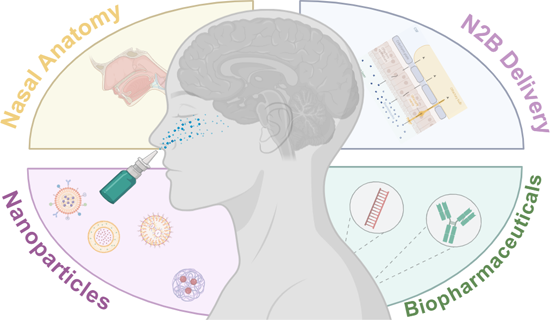
- clinical trials is limited. For biopharmaceutics, no such trials have been started yet. Only APH-1105, an investigational nanomaterial-based small-molecule drug product in the form of sterile, pyrogen-free lyophilized powder is investigated for the intranasal administration to treat Alzheimer’s disease in


Nanoarchitectonics with cetrimonium bromide on metal nanoparticles for linker-free detection of toxic metal ions and catalytic degradation of 4-nitrophenol
Beilstein J. Nanotechnol. 2024, 15, 1312–1332, doi:10.3762/bjnano.15.106
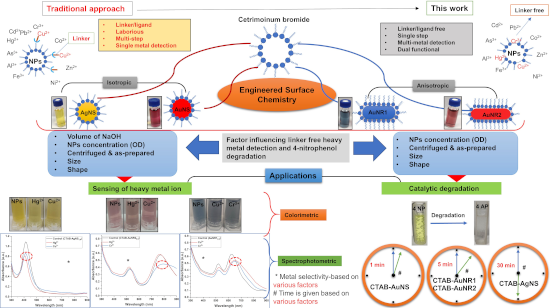
- Akash Kumar Raja Gopal Rayavarapu Nanomaterial Toxicology Laboratory, Drug and Chemical Toxicology Group, Food, Drug and Chemical, Environment and Systems Toxicology (FEST) Divison, CSIR-Indian Institute of Toxicology Research (CSIR-IITR), Vishvigyan Bhawan, 31 Mahatma Gandhi Marg, Lucknow 226001




Interaction of graphene oxide with tannic acid: computational modeling and toxicity mitigation in C. elegans
Beilstein J. Nanotechnol. 2024, 15, 1297–1311, doi:10.3762/bjnano.15.105
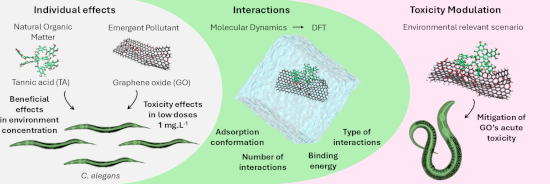
- characteristics made TA attractive to nanomaterial synthesis and functionalization for applications in nanomedicine, sensors, electronics, and composites [25][26][27]. In these different fields, TA has been applied in green alternative methods of GO synthesis and physicochemical modifications (e.g., reduction and
- regarding the electronic properties of the system, such as the most reactive sites and their interactions. Our findings provided new insights into toxicity mitigation and behavior of GO in the environment, as well as, the safety of application of TA for synthesis and functionalization of this nanomaterial
- completed aggregated with a high polydispersity index. The quality criteria of DLS analysis for GO with a concentration lower than 10 mg·L−1 were not satisfactory; therefore, they could not be used to evaluate the dispersion state of more diluted GO suspensions, such as 1 mg·L−1 of nanomaterial. However, it


Introducing third-generation periodic table descriptors for nano-qRASTR modeling of zebrafish toxicity of metal oxide nanoparticles
Beilstein J. Nanotechnol. 2024, 15, 1142–1152, doi:10.3762/bjnano.15.93
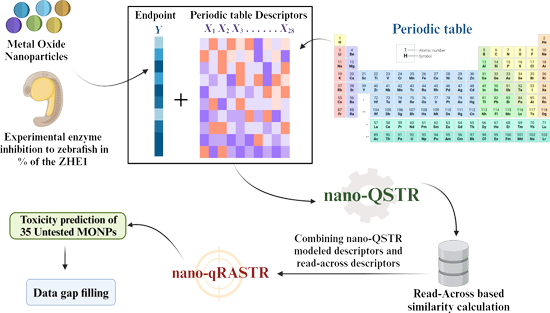
- radius of the nanomaterial components but positively by the molecular bulk of the nanomaterials. Electronegativity and atomic size determine the reactivity and contact strength of nanomaterials with biological systems, whereas the molecule bulk affects the mechanism of inhibition through steric effects


Interface properties of nanostructured carbon-coated biological implants: an overview
Beilstein J. Nanotechnol. 2024, 15, 1041–1053, doi:10.3762/bjnano.15.85
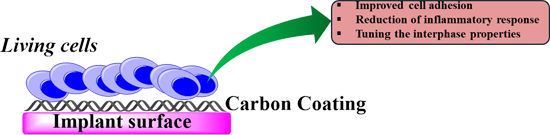
- solid choice to prevent massive implant degradation. Carbon nanomaterial coatings can prevent adverse chemical reactions triggered by both the adsorption of proteins and the metabolism of cells [151][152][153]. Hassan et al. [97] extensively investigated the effect of graphene and graphitic coatings as



Gold nanomakura: nanoarchitectonics and their photothermal response in association with carrageenan hydrogels
Beilstein J. Nanotechnol. 2024, 15, 678–693, doi:10.3762/bjnano.15.56

- Nabojit Das Vikas Akash Kumar Sanjeev Soni Raja Gopal Rayavarapu Nanomaterial Toxicology Laboratory, Drug and Chemical Toxicology Group, Food, Drug & Chemical, Environment and Systems Toxicology (FEST) Division, CSIR-Indian Institute of Toxicology Research (CSIR-IITR), Vishvigyan Bhawan, 31






Radiofrequency enhances drug release from responsive nanoflowers for hepatocellular carcinoma therapy
Beilstein J. Nanotechnol. 2024, 15, 569–579, doi:10.3762/bjnano.15.49
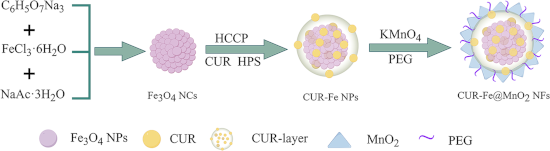
- ]. Radiofrequency-induced hyperthermia has been confirmed to augment the permeability of the plasma membrane, facilitating the entry of drugs into tumor cells to kill them [28][29]. In this study, we present the synthesis of an intelligent TME-responsive nanomaterial, superparamagnetic ferric oxide nanoclusters


Classification and application of metal-based nanoantioxidants in medicine and healthcare
Beilstein J. Nanotechnol. 2024, 15, 396–415, doi:10.3762/bjnano.15.36
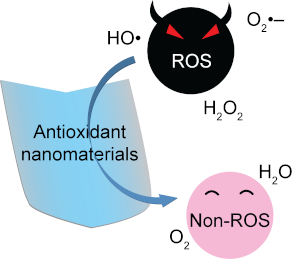
- nanomaterials in medicine and healthcare are also discussed. This review provides a deeper understanding of the mechanisms of metal-based nanoantioxidants and a guideline for using these nanomaterials in medicine and healthcare. Keywords: antioxidant nanomaterial; healthcare; medicine; nanotechnology


Comparative electron microscopy particle sizing of TiO2 pigments: sample preparation and measurement
Beilstein J. Nanotechnol. 2024, 15, 317–332, doi:10.3762/bjnano.15.29
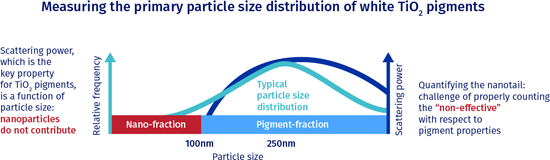
- 100 nm boundary of the EU nanomaterial definition, but the TiO2 pigment manufacturing processes results in a finite nanoscale content fraction. This optically inefficient nanoscale fraction needs to be quantified in line with EU regulations. In this paper, we describe the measurement procedures used
- particles can be described as rounded polyhedra with an aspect ratio of around 1.2, which results in the smallest axis (MinFeret) being only slightly smaller than the ECD. While the EU nanomaterial definition uses the MinFeret, it is less error prone to estimate the ECD, which is also a parameter more


Vinorelbine-loaded multifunctional magnetic nanoparticles as anticancer drug delivery systems: synthesis, characterization, and in vitro release study
Beilstein J. Nanotechnol. 2024, 15, 256–269, doi:10.3762/bjnano.15.24
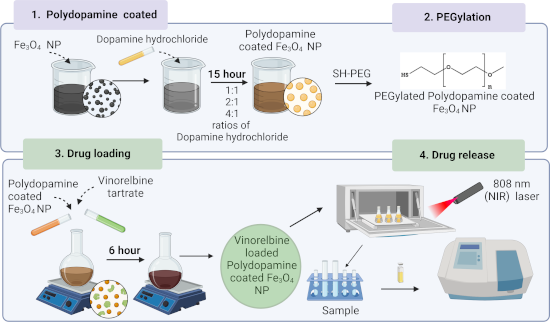
- photothermal therapy capabilities, the PDA shell mitigates nanomaterial toxicity while increasing biocompatibility. The strategic integration of PEGylation into tumor-targeted drug delivery systems significantly amplifies passive tumor targeting and retention through the enhanced permeability and retention
- noteworthy potential in photothermal therapy, magnetic targeting, MRI imaging, and chemotherapy. This versatile approach represents a significant advancement in cancer treatment modalities, offering a promising avenue for future research and clinical applications. Our work provides a nanomaterial endowed


Multiscale modelling of biomolecular corona formation on metallic surfaces
Beilstein J. Nanotechnol. 2024, 15, 215–229, doi:10.3762/bjnano.15.21
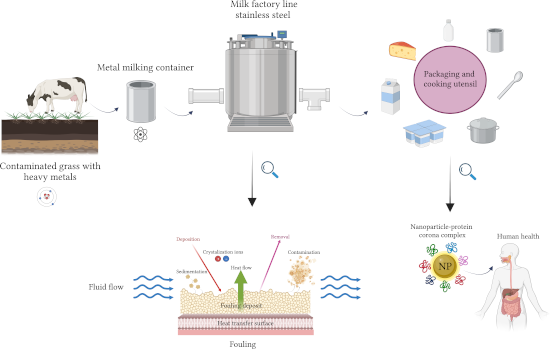
- GROMACS-2018.6 and PLUMED (PLUMED2-2.5.1.conda.5) software packages [29][30][31]. CHARMM-GUI/Nanomaterial Modeler was employed to construct the topology and force fields of three fcc surfaces of Al: (100), (110), and (111) [32]. The General Amber Force Field (GAFF) was utilized to model side-chains
- properties of the nanomaterial, the characteristics of the surrounding medium, and the biological factors at play. A dataflow scheme of the multiscale modelling approach implemented in this study, including an all-atom model of surface and AAs, a CG UnitedAtom model for the entire protein-surface interaction





Experimental investigation of usage of POE lubricants with Al2O3, graphene or CNT nanoparticles in a refrigeration compressor
Beilstein J. Nanotechnol. 2023, 14, 1041–1058, doi:10.3762/bjnano.14.86
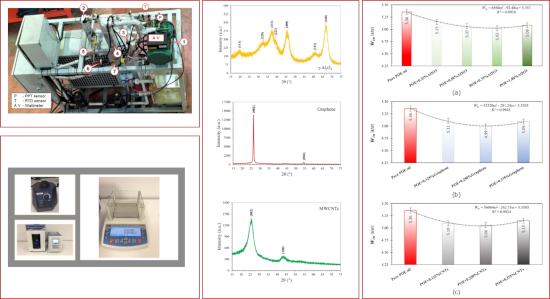
- determine the elemental composition and purity of the graphene nanomaterial. The results of the EDS analysis are given in Figure 4c, which reveals the existence of C and Selements, with atomic weight percentages of 99.7 and 0.3, respectively. The origin of the detected S, as revealed by EDS analysis, may be





A visible-light photodetector based on heterojunctions between CuO nanoparticles and ZnO nanorods
Beilstein J. Nanotechnol. 2023, 14, 1018–1027, doi:10.3762/bjnano.14.84
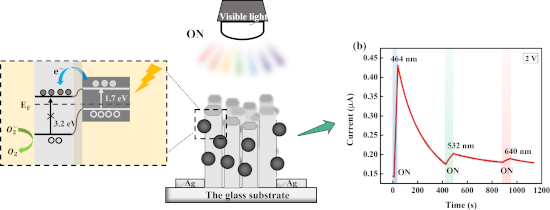
- the visible range is still a challenge regarding the widespread use of this nanomaterial. Traditional methods to modify ZnO, such as doping with transition metals [24] and decorating with noble metals [25], offer additional flexibility. Doping can significantly influence the optical and electrical


Nanoarchitectonics of photothermal materials to enhance the sensitivity of lateral flow assays
Beilstein J. Nanotechnol. 2023, 14, 988–1003, doi:10.3762/bjnano.14.82
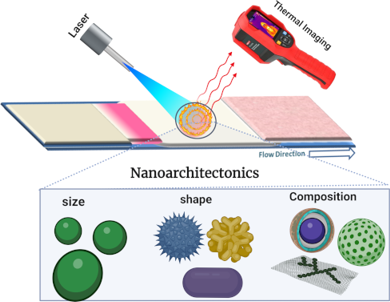
- produced is directly proportional to the amount of nanomaterial present in the test zone, which, in turn, is proportional to the concentration of the analyte in the sample (Figure 1). The integration of light energy in the procedure does not complicate the assay; its native procedure and rapidness are
- the aggregation pattern of nanomaterials, and extrinsic factors, including surrounding medium, medium viscosity, and concentration of the nanomaterial. Most often, nanomaterials with complex three-dimensional structures have better optical and physicochemical properties for the use in colorimetry
- nm GNPs have a fivefold higher cross-sectional area, hence, they absorb more light (µa = 87.36 µm−1) than they scatter (µs = 5.25 µm−1) and yield a great amount of heat [55]. The cross-sectional area and, hence, the absorption efficiency also depend on the architecture of the nanomaterial. Absorption


Metal-organic framework-based nanomaterials for CO2 storage: A review
Beilstein J. Nanotechnol. 2023, 14, 964–970, doi:10.3762/bjnano.14.79
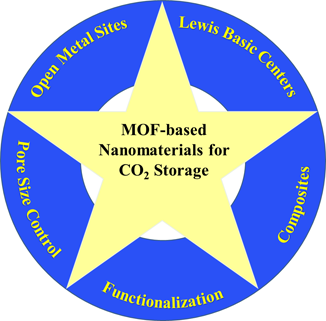
- utilized 5-aminotetrazole to synthesize ZTF-1, a MOF nanomaterial featuring LBCs [30]. This approach offered the advantage of creating a synergistic effect, leading to a noteworthy CO2 adsorption capacity of 5.6 mmol·g−1. Strategies for enhanced CO2 storage in MOF-based nanomaterials Pore size control
- 2010 American Chemical Society. This content is not subject to CC BY 4.0. Schematic illustration for the preparation of a CuBTC-NH2 nanomaterial. Figure 2 was republished with permission of The Royal Society of Chemistry, from [27] (“Amino substituted Cu3(btc)2: a new metal–organic framework with a