


Search results
Search for "optoelectronic applications" in Full Text gives 34 result(s) in Beilstein Journal of Nanotechnology.
In-situ monitoring by Raman spectroscopy of the thermal doping of graphene and MoS2 in O2-controlled atmosphere
Beilstein J. Nanotechnol. 2017, 8, 418–424, doi:10.3762/bjnano.8.44
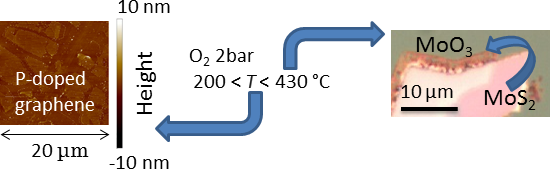
- and the energy of the Fermi level evidenced that doping of graphene is an important aspect for electronic devices. The possibility to obtain stable p- or n-type doping in order to modulate the Gr sheet resistance for specific electronic and optoelectronic applications is mandatory for technical
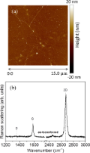
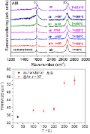
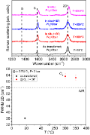


Ordering of Zn-centered porphyrin and phthalocyanine on TiO2(011): STM studies
Beilstein J. Nanotechnol. 2017, 8, 99–107, doi:10.3762/bjnano.8.11
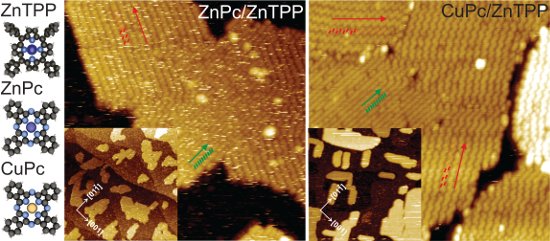
- conditions. Keywords: dye-sensitized solar cells; molecular nanostructures; phthalocyanines; porphyrins; rutile surfaces; STM imaging; Introduction There is an increasing interest in optoelectronic applications of organic molecular heterostructures which utilize inorganic substrates, such as titanium


Organized films
Beilstein J. Nanotechnol. 2016, 7, 406–408, doi:10.3762/bjnano.7.35

- a molecule in a controlled way for electronic and optoelectronic applications. In this respect, defined protein incorporation, for example, for designing a biosensor, seemed hopeless. Incidentally, these problems were largely shared by self-assembled monolayers (SAMs), as exemplified by the most
Transformations of PTCDA structures on rutile TiO2 induced by thermal annealing and intermolecular forces
Beilstein J. Nanotechnol. 2015, 6, 1498–1507, doi:10.3762/bjnano.6.155
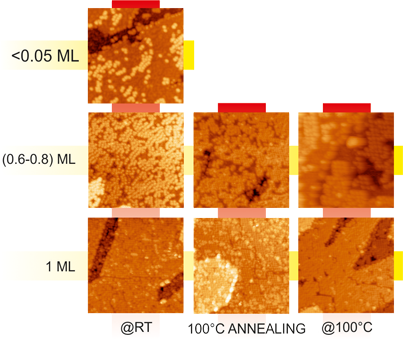
- point of view of optoelectronic applications [17]. In the following, we extend previous research on the PTCDA/TiO2(110)-(1 × 1) system [36]. Godlewski et al. [36] essentially paid attention to the influence of dispersion forces (changed by the density of molecules on the surface) on the formation of the


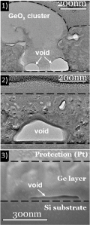
Nanoporous Ge thin film production combining Ge sputtering and dopant implantation
Beilstein J. Nanotechnol. 2015, 6, 336–342, doi:10.3762/bjnano.6.32
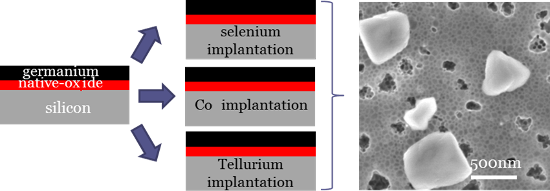
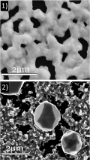
- interesting properties for optoelectronic applications. For example, porous Si was shown to exhibit an increased band gap compared to bulk Si due to quantum (Q) size effects, related either to the formation of pseudo Q-wires or Q-dots in the porous structure, depending on the production method [1]. Generally


Silicon and germanium nanocrystals: properties and characterization
Beilstein J. Nanotechnol. 2014, 5, 1787–1794, doi:10.3762/bjnano.5.189
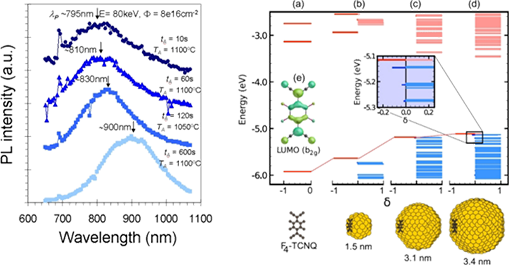
- application in areas such as optoelectronic applications and memory devices has been progressively unraveled. Nevertheless, new challenges with no parallel in the respective bulk material counterparts have arisen. In this review, we consider what has been achieved and what are the current limitations with
- deal of attention, due to the promising optoelectronic applications [27]. It has been shown that in order to study the donor doping and dependences of the PL intensity in such systems, it is crucial to understand and control the presence of defects. The effects of donors and defects to the PL of Si NCs


Growth evolution and phase transition from chalcocite to digenite in nanocrystalline copper sulfide: Morphological, optical and electrical properties
Beilstein J. Nanotechnol. 2014, 5, 1542–1552, doi:10.3762/bjnano.5.166
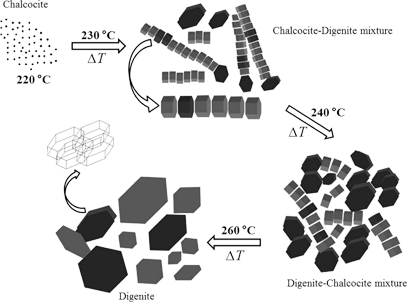
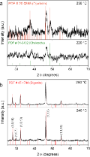
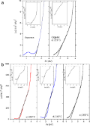
- structure. All CuxS products could be promising for optoelectronic applications. Keywords: abundant materials in the crust of Earth; electrical resistance; nanocrystals; nanodisks; non-toxic semiconductors; optical band gap; phase transition; photocurrent; Introduction Metallic chalcogenides based on
- nanostructures, and phase transition were completely described in a scheme based on the TEM images. The full phase transition from chalcocite to digenite is obtained at 260 °C in an organic media. It is clear that the optical and electrical properties are suitable for optoelectronic applications, such as solar




Current–voltage characteristics of single-molecule diarylethene junctions measured with adjustable gold electrodes in solution
Beilstein J. Nanotechnol. 2012, 3, 798–808, doi:10.3762/bjnano.3.89
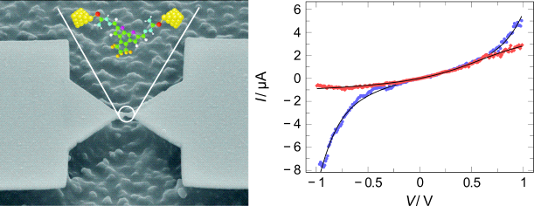
- small geometrical change, which makes diarylethene molecules promising building blocks for optoelectronic applications [19][20]. Since electrical measurements of diarylethene molecules started, measurements of the charge-transport properties of molecular ensembles by using large-area samples [21


Ultraviolet photodetection of flexible ZnO nanowire sheets in polydimethylsiloxane polymer
Beilstein J. Nanotechnol. 2012, 3, 353–359, doi:10.3762/bjnano.3.41
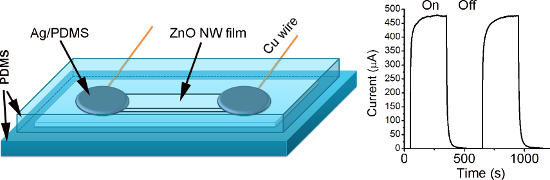
- photoresponse. Keywords: permeable polymer; photoresponse; polydimethylsiloxane; UV photodetection; ZnO nanowires; Introduction ZnO is a direct wide band gap semiconductor with a 3.37 eV gap and a high exciton binding energy of 60 meV at room temperature, which is promising for optoelectronic applications


Other Beilstein-Institut Open Science Activities



