


Search results
Search for "silver ions" in Full Text gives 61 result(s) in Beilstein Journal of Nanotechnology.
Photothermally active nanoparticles as a promising tool for eliminating bacteria and biofilms
Beilstein J. Nanotechnol. 2020, 11, 1134–1146, doi:10.3762/bjnano.11.98
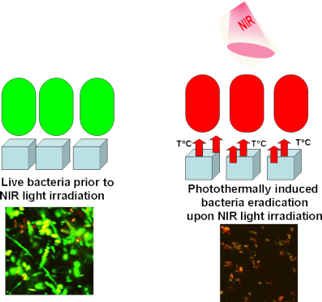
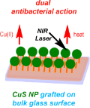
- plasmonic MoO3−x nanosheets were designed to be a highly efficient NIR-driven antibacterial agent [100]. This approach enhanced the nanocube antibacterial activity towards E. coli and S. aureus upon NIR light irradiation due to the local temperature increase, release of silver ions and bacterial membrane


Gram-scale synthesis of splat-shaped Ag–TiO2 nanocomposites for enhanced antimicrobial properties
Beilstein J. Nanotechnol. 2020, 11, 1119–1125, doi:10.3762/bjnano.11.96
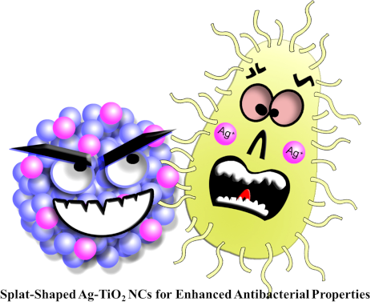
- the Gram-positive bacteria S. aureus. During the incubation with Ag–TiO2 nanocomposites, the silver ions were released from the NCs and gradually diffused out in the seeded agar. Then, the silver ions attached to the bacterial membrane, damaging the proteins and inactivating the bacteria metabolism


Silver-decorated gel-shell nanobeads: physicochemical characterization and evaluation of antibacterial properties
Beilstein J. Nanotechnol. 2020, 11, 620–630, doi:10.3762/bjnano.11.49
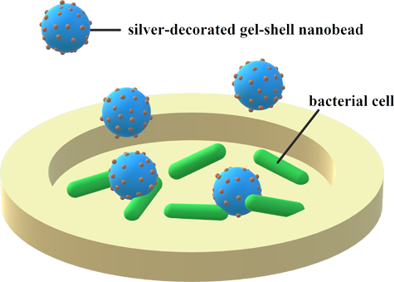
- of composite nanobeads with antibacterial properties. The particles consist of polystyrene cores that are surrounded by sulfonic gel shells with embedded silver nanoparticles. The nanocomposite beads are prepared by sulfonation of polystyrene particles followed by accumulation of silver ions in the
- shell layer and subsequent reduction with sodium borohydride. The resulting material has been characterized by electron microscopy, vibrational and X-ray photoelectron spectroscopy and several other experimental techniques. It was shown that sodium borohydride reduces silver ions embedded in the gel
- charged sulfonic groups. The gel shell can be utilized for the accumulation of cationic species, e.g., the accumulation of a monomer followed by further polymerization [2][22]. Polystyrene-based gel-shell particles have been also used for the accumulation of silver ions followed by their reduction to


Nanoparticles based on the zwitterionic pillar[5]arene and Ag+: synthesis, self-assembly and cytotoxicity in the human lung cancer cell line A549
Beilstein J. Nanotechnol. 2020, 11, 421–431, doi:10.3762/bjnano.11.33
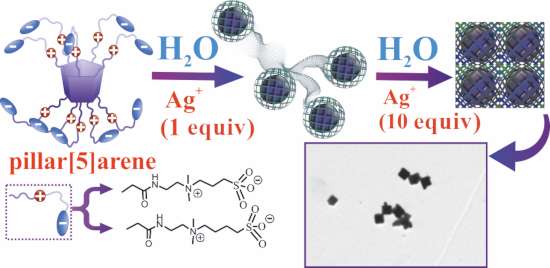
- toxicity of Ag+ ions, multicore complexes prepared on the basis of macrocyclic ligands [9][10][11][12][13] and silver ions are of greatest interest. The ability of macrocyclic systems to form supramolecular associates, due to noncovalent interactions with Ag+, can reduce toxicity and preserve the
- the stability of supramolecular assemblies to pH changes [22][23]. Another remarkable property of sulfobetaine fragments is the ability to interact with silver ions [24][25][26] and participate in the stabilization of quantum dots [27]. It is worth noting that the use of polymer systems containing
- macrocycle 3, in the presence of an excess of AgNO3, stable nanoparticles are formed, we further studied the ability of the 3/Ag+ associates to reduce the toxicity of Ag+ for eukaryotic cells. We first carried out the calculation of the minimum inhibitory concentration for silver ions. The minimum inhibitory




Gold and silver dichroic nanocomposite in the quest for 3D printing the Lycurgus cup
Beilstein J. Nanotechnol. 2020, 11, 16–23, doi:10.3762/bjnano.11.2
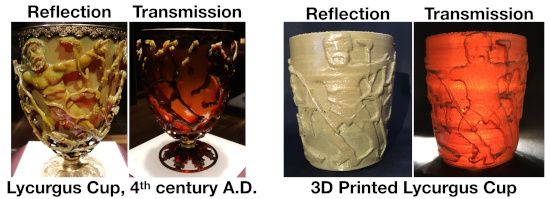
- variations, we found that reducing silver ions at room temperature immediately followed by an addition of a polyvinylpyrrolidone (PVP) solution formed dichroic silver nanoparticles in minutes. The addition of the reducing agent (NaBH4) to a silver nitrate solution forms nanoclusters, and the immediate



Toxicity and safety study of silver and gold nanoparticles functionalized with cysteine and glutathione
Beilstein J. Nanotechnol. 2019, 10, 1802–1817, doi:10.3762/bjnano.10.175
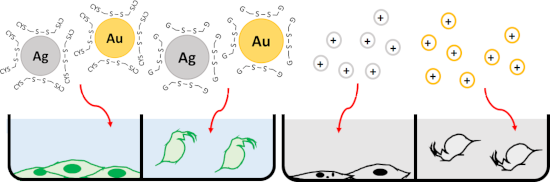
- ). The dissolution behavior of AuNPs and AgNPs was tested by ultrafiltration followed by quantification of released free gold or silver ions. The test media were UPW, cell culture medium EMEM with the addition of 10% FBS, and standard culture media for Daphnia magna cultivation (SCM). Freshly prepared


Enhanced inhibition of influenza virus infection by peptide–noble-metal nanoparticle conjugates
Beilstein J. Nanotechnol. 2019, 10, 1038–1047, doi:10.3762/bjnano.10.104
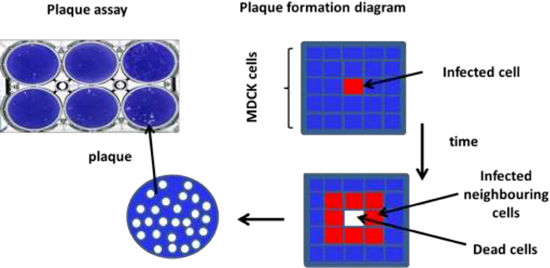
- demonstrate that conjugation of FluPep to gold and silver nanoparticles enhances its antiviral potency; the antimicrobial activity of silver ions may enable the design of even more potent antimicrobial inhibitors, capable of targeting both influenza and bacterial co-infections. Keywords: antiviral peptides




Comparative biological effects of spherical noble metal nanoparticles (Rh, Pd, Ag, Pt, Au) with 4–8 nm diameter
Beilstein J. Nanotechnol. 2018, 9, 2763–2774, doi:10.3762/bjnano.9.258
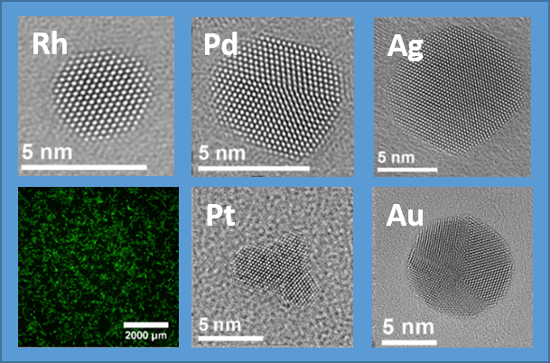
- oxidative release of silver ions [38][39][40][41][42][43], which may affect biological systems in different ways, for example, by disruption of the cell wall or by interaction with cellular enzymes [44]. However, it is often difficult to compare literature reports because typically only nanoparticles of one
- concentration from 25 to 50 µg mL−1 (Figure 7). These effects are well known for silver, silver chloride and silver ions [33][38][44][92]. Cell detachment was only observed at toxic concentrations of silver nanoparticles (25 to 50 µg mL−1), but not at subtoxic concentrations (2.5 to 10 µg mL−1). Thus, cell
- the toxicity of silver nanoparticles is due to the oxidative release of silver ions [38][39][40][43][67][94][95][96][97][98][99][100], we can tentatively assume that such a dissolution does not occur for the more noble metals, and that the nanoparticles themselves are not cytotoxic. Due to the more


SERS active Ag–SiO2 nanoparticles obtained by laser ablation of silver in colloidal silica
Beilstein J. Nanotechnol. 2018, 9, 2396–2404, doi:10.3762/bjnano.9.224
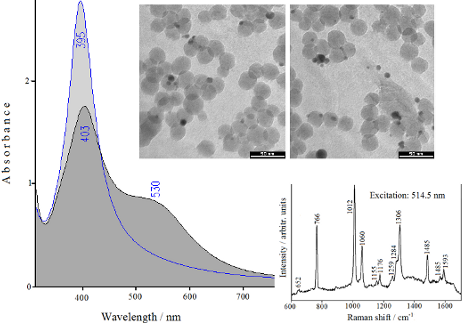
- occurs when silver ions are chemically reduced), as proposed in several papers [17][18][19][20][21][22][23]. Here, we have ablated a silver target in a colloidal silica solution by nanosecond pulsed laser ablation and have verified the presence of Ag nanoparticles by UV–visible absorption spectroscopy


The role of adatoms in chloride-activated colloidal silver nanoparticles for surface-enhanced Raman scattering enhancement
Beilstein J. Nanotechnol. 2018, 9, 2236–2247, doi:10.3762/bjnano.9.208
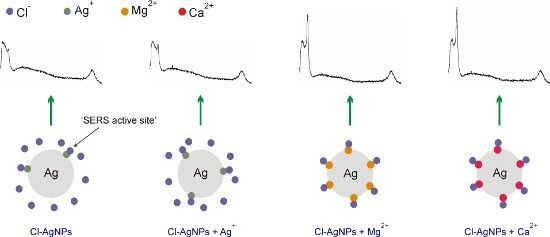
- surface of silver chloride particles suspended in water. The photoconversion of silver salts to metallic silver particles is the basic principle of film photography: silver ions in silver halide particles are photoreduced by the transfer of electrons from halide ions [4][5]. Chloride anions are often



Facile chemical routes to mesoporous silver substrates for SERS analysis
Beilstein J. Nanotechnol. 2018, 9, 880–889, doi:10.3762/bjnano.9.82
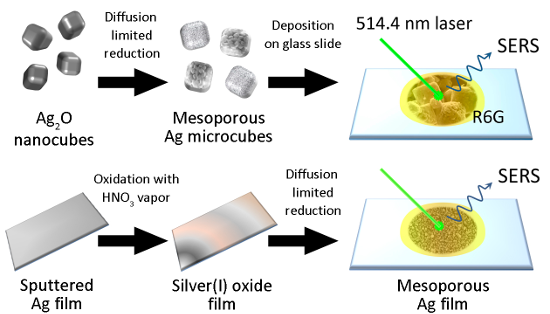
- likely, this effect is related to recrystallization processes, which include removing silver ions from the lattice and its further deposition onto the exterior surface of the domains when reduced. Such a diffusion-limited reduction is the processing pathway towards a porous material with uniform pores


Colloidal solution of silver nanoparticles for label-free colorimetric sensing of ammonia in aqueous solutions
Beilstein J. Nanotechnol. 2018, 9, 499–507, doi:10.3762/bjnano.9.48
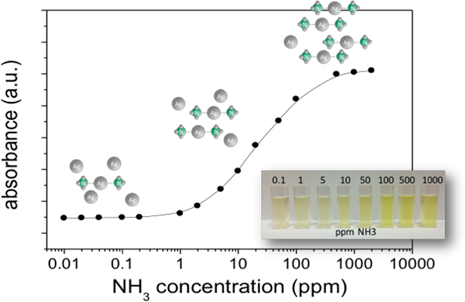
- to control and stabilize the synthesis of nanoparticles by adding ammonia in colloidal solutions [18]. It is also known that ammonia reacts with silver ions and gives rise to [Ag(NH3)2]+ [19][20][21], a weak oxidant able to decrease the reduction rate [22]. When very stable complexes between silver
- the synthesis of silver nanoparticles improving oxidation of hydroxy groups in glucose, and giving rise to an accelerated reduction of silver in the fluid. The rationale of this behaviour is given by correlating the formation of nanoparticles to the content of silver ions in the solution. The
- concentration of silver ions is constant for all syntheses carried out in the present work. Initially, at low concentrations of ammonia, the oxidation of hydroxy groups facilitates the rate of nucleation of silver nanoparticles. Then a high rate of nucleation of silver nanoparticles was observed in the NH3



Vapor-based polymers: from films to nanostructures
Beilstein J. Nanotechnol. 2017, 8, 2219–2220, doi:10.3762/bjnano.8.221

- deposition, is used as a top layer above an electro-deposited silver coating, ensuring the prolonged release of antibacterial silver ions. Another advantage of vapor deposition techniques is the potential of synthesizing copolymers of chemically or functionally distinct monomers [12]. Alternatively, vapor
Bi-layer sandwich film for antibacterial catheters
Beilstein J. Nanotechnol. 2017, 8, 1982–2001, doi:10.3762/bjnano.8.199
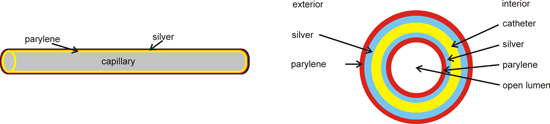
- exterior side of the capillary neglects the fact that bacteria mainly ascend through the interior of the catheter. 2. Ag and its ions are well known as antibacterial reagent, but also to precipitate with Cl− ions to AgCl. Since urine is a 0.1 M solution of sodium chloride, silver ions could never work in
- easily precipitated by Cl− ions. The solubility product is 10−10 mol2/L2. Urine contains approximately 0.1 M of Cl−. Silver and silver ions can only be used because urine also contains urease and urea, which generate ammonia, NH3. Ammonia is responsible for a successful application of the antibacterial
- on the assumption that certain illnesses, such as necrosis are triggered by silver ions, but only for concentrations beyond a certain threshold value. These values are explicitly denoted as “estimated” and are given with an uncertainty of approximately one order of magnitude (averaged for all human


Optical response of heterogeneous polymer layers containing silver nanostructures
Beilstein J. Nanotechnol. 2017, 8, 1065–1072, doi:10.3762/bjnano.8.108
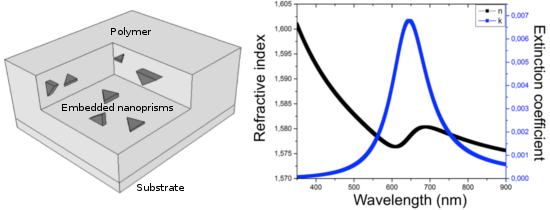
- our structures, through AFM or TEM studies, may improve our optical models in the future. Experimental Synthesis of nanoparticles The NPs were synthesized by the reduction of silver ions by sodium borohydride at room temperature in water. The nanospheres were synthesized in a one-step method [17]. The


Structural properties and thermal stability of cobalt- and chromium-doped α-MnO2 nanorods
Beilstein J. Nanotechnol. 2017, 8, 1032–1042, doi:10.3762/bjnano.8.104
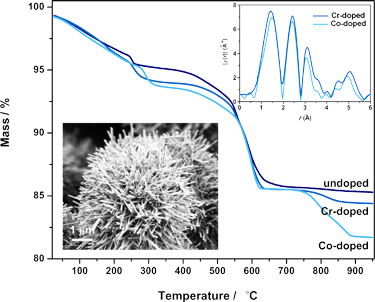
- introduction of silver ions into the cryptomelane structure also lowered thermal stability due to a partial distortion of the regular channel-like structure [22]. The influence of doping the pristine material with different ions on its thermal stability is quite complex. When an ion of higher valence (3+, 2


Sandwich-like layer-by-layer assembly of gold nanoparticles with tunable SERS properties
Beilstein J. Nanotechnol. 2016, 7, 1028–1032, doi:10.3762/bjnano.7.95
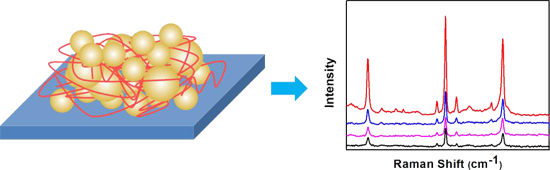
- alternating the adsorption of polyethyleneimine–silver ions and Au NPs onto substrates and the subsequent in situ reduction of the silver ions [17]. Compared with the parallel samples, the bimetallic LbL film showed improved SERS properties. Although a few examples of SERS substrates based on LbL strategy


Templated green synthesis of plasmonic silver nanoparticles in onion epidermal cells suitable for surface-enhanced Raman and hyper-Raman scattering
Beilstein J. Nanotechnol. 2016, 7, 834–840, doi:10.3762/bjnano.7.75
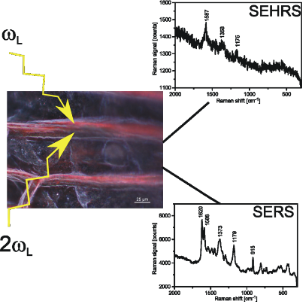
- the onion tissue. The luminescence pattern in Figure 1 shows that some silver ions are taken up into the protoplast during the osmotic imbalance when the hypertonic silver salt solution is added, and the small clusters must be stabilized there. In contrast, at the outer cell walls and in the


Antibacterial activity of silver nanoparticles obtained by pulsed laser ablation in pure water and in chloride solution
Beilstein J. Nanotechnol. 2016, 7, 465–473, doi:10.3762/bjnano.7.40
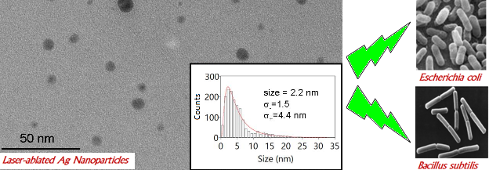
- microorganisms is not yet fully understood, it is generally believed that different mechanisms determine the antimicrobial activity of AgNPs based on both the release of silver ions and the nanoparticle characteristics [15][16]. Some of these proposed mechanisms include: (a) the direct contact between NPs and
- NP size. The UV–vis absorption spectra, instead, evidenced a larger content of oxidized silver on the surface of the ps-ablated nanoparticles. This results in the release of more silver ions, which is recognized to be quite important for the antimicrobial activity [15][16]. For the colloids obtained


Two step formation of metal aggregates by surface X-ray radiolysis under Langmuir monolayers: 2D followed by 3D growth
Beilstein J. Nanotechnol. 2015, 6, 2406–2411, doi:10.3762/bjnano.6.247
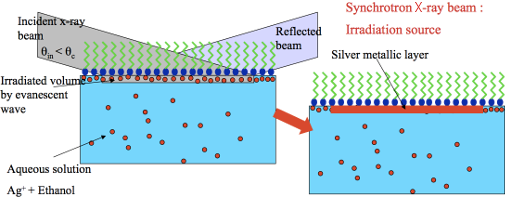
- place around the organic templates. We have previously applied this strategy to a spherical and a planar geometry. In the first case, we observed the formation of silver nanoshells upon irradiation of an aqueous solution of linoleic acid micelles that contained silver ions [6][7]. In the latter case, we


Ultrastructural changes in methicillin-resistant Staphylococcus aureus induced by positively charged silver nanoparticles
Beilstein J. Nanotechnol. 2015, 6, 2396–2405, doi:10.3762/bjnano.6.246
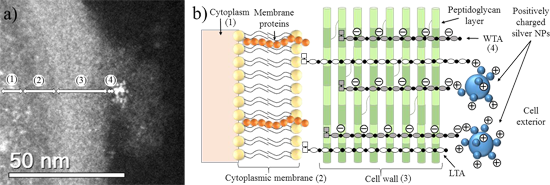
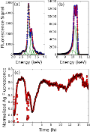
- Abstract Silver nanoparticles offer a possible means of fighting antibacterial resistance. Most of their antibacterial properties are attributed to their silver ions. In the present work, we study the actions of positively charged silver nanoparticles against both methicillin-sensitive Staphylococcus
- species in a citrate-stabilized nanosilver colloidal solution was reported: neutral AgNPs (Ag0), silver ions (Ag+) and Ag+ adsorbed on Ag0 (Ag0/Ag+). Battharai et al. was able to show the presence of Ag0 by performing a TEM investigation. Additionally, the existence of Ag+ adsorbed on Ag0 was discovered
- plasmids has been studied by geneticists at a molecular level [46]. The continuous leaching of silver ions by AgNPs [42] creates a favorable antimicrobial environment. MSSA and MRSA were treated with a solution of AgNPs to study the ultrastructural changes and bactericidal and lytic effects that were


Synthesis, characterization and in vitro effects of 7 nm alloyed silver–gold nanoparticles
Beilstein J. Nanotechnol. 2015, 6, 1212–1220, doi:10.3762/bjnano.6.124
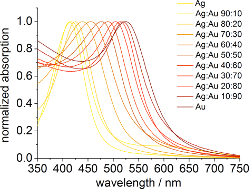
- reduces the amount of released silver ions. In a comparable toxicity study with laser-generated alloyed Ag/Au nanoparticles on cumulus-oocyte complexes and spermatozoa [38] and human gingival fibroblasts [39], a passivating effect of gold on silver was reported. In contrast to these studies, the toxicity
- and lower specific surface area, the pure silver nanoparticles should release silver ions at a lower rate. Furthermore, cells treated with nanoparticles that contain more gold than silver remained viable after 72 h. This increase in viability by addition of gold containing nanoparticles to the cells
- was also reported by Mahl et al. [30]. When investigations about cellular and bacterial toxicity are carried out, the purification of the nanoparticles is a crucial factor. As silver containing nanoparticles are often prone to release silver ions during storage that are more toxic than the


Protein corona – from molecular adsorption to physiological complexity
Beilstein J. Nanotechnol. 2015, 6, 857–873, doi:10.3762/bjnano.6.88
- silver NPs it was shown that their cytotoxicity is predominantly caused by the release of silver ions even when polymer coatings were applied [25][113][153]. The somewhat independent modes of action of the NP surface and the core need therefore to be considered in detail to assess the biological impact



Influence of gold, silver and gold–silver alloy nanoparticles on germ cell function and embryo development
Beilstein J. Nanotechnol. 2015, 6, 651–664, doi:10.3762/bjnano.6.66
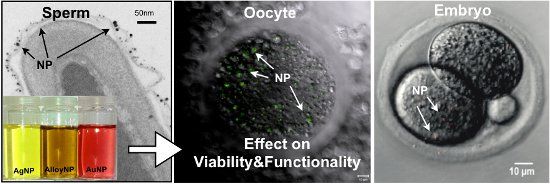
- effect was caused by silver ions. However, it supports findings made on spermatogonial stem cells in vitro, which claimed a decrease in cell proliferation after AgNP exposure [40][41]. Observations concerning female reproductive organs are rather rare as most nanoparticle biodistribution studies have
- driven by oxidation and inflammation [77], it is unclear whether silver in its nanoparticulate form is responsible for the toxic effects, as some studies claim [78], or whether they are solely caused by silver ions dissolving in the course of oxidation of the metal [20]. In our study silver ions proved
- to be equally toxic than alloy particles containing 80% of silver and pure AgNP pointing out that at least their toxic potential is similar. More recent and so far unpublished data seems to further confirm the hypothesis, that silver nanoparticle toxicity is mainly derived from the silver ions. In a





Hematopoietic and mesenchymal stem cells: polymeric nanoparticle uptake and lineage differentiation
Beilstein J. Nanotechnol. 2015, 6, 383–395, doi:10.3762/bjnano.6.38
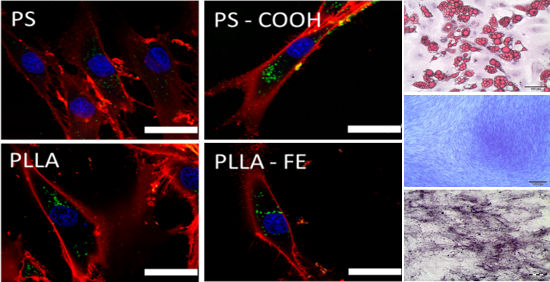
- species (ROS) can lead to an increased release of IL-8. The observation of an increased IL-8 release has also been reported for silver ions/nanoparticles [33] with hMSCs. For hHSCs, no increase of IL-8 release was observed. Clearly, the effect on differentiation of hMSCs should be investigated separately





