Search results
Search for "chemical reduction" in Full Text gives 62 result(s) in Beilstein Journal of Nanotechnology.
Synthesis and applications of carbon nanomaterials for energy generation and storage
Beilstein J. Nanotechnol. 2016, 7, 149–196, doi:10.3762/bjnano.7.17
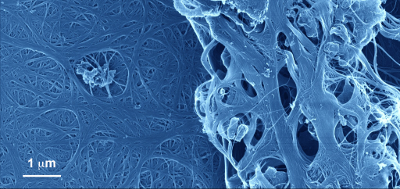
- based on the chemical exfoliation of graphite and thermal or chemical reduction of graphene oxide can produce graphene on an industrial scale but unfortunately with structural defects that can affect the electronic and electrical properties [84][85]. These are the main problems that impede the
- considered due to the simplicity of these systems and the reduced exposure time [123]. A cheaper and easy way to reduce GO is by chemical reduction, which is usually done at room temperature or with low heating [109]. Among the many chemical reagents that could reduce GO, hydrazine and its derivatives are
















Two step formation of metal aggregates by surface X-ray radiolysis under Langmuir monolayers: 2D followed by 3D growth
Beilstein J. Nanotechnol. 2015, 6, 2406–2411, doi:10.3762/bjnano.6.247
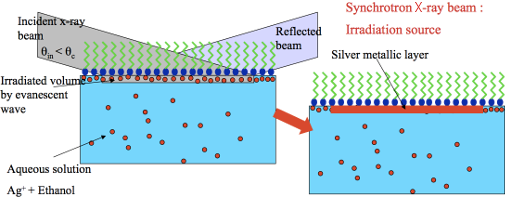
- ultrathin metal–organic systems is an active research field. Indeed, due to their adjustable optical, magnetic, electronic, and catalytic properties these systems demonstrate many applications [1][2]. The usual approach for the synthesis of this type of material is the chemical reduction of metal-ion


Self-assembly mechanism of Ni nanowires prepared with an external magnetic field
Beilstein J. Nanotechnol. 2015, 6, 2123–2128, doi:10.3762/bjnano.6.217
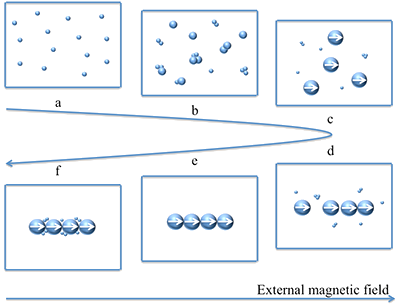
- Xiaoyu Li Hu Wang Kenan Xie Qin Long Xuefei Lai Li Liao School of Chemical Engineering, Sichuan University, Chengdu 610065, PR China 10.3762/bjnano.6.217 Abstract Nickel nanowires with a mean diameter of about 95 nm and lengths of up to 26 μm were prepared by a chemical reduction method in
- magnetic field. Keywords: chemical reduction; external magnetic field; Ni nanoparticles; Ni nanowires; self-assembly mechanism; Introduction For the past decades, ferromagnetic (e.g., Fe, Co, Ni) nanowires have raised considerable attention due to their application prospects in magnetic, optoelectronic
- electrodeposition [7][8][9][10], block copolymer lithography [11], and wet chemical reduction [12]. Among these methods, template-based electrodeposition is the most widely used to prepare Ni nanowires as highly-ordered and size-controlled nanowires can be obtained with this method. However, additional steps such





Structural and magnetic properties of iron nanowires and iron nanoparticles fabricated through a reduction reaction
Beilstein J. Nanotechnol. 2015, 6, 1652–1660, doi:10.3762/bjnano.6.167
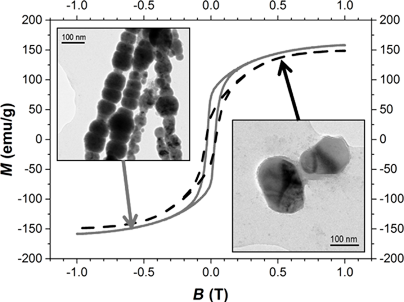
- of iron nanowires and iron nanoparticles which have been synthesized via a simple chemical reduction of iron salt. Results and Discussion At the beginning, it is worth to emphasize that the only difference in the fabrication processes of the two investigated nanostructures, iron nanowires and iron
- as described in [3][12][15][35][36]. Therefore, the fabrication procedures are described briefly here. Both nanostructures were synthesized through a chemical reduction of 0.2 mL of a 0.5 M aqueous solution of iron(III) chloride hexahydrate (FeCl3·6H2O; 98%, Sigma-Aldrich) with 2 mL of a 1 M aqueous



Preparation of Ni/Cu composite nanowires
Beilstein J. Nanotechnol. 2015, 6, 1268–1271, doi:10.3762/bjnano.6.130
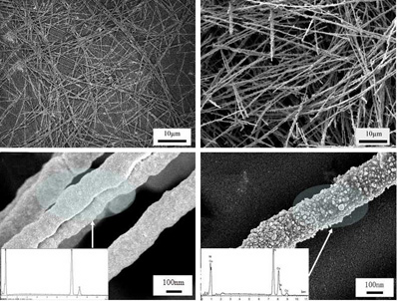
- nickel nanowires were prepared through chemical reduction in solution under a magnetic field. Secondly, copper was reduced on the surface of the nickel nanowires, during which Ni/Cu composite nanowires with an average length of 80 µm and diameter of about 200 nm were synthesized. The products were


The convenient preparation of stable aryl-coated zerovalent iron nanoparticles
Beilstein J. Nanotechnol. 2015, 6, 1192–1198, doi:10.3762/bjnano.6.121
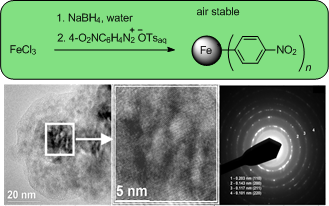
- chemistry is proposed. Surface-modified zerovalent iron NPs (ZVI NPs) were prepared by simple chemical reduction of iron(III) chloride aqueous solution followed by in situ modification using water soluble arenediazonium tosylate. The resulting NPs, with average iron core diameter of 21 nm, were coated with
- analysis were performed in order to characterize the resulting material. Keywords: arenediazonium salts; chemical reduction; covalent modification; surface-modified nanoparticles; zerovalent iron nanoparticles; Introduction Functionalized magnetic nanoparticles (NPs) have aroused great interest recently
- methods for zerovalent iron (ZVI) NP synthesis is chemical reduction. A variety of different approaches have been employed to protect this sensitive material from oxidation, where commonly used methods include coating with carbon [19][22], silica [23], noble metals and oxides [24][25][26], or the


Palladium nanoparticles anchored to anatase TiO2 for enhanced surface plasmon resonance-stimulated, visible-light-driven photocatalytic activity
Beilstein J. Nanotechnol. 2015, 6, 428–437, doi:10.3762/bjnano.6.43
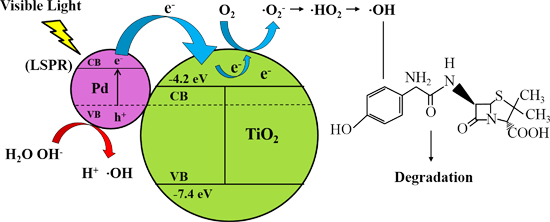
- photoactivity. There are several synthesis methods available for preparing plasmonic photocatalysts, namely photodeposition [3][30][31], hydrothermal [4][32][33][34], ion exchange [35][36], chemical reduction [25][37][38], physical vapour deposition [27][39][40], and deposition–precipitation [41][42][43]. Among


The impact of the confinement of reactants on the metal distribution in bimetallic nanoparticles synthesized in reverse micelles
Beilstein J. Nanotechnol. 2014, 5, 1966–1979, doi:10.3762/bjnano.5.206
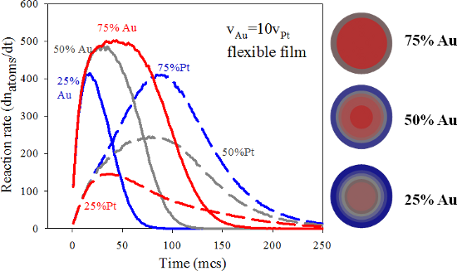
- the chemical reduction rate, but also on the intermicellar exchange rate. Furthermore, intermicellar exchange causes the accumulation of slower precursors inside the micelles, which favors chemical reduction. As a consequence, slower reduction rates strongly correlate with the number of reactants in
- channel between them. When one of the two metal salts ([AuCl4]−or [PtCl6]2− for the preparation of Au/Pt particles) and the reducing agent (e.g., hydrazine) are located in the same micelle, the chemical reduction takes place inside the reverse micelle to obtain metal atoms (Au or Pt). That is, the
- kex was used in this investigation (). Chemical reduction rates Due to the redistribution of material between the micelles, one metal salt and the reducer can be located inside the same micelle in order for chemical reduction to take place. The reduction potentials of the two metal salts, [AuCl4]− and


Highly NO2 sensitive caesium doped graphene oxide conductometric sensors
Beilstein J. Nanotechnol. 2014, 5, 1073–1081, doi:10.3762/bjnano.5.120
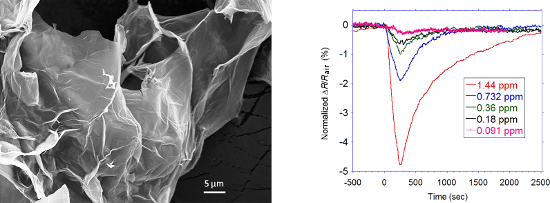
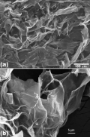
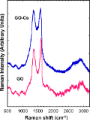
- . We attribute this drop to the chemical reduction of the GO caused by the Cs2CO3 that tends to decrease the work function as observed by [55][59][60][61]. This result suggests that doped GO may have good performance as a gas sensing material. XPS survey analysis of the GO (Figure 3a, blue line




Enhancement of photocatalytic H2 evolution of eosin Y-sensitized reduced graphene oxide through a simple photoreaction
Beilstein J. Nanotechnol. 2014, 5, 801–811, doi:10.3762/bjnano.5.92
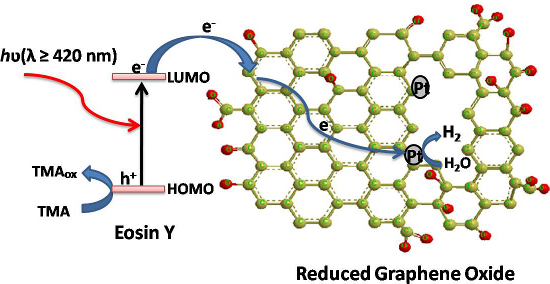
- efficient electron relay between the photoexcited EY and the loaded Pt co-catalyst, which shows an AQY of 4.15% under visible light irradiation. In these works, RGO was obtained by a chemical reduction of GO with hydrazine or sodium borohydride as a reductant. Graphene, an atom-thick two-dimensional (2D
- -RGO/Pt produced by chemical reduction methods in the literature [19][20]. A possible mechanism is discussed. Results and Discussion The effect of irradiation time on the performance of RGOx Figure 1 shows UV–vis spectra of GO and RGOx solution. The peak at 232 nm is due to the C=C bond in an aromatic





Thermal stability and reduction of iron oxide nanowires at moderate temperatures
Beilstein J. Nanotechnol. 2014, 5, 323–328, doi:10.3762/bjnano.5.36
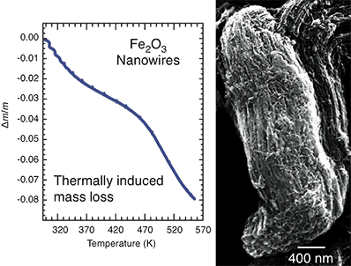
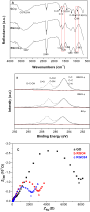
- method [25] that allows for a good control over the size of the nanoparticles [26]. The characterization was carried out as a function of the annealing temperature in order to assess the thermal stability of the NWs and the temperatures, above which a chemical reduction of the Fe ions takes place
- . Thermogravimetry measurements distinctly show the mass reduction due to oxygen loss, and infrared transmittance and core-level photoemission measurements allow to follow the reduction process of the iron ions at different temperatures, showing the chemical reduction to Fe3O4 starting at moderate temperatures
- either shape or morphology in the bundled structure. Thus, the thermal treatment causes a chemical reduction, while not affecting the structure of the assembly, which renders the NWs a stable system for potential use in batteries, even after heating. We underline that heating at 650 K is by far a much


In situ monitoring magnetism and resistance of nanophase platinum upon electrochemical oxidation
Beilstein J. Nanotechnol. 2013, 4, 394–399, doi:10.3762/bjnano.4.46
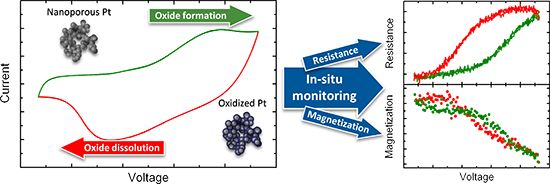
- different behavior has to be assigned to the strongly different types of surface states originating from the preparation, which is a chemical reduction process for the commercial Pt powder, whereas dealloying takes place under strongly oxidizing conditions. In fact, as shown by Viswanath et al. [18