Search results
Search for "morphology" in Full Text gives 1296 result(s) in Beilstein Journal of Nanotechnology. Showing first 200.
Beyond the shell: exploring polymer–lipid interfaces in core–shell nanofibers to carry hyaluronic acid and β-caryophyllene
Beilstein J. Nanotechnol. 2025, 16, 2015–2033, doi:10.3762/bjnano.16.139
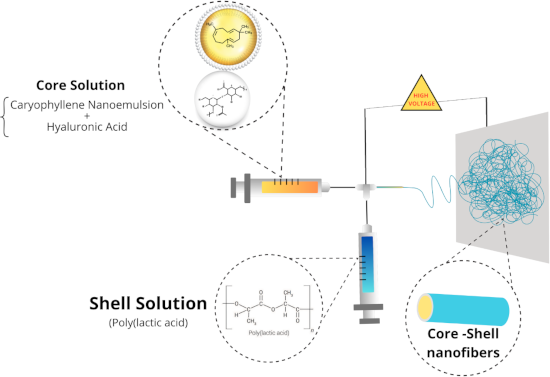
- process variables, such as high voltage, flow rate, and the distance from the Taylor cone to the collector, which significantly impacts nanofiber morphology [17]. Furthermore, selection of the material to be electrospun is crucial, requiring control over key attributes such as molecular weight, polymer
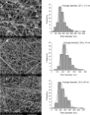
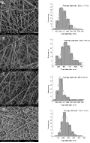
- morphological analysis. Varying the process parameters and the concentration of the constituent(s) seems to be an effective way to control the morphology of the electrospun mats, especially the diameter of the fibers, as demonstrated by Coelho et al. [45]. This study investigated the influence of core
- composition on fiber formation by analyzing the concentrations of the core components and the process flow rate as variables. It was observed that the concentration of NE-βCp in the core had a significant impact on fiber morphology, as illustrated in Figure 2. The presence of NE-βCp led to an increase in the




The cement of the tube-dwelling polychaete Sabellaria alveolata: a complex composite adhesive material
Beilstein J. Nanotechnol. 2025, 16, 1998–2014, doi:10.3762/bjnano.16.138
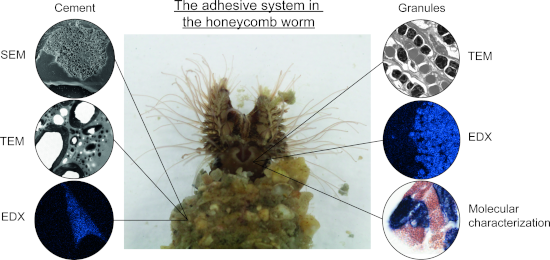
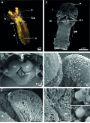
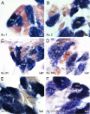
- organ is the external part of an extended glandular system comprising two types of cement cells located in the parathoracic region of the worm, around the digestive tract and at the base of parapodia. The two types of cells can be distinguished by the morphology of their secretory granules, which are
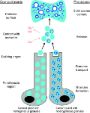
- distinguish both types of cement glands based on their secretory granule morphology, and images were taken with an AxioCam 305 digital camera (Carl Zeiss MicroImaging). Results Tube structure As described by Vovelle [6], the tubes of S. alveolata are generally rectilinear and cylindrical, measuring up to 12
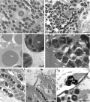
- . The sizes of the electron-dense granules and lacunae are 50–700 nm and 50–1400 nm in diameter, respectively. They are homogeneously distributed in the matrix between the hollow spheroids (Figure 2F,G). Morphology and ultrastructure of the adhesive glands The body of S. alveolata measures approximately



Laser ablation in liquids for shape-tailored synthesis of nanomaterials: status and challenges
Beilstein J. Nanotechnol. 2025, 16, 1963–1997, doi:10.3762/bjnano.16.137
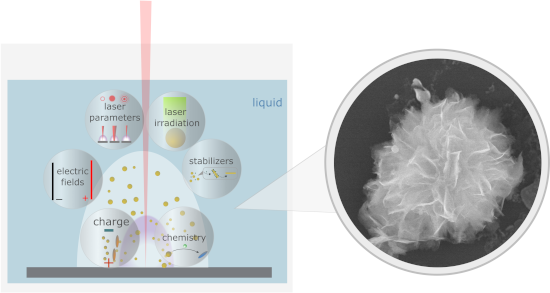
- of their impact on the conditions for anisotropic NP formation and growth. The description of the methods developed for the control over nanomaterial morphology is summarized by the vision of the current challenges and development routes of laser ablation in liquids. Keywords: laser ablation in
- liquids; laser irradiation; nanofabrication; nanoparticles; shape control; Perspective 1 Introduction: Mechanisms and key parameters influencing the morphology of laser-produced NPs The precise control and tailoring of NP parameters has long been an aim of the laser ablation synthesis in liquids
- (nanosecond), this interaction should be taken into account, resulting in the ionization and heating of the ejected material. The initial stages of interaction of a laser beam with a solid target are strongly dependent on laser pulse duration and fluence, surrounding liquid, target morphology and composition





Evaluating metal-organic precursors for focused ion beam-induced deposition through solid-layer decomposition analysis
Beilstein J. Nanotechnol. 2025, 16, 1942–1951, doi:10.3762/bjnano.16.135
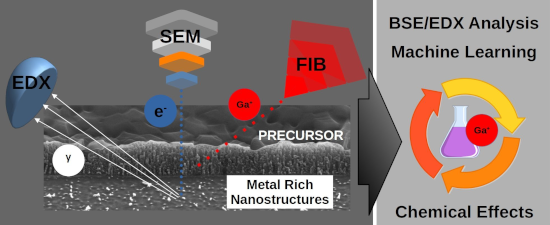
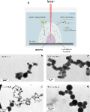
- new metal-organic precursors, in the form of supported thick layers, to the ion beam irradiation is studied through analysis of the chemical composition and morphology of the resulting structures. This is done using SEM backscattered electron/energy-dispersive X-ray spectroscopy along with machine
- cost-intensive nature of analyzing the morphology and composition of the deposits, we propose a method/approach to minimize studies within the experimental reactor and identify promising potential precursors. Testing Pathway and Methods Used The proposed approach for effectively testing new metal
- irradiation and what kind of morphology is developed for the finally formed metal-rich structures. (3) Analyzing BSE images of the evolving surface morphology at successive stages of FIB irradiation in order to determine “the sputtering point”, that is, the threshold ion fluence at which the sputtering


Self-assembly and adhesive properties of Pollicipes pollicipes barnacle cement protein cp19k: influence of pH and ionic strength
Beilstein J. Nanotechnol. 2025, 16, 1863–1872, doi:10.3762/bjnano.16.129
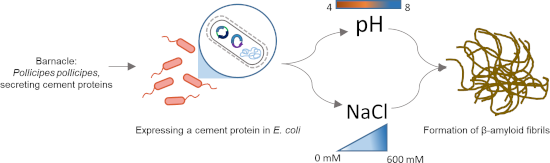
- work, we expressed recombinant P. pollicipes cp19k (rPpolcp19k) in E. coli and identified key environmental modulators of fibril formation by the protein. Transmission electron microscopy (TEM) was used to study the rate of fibril formation and morphology under varied pH and salt concentration
- positive in the ThT assay, indicating that, despite the difference in morphology, they contain a β-sheet-rich architecture characteristic of amyloid structures, which is increasingly implicated in enhancing cohesive strength in marine adhesives [33]. rPolcp19k-his fibrils formed in the high pH/low salt
- curled-fibril morphology has been reported for cp19k homologues from other barnacle species, but at the low pH/low salt concentration conditions noted above, and these fibrils did not exhibit fluorescence in ThT assays and were instead proposed to be largely non-amyloid and α-helical in content [29


On the road to sustainability – application of metallic nanoparticles obtained by green synthesis in dentistry: a scoping review
Beilstein J. Nanotechnol. 2025, 16, 1851–1862, doi:10.3762/bjnano.16.128
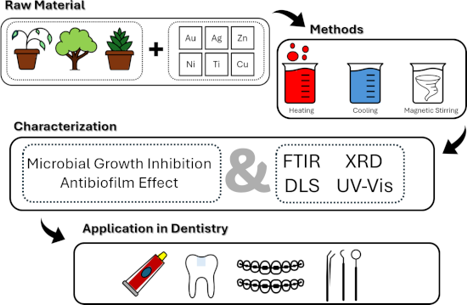
- biomaterials [16][17]. Owing to their high adaptability to various metals, including silver, zinc, iron, and platinum, their operational simplicity, and the ability to control nanoparticle size and morphology by selecting plant extracts and reaction conditions, green synthesis is gaining increasing prominence
- morphology and size, which are crucial for optimizing biological activity [8][38]. The Myrtaceae family, particularly Syzygium aromaticum, is a well-established source of eugenol, a potent phenolic compound with known antimicrobial and antioxidant properties, enhancing the bioactivity of synthesized
- between them and results in more uniform nucleation and better control over particle size and morphology. Moreover, continuous stirring prevents aggregation of the nanoparticles, contributing to their colloidal stability. Studies have shown that variations in stirring speed can significantly impact the


Current status of using adsorbent nanomaterials for removing microplastics from water supply systems: a mini review
Beilstein J. Nanotechnol. 2025, 16, 1837–1850, doi:10.3762/bjnano.16.127
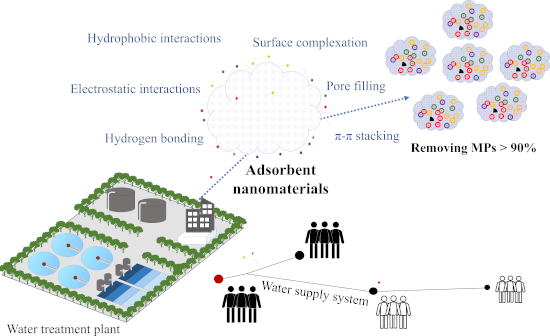
- a magnetic nanoseed concentration of just 0.002 g·L−1, these composites enabled 98% PET extraction, with the separation efficiency largely influenced by the morphology of the magnetic seeds. In addition to ensuring highly efficient magnetic separation of MP particles, this approach significantly


Phytol-loaded soybean oil nanoemulsion as a promising alternative against Leishmania amazonensis
Beilstein J. Nanotechnol. 2025, 16, 1826–1836, doi:10.3762/bjnano.16.126

- Pharmacy, Federal University of Rio Grande do Norte-UFRN, Natal, RN, Brazil Immunoparasitology Laboratory, Department of Clinical and Toxicological Analysis, Centre of Health Sciences, Federal University of Rio Grande do Norte-UFRN, Natal, RN, Brazil Department of Morphology, Federal University of Rio
- evaluated over a 30-day period by monitoring droplet size, PdI, ZP, and pH using the same methodologies previously described. Morphology The morphology of the nanoemulsion droplets was examined by transmission electron microscopy using a FEI Tecnai G2 Spirit Biotwin microscope operating at 120 kV (FEI


Electrical, photocatalytic, and sensory properties of graphene oxide and polyimide implanted with low- and medium-energy silver ions
Beilstein J. Nanotechnol. 2025, 16, 1794–1811, doi:10.3762/bjnano.16.123
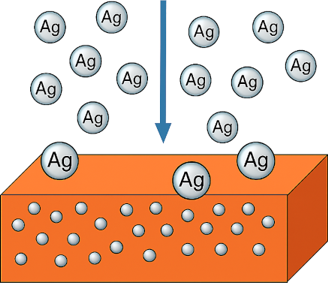
- of GO and PI. Elemental and structural changes induced by implantation were analyzed using Rutherford backscattering spectroscopy, elastic recoil detection analysis, Raman spectroscopy, Fourier-transform infrared spectroscopy, and X-ray photoelectron spectroscopy. Surface morphology was assessed via
- amorphization of the material and probably to the carbonization of the polyimide. Surface morphology studied by AFM Changes in the surface morphology of PI implanted with 20 keV and 1.5 MeV Ag ions at different fluences were examined by atomic force microscopy (AFM). The basic parameters arithmetic average
- height (Ra) and mean roughness (RMS) are listed in Table 4 [25]. Figure 9 illustrates the alteration in the surface morphology of graphene oxide (GO) resulting from the implantation of 20 keV Ag ions (Figure 9) depending on the applied ion fluence. The minimal roughness was achieved when the GO sample


Exploring the potential of polymers: advancements in oral nanocarrier technology
Beilstein J. Nanotechnol. 2025, 16, 1751–1793, doi:10.3762/bjnano.16.122
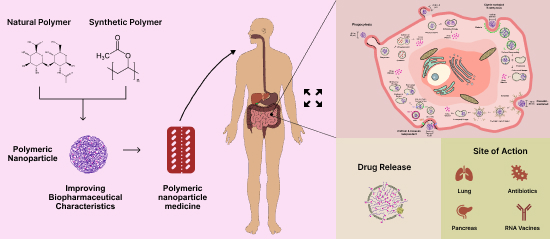
- control over site specificity and drug release [28]. The absorption of PNs depends on their size, surface characteristics, and morphology, which may exhibit distinct features, classifying them as either nanocapsules or nanospheres. Nanocapsules consist of an oily core where the drug is encapsulated
- overall release kinetics [24][32][33]. From a pharmacokinetic perspective, the size, surface charge, and morphology of PNs can modulate their transit through the GIT, and such properties can be tuned during nanoparticle preparation. The choice of manufacturing method considers not only these parameters


Multifunctional anionic nanoemulsion with linseed oil and lecithin: a preliminary approach for dry eye disease
Beilstein J. Nanotechnol. 2025, 16, 1711–1733, doi:10.3762/bjnano.16.120
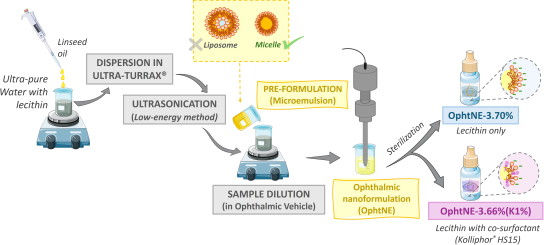
- digital pH meter (HI2221, Hanna Instruments, BR) equipped with a calibrated glass electrode and a temperature sensor. The electrode and sensor were immersed in the samples, and pH readings were recorded once the measurements stabilized. Transmission electron microscopy The morphology of the nanoemulsions



Prospects of nanotechnology and natural products for cancer and immunotherapy
Beilstein J. Nanotechnol. 2025, 16, 1644–1667, doi:10.3762/bjnano.16.116

- spectroscopy, TEM, DLS, X-ray diffraction (XRD), and Fourier-transform infrared (FTIR) spectroscopy, revealing a polygonal or oval morphology. To evaluate the antitumor effects, cytotoxicity assays, cellular uptake assays, apoptosis detection, ROS production, qRT-PCR, and Western blotting for gene and protein


Venom-loaded cationic-functionalized poly(lactic acid) nanoparticles for serum production against Tityus serrulatus scorpion
Beilstein J. Nanotechnol. 2025, 16, 1633–1643, doi:10.3762/bjnano.16.115
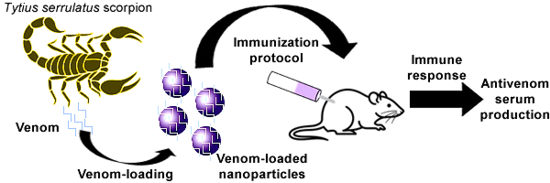
- Pharmacy, Federal University of Rio Grande do Norte (UFRN), Natal, RN, Brazil Department of Morphology, Federal University of Rio Grande do Norte-UFRN, Natal, RN, Brazil 10.3762/bjnano.16.115 Abstract Reported accidents involving scorpion poisoning by Tityus serrulatus are the most frequent in Brazil. The
- cationic nanoparticles prepared by ionic gelation with 100% encapsulation efficiency [1][2]. Additionally, PEI with high branching density has been shown to enhance complexation and transfection efficiency [23]. The morphology obtained by AFM and FEGSEM showed particles with a smooth surface, spherical


Bioinspired polypropylene-based functionally graded materials and metamaterials modeling the mistletoe–host interface
Beilstein J. Nanotechnol. 2025, 16, 1592–1606, doi:10.3762/bjnano.16.113
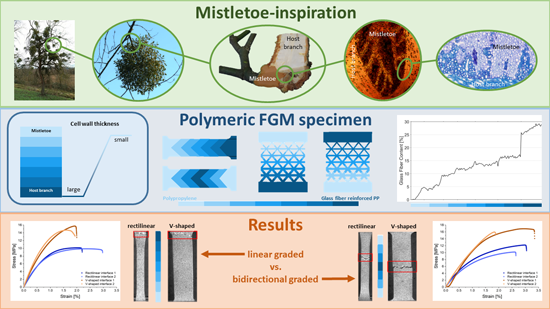
- toughness along a specific direction or within a defined volume [7]. By strategically varying the composition or morphology of the material, FGMs can be designed with enhanced performance characteristics tailored to specific application requirements. The gradient can be continuous or discontinuous, or step


Photocatalytic degradation of ofloxacin in water assisted by TiO2 nanowires on carbon cloth: contributions of H2O2 addition and substrate absorbability
Beilstein J. Nanotechnol. 2025, 16, 1567–1579, doi:10.3762/bjnano.16.111
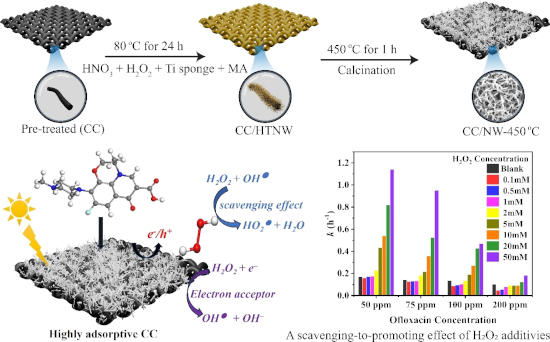
- Discussion Microstructure and morphology of photocatalysts Figure 1a shows schematically the synthesis of TiO2 nanowires on an activated carbon cloth substrate. When the carbon cloth is immersed in the Ti–H2O2 precursor solution maintained at 80 °C, first, the carbon cloth surface is activated, and, second
- TiO2 nanowires, while largely retaining their original one-dimensional morphology. Figure 1b–d presents representative FESEM images of the resulting TiO2 nanowires uniformly deposited on the carbon cloth substrate. Each carbon fiber is evenly coated with quasi-aligned nanowires that radiate outward


Influence of laser beam profile on morphology and optical properties of silicon nanoparticles formed by laser ablation in liquid
Beilstein J. Nanotechnol. 2025, 16, 1533–1544, doi:10.3762/bjnano.16.108
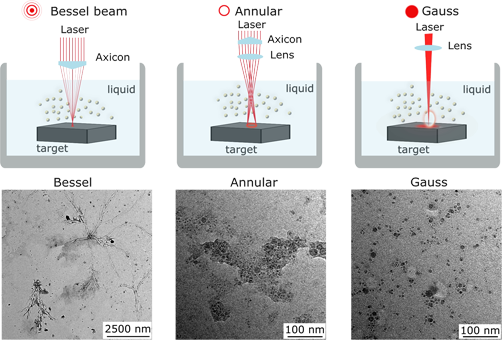
- Abstract In this study, silicon nanoparticles (NPs) were produced by pulsed laser ablation in a liquid, aiming to investigate the influence of a laser beam profile on the properties of the resultant NPs. Morphology, inner structure, and phase composition of the formed NPs were characterized by means of
- as an ablation source. The beam profile has been shown to be a crucial factor significantly influencing morphology and composition of the nanostructures produced. Namely, the conditions generated using a Bessel beam profile favored the production of nanostructures having elongated filament-like
- morphology. The synthesized colloidal Si NPs are suggested for applications as a component of electrode materials in supercapacitors and batteries. Keywords: laser ablation; laser beams with Bessel, annular, Gaussian profiles; laser-induced modification; silicon nanoparticles; Introduction Silicon, due to


Cross-reactivities in conjugation reactions involving iron oxide nanoparticles
Beilstein J. Nanotechnol. 2025, 16, 1504–1521, doi:10.3762/bjnano.16.106
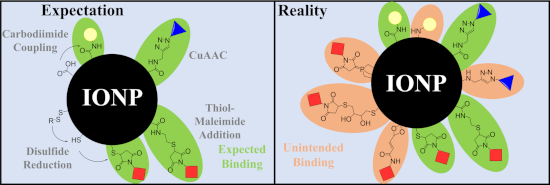
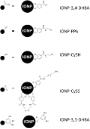
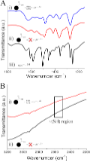
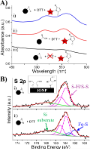
- targeting and drug payload delivery. The ability to chemically modify the ligand layer of IONPs, while maintaining their morphology and magnetic properties, is thus paramount to the preparation of functional IONPs. The use of highly selective conjugation reactions such as 1-ethyl-3-(3-dimethylaminopropyl







Laser processing in liquids: insights into nanocolloid generation and thin film integration for energy, photonic, and sensing applications
Beilstein J. Nanotechnol. 2025, 16, 1428–1498, doi:10.3762/bjnano.16.104
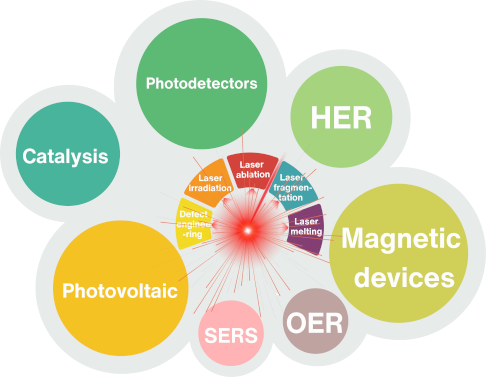
- stability in addition to other benefits like tunable size and morphology, crystalline phases, new compounds and alloys, and defect engineering. These nanocolloids are useful for fabricating different devices mainly with applications in optoelectronics, catalysis, sensors, photodetectors, surface-enhanced
- medium characteristics (e.g., chemical composition and viscosity) influence the size, morphology, and surface properties of the Au NPs, which, in turn, determine their performance. The effect of solvents on morphology of generated NPs in laser ablation is shown in Figure 2. While PLAL offers a rich
- pulses of varying durations (nanoseconds, picoseconds, and femtoseconds), the influence of laser parameters (wavelength, fluence, and pulse duration) and surrounding environments on the morphology of nanostructures focusing on nanomaterial synthesis and their applications in sensing and photonics. The






Photochemical synthesis of silver nanoprisms via green LED irradiation and evaluation of SERS activity
Beilstein J. Nanotechnol. 2025, 16, 1417–1427, doi:10.3762/bjnano.16.103
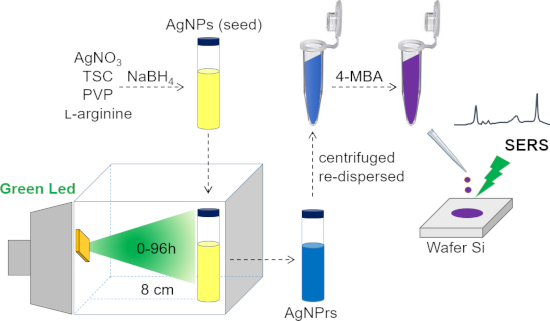
- –vis spectrum exhibited a single absorption peak at 402 nm, characteristic of the in-plane dipole (IPD) resonance of spherical silver nanoparticles. The solution retained its yellow color, indicating that the seed morphology remained largely unchanged and that no formation of anisotropic silver
- showing two distinct IPD peaks corresponding to each morphology. After 48 h, AgNP seeds were no longer visibly present in significant amounts; the sample was mainly composed of AgNPrs. This observation correlates with the appearance of the OPQ peak, characteristic of nanoplate thickness, and the
- formation achieved after 72 h of irradiation. The resulting AgNPrs showed significantly enhanced SERS performance compared to spherical AgNPs, attributed to the anisotropic morphology and formation of electromagnetic hot spots at the nanoplate tips and edges. Using 4-MBA as a Raman probe, the AgNPr-based


Parylene-coated platinum nanowire electrodes for biomolecular sensing applications
Beilstein J. Nanotechnol. 2025, 16, 1392–1400, doi:10.3762/bjnano.16.101
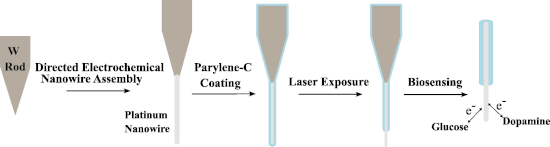
- advantage makes them suitable for biosensing applications with high spatial resolution involving single cells. The morphology and functionality of the electrodes were characterized through elemental analysis and copper deposition, demonstrating their capability for effective surface modification. Results


Synthesis and antibacterial properties of nanosilver-modified cellulose triacetate membranes for seawater desalination
Beilstein J. Nanotechnol. 2025, 16, 1380–1391, doi:10.3762/bjnano.16.100
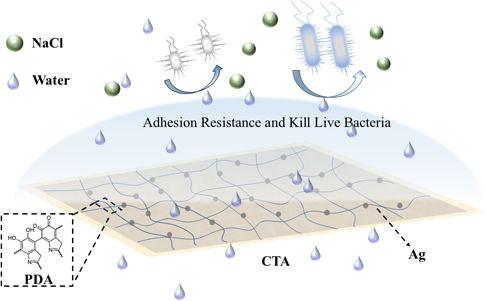
- the CTA membrane, thereby corroborating the conclusions drawn from the SEM images. To investigate the morphological changes of Ag@PCTA during the desalination process, SEM was used to examine the surface morphology of the coating and to identify any signs of degradation or loss. The surface images
- . Bruker AV400 and VARIAN 300 NMR spectrometers were used to collect 13C NMR spectra at 298 K. CDCl3 solvent was used as internal standard in 13C NMR experiment (δ 77.00 ppm). A Scienta ESCA200 apparatus was used to record XPS spectra. The morphology of the membrane was monitored using a field-emission SEM


Enhancing the therapeutical potential of metalloantibiotics using nano-based delivery systems
Beilstein J. Nanotechnol. 2025, 16, 1350–1366, doi:10.3762/bjnano.16.98
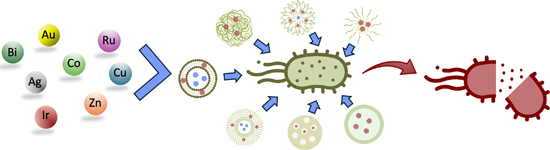
- encapsulation of the antimicrobial morin-Cu(II) complex 13 (Figure 4) in human serum albumin (HSA) or PLGA NPs [118]. The resulting nanoencapsulated systems displayed spherical morphology and high encapsulation efficiency, with average particles sizes of 214 ± 6 nm for Mor-Cu-HSA-NPs and 185 ± 7.5 nm for Mor-Cu


Ferroptosis induction by engineered liposomes for enhanced tumor therapy
Beilstein J. Nanotechnol. 2025, 16, 1325–1349, doi:10.3762/bjnano.16.97
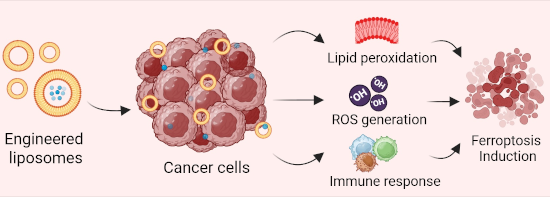
- accumulation of lipid ROS. Ferroptosis clearly differs from necrosis, apoptosis, and autophagy in terms of cellular morphology and function [7]. Recently, studies have indicated that ferroptosis can be utilized for cancer therapy since it effectively eliminates cancer cells and reverses drug resistance [8][9
- light scattering (DLS) is commonly used to determine liposome size and size distribution. Transmission electron microscopy (TEM) and atomic force microscopy (AFM) can be used to image liposome morphology and determine lamellarity. Zeta potential measurements assess the surface charge of liposomes, which
- and allows for the calculation of their hydrodynamic size [110]. Furthermore, microscopy techniques make the size and morphology of liposomes directly visible [110][125]. In particular, cryo-TEM is advantageous because the samples do not need to be stained or fixed, and the natural structure of the


Wavelength-dependent correlation of LIPSS periodicity and laser penetration depth in stainless steel
Beilstein J. Nanotechnol. 2025, 16, 1302–1315, doi:10.3762/bjnano.16.95
- conducted to examine the surface morphology of the samples and precisely measure the depth to which the laser heat affected or penetrated the zone. Imaging was performed using an FEI NOVA NANO SEM 450 scanning electron microscope. External etching was executed using a DC power supply machine, applying a
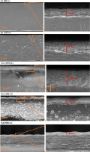
- LIPSS with varying laser power The spatial periodicity of LIPSS varies under different experimental conditions. This section specifically examines how surface morphology and the periodicity of LSFL and HSFL change with varying power values while maintaining a fixed wavelength of 800 nm. Figure 2
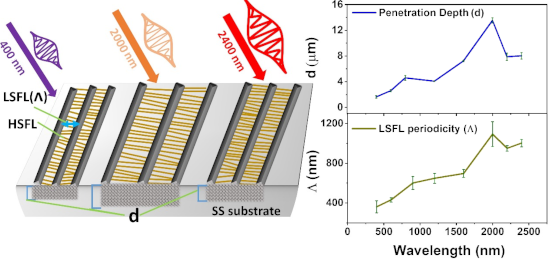
- pure metals [70][71][72]. Figure 7 displays cross-sectional surface morphology images for samples irradiated with 600, 1200, 2000, 2200, and 2400 nm laser wavelength. As depicted in Figure 8 and Table 2, the diagram reveals a contradiction to the established principle of skin depth, as the depth of




Enhancing the photoelectrochemical performance of BiOI-derived BiVO4 films by controlled-intensity current electrodeposition
Beilstein J. Nanotechnol. 2025, 16, 1289–1301, doi:10.3762/bjnano.16.94
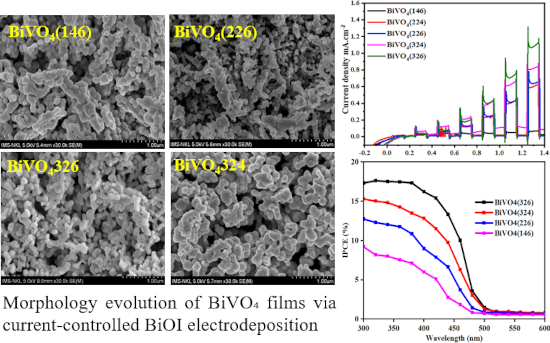
- optimize the crystallinity, surface morphology, and electronic properties of the films. Subsequently, an electrochemical deposition method was developed to facilitate the uniform distribution of V2O5 among Bi–O–I flakes to homogeneously enhance the conversion reaction. The XRD pattern confirms the
- better control over film morphology and crystallinity under mild conditions. Kim et al. [18] reported that BiVO4 films fabricated via electrodeposition achieved a maximum photocurrent density of 1.4 mA·cm−2 at 1.23 V vs RHE. These films exhibited a three-dimensional nanoporous structure that facilitated
- -guided route for improving water oxidation performance. However, the use of a constant-potential deposition technique presents limitations in controlling the film thickness, morphology, and uniformity, which are crucial for consistent BiVO4 performance after conversion. Variability in the BiOI film