


Search results
Search for "phase transformation" in Full Text gives 64 result(s) in Beilstein Journal of Nanotechnology.
Size-dependent density of zirconia nanoparticles
Beilstein J. Nanotechnol. 2015, 6, 27–35, doi:10.3762/bjnano.6.4
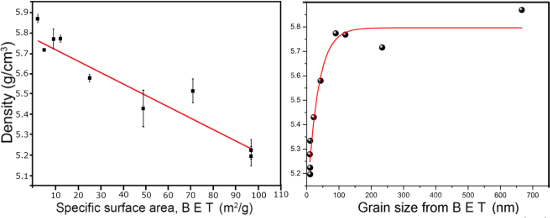
- stability of the surface layers in contrast to bulk materials, where a phase transformation would occur under the given conditions [33]. ZrO2 samples were prepared in the presence of D2O and subsequently dried in vacuum at 25 °C or at 800 °C, followed by immersion in H2O for 60 min. A comparison of the FTIR


Bright photoluminescence from ordered arrays of SiGe nanowires grown on Si(111)
Beilstein J. Nanotechnol. 2014, 5, 2498–2504, doi:10.3762/bjnano.5.259
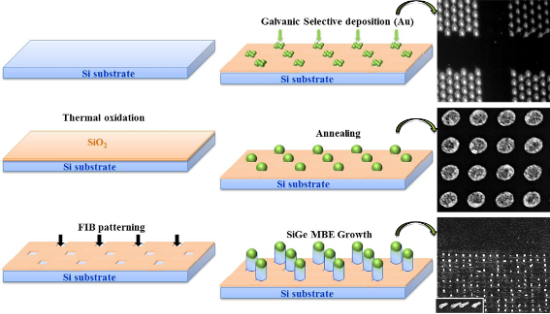
- dioxide prevents further metal ion reduction. Since the gold salt reduction process is not possible on SiO2, the reaction immediately stops after the formation of SiO2 [30]. After the selective galvanic deposition of gold clusters on the substrate, the samples were loaded into the MBE chamber. The phase
- transformation from the small Au nanoclusters located within the SiO2-cover-free nanopits to the Au0.18Si0.82 eutectic alloy is obtained by thermal annealing at 550 °C for 30 min. The annealing and growth experiments were performed in the MBE growth chamber of a Riber SIVA32 system with a base pressure of 10−11


Cathode lens spectromicroscopy: methodology and applications
Beilstein J. Nanotechnol. 2014, 5, 1873–1886, doi:10.3762/bjnano.5.198

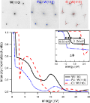
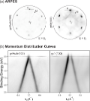
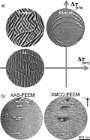
- direction. By cooling the sample from growth to room temperature, a phase transformation occurs in the graphene film, which develops neighboring phases characterized by flat and buckled morphology. Adjacent striped-shaped domains of different carbon surface density alternate on the film at microscopic
- density of C adatom gas on the Au layer readily condense to form graphene islands. Upon subsequent cooling to room temperature, the morphology and structure of graphene remain unchanged. In fact, we could not detect any evidence of phase transformation or formation of stripe-shaped domains resembling



Growth evolution and phase transition from chalcocite to digenite in nanocrystalline copper sulfide: Morphological, optical and electrical properties
Beilstein J. Nanotechnol. 2014, 5, 1542–1552, doi:10.3762/bjnano.5.166
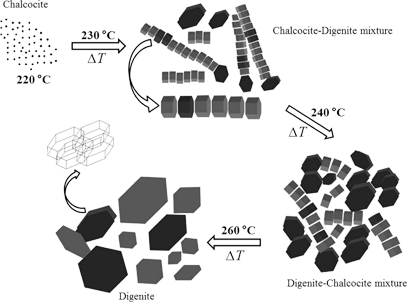
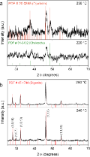
- for 100% intensity in the XRD pattern). From TEM images, it can be observed that the phase transformation occurs from 220 to 260 °C and involves three stages: the nucleation, the shape evolution of the chalcocite crystals and the transition of the chalcocite to the digenite phase. Nanoparticles are
- predominant at 230 °C while nanodisks and prisms are the main morphology at 240 °C. A full phase transition from chalcocite to digenite is obtained at 260 °C. Wang et al. obtained nanodisks of chalcocite Cu2S at 220 °C [15]. But, in our case, this temperature is the first stage to the phase transformation
- tailoring of the Cu/S stoichiometric ratio and the phase transformation had been reached at temperatures between 230 to 700 °C [21]. Grozdanov and Najdoski found that the electrical sheet resistance decreases as the copper content decreased [25]. This is consistent with our results. Conclusion Copper




Synthesis, characterization, and growth simulations of Cu–Pt bimetallic nanoclusters
Beilstein J. Nanotechnol. 2014, 5, 1371–1379, doi:10.3762/bjnano.5.150
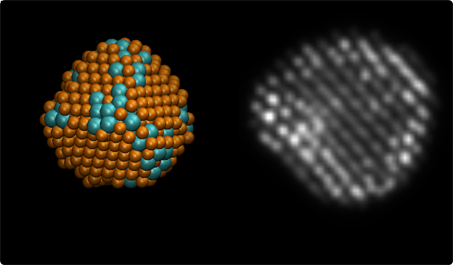
- and ethanol were used as received without further purification. Preparation of Cu–Pt bimetallic nanoclusters In a first step, the H2PtCl6·xH2O metal ions were transferred into a toluene solution by a phase transformation process. An aqueous solution of 30 mM of 5 mL Pt precursor was mixed with a 60 mM


Nanoscale particles in technological processes of beneficiation
Beilstein J. Nanotechnol. 2014, 5, 458–465, doi:10.3762/bjnano.5.53
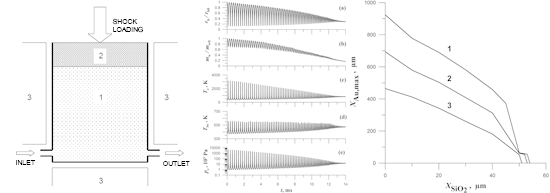
- dominate over those of thermal conductivity. Since the vapor temperature is significantly higher than that of the liquid and the phase equilibrium is violated, it is necessary to take into account the heat exchange between vapor and liquid due to phase transformation. Furthermore, imperfection of dense gas
- of the wave of phase transformation. Furthermore, since the convective transport dominates over thermal conductivity, the convective flows of mass, momentum and energy are conserved when passing the Knudsen layer under the condition of the violation of the phase equilibrium. The structure of the
- to the value of 3100 K, which is 1.4 times higher than the corresponding value obtained under the assumptions of the model in [8][9][10][11], which takes into account adiabatic compression of the vapor but does not take into account the phase transformation liquid–vapor. Thus the model described in


Oriented attachment explains cobalt ferrite nanoparticle growth in bioinspired syntheses
Beilstein J. Nanotechnol. 2014, 5, 210–218, doi:10.3762/bjnano.5.23
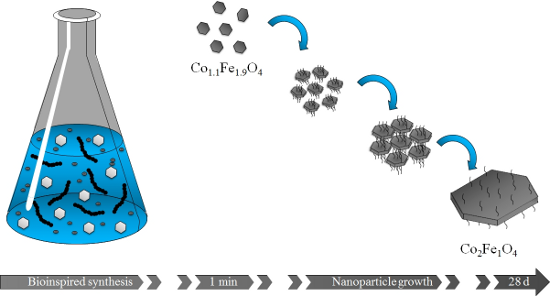
- . The experiments show that during this aggregation process, a phase transformation towards the stoichiometric Co2FeO4 phase occurs. Such phase transformations have been discussed previously [12]. The lack of literature concerning the more cobalt-rich ferrite phase currently prevents a more detailed
- mesocrystals remain after the aggregation of primary building blocks can be explained by the starting composition. Before the secondary particle is formed, a phase transformation from the iron-rich phase to cobalt-rich phase takes place. The initial starting composition is richer in iron though, while the


Low-dose patterning of platinum nanoclusters on carbon nanotubes by focused-electron-beam-induced deposition as studied by TEM
Beilstein J. Nanotechnol. 2013, 4, 77–86, doi:10.3762/bjnano.4.9
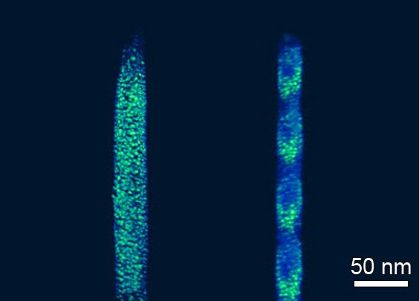
- -temperature phase transformation is also obtained by using low-energy electron irradiation [44]. Another alternative to improve the crystallinity of as-deposited nanostructures is to use higher energy electron irradiation in TEM, with 200 kV electrons used to remove the amorphous carbon [32]. In this context


Focused electron beam induced deposition: A perspective
Beilstein J. Nanotechnol. 2012, 3, 597–619, doi:10.3762/bjnano.3.70
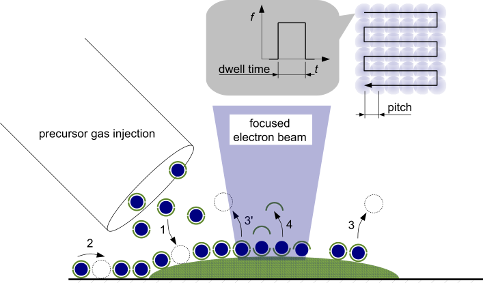
- to low temperatures. This indicates that the phase transformation from an amorphous to the ordered L10 phase is accompanied by a corresponding phase transition from a superparamagnetic to a moderately hard ferromagnetic state. The overall magnetic properties of these samples depend strongly on the


Mesoporous MgTa2O6 thin films with enhanced photocatalytic activity: On the interplay between crystallinity and mesostructure
Beilstein J. Nanotechnol. 2012, 3, 123–133, doi:10.3762/bjnano.3.13
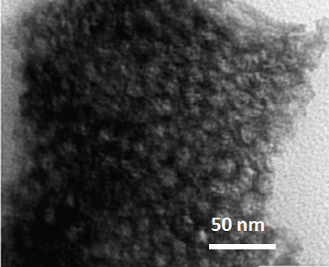
- temperature approached that of the onset of crystallization, decay in the ordered mesoporous structure became significant due to the further mechanical stress accompanying the amorphous–crystalline phase transformation [29]. There was a decline in photocatalytic activity at the point where the advantages of






Size-dependent phase diagrams of metallic alloys: A Monte Carlo simulation study on order–disorder transitions in Pt–Rh nanoparticles
Beilstein J. Nanotechnol. 2012, 3, 1–11, doi:10.3762/bjnano.3.1
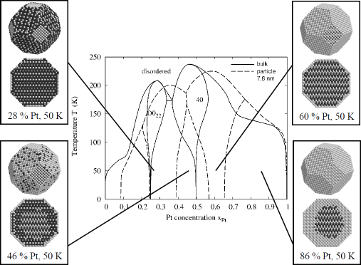
- as a paradigmatic test case for the change in phase transformation lines with a change in particle size. The broadening of the concentration range of ordered phases is concluded to be a consequence of the presence of the particle surface, which serves as a reservoir for excess atoms. When the surface


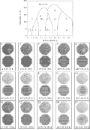


![[Graphic 37]](/bjnano/content/inline/2190-4286-3-1-i43.png?max-width=637&scale=1.18182) up to 8th neighbors for a Pt...
up to 8th neighbors for a Pt...

![[Graphic 28]](/bjnano/content/inline/2190-4286-3-1-i34.png?max-width=637&scale=1.18182) (lower points) and
(lower points) and ![[Graphic 29]](/bjnano/content/inline/2190-4286-3-1-i35.png?max-width=637&scale=1.18182) (upper points) WC-order parameters versus temperature for di...
(upper points) WC-order parameters versus temperature for di...


![[Graphic 31]](/bjnano/content/inline/2190-4286-3-1-i37.png?max-width=637&scale=1.18182) (lower points) and
(lower points) and ![[Graphic 32]](/bjnano/content/inline/2190-4286-3-1-i38.png?max-width=637&scale=1.18182) (upper points). The Pt concentration is ...
(upper points). The Pt concentration is ...

![[Graphic 33]](/bjnano/content/inline/2190-4286-3-1-i39.png?max-width=637&scale=1.18182) (lower points) and
(lower points) and ![[Graphic 34]](/bjnano/content/inline/2190-4286-3-1-i40.png?max-width=637&scale=1.18182) (upper points) constrained to a core region...
(upper points) constrained to a core region...

![[Graphic 39]](/bjnano/content/inline/2190-4286-3-1-i45.png?max-width=637&scale=1.18182) and
and ![[Graphic 38]](/bjnano/content/inline/2190-4286-3-1-i44.png?max-width=637&scale=1.18182) of three different particle sizes and bulk material a...
of three different particle sizes and bulk material a...

Investigation on structural, thermal, optical and sensing properties of meta-stable hexagonal MoO3 nanocrystals of one dimensional structure
Beilstein J. Nanotechnol. 2011, 2, 585–592, doi:10.3762/bjnano.2.62
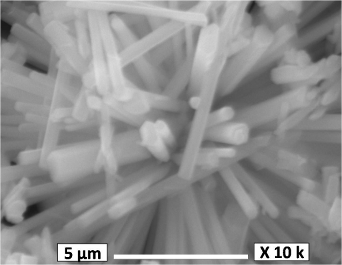
- crystallite size and one dimensional growth. Usually, the α-MoO3 is a stable structure formed at a higher temperature relative to the metastable h-MoO3. Thus, there is a phase transformation from h-MoO3 to α-MoO3 at 400 °C, which is inferred from TGA/DTA studies [14][16]. With an increase in temperature, the
- coordinated water and ammonia molecules from the internal structure of the MoO3 material, which promotes an irreversible phase transformation from the hexagonal to the orthorhombic structure [14][16]. The powder subjected to TGA measurements was subjected to XRD analysis, and the result confirmed that above


Switching adhesion forces by crossing the metal–insulator transition in Magnéli-type vanadium oxide crystals
Beilstein J. Nanotechnol. 2011, 2, 59–65, doi:10.3762/bjnano.2.8
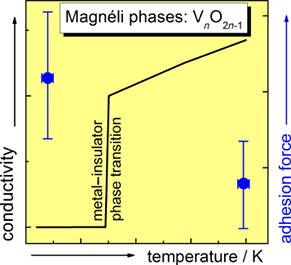
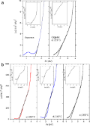
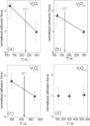
- rather due to the phase transformation in the crystal. The measurements reveal that in this case the adhesion force remains indeed constant when going to high or low temperatures (see Figure 5d). This behavior clearly indicates that the jump in the adhesion force is correlated to the change in the
- electronic properties of vanadium oxide crystals due the phase transformation when crossing the MIT temperature. For the investigated Magnéli-type oxides with a MIT, the adhesion force of the insulating phase is roughly twice as high as in the metallic state. This behavior is in contrast to observations at



Flash laser annealing for controlling size and shape of magnetic alloy nanoparticles
Beilstein J. Nanotechnol. 2010, 1, 55–59, doi:10.3762/bjnano.1.7
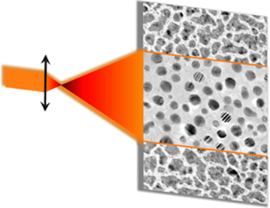
- . Figure 3 shows that flash laser annealing experiments performed on L10 ordered CoPt NPs result in FCC clusters. This phase transformation is demonstrated by the disappearance of the 110 and 201 superstructure reflections, characteristic of chemically ordered structures, on the diffraction pattern of the





