Search results
Search for "step" in Full Text gives 1538 result(s) in Beilstein Journal of Nanotechnology. Showing first 200.
Evaluating metal-organic precursors for focused ion beam-induced deposition through solid-layer decomposition analysis
Beilstein J. Nanotechnol. 2025, 16, 1942–1951, doi:10.3762/bjnano.16.135
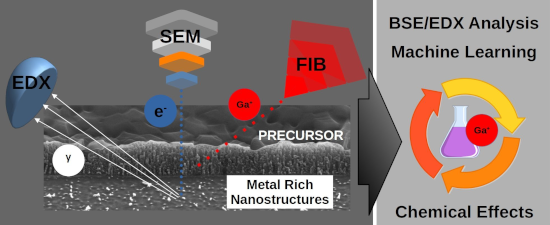
- -organic precursors involves a series of steps that are crucial to ensure accurate and comprehensive results. These stages include: (1) Deposition of the precursor onto a Si(111) substrate through sublimation using previously established parameters [22][29][32][34]. This step allows for precise control of
- hyperspectral data, which involves acquiring multiple X-ray spectra from different points of the final sample morphology. This step allows for a more detailed analysis of the chemical composition and distribution of elements within the irradiated sample. (5) Decomposing SEM EDX hyperspectral data using advanced
- technique, which is a high-resolution analytical method that can provide elemental information at the nanoscale. This step ensures precise identification and quantification of all elements present in the grown structures. (7) The final step involves examining the chemical composition of the resulted


Programmable soliton dynamics in all-Josephson-junction logic cells and networks
Beilstein J. Nanotechnol. 2025, 16, 1883–1893, doi:10.3762/bjnano.16.131

- exploit this sparsity when solving the system. The equations are integrated numerically using an adaptive-step-size solver based on the explicit Runge–Kutta (4th and 5th order) formula, commonly known as the Dormand–Prince pair [44][45], which is well suited for this class of non-stiff problems. The
- the kinetic soliton’s propagation rate. As a preliminary step, we characterized the dependence of the kinetic soliton propagation velocity on the damping parameter of the connecting junctions, α (see Figure 1b). We define the velocity as the number of grounded junctions traversed per unit of


Low-temperature AFM with a microwave cavity optomechanical transducer
Beilstein J. Nanotechnol. 2025, 16, 1873–1882, doi:10.3762/bjnano.16.130
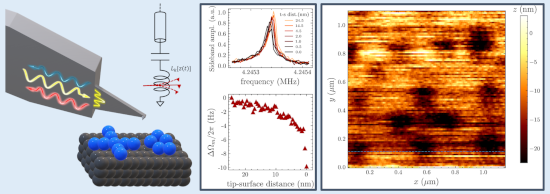
- driving the coarse z-positioner with the Attocube ANC-300 control unit that provides the 60 V saw-tooth pulses to the piezo actuators. The stick–slip motion of the actuator under high-voltage saw-tooth pulses (≈50 nm/step) produces significant heating at the 10 mK stage. Under continuous operation, the
- tracking with abrupt changes in topography. The latter occurred during the scan; in multiple instances, the feedback temporarily loses track of the surface immediately after the tip encounters a step. The single scan line on the fast axis (i.e., x-axis) shown in Figure 4b,c clearly shows different behavior
- resonance frequency shift as a function of the tip–surface distance. (a) AM-AFM imaging of the calibration grating over a 1 µm × 1 µm scan area containing a single vertical stripe with a 10 nm step height. The dashed lines in the image mark the location of the scan lines in (b) and (c). (a) FM-AFM imaging


Self-assembly and adhesive properties of Pollicipes pollicipes barnacle cement protein cp19k: influence of pH and ionic strength
Beilstein J. Nanotechnol. 2025, 16, 1863–1872, doi:10.3762/bjnano.16.129
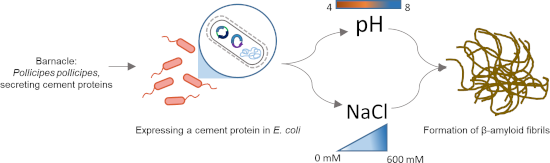
- . coli BL21 (DE3) cells as previously described [21] and purified by two step purification, that is, immobilised metal affinity chromatography (IMAC) followed by ion exchange chromatography (IEC). For IMAC, the Co-IDA resin column was washed with 25 mM Tris-HCl buffer (pH 8.0) containing 150 mM NaCl and


Phytol-loaded soybean oil nanoemulsion as a promising alternative against Leishmania amazonensis
Beilstein J. Nanotechnol. 2025, 16, 1826–1836, doi:10.3762/bjnano.16.126

- -solvent, Tween® 80, and ʟ-α-phosphatidylcholine (PC), as surfactants. For nanoemulsions containing phytol, 10 mg/g of the drug was added to OP. Subsequent to the nanoemulsification step, the nanoemulsions were transferred into hermetically sealed glass vials and stored at room temperature for further


Electrical, photocatalytic, and sensory properties of graphene oxide and polyimide implanted with low- and medium-energy silver ions
Beilstein J. Nanotechnol. 2025, 16, 1794–1811, doi:10.3762/bjnano.16.123
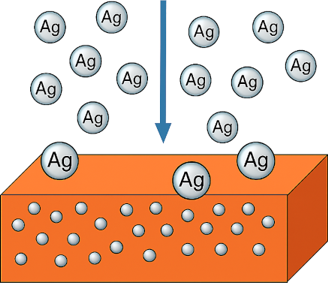
- and exposed to UV light (254 nm, 40 W) for 180 min. Subsequently, the rhodamine B concentration and disintegration were examined using absorption spectra via a UVISEL ellipsometer (75 W Xe lamp, Horiba, France) in the 450–650 nm wavelength range with a 1 nm step. The ellipsometer beam spot size was 1


Exploring the potential of polymers: advancements in oral nanocarrier technology
Beilstein J. Nanotechnol. 2025, 16, 1751–1793, doi:10.3762/bjnano.16.122
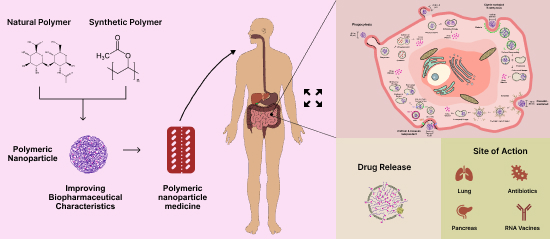
- commonly used methods for the preparation of PNs employing preformed polymers. These methods typically begin with the formulation of an emulsifying system, a step common to all techniques, followed by the formation of NPs through a process that varies depending on the method, such as solvent precipitation


Beyond the bilayer: multilayered hygroscopic actuation in pine cone scales
Beilstein J. Nanotechnol. 2025, 16, 1695–1710, doi:10.3762/bjnano.16.119
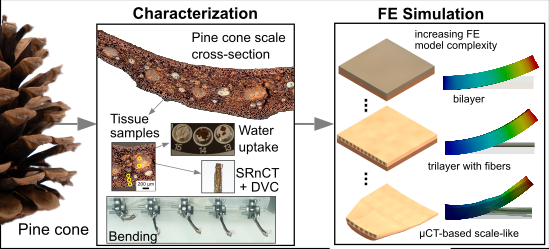
- weighed every 20 min until all samples reached equilibrium. Equilibrium was defined as a change of mass of less than 0.01% over a period of 40 min. The 0% RH climate step was maintained for at least 96 h to ensure an equilibrium when measuring the dry mass of the samples. During the measurements, an error
- occurred in one sample of sclerenchyma fiber tissue, resulting in a pronounced mass shift from one weighing step to the next, making it unsuitable for further analysis. The relative mass change of the samples with respect to the measured dry mass was calculated and used for further analysis. Axially
- information. DVC was performed using the image registration software Elastix with its implemented B-spline transformation (ver. 5.1.0) [39]. The images were aligned in a two-step process, first with an affine transformation and then with a B-spline transformation. For both steps, a pyramidal approach with


Ambient pressure XPS at MAX IV
Beilstein J. Nanotechnol. 2025, 16, 1677–1694, doi:10.3762/bjnano.16.118
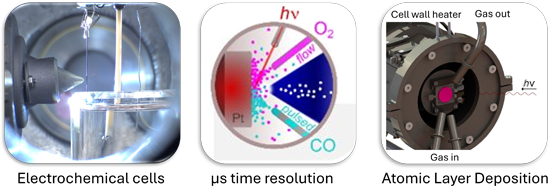
- technology for the future development of smaller and more power-efficient devices. One step in this development is the replacement of silicon, which cannot reach the development goals set by international technological roadmaps [61]. A potential replacement for silicon oxide is a high-k oxide material such





Bioinspired polypropylene-based functionally graded materials and metamaterials modeling the mistletoe–host interface
Beilstein J. Nanotechnol. 2025, 16, 1592–1606, doi:10.3762/bjnano.16.113
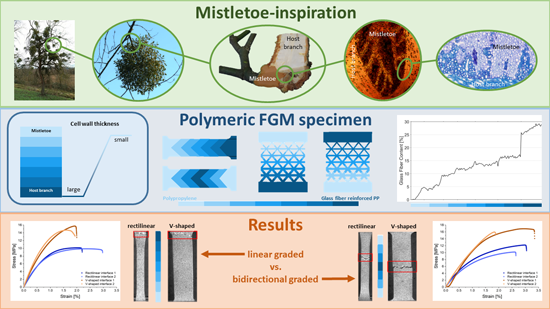
- toughness along a specific direction or within a defined volume [7]. By strategically varying the composition or morphology of the material, FGMs can be designed with enhanced performance characteristics tailored to specific application requirements. The gradient can be continuous or discontinuous, or step
- 13.50 × 8.00 mm2 for each layer were cut from a tensile specimen with linear gradient and rectilinear interface using the laser cutter mentioned above, resulting in a total of seven specimens. Each specimen was scanned at a resolution of 4 μm, with a 360° scan and a rotation step of 0.3°, using a
- cross sections of the individual scans (Figure 4A) and quantitatively over the course of the entire specimen (Figure 4D). In addition to the slight variations within a specimen, the step changes at the cut intersections between the pieces are noticeable. These can be explained by the material removed


Few-photon microwave fields for superconducting transmon-based qudit control
Beilstein J. Nanotechnol. 2025, 16, 1580–1591, doi:10.3762/bjnano.16.112
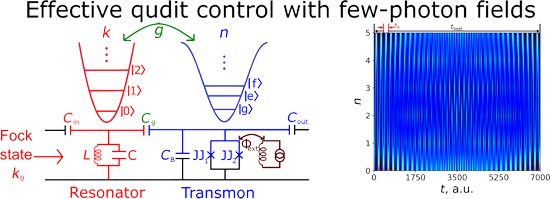
- system “step by step” by choosing the appropriate frequency of the classical field for each stage, as was done in [54]. However, this procedure requires a rather complex experimental setup and takes a significant amount of time. For our particular system, we have identified and demonstrated the


Modeling magnetic properties of cobalt nanofilms used as a component of spin hybrid superconductor–ferromagnetic structures
Beilstein J. Nanotechnol. 2025, 16, 1557–1566, doi:10.3762/bjnano.16.110
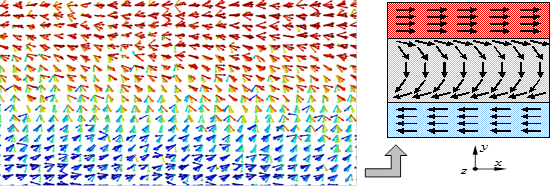
- for integration steps dt = 0.1–10.0 fs were plotted. These graphs are selectively illustrated in Figure 2. For the other integration steps, the dependences have similar behavior. The dotted line in Figure 2 shows the average values of energy and magnetization modulus for an integration step of 0.1 fs
- step on the fluctuations of the magnetic properties of the system, the relative deviations of the normalized magnetic energy ΔE(Δt) and magnetization modulus ΔM(Δt) were calculated. At the same time, additional averaging over the already performed time steps was performed for the considered quantities
- : where Nstep is the previously performed number of time steps; Ek(Δt) and Mk(Δt) are magnetic energy and magnetization modulus at the current time step; ⟨E⟩(Δt) and ⟨M⟩(Δt) are average values of the considered parameters over the entire time period. The deviations of the magnetic parameters from Equation


Transient electronics for sustainability: Emerging technologies and future directions
Beilstein J. Nanotechnol. 2025, 16, 1545–1556, doi:10.3762/bjnano.16.109

- using single-step processes. However, to enable more complex functionalities, such as processing, digital communication, and memory, integrated logic devices must be developed, which inherently calls for a foundry-level scale-up. Since bioresorbable electronics can leverage existing silicon-based


Dendrimer-modified carbon nanotubes for the removal and recovery of heavy metal ions from water
Beilstein J. Nanotechnol. 2025, 16, 1522–1532, doi:10.3762/bjnano.16.107

- ions (Pb2+ and Cd2+) from aqueous solutions with enhanced recyclability than less dendrimerized CNTs. Kinetic studies have revealed that the adsorption process followed a pseudo-second order kinetic model, and the rate-limiting step was mainly chemisorption. This study has not only excluded the
- (Scheme 1). This first step is crucial to ensure a high growth rate of dendrimers in subsequent steps by the repeated reaction of MA and ethylene diamine (EDA). We have characterized the CNTs-MA material by Raman spectroscopy to find the degree of functionalization, and the results are depicted in Figure
- efficiencies of 81.9 and 74.3% for Pb2+ and Cd2+ metal ions, respectively, affirming its potential use for practical applications. Based on kinetic studies, the adsorption process was best described by a pseudo-second order reaction, and the rate-limiting step was mainly chemisorption. Calculated value of


Cross-reactivities in conjugation reactions involving iron oxide nanoparticles
Beilstein J. Nanotechnol. 2025, 16, 1504–1521, doi:10.3762/bjnano.16.106
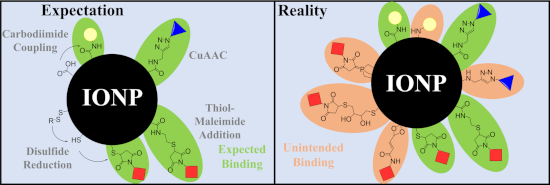
- IONPs, which can be coupled to azides through the CuAAC, with no detectable cross-reactivity. At this point, it may be tempting to label the conjugation reaction as a success. However, an important step in the synthesis has been neglected: We have not provided evidence that the binding of PPA is through
- . Our previous study on buffer interactions with IONPs [67] demonstrated that the buffer Tris, whose structure is analogous to THPP, showed significant binding to the IONP surface, likely through its hydroxy groups. It is clear that the addition of a disulfide cleavage step is not feasible by any
- were performed at this step to ensure that any Cy5 binding was indeed the result of the CuAAC. From the UV–vis spectra, we see that even in the absence of surface carboxylate groups, there is significant binding of PPA, as evidenced by the Cy5-azide loading on the EDC/NHS-treated (Figure 13A.i) and EDC







Laser processing in liquids: insights into nanocolloid generation and thin film integration for energy, photonic, and sensing applications
Beilstein J. Nanotechnol. 2025, 16, 1428–1498, doi:10.3762/bjnano.16.104
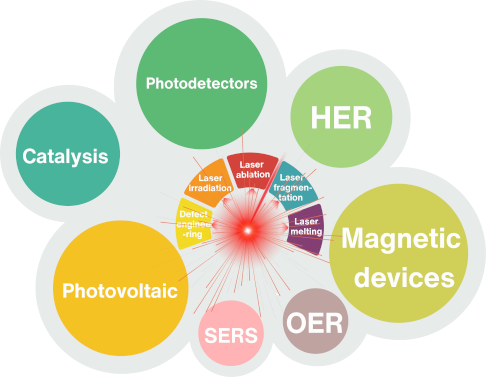
- colloidal solutions, enabling the generation of NPs with controlled sizes and shapes. One of the early significant studies in this field was conducted by Pyatenko et al. in 2007 [63], who demonstrated that spherical Ag NPs of various sizes could be synthesized through one-step or multistep processes
- , and HER/OER devices. These films exhibit unique morphologies and properties due to the controlled nanoparticle size and dispersion. Additionally, these nanocolloids enable facile, low-temperature, single-step film fabrication under standard laboratory conditions, making it an efficient and versatile






Photochemical synthesis of silver nanoprisms via green LED irradiation and evaluation of SERS activity
Beilstein J. Nanotechnol. 2025, 16, 1417–1427, doi:10.3762/bjnano.16.103
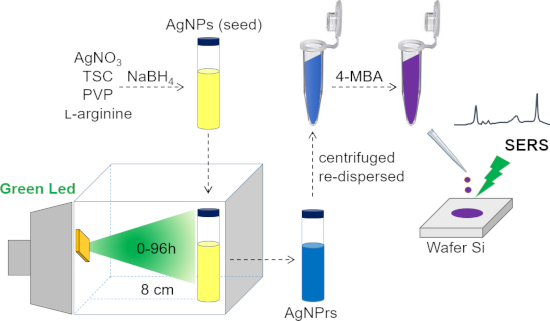
- step of the entire process [3]. During this stage, small silver nanoparticles (seeds) can combine and evolve into anisotropic nanostructures through a chemical process in the presence of hydrogen peroxide (H2O2) and sodium borohydride, commonly referred to as the Mirkin method [4]. Recently


Parylene-coated platinum nanowire electrodes for biomolecular sensing applications
Beilstein J. Nanotechnol. 2025, 16, 1392–1400, doi:10.3762/bjnano.16.101
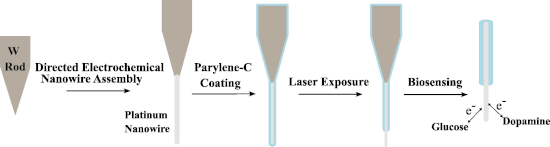
- inappropriate for some applications [13][14][15]. Among various manufacturing techniques, directed electrochemical nanowire assembly (DENA) stands out as a one-step method that enables rapid and tunable fabrication of crystalline metal nanowires [16][17]. In the DENA method, AC power and a metal salt (e.g., Au
- dopamine testing experiments, and all solutions were prepared with 18 MΩ·cm deionized water. A Gamry 1000E potentiostat was used for DPV tests, where the scan range was from −0.2 to 0.7 V, the step value was 2.0 mV, the sample period was 0.5 s, the pulse time was 0.05 s, and the pulse size was 25 mV. To
- electrodes were used as above. The Gamry potentiostat was used for CV tests with scan range from −0.5 to 0.5 V, 30 mV/s, 1 mV step size (1 data point for 1 mV change, 30 data point per second), and four cycles. For noise reduction and statistical considerations, the mean value from the last three cycles were


Automated collection and categorisation of STM images and STS spectra with and without machine learning
Beilstein J. Nanotechnol. 2025, 16, 1367–1379, doi:10.3762/bjnano.16.99
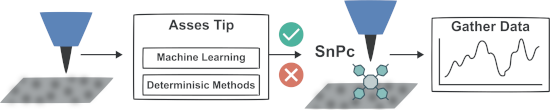
- characteristic feature corresponding to the surface state, which appears as a step function around a specific bias value, which for the Au(111) surface appears at around −0.48 V [13][14]. One notable attempt to automate this classification using machine learning (ML) was carried out by Wang et al. [15]. This
- shown in Figure 2. One addition to this method compared to the automated data gathering method described in Barker et al. [19] is the addition of I(z) classifications prior to performing imaging to ensure a tunnelling junction. This acts as a rapid “pre-filtering” step, eliminating tips that do not show
- completing this data gathering step, the tip moves away from the imaging area for a tip preparation event, in order to change the apex substantially before repeating the entire process to collect another dataset with a different tip. Throughout, if the tip is classified as “bad” in either of the I(z




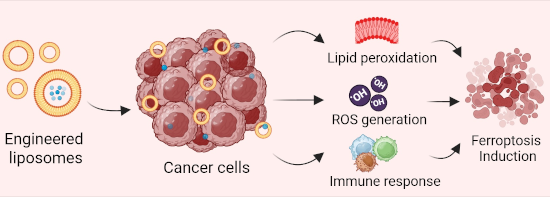
Ferroptosis induction by engineered liposomes for enhanced tumor therapy
Beilstein J. Nanotechnol. 2025, 16, 1325–1349, doi:10.3762/bjnano.16.97


Deep-learning recognition and tracking of individual nanotubes in low-contrast microscopy videos
Beilstein J. Nanotechnol. 2025, 16, 1316–1324, doi:10.3762/bjnano.16.96
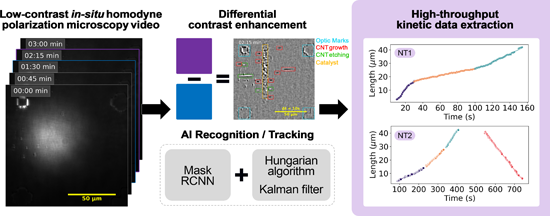
- clusters were then subjected to a Kalman filter to merge segments corresponding to the same nanotube (Supporting Information File 4). The information about tracked segments is entered into tables for final manual verification and labeling of events. This manual step remains essential due to the complexity
- , there is room for improvement in processing algorithms. In particular, manual verification and labeling of tracked nanotubes, particularly for complex cases, remains essential and is currently the most time-consuming step in the process [20]. Currently, brightness and contrast adjustments rely on


Wavelength-dependent correlation of LIPSS periodicity and laser penetration depth in stainless steel
Beilstein J. Nanotechnol. 2025, 16, 1302–1315, doi:10.3762/bjnano.16.95
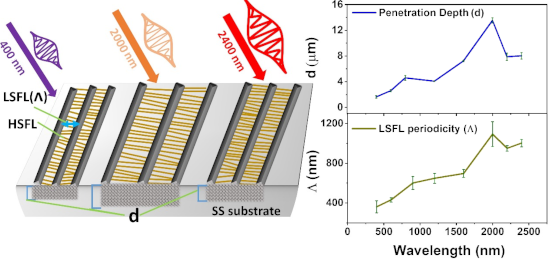
- ablation techniques for micro/nanostructuring have garnered significant attention due to their versatile applications. In particular, fabricating subwavelength structures using high-power pulsed lasers offers a flexible, single-step processing approach compatible with industry standards, making it a
- 20 µm. It involved a meticulous process to fine-tune laser parameters such as power, speed, and step size to attain the desired LIPSS pattern. Each incident wavelength required creating samples with varying scanning speeds, specifically, 0.2, 0.5, 0.8, and 1.5 mm/s, with the input laser beam power
- fixed at 20 mW. For each wavelength, four different step sizes and scanning speeds were explored. Table 1 below displays the optimal spatial periodicity of LIPSS structures obtained for each wavelength. In this work, we fabricated LIPSS over a large area 5 mm × 5 mm and optimization was carried out for





Functional bio-packaging enhanced with nanocellulose from rice straw and cinnamon essential oil Pickering emulsion for fruit preservation
Beilstein J. Nanotechnol. 2025, 16, 1234–1245, doi:10.3762/bjnano.16.91
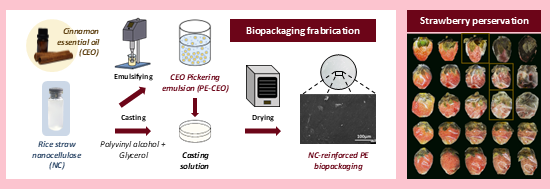
- a bleaching stage were used to extract cellulose from the straw. In the first acid hydrolysis step, the cellulose was treated with 62% H2SO4 solution at a solid-to-liquid ratio of 1:12 (g·mL−1), continuously stirred at a temperature of 40–42 °C for 2 h. The reaction was then quenched by 10-fold
- dilution of the solution. The solution was washed by centrifugation three times and filtered through a 10 μm nylon mesh filter membrane. In the neutralization step, the solution was neutralized by dialysis with deionized water, which was replaced every 6 h, and sonicated using a Hielscher UP400St




Investigation of the solubility of protoporphyrin IX in aqueous and hydroalcoholic solvent systems
Beilstein J. Nanotechnol. 2025, 16, 1209–1215, doi:10.3762/bjnano.16.89
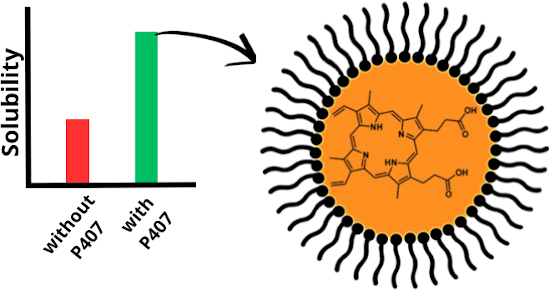
- , the findings observed at 0.4 mg/mL PpIX are not in line. While spectrophotometric readings indicated high solubility, the visual inspection revealed turbidity, suggesting incomplete dissolution of the photosensitizer. This discrepancy may be attributed to the filtration step performed prior to UV–vis


Transfer function of an asymmetric superconducting Gauss neuron
Beilstein J. Nanotechnol. 2025, 16, 1160–1170, doi:10.3762/bjnano.16.85
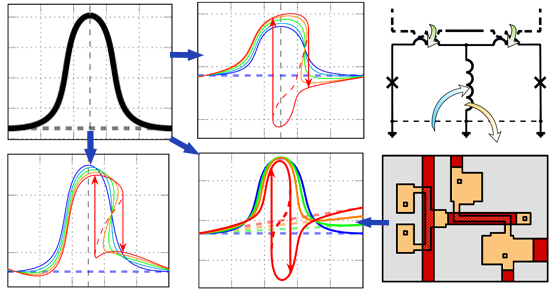
- subtracting Equation 2–Equation 3. The symmetric case assumes LA = LB = L and IcA = IcB = Ic. The next step is to adopt dimensionless units: the magnetic flux is normalized by Φ0/2π, the current is normalized by the critical current Ic, and the inductance is normalized by the Josephson inductance LJ = Φ0/2πIc
- ϕin. By symmetry, we obtain φ− = 0 according to Equation 12 and according to Equation 13 and Equation 14. The solution of this transcendental equation can be represented as a parameterized integral [8]: where θ(x) is the Heaviside step function. The numerical solution of Equation 15 is shown in Figure